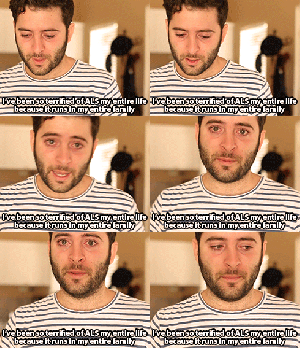
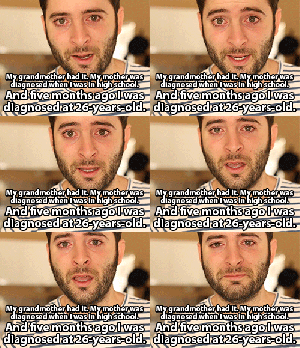
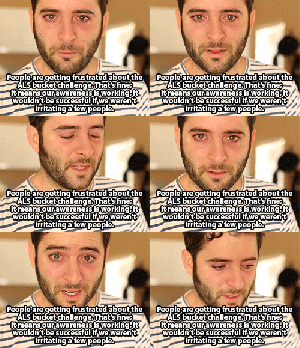
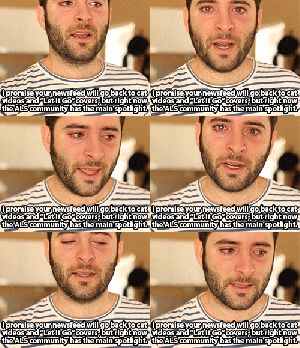
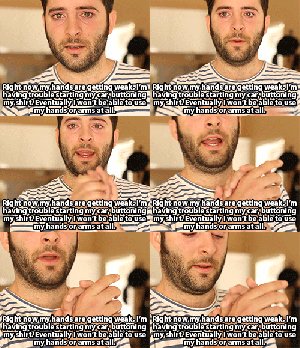
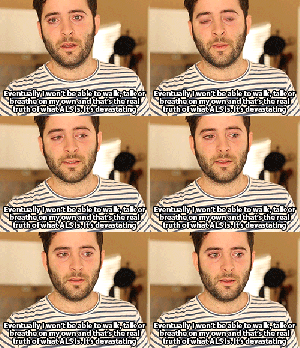
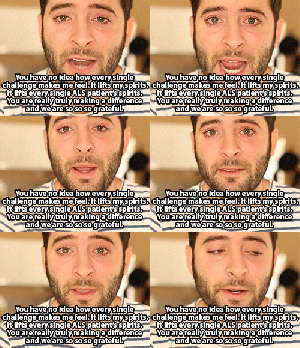
THIS MAN HAS ALS, AND HIS ICE BUCKET CHALLENGE WILL MAKE YOU LAUGH. THEN IT’LL MAKE YOU CRY
The video begins humorously as Anthony Carbajal, a photographer, dresses up in a neon bikini top and soaps up a car before being doused with ice water.
People talk so much shit about the challenges. Saying it is wasting water when other countries can’t get water to drink. So donate to them too! It’s simple and a good cause. Finding a cure for ALS is a step closer to finding Multiple Sclerosis. And I want that because my mother has MS. So stop putting such a worthy cause down. And if you think it’s taking the spot light away from other causes, start speaking up!!
Tag: understanding
Don’t Call Robin Williams’ Death a Waste
Suicide isn’t “giving up” or “giving in.” Suicide is a terrible decision made by someone whose pain is so great that they can no longer hold it, and feel they have no other option in life but to end it. It’s a decision you can’t t…When people describe a suicide as a ‘waste’ IDK it pushes buttons inside me. When I was younger, and when I was so depressed I was considering suicide, my primary reason was feeling like I was already a waste – a waste on peoples’ time, a waste on their resources, a waste of their affection. I’d been convinced that I was completely selfish, that I took and took without giving back, and that I only caused misery to others by being alive because I was so thoughtless. I was convinced that, after a brief mourning period, their lives would be better if I wasn’t around to ruin them anymore.
Now I’m an adult and I understand that when a thirteen-year-old feels that way, it’s because the adults in their life have failed them. Kids, as we say in the SPN fandom, are supposed to eat your food and break your heart. A teenager being self-absorbed is developmentally normal, especially when that teenager is being relentlessly bullied, is friendless, is struggling with school, and otherwise has plenty of misery going on in their own lives that prevents them from being terribly interested in other peoples’. I stopped being suicidal when someone told me it was okay to care about myself first. I had literally never heard that before. I thought I had to justify my own existence. I thought if I wasn’t satisfying other people, if I wasn’t making other people happy, then I didn’t deserve to live.
When people talk about ‘waste’, what are we wasting? Are we wasting their time by forcing them to grieve? Are we wasting their resources by demanding their attention? ”You’re wasting the rest of your lives”. Okay, fine, but they’re OUR lives. They aren’t yours. You aren’t entitled to them. You don’t get to obligate us to continue in misery because our deaths would affect YOU. People who say suicide is selfish, or a pointless waste, make me furious because they want us to just continue living on in abject misery, the kind of misery that makes us literally want to die… why? Because they’re entitled to us? Because we owe it to them? Because their discomfort is worth more than our agony?
I don’t support suicide. I don’t want anyone to commit suicide. But I understand why. And I understand that half the time, the people who claim people who kill themselves are wasting their lives, or being selfish, don’t actually have any interest in fixing the real problems, because that’s too much work; it costs too much; it requires too much time and too much care. If you actually cared about helping people who are in agony, you wouldn’t call them selfish for wanting to escape it, and you wouldn’t call that escape a ‘waste’. You’d call it a tragedy, because whatever could have been done to make life bearable HERE was not done. A solution was not found. The pain was not eased. And only one escape was left.
I’m still depressed, but I’m better now. I haven’t been in a suicidal state for more than ten years. I was able to change my circumstances enough that the people who had instilled those toxic beliefs in me no longer had control over me, and I had a daemon at my side reminding me that it is okay, that it is healthy, to care about my own self-interest. Now my husband is in the hospital because, like Robin, he is bipolar. He’s been depressed, without a manic swing, for three months, and it’s only getting worse. He’s hurting himself, and he’s looking for a way out. But he has a way out that isn’t killing himself – there is a good hospital close to us where he knows the doctors and feels comfortable, where they will listen to him and adjust his medication. He has a wife and a son who understand his illness, who support him and NEVER blame him, and who will gladly take on the challenge of handling his affairs in his absence because we are his team, and we are on his side.
Despite all this, I honestly believe I’ll lose him one day. It gets worse, it doesn’t get better. The progression of his condition has been so severe over the course of six years that I’m scared to contemplate where we’ll be in ten. And I’m resigned to that. I accept it. I love him for the time he’s here, and I want to ease as much of his pain as it’s in my power to do. I’m furious that I’m so impotent and I can’t do more because when you love someone you don’t want them to suffer.
Robin Williams was in pain. Now he isn’t anymore. I’m grieved for the suffering he endured, and for his family and friends who are suffering now. Losing a battle like this is terrible and tragic and heartbreaking. We all wish we could have done better by him. And if you want others to avoid following his example, we need to do better by them. We have to ease the pain HERE. We have to make good care accessible to them HERE. We have to fight stigma and support members of our community HERE. It may not always end up being enough, because most of the time it gets worse, not better. But we should do it because people are suffering, and they need help, and they don’t have to earn the right to their own existence. They don’t owe us their suffering. We owe them relief.
A Life Of Anxiety Documented
John Keedy used to be uncomfortable talking about his problems with anxiety, but not anymore. He hopes his series of photos will help others with mental illness see that they’re not alone.
The number of high profile deaths recently relating back to addiction and mental health issues is absolutely devastating; those struggling should be met with kindness and understanding, not stigma and hate.
For anyone out there battling demons such as these, know that you are not alone and you deserve to be helped and to be loved.
!!!! This is awesome
These are from a wonderful book called The Art Of Comforting. Check it out and learn how to be better at supporting people going through difficult things.

Kids with Autism, Sensory Processing Disorders Show Brain Wiring Differences
Researchers at UC San Francisco have found that children with sensory processing disorders have decreased structural brain connections in specific sensory regions different than those in autism, further establishing SPD as a clinically important neurodevelopmental disorder.
The research, published in the journal PLOS ONE, is the first study to compare structural connectivity in the brains of children with an autism diagnosis versus those with an SPD diagnosis, and with a group of typically developing boys. This new research follows UCSF’s groundbreaking study published in 2013 that was the first to find that boys affected with SPD have quantifiable regional differences in brain structure when compared to typically developing boys. This work showed a biological basis for the disease but prompted the question of how these differences compared with other neurodevelopmental disorders.
“With more than 1 percent of children in the U.S. diagnosed with an autism spectrum disorder, and reports of 5 to 16 percent of children having sensory processing difficulties, it’s essential we define the neural underpinnings of these conditions, and identify the areas they overlap and where they are very distinct,” said senior author Pratik Mukherjee, MD, PhD, a professor of radiology and biomedical imaging and bioengineering at UCSF.
SPD Gains Recognition as Distinct Condition
SPD can be hard to pinpoint, as more than 90 percent of children with autism also are reported to have atypical sensory behaviors, and SPD has not been listed in the Diagnostic and Statistical Manual used by psychiatrists and psychologists.
“One of the most striking new findings is that the children with SPD show even greater brain disconnection than the kids with a full autism diagnosis in some sensory-based tracts,” said Elysa Marco, MD, cognitive and behavioral child neurologist at UCSF Benioff Children’s Hospital San Francisco and the study’s corresponding author. “However, the children with autism, but not those with SPD, showed impairment in brain connections essential to the processing of facial emotion and memory.”
Children with SPD struggle with how to process stimulation, which can cause a wide range of symptoms including hypersensitivity to sound, sight and touch, poor fine motor skills and easy distractibility. Some SPD children cannot tolerate the sound of a vacuum, while others can’t hold a pencil or struggle with emotional regulation. Furthermore, a sound that is an irritant one day can be tolerated the next. The disease can be baffling for parents and has been a source of much controversy for clinicians who debate whether it constitutes its own disorder, according to the researchers.
“These kids, however, often don’t get supportive services at school or in the community because SPD is not yet a recognized condition,” said Marco. “We are starting to catch up with what parents already knew; sensory challenges are real and can be measured both in the lab and the real world. Our next challenge is to find the reason why children have SPD and move these findings from the lab to the clinic.”
Examining White Matter Tracts in the Brain
In the study, researchers used an advanced form of MRI called diffusion tensor imaging (DTI), which measures the microscopic movement of water molecules within the brain in order to give information about the brain’s white matter tracts. The brain’s white matter forms the “wiring” that links different areas of the brain and is therefore essential for perceiving, thinking and action. DTI shows the direction of the white matter fibers and the integrity of the white matter, thereby mapping the structural connections between brain regions.
The study examined the structural connectivity of specific white matter tracts in16 boys with SPD and 15 boys with autism between the ages of 8 and 12 and compared them with 23 typically developing boys of the same age range.
The researchers found that both the SPD and autism groups showed decreased connectivity in multiple parieto-occipital tracts, the areas that handle basic sensory information in the back area of the brain. However, only the autism cohort showed impairment in the inferior fronto-occipital fasciculi (IFOF), inferior longitudinal fasciculi (ILF), fusiform-amygdala and the fusiform-hippocampus tracts – critical tracts for social-emotional processing.
“One of the classic features of autism is decreased eye-to-eye gaze, and the decreased ability to read facial emotions,” said Marco. “The impairment in this specific brain connectivity, not only differentiates the autism group from the SPD group but reflects the difficulties patients with autism have in the real world. In our work, the more these regions are disconnected, the more challenge they are having with social skills.”
Kids with isolated SPD showed less connectivity in the basic perception and integration tracts of the brain that serve as connections for the auditory, visual and somatosensory (tactile) systems involved in sensory processing.
“If we can start by measuring a child’s brain connectivity and seeing how it is playing out in a child’s functional ability, we can then use that measure as a metric for success in our interventions and see if the connectivities are changing based on our clinical interventions,” said Marco. “Larger studies to replicate this early work are clearly needed but we are encouraged that DTI can be a powerful clinical and research tool for understanding the basis for sensory neurodevelopmental differences.”
Find out what it is like to be colour blind by exploring the many links from this page to other websites which have been produced to show people with normal colour vision what it is like to live in a colour blind world….
If you know someone who’s depressed, please resolve to never ask them why. Depression isn’t a straightforward response to a bad situation; depression just is, like the weather. Try to understand the blackness, lethargy, hopelessness, and loneliness they’re going through. Be there for them when they come through the other side.
It’s hard to be a friend to someone who’s depressed, but it’s one of the kindest, noblest, and best things you’ll ever do.
Is this dysphoria?
notyourqueertheoryposterchild:
I think there is a lot of confusion amongst the transgender community about what constitutes gender dysphoria. Everyone is going to have a different experience, and while there will almost always be commonalities, you can’t make sweeping statements and expect everyone to fall under that definition. Websites with lists of symptoms like ‘depression’, ‘anxiety’, and ‘low self esteem’ really don’t help much – they all seem to imply you know it if you are gender dysphoric, but from spending even an hour in the FTM tag on Tumblr you’d know that’s clearly not the case for plenty of young people.
I would define gender dysphoria as feelings of discontent, dissociation or depression regarding a person’s biological sex. I would also tack on a disclaimer stating that these feelings shouldn’t solely be caused by society or other people – if your only source of discomfort with your gender comes from ‘the way society sees me as [gender]’ then you need to seriously rethink whether you need medical transition.
However, this definition doesn’t explain how ‘feelings of discontent, dissociation or depression’ could manifest, so here’s a list of possibilities. I’m going to use the term sex-typical to mean characteristics due to your biological sex, such as prominent hips or breasts for FTM people, or broad shoulders or facial hair for MTF people.
Discontent:
- feeling ashamed or embarrassed by your body, specifically by sex-typical features
- not being able to fit into the type of clothes you want to wear because of your sex-typical body shape
- feeling like you are not living the life you should be
- feeling uncomfortable in gender-specific spaces such as bathrooms or women’s or men’s support groups
Dissociation:
- surprise or discomfort when sex-typical traits are touched/bumped (eg forgetting you have breasts, then holding something to your chest and feeling them)
- inability to mentally picture your body in sexual situations
- a sense of disconnect or lack of understanding about your emotional responses
- inability to relate to discussions of what is expected of people your gender (eg talking about ‘one day, when you’re a mum/dad’)
- not feeling close to other people of your biological sex (note: this doesn’t mean ‘I’m not like the other girls, they’re all popular and into fashion and I’m edgy and different’, I’m talking about a severe lack of understanding or disconnect from the majority of men/women)
- (FTM specific) forgetfulness with regards to menstrual periods
Depression:
- long term feelings of anxiety or depression about your sex-typical characteristics OR with no recognisable cause
- desire to self-harm or cause harm to/remove your genitals
- in sexual people, a lack of sex drive due to discomfort with your genitals or feelings of shame, embarrassment or depression during/after sex
- extreme discomfort or disgust with sex-typical bodily functions (eg growing facial hair for MTF people or menstrual periods for FTM people)
- a sense of fatalism or resignation towards a future living as your birth gender – feeling like there’s no hope for the future or that there is nothing to look forward to
Standard disclaimer that I’m only trying to provide helpful information, this is in no way definitive, your personal experience may be different, and so on. This isn’t supposed to act as a diagnostic chart, but rather to give you something to think about if you’re still not sure. Medical transition is a huge step, and if you don’t currently experience gender dysphoria, the changes induced by HRT could well kick start it back towards your biological sex. So please, think long and hard about where your feelings are coming from, what’s causing them, and whether medical transition will help, before jumping into something with irreversible and potentially unwanted effects.
Here is a handy link that helps describes some differences between dysmorphia and dysphoria:http://amydentata.com/2012/03/06/the-difference-between-dysphoria-and-negative-body-image/