Thor: Sleepy Lokis by kaetiegaard

Devotional blog dedicated to the Goddess Sigyn offering support to those who are "holding the bowl" within difficult relationships.
Thor: Sleepy Lokis by kaetiegaard

So I have always been extremely embarrassed that my left ear is deaf. I tried to hide it in every way possible. It made me feel broken and useless, especially listening and playing music. My original idea was to put music notes behind my ear, but for some reason the idea just didn’t feel quite right considering I couldn’t hear said music. I came up with the mute symbol idea because lately I have learned to embrace my deafness. I tend to joke around that my left ear is like my mute button when I want to ignore someone. Now I am no longer ashamed and find strength in the humor of my tattoo.
That is pretty great.
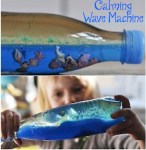

Calming Wave Machine (Sensory Bottle)
– Supplies:
- Clear plastic bottle
- Water
- Blue food coloring
- Cooking oil (ex. vegetable, sun seed, canola, etc.)
- Small seashells/stones, glitter, plastic fish/shells, sea themed beads, coarse sand, etc.
- Super glue or duct tape
- Alka seltzer (optional)
– Directions
- Fill 1/3 of the bottle with water, and the rest with oil.
- Add 1 drop of blue food coloring and the small sea items
- Since the oil and water do not mix, the oil creates slow waves in the water when you turn it back and forth.
- By adding Alka Seltzer tablets, you can create a cool lava lamp effect (click here)
- The cap can be secured with superglue or duct tape
Other ideas for “calm bottles” can be found here, here and here. Goes well with deep breathing exercises (here).
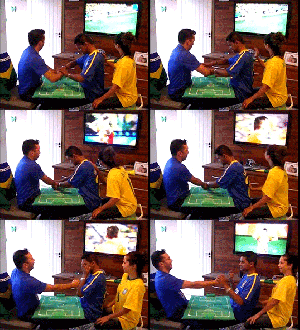
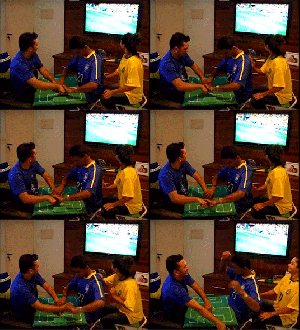
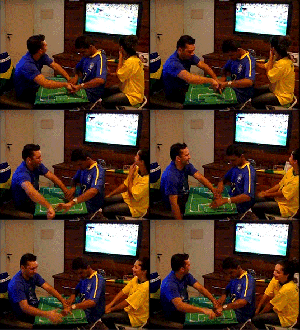
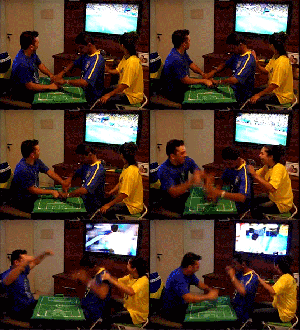
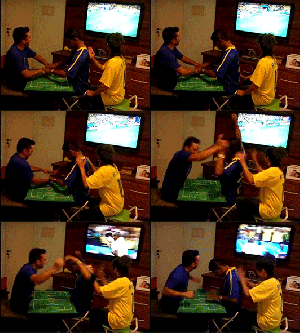
Deafblind Brazilian “watches” World Cup with the help of his friends – Video
THESE are real friends. Absolutely amazing.
cleverandengagingtitlegoeshere:
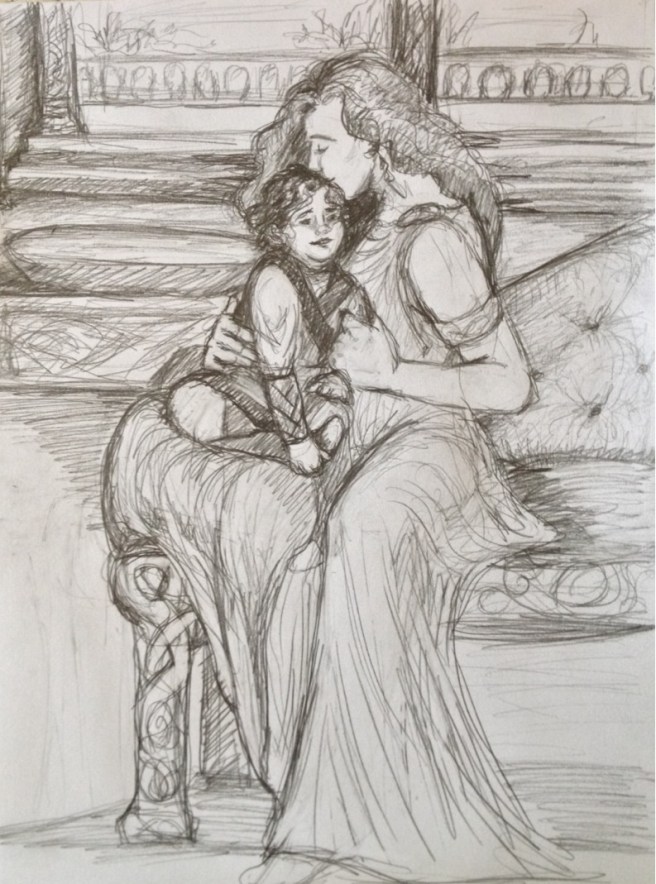
Sigyn and Vali
Based on a piece by Mary Cassatt
Dedicated to my friend Dr. Amber!
1. Trauma permanently changes us.
This is the big, scary truth about trauma: there is no such thing as “getting over it.” The five stages of grief model marks universal stages in learning to accept loss, but the reality is in fact much bigger: a major life disruption leaves a new normal in its wake. There is no “back to the old me.” You are different now, full stop.
This is not a wholly negative thing. Healing from trauma can also mean finding new strength and joy. The goal of healing is not a papering-over of changes in an effort to preserve or present things as normal. It is to acknowledge and wear your new life — warts, wisdom, and all — with courage.
2. Presence is always better than distance.
There is a curious illusion that in times of crisis people “need space.” I don’t know where this assumption originated, but in my experience it is almost always false. Trauma is a disfiguring, lonely time even when surrounded in love; to suffer through trauma alone is unbearable. Do not assume others are reaching out, showing up, or covering all the bases.
It is a much lighter burden to say, “Thanks for your love, but please go away,” than to say, “I was hurting and no one cared for me.” If someone says they need space, respect that. Otherwise, err on the side of presence.
3. Healing is seasonal, not linear.
It is true that healing happens with time. But in the recovery wilderness, emotional healing looks less like a line and more like a wobbly figure-8. It’s perfectly common to get stuck in one stage for months, only to jump to another end entirely … only to find yourself back in the same old mud again next year.
Recovery lasts a long, long time. Expect seasons.
4. Surviving trauma takes “firefighters” and “builders.” Very few people are both.
This is a tough one. In times of crisis, we want our family, partner, or dearest friends to be everything for us. But surviving trauma requires at least two types of people: the crisis team — those friends who can drop everything and jump into the fray by your side, and the reconstruction crew — those whose calm, steady care will help nudge you out the door into regaining your footing in the world. In my experience, it is extremely rare for any individual to be both a firefighter and a builder. This is one reason why trauma is a lonely experience. Even if you share suffering with others, no one else will be able to fully walk the road with you the whole way.
A hard lesson of trauma is learning to forgive and love your partner, best friend, or family even when they fail at one of these roles. Conversely, one of the deepest joys is finding both kinds of companions beside you on the journey.
5. Grieving is social, and so is healing.
For as private a pain as trauma is, for all the healing that time and self-work will bring, we are wired for contact. Just as relationships can hurt us most deeply, it is only through relationship that we can be most fully healed.
It’s not easy to know what this looks like — can I trust casual acquaintances with my hurt? If my family is the source of trauma, can they also be the source of healing? How long until this friend walks away? Does communal prayer help or trivialize?
Seeking out shelter in one another requires tremendous courage, but it is a matter of life or paralysis. One way to start is to practice giving shelter to others.
6. Do not offer platitudes or comparisons. Do not, do not, do not.
“I’m so sorry you lost your son, we lost our dog last year … ” “At least it’s not as bad as … ” “You’ll be stronger when this is over.” “God works in all things for good!”
When a loved one is suffering, we want to comfort them. We offer assurances like the ones above when we don’t know what else to say. But from the inside, these often sting as clueless, careless, or just plain false.
Trauma is terrible. What we need in the aftermath is a friend who can swallow her own discomfort and fear, sit beside us, and just let it be terrible for a while.
7. Allow those suffering to tell their own stories.
Of course, someone who has suffered trauma may say, “This made me stronger,” or “I’m lucky it’s only (x) and not (z).” That is their prerogative. There is an enormous gulf between having someone else thrust his unsolicited or misapplied silver linings onto you, and discovering hope for one’s self. The story may ultimately sound very much like “God works in all things for good,” but there will be a galaxy of disfigurement and longing and disorientation in that confession. Give the person struggling through trauma the dignity of discovering and owning for himself where, and if, hope endures.
8. Love shows up in unexpected ways.
This is a mystifying pattern after trauma, particularly for those in broad community: some near-strangers reach out, some close friends fumble to express care. It’s natural for us to weight expressions of love differently: a Hallmark card, while unsatisfying if received from a dear friend, can be deeply touching coming from an old acquaintance.
Ultimately every gesture of love, regardless of the sender, becomes a step along the way to healing. If there are beatitudes for trauma, I’d say the first is, “Blessed are those who give love to anyone in times of hurt, regardless of how recently they’ve talked or awkwardly reconnected or visited cross-country or ignored each other on the metro.” It may not look like what you’d request or expect, but there will be days when surprise love will be the sweetest.
9. Whatever doesn’t kill you …
In 2011, after a publically humiliating year, comedian Conan O’Brien gave students at Dartmouth College the following warning:
“Nietzsche famously said, ‘Whatever doesn’t kill you makes you stronger.’ … What he failed to stress is that it almost kills you.”
Odd things show up after a serious loss and creep into every corner of life: insatiable anxiety in places that used to bring you joy, detachment or frustration towards your closest companions, a deep distrust of love or presence or vulnerability.There will be days when you feel like a quivering, cowardly shell of yourself, when despair yawns as a terrible chasm, when fear paralyzes any chance for pleasure. This is just a fight that has to be won, over and over and over again.
10. … Doesn’t kill you.
Living through trauma may teach you resilience. It may help sustain you and others in times of crisis down the road. It may prompt humility. It may make for deeper seasons of joy. It may even make you stronger.
It also may not.
In the end, the hope of life after trauma is simply that you have life after trauma. The days, in their weird and varied richness, go on. So will you.
Right this minute, there is someone going through chemotherapy shopping at your grocery store, buying popsicles and ice cream to help their sore mouth, and worrying what the cashier is going to think.
There is someone on hemodialysis buying white bread instead of whole wheat, trying to keep their phosphorus levels reasonable between appointments and hoping for the best.
There is a person attending intensive outpatient treatment for their eating disorder who has been challenged by their therapist to buy a Frappuccino.
There are dietitians picking up a dozen different candy bars to eat with their clients, who feel ashamed and guilty about enjoying them.
There is someone who just doesn’t have it in them to cook right now, and this frozen pizza and canned soup will keep them going.
There are people recovering from chronic dieting and semi-starvation who are buying chocolate and chips at their deprived body’s insistence.
All around us are people listening to what their bodies need and attempting to make the best possible choice within a context of overwhelming food pressure. All of their choices are valid, and every single one of these foods is “real.”
This intense love is frightening, because every day, I fear that one more thing will push him over the edge. That one more time of me rolling over in bed, teary-eyed, for no reason, could push him …
to all my followers who take antipsychotic medications:
please remember the heat stroke advisory! please remember your meds may make it more difficult for your body to regulate its core temperature! wear your loosest clothes and limit your sun exposure!
i’ve gotten awful side-effects from my medications in the summer, please be careful and hydrate/stay cool/use sunscreen! last summer i had phototoxicity a few times from my meds and got giant swollen lumps all over my body and it was very unpleasant.
(and anti-depressants can also have some effects)
wow I had no idea about this
anticonvulsants do this shit too, I’m on lamictal for my bipolar and didn’t know how much it would ramp up my photosensitivity (I already burn like a mofo) and got a sunburn so bad I was in bed sick for two days and nearly had to go to the hospital because of the fever. epileptic and bipolar friends, be safe!