
http://www.yourholidaymom.com/ is a blog run by a bunch of moms (and sometimes other parents) who will post a letter to you daily until Christmas with words of acceptance and welcome. It was designed specifically as a project for kids and adults who face rejection over the holidays because of their sexuality or gender. This meant a lot to me the first year that I was isolated by my family, and I wanted to share it with all of you.
Author: Sephira
Born and raised primarily in Northern Virginia, my family and I moved to North Carolina in 2006. Married for over 20 years, my husband and I have two boys and a gaggle of cats.
For me, writing is a great stress reliever. I can let my mind wander and let my emotions run free in a way that is generally not possible in my normal everyday life. My writings run the gamut in terms of style and genre – for instance my first novel is a historical romance set in the Civil War, but some of the other things I have in the works are fantasy or thrillers, among other things.
It probably goes without saying, but my poetry is somewhat eclectic in nature, and again while some may feel the need to stick with a particular form, I tend to write just whatever comes to mind. Let the winds of inspiration lead me on…
I’m always interested in comments and feedback. So please feel free to share your thoughts with me!
The Old Norse name ‘Sigyn’
Nobody requested this one, probably because here is a standard, generally accepted interpretation that seems far less controversial than many other mythological names or words. Personally, I disagree with that interpretation, or at least the idea that we can be fully confident in it.
Typically the name is taken to be a compound of sigr ‘victory’ and a feminine equivalent to the word vinr m. ‘friend’ so that it means literally ‘victory-(female) friend’. The word sigr ‘victory’ is extremely common in compounded personal names and often, though not always, loses its stem-final r, such as in Sigurðr, Sigrún(where the r is part of the word rún), Sigfǫðr (a name of Óðinn, ‘victory-father’).
1. -yn: ‘(female) friend’ or something else?
The ‘(female) friend’ component comes from -yn, believed to be contracted from an earlier -vin, so that the original name was *Sigvin. I don’t believe it’s attested in that form, but it is a well enough attested alternation, such as in Bjǫrgyn ~ Bjǫrgvin ‘Bergen, Norway’. In my opinion there is a major obstacle to this etymology, which is the genitive of the name, Sigynjar (or perhaps *Sigvinjar). It appears in the genitive fairly frequently (because of its use in kennings for Loki) and I have never found an example without the j (that is, a consonantal “i” in manuscripts). The Old Icelandic word for an explicitly female friend is vina, and there is no trace of a word *vin, genitive *vinjar, with that meaning. There is an Old High German winia, but a hypothetical Old Icelandic cognate would be *vinja, genitive *vinju, and it seems unreasonable to propose yet another word meaning ‘(female) friend’ alongside an already existing word solely for the purposes of explaining one name, especially when there are other, much more likely explanations available.
There IS a word vin ~ vinjar, meaning ‘meadow’. It isn’t unthinkable that this could be the -yn in Sigyn, as Loki’s mother’s name Laufey also seems to refer to an element of landscape. Anatoly Liberman believes that Loki was originally a chthonic deity, and if that is true it might make some sense that his wife would be as well, but this is definitely a long way from certain, and there are not really very strong signs of Sigyn being inherently chthonic herself other than that she stays with Loki while he is chained up. Is that enough to go on? Maybe, but I personally think there are better possibilities.
There is no particularly compelling reason to believe that -yn must have come from an earlier -vin. It’s not impossible, but there’s no reason it couldn’t just come from a regular -yn. The y could have come by i-umlaut of a Proto-Norse *u, so *-unju > -yn or *-wunju > *-yn.
A Proto-Norse *unju has been proposed as a feminine name-forming suffix (equivalent to masculine *-unaz which has been proposed for jǫtunn, a possibly *Óðunn, and more) also appearing in Fjǫrgyn and Hlóðyn, and possibly extended into a longer Old Norse suffix –ynja that may have had a small amount of productivity in forming feminine equivalents to masculine words, such as ásynja ‘goddess (female áss), apynja ‘female monkey (api), ljónynja ‘lioness’, and karlynja (a weird word for ‘woman’ derived from karl ‘man’ in the Icelandic version of Genesis). It is controversial, however, as alternatives have been proposed for both Fjǫrgyn and Hlóðyn. Since Fjǫrgyn and Hlóðyn are alternate names for Jǫrð (‘earth’/the earth goddess), an ending vin f. ‘meadow’ actually does seem possible for both of them.
A Proto-Norse *wunju does not have any attested reflexes in Nordic languages (if not Sigyn), but would be cognate to Old English wyn(n) f. ‘joy’, which is also the name of the w-rune ᚹ. It is almost definitely related to Icelandic words like yndi n. ‘joy’. It is used in compounded personal names in Old English such as Ælfwynn.
Personally, I believe that of the several possibilities, a word cognate to Old English wynn is the most likely explanation, given that:
- we actually know it existed, even if in Old English rather than Old Norse — still better than an entirely hypothetical construct like *vin ‘girl-friend’
- there is precedence for its use in compounded personal names
- Sigyn does not show very strong signs of being an earth goddess like Fjǫrgyn/Hlóðyn which would increase the likelihood of vin f. ‘meadow’ (although this can’t be ruled out entirely), and that depends on the very speculative (and not widely accepted as far as I know) proposal that Fjǫrgyn and Hlóðyn are formed in such a way.
- If Fjǫrgyn and Hlóðyn are formed with an ending inherited from Indo-European (so that Fjǫrgyn is cognate to Lithuanian Perkūnė) then that is also a strong contender for Sigyn, but that is wrought with controversy and may not have actually existed.
2. Revisiting sig-
As mentioned above, sig- meaning ‘victory’ is a very common name element, and as such the fact that Sigyn is nowhere connected to victory in the preserved corpus of Norse mythology isn’t a problem. Nobody ever said that every deity must have a name relating to what they do, just that it’s very often the case. In fact, sometimes names go unchanged even after they become outdated and irrelevant, perhaps preserving a small piece of an earlier body of mythology.
However there is another word sig in Old Norse that could, without straining very hard, relate to Sigyn as we know her from the mythology, which Ásgeir Blöndal Magnússon, in his Icelandic etymological dictionary, linked to Sigyn.
A sig (2) n. is a rope that people use to rappel down a rock face or into a pit, or a rope with weights on the ends to hold something down. Either of the two uses of the word is mythologically relevant; the former because she likely had to physically descend (síga, p.part. sigat) beneath Hveralundr where Loki was tied down, and the latter because she cares for Loki while he is held down by ropes (sig).
For a goddess who receives very little attention in the Norse myths as we have them, Sigyn is distinguished by a remarkably early mention in the 9th century poem Haustlǫng, wherein Loki is called “the burden of Sigyn’s arms”. Therefore we know that already at a very early time — probably around 200 years before Vǫlsupá and over 400 years before Snorri’s commentary, Sigyn played an important role in Loki’s story, and this is further supported by the Gosforth cross:
Although there are plenty of reasons to believe that the story of Ragnarök as told by Snorri and even by Vǫluspá had changed substantially from earlier versions, Loki’s binding and Sigyn’s attending to him seems to have been very stable. I think that it’s very reasonable to identify the sig- element in Sigyn’s name with a rope, whether used for physical descent or tying down.
3. What does it mean?
I don’t think that what I’ve said here provides enough evidence to propose a translation exactly. The two elements I’m proposing are most likely are sig ‘rope for descending; weighted rope for holding things down’ and -*yn, a reflex of PGmc *wunjō ‘joy’.
Another possibility, though I think less likely and less demonstrably supportable, would be sig- and a reflex of *-unjō, which would probably mean something like ‘goddess of/relating to sig (‘rope’)’.
It’s also important to note that while I think my objections against identifying the second element -yn as meaning ‘(female) friend’ are strong, my rejection of sig- as ‘victory’ is not nearly as certain, especially given its extremely common use in personal names, not only in Old Norse but in many Germanic languages, including Old Norse/Icelandic Signý, a name often substituted for Sigyn in manuscripts (presumably because the scribe was unfamiliar with the name Sigyn and thought an error had been made in the manuscript that was being copied).
Sources
- Ásgeir Blöndal Magnússon. 1989. Íslensk orðsifjabók. Reykjavík: Orðabók Háskolans.
- Cleasby, Richard and Guðbrandur Vigfússon. 1874. An Icelandic-English Dictionary. Oxford: The Clarendon Press.
- Krahe, Hans and Wolfgang Meid. 1969. Germanische Sprachwissenschaft. vol. 2: “Formenlehre”. Berlin: de Gruyter.
- Lehman, Winifred P. 1986. A Gothic Etymological Dictionary. Leiden: Brill. (on the name Fjǫrgyn)
- Simek, Rudolf. 1993. Dictionary of Northern Mythology. trans. Angela Hall. Cambridge: D.S. Brewer. (for the “standard accepted definition”, also listed on Wikipedia, citing Andy Orchard)
- Image from Wikimedia Commons.

I have to believe that caring for myself is not self indulgent. Caring for myself is an act of survival.
Audre Lorde (via onlinecounsellingcollege)
Belated But Essential Steps to Respect
When the people we entrust with our health and wellbeing use the term “retarded,” they grant legitimacy to a word that has been deemed offensive by the culture at large. They cause harm to the very people they have pledged to heal….
To the people that say “you should respect your family”:
- Stop assuming that everyone has been treated well by that family.
- Respect is not freely given, it is earned. You don’t owe anyone respect. You do not owe anyone anything.
- This line is used repeatedly in abusive situations. It is frequently used in emotional abuse in the form of gaslighting to make the survivor doubt their perceptions of events. It also is frequently used to control, manipulate and coerce behaviour.

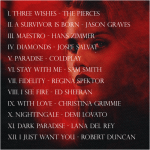
Fidelity | A Playlist/Soundtrack for the norse Goddess of Fidelity: Sigyn
// I. The Pierces – Three Wishes // II. Jason Graves – A Survivor Is Born // III. Hans Zimmer – Maestro // IV. Josef Salvat – Diamonds // V. Coldplay – Paradise// VI. Sam Smith –Stay With Me // VII. Regina Spektor – Fidelity // VIII. Ed Sheeran – I See Fire // IX. Christina Grimmie – With Love // X. Demi Lovato – Nightingale // XI. Lana Del Rey – Dark Paradise // XIII. Robert Duncan – I Just Want You
ToyBox Tools – helping children with developmental disabilities learn how to play
Hasbro’s fundamental mission is to bring joy and play to children and their families around the world. But for some children play can be challenging. For children with a developmental disability, play isn’t always accessible out of the box, relegating countless toys to the back of the closet or the donation bin. But more importantly, the joy and benefits that play can bring, the connection between peers, siblings and other generations may be lost.
Believing that we could do more, a passionate group of Hasbro employees from across the Company, came together to team up with Autism Project – a long term philanthropic partner of the Hasbro Children’s Fund, to figure out a way to help. The team learned that many classic Hasbro toys were being widely used by teachers and occupational therapists working in the field and that they were creating their own supportive play tools which provided structure that is critical to the way certain children manipulate concepts to help them understand play. ToyBox Tools was created to provide that structure through a series of tools, rooted in evidence-based and emerging best practices. The instructional videos, printable materials and play-mats are designed to help families, caregivers and teachers unlock the power of play and to make play more fun and enjoyable at a child’s own pace. ToyBox Tools recognizes that parents and caregivers know their children best and encourages them to use their judgment in selecting the right product and level appropriate for their child.
Collectively our mission is to make “play accessible".
ToyBox Tools – helping children with developmental disabilities learn how to play

Halloween theme for Loki. I made the blood candles myself. Loki wanted the caramels left there all night! The cup is warm milk, garnished with black pepper, cloves, and mint. Loki’s recipe, but I must say, it was delicious. That fish sculpture next to Sigyn’s bowl is the ugliest damn thing I’ve ever seen. I was like, ‘let’s buy sparkly glass ornaments for your table!’ and Loki was like, ‘nope. fish.’ So now I’m using it to hold a candle for Sigyn, which feels oddly intimate.

