
I think one of the worst parts of having a chronic disease is how it sometimes just breaks you.
You can have several bad days in a row and handle it fine; then one day you lose it because you’ve gone so long taking it that you eventually get to a point where you just can’t do it anymore.
You’ll try to open the dryer door and can’t.
You’ll be cold and won’t be able to get warm. The kind of cold where you can’t get warm so you want to put your blanket in the dryer for half hour but you can’t open the damn door.
You feel grateful for any help you have, but you wish you didn’t need it in the first place.
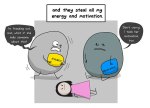
No one tells you when you get sick that you will have days that don’t just test your pain levels or your patience, they will literally test your very will to get through the day.
Tag: understanding
24 Things People With Generalized Anxiety Disorder Want You To Know


a helpful pain scale for people who have difficulty with doing body inventory or quantifying pain
0-10 Scale of Pain Severity
10 – Unable to Move I am in bed and can’t move due to my pain. I need someone to take me to the emergency room to get help for my pain.
9 – Severe My pain is all that I can think about. I can barely talk or move because of the pain.
8 – Intense My pain is so severe that it is hard to think of anything else. Talking and listening are difficult.
7 – Unmanageable I am in pain all the time. It keeps me from doing most activities.
6 – Distressing I think about my pain all of the time. I give up many activities because of my pain.
5 – Distracting I think about my pain most of the time. I cannot do some of the activities I need to do each day because of the pain.
4 – Moderate I am constantly aware of my pain but I can continue most activities.
3 – Uncomfortable My pain bothers me but I can ignore it most of the time.
2 – Mild I have a low level of pain. I am aware of my pain only when I pay attention to it.
1 – Minimal My pain is hardly noticeable.
0 – No Pain I have no pain.
Hey this is super useful, the scale of frowny faces on the doctor’s wall really does nothing to help me evaluate pain. When my hands were really bad I knew the pain was there all the time and often impacting my ability to sleep or do things but I wasn’t sure how to translate that to numbers. Looking at this chart I think I under-ranked the pain level.
I’m pretty much always at a 3 or 4.
Wow, I was really under rating my pain during that whole bladder inflammation thing.
Huh. OK so I’ve been underrating my pain for a long-ass time.
HIV
I work with people who have HIV as a part of my job. If you have HIV please remember:
HIV can be controlled by medications for a super long time (think 30 years+). It is more like getting a diabetes diagnosis than a death sentence.
No matter how your infection happened you deserve to live and have a happy life.
By federal law in the United States there is tons of resources to help you get medication for FREE.
You can find partners who will accept you and love you.
You can have children who are born HIV-. If a child is born in a first world county with medical care the likelyhood of transmission is rediculously low.
On medication your likelyhood of infecting others decreases significantly depending on your viral load.
PEP and PrEP are exciting things to look into to be able to have unprotected sex and prevent transmission.
HIV does not have to be central to your identity.
People who take their medication like prescribed can actually have as few as 2 doctor appointments a year for their condition !
Don’t let stigma, fear and lack of education get you down! You are a wonderful person and can achieve wonderful things. Don’t give up.
And if you don’t know your status please get tested. Please!
Understanding depression in a friend or family member
– Depression is a serious condition. Don’t underestimate the seriousness of depression. Depression drains a person’s energy, optimism, and motivation. Your depressed loved one can’t just “snap out of it” by sheer force of will.
– The symptoms of depression aren’t personal. Depression makes it difficult for a person to connect on a deep emotional level with anyone, even the people he or she loves most. In addition, depressed people often say hurtful things and lash out in anger. Remember that this is the depression talking, not your loved one, so try not to take it personally.
– Hiding the problem won’t make it go away. Don’t be an enabler. It doesn’t help anyone involved if you are making excuses, covering up the problem, or lying for a friend or family member who is depressed. In fact, this may keep the depressed person from seeking treatment.
– You can’t “fix” someone else’s depression. Don’t try to rescue your loved one from depression. It’s not up to you to fix the problem, nor can you. You’re not to blame for your loved one’s depression or responsible for his or her happiness (or lack thereof). Ultimately, recovery is in the hands of the depressed person.
Signs that your friend or family member may be depressed
· He or she doesn’t seem to care about anything anymore.
· He or she is uncharacteristically sad, irritable, short-tempered, critical, or moody.
· He or she has lost interest in work, sex, hobbies, and other pleasurable activities.
· He or she talks about feeling “helpless” or “hopeless.”
· He or she expresses a bleak or negative outlook on life.
· He or she frequently complains of aches and pains such as headaches, stomach problems, and back pain.
· He or she complains of feeling tired and drained all the time.
· He or she has withdrawn from friends, family, and other social activities.
· He or she is either sleeping less than usual or oversleeping.
· He or she is eating either more or less than usual, and has recently gained or lost weight.
· He or she has become indecisive, forgetful, disorganized, and “out of it.”
· He or she is drinking more or abusing drugs, including prescription sleeping pills and painkillers.
How to talk to a loved one about depression
Sometimes it is hard to know what to say when speaking to a loved one about depression. You might fear that if you bring up your worries he or she will get angry, feel insulted, or ignore your concerns. You may be unsure what questions to ask or how to be supportive.
If you don’t know where to start, the following suggestions may help. But remember that being a compassionate listener is much more important than giving advice. Encourage the depressed person to talk about his or her feelings, and be willing to listen without judgment. And don’t expect a single conversation to be the end of it. Depressed people tend to withdraw from others and isolate themselves. You may need to express your concern and willingness to listen over and over again. Be gentle, yet persistent.
Ways to start the conversation:
· I have been feeling concerned about you lately.
· Recently, I have noticed some differences in you and wondered how you are doing.
· I wanted to check in with you because you have seemed pretty down lately.
Questions you can ask:
· When did you begin feeling like this?
· Did something happen that made you start feeling this way?
· How can I best support you right now?
· Do you ever feel so bad that you don’t want to be anymore?
· Have you thought about getting help?
Remember, being supportive involves offering encouragement and hope. Very often, this is a matter of talking to the person in language that he or she will understand and respond to while in a depressed mind frame.
What you can say that helps:
· You are not alone in this. I’m here for you.
· You may not believe it now, but the way you’re feeling will change.
· I may not be able to understand exactly how you feel, but I care about you and want to help.
· When you want to give up, tell yourself you will hold of for just one more day, hour, minute — whatever you can manage.
· You are important to me. Your life is important to me.
· Tell me what I can do now to help you.
Avoid saying:
· It’s all in your head.
· We all go through times like this.
· Look on the bright side.
· You have so much to live for why do you want to die?
· I can’t do anything about your situation.
· Just snap out of it.
· What’s wrong with you?
· Shouldn’t you be better by now.
Source: http://www.helpguide.org/mental/living_depressed_person.htm (abridged)
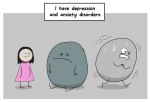
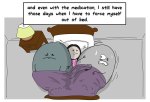
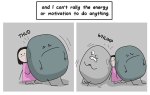

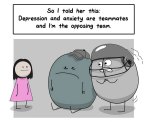












“Is that what you’re wearing?” is super rude though like why would I have put these clothes on my body if I wasn’t gonna wear them you judgemental mofo.
Schizophrenia Revealed To Be 8 Genetically Distinct Disorders
from the amazing heyatleastitsnotcancer.tumblr.com
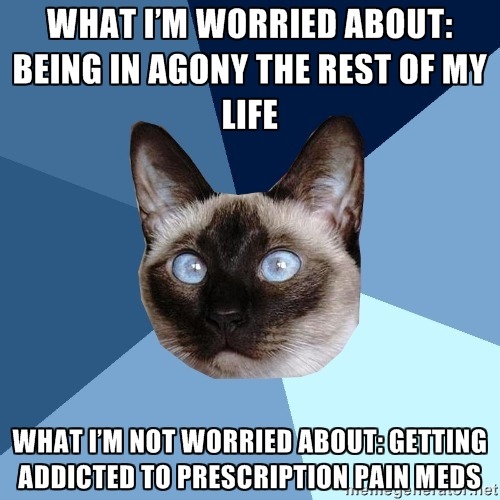
[picture of a Siamese cat’s head against a triangle-sectioned background with many shades of blue. Top line of text reads: What I’m worried about: Being in agony the rest of my life || Bottom line of text reads: What I’m not worried about: Getting addicted to prescription pain meds]
Honestly? This. I’ll take the chance to escape having NO quality of life whatsoever.
I wish more people understood this.
 Holding the Bowl