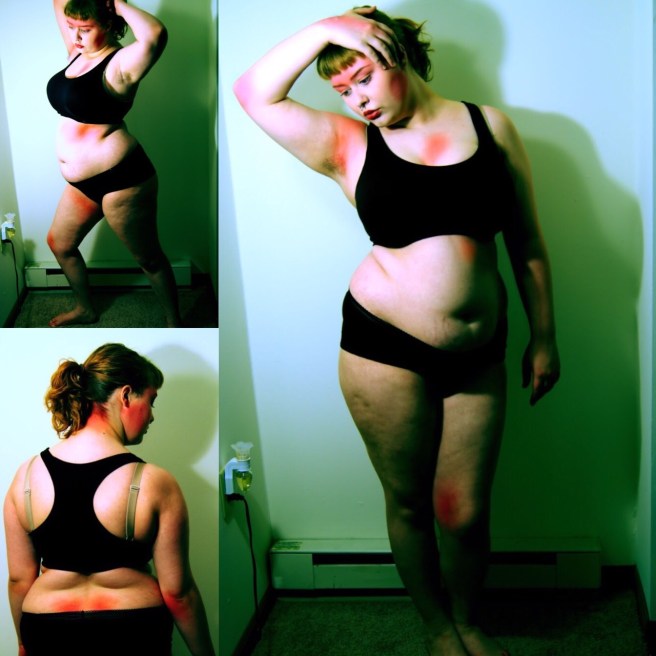
This is going to be a very vulnerable post for me, and not because I’m half naked and showing my face. This is the beginning of a photography series involving chronic illness.
In December of 2015 I was diagnosed with a genetic disorder called Ehlers Danlos Syndrome after a lifetime of health problems that never seemed connected. EDS is a collagen error in my genes meaning my collagen doesn’t form the way it’s meant to. Since collagen is the glue of the body, this means that almost everything can be affected. From Wikipedia, “Collagen provides structure and strength to connective tissue. A defect in collagen can weaken connective tissue in the skin, bones, blood vessels, and organs, resulting in the features of the disorder.” People with EDS often have chronic pain in their joints due to loose ligaments and weak muscles allowing those joints to frequently dislocate. Muscle spasms and nerve pain are also common. The pain involved with EDS is what this set of photos focuses on.
I experience chronic pain every day. I tend to keep it hidden because continually complaining about my pain will only make it harder to handle. It’s not something you can see so I know people, aka my family, have a hard time believing that it’s actually happening, especially when I push through my pain with a smile.
This set of photos is meant to help people visualize the pain I experience that they don’t get to see. It’s meant to bring an understanding that you can never know what someone may be experiencing that you can’t see.
The pink/red spots highlighted on my body are places where I experience pain regularly, most often all at the same time.
(Okay to reblog, please don’t remove the caption, 100% NOT for blogs with raunchy porn or fat fetish/feeder blogs)
thank you for sharing this. you’re brave and beautiful.
having an invisible disability is so frustrating. it’s easy to get mad at the people around me for inadvertently making my life harder, but even when they know intellectually that i have these problems – and even specifically what the problems are – they can’t SEE when i’m having a rough day, they can’t SEE when i’m having a flare-up. some days, if there’s an empty 12-pack box on the kitchen floor, i can easily pick it up and take it out to the recycling bin; some days, i can’t even step over it, and just nudging it aside with my foot makes me wince. it’s not my friends’ and family’s fault they don’t know when i’m hurting. i don’t want to guilt people for that. what i do want them to understand is that the fact my illness is invisible makes it even suckier.
i’ve taken to using my cane in public even when i’m not having a bad mobility day, because people see it and are a little bit more careful around me, so they’re less likely to do something that will give me a bad day. OP, if you don’t use a cane, you might consider starting, even if balance while walking isn’t an issue for you; people bump into you on the sidewalk a whole lot less, and don’t let their dogs jump on you. 😀
Because you can never have enough guides to Disability Etiquette …
I’ve been wanting to write a post about “disability etiquette” for quite awhile. Mainly, I want to try to come up with a simple set of guidelines that covers the essentials of what we consider “disability etiquette.” First, I think we have to be clear about what “disability etiquette” is for.
Is it meant to make social interactions less annoying and humiliating for disabled people, so our everyday lives suck a little less? Or, is it designed to make non-disabled people feel more confident interacting with disabled people, so they will interact with us instead of shying away?
Obviously, it’s a little of both, and I don’t think the two goals necessarily conflict. With both in mind, let’s take a shot at a three-point guide, structured by three very basic questions I think non-disabled have about us, and that we have about how we actually want social interactions to go:
Question 1:
Is it okay to ask a disabled person about their disability?
Answer:
It depends on the situation and how well you know the disabled person. If you’re a stranger or an occasional acquaintance, it’s hard to justify asking a disabled person about the specifics of his or her disability. Even if you know them pretty well, if you’re talking about work, or your last vacation, then it’s probably awkward and inappropriate to suddenly say, “You know, I’ve always wondered, what is your disability actually called?” On the other hand, if you are a wheelchair user and you’re in an emergency room because you’re violently ill, it’s probably okay for your nurse to ask for some details, even if he or she is a complete stranger.
If you’re not sure whether you know someone well enough to ask, think of an analogy. In a similar situation and level of acquaintance, would you ask whether a person is married or has kids? Would you dig further and ask if they are divorced or widowed? The better you already know and trust someone … and the better they know and trust you … the more it’s potentially okay to ask about a person’s own disability.
Above all, think about why you want to ask. Is there a truly practical need to know? Do you really care about the person, and want to know them better as a person? Or, is it insatiable curiosity, like an itch you’re just dying to scratch? If your motivation is more like the latter, it’s a good sign you should probably leave it alone.
What’s it all about? Appropriateness.
Question 2:
Is it okay to ask if a disabled person needs some help?
Answer:
Asking is the key. It’s almost always good to ask. The problems arise when people dive in to help without asking, or when they ask, but then don’t listen or overrule the answer.
If you ask a disabled person if they need help getting into or out of a building, and the answer is, “Yes!”, ask how you can help, and do what you can realistically do to help, according to the disabled person’s instructions. If the answer is, “No thank you,” or even “NO! Go away!”, respect the answer, and don’t take it personally. That can be hard to do if you’ve just been snapped at. But, if you’re original motivation was really to help, then it shouldn’t matter if the answer you got was politely given or incredibly rude. If you find yourself feeling personally offended, ask yourself whether your real priority was making the other person’s day a little easier, or was your actual goal to feel a little better about yourself. There’s nothing wrong with boosting your ego a little by helping others, but things start to get out of balance when that’s why you offer people help.
Of course, if the disabled person takes you up on your offer, first ask how you can help and then follow the disabled person’s instructions. Don’t take “Yes, thanks” as your cue to take charge of the situation. That is exactly the sort of thing that causes many of us to resist help, especially from strangers, even when we probably really do need it. Also, following instructions is critical, even if you’re sure you know what you’re doing. The disabled person usually knows much better than you do how you can help them, and may also be more aware of the safest ways to do things for both of you.
What’s it all about? Control.
Question 3:
For real now, no messing around … which term should I use? Disabled Person? Person with a Disability? Physically Challenged? Special Needs?
Answer:
This one can frustrating, for sure. It seems like we are always changing our minds and can never agree even among ourselves which terms to use and encourage others to use. Given that reality, your best bet is to take a two step approach to terminology.
Start out using “disability” and “disabled” as your default terms. A lot of disabled people still don’t like “disabled” and “disability,” but it does seem to be the most universally understood and accepted term, applicable to all kinds of disabilities and across all cultures. Whether it makes complete sense to your way of thinking at the moment, it is the most widely accepted way of referring to physical or mental impairments.
If those words are accepted with no comment, you’re fine. If a disabled person objects though, and says they prefer other terms, then respect their preference, whatever it might be.
It’s worth noting that there is currently a debate going on inside the disability community between person-first language … where you say “person with a disability,” and identity first language … where you say “disabled person” or just “disabled.” If you’re not disabled yourself, you really don’t need to worry about this. Just go with what the disabled person or people you are with seem to like better.
Above all, never lecture to a disabled person on why your preferred terms are correct, and the terms they prefer is wrong or misinformed. You might know something deeper and more significant about disability than a person who actually lives with disabilities everyday, but it’s unlikely. In any case, telling a disabled person that they’re doing disability wrong is just obnoxious. Don’t do it.
What’s it all about? Respect.
Is there more to “disability etiquette” than these three things … Appropriateness, Control, and Respect? I’m not sure there is.
Stimming is shorthand for self-stimulatory behavior. Stimming is often repetitive movements that seem purposeless on the outside, but it’s actually serving a very important purpose: regulating our nervous systems! 😀
I stim to create sensation when I feel understimulated, I stim to shut out other stimuli if I’m overstimulated, I stim to help me focus on something, I stim to express myself and sometimes I stim just for the heck of it. Sometimes I start stimming without realizing it and become conscious of myself doing it(semi-voluntary) and sometimes I choose to start doing it(voluntary).
Like right now, I just now realized I’m bouncing my leg like a jackhammer. I don’t remember starting to do it. Then I rocked backwards and forwards twice while waving my arms in the air– I chose to do that.
You might be stimming a lot and not realize it. Any action that’s repetitive can be a stim. Leg jiggling, twirling a pen, tapping your fingers, chewing the erasers off your pencils, looking at things that sparkle or are colorful, rubbing velvet or stucco, sniffing bottles of lotion, sucking on lemon slices, making random noises, listening to music or repeating the same song over and over are all forms of stimming. The list is honestly endless.
This is happy stimming mixed in with sensory seeking stimming. Trust me, you will see the happy stims because the rhythm and “size” of my happy stim movements are different than sensory seeking stim movements:
And here’s a video of visual stimming from my perspective. I like sparkly things and how moving them can make points of light appear to flow like water. Sometimes I look at it with my eyes unfocused and my imagination goes wild.
(* * * Warning: Video may induce sensory overload if you have issues with sparkle, flicker or shifting light patterns.* * *)
Dissociating is one of the most common responses to abuse and trauma. It involves feeling numb, detached or unreal and (while it happens to everyone once in a while) is experienced more frequently and severely in survivors. Dissociating people vary widely in symptoms and may experience any or all of the things from the following list.
You may be dissociating if you:
find yourself staring at one spot, not thinking anything
feel completely numb
feel like you’re not really in your body, like you’re watching yourself in a movie.
feel suddenly lightheaded or dizzy
lose the plot of the show or conversation you were focused on
feel as if you’re not quite real, like you’re in a dream
feel like you’re floating
suddenly feel like you’re not a part of the world around you
feel detached and far away from other people, who may seem mechanical or unreal to you
are very startled when someone/something gets your attention
completely forget what you were thinking just a moment ago
suddenly cover your face or react as if you’re about to be hurt for no reason
can’t remember important information about yourself, like your age or where you live
find yourself rocking back and forth
become very focused on a small or trivial object or event
find that voices, sounds or writing seem far away and you sometimes have trouble understanding them.
feel as if you’ve just experienced a flashback (perhaps rapidly) but you can’t remember anything about it.
perceive your body as foreign or not belonging to you
(likes and reblogs always taken as support)
To my anon asking about dissociation. I hope you see this.
I thought dissociation was only when I have straight up out of body experiences turns out I’m dissociated like 99% of the time lmso
Sensory overload has been found to be associated with disorders such as:
Fibromyalgia (FM)
Chronic Fatigue Syndrome (CFS)
Post Traumatic Stress Disorder (PTSD)
Autistic spectrum disorders
Generalized Anxiety Disorder (GAD)
Synesthesia
Sensory overload occurs when one (or more) of the body’s senses experiences over-stimulation from the environment.
Basically it feels like everything is happening at once, and is happening too fast for you to keep up with.
Sensory overload can result from the over stimulation of any of the senses.
Hearing: Loud noise or sound from multiple sources, such as several people talking at once.
Sight: Bright lights, strobe lights, or environments with lots of movement such as crowds or frequent scene changes on TV.
Smell and Taste: Strong aromas or spicy foods.
Touch: Tactile sensations such as being touched by another person or the feel of cloth on skin.
Obviously, everyone reacts in differently to sensory overload.
Some behavioural examples are:
Irritability – “Shutting down” – Covers eyes around bright lights – Difficulty concentrating Angry outbursts – Refuses to interact and participate – Covers ears to close out sounds or voices – Jumping from task to task without completing Overexcitement – Low energy levels – Difficulty speaking – Compains about noises not effecting others High energy levels – Sleepiness/fatigue – poor eye contact – Overly sensitive to sounds/lights/touch Fidgeting and restlessness – Avoids touching/being touched – Muscle tension – Difficulty with social interactions
There are two different methods to prevent sensory overload: avoidance and setting limits:
Create a more quiet and orderly environment – keeping the noise to a minimum and reducing the sense of clutter.
Rest before big events.
Focus your attention and energy on one thing at a time.
Restrict time spent on various activities.
Select settings to avoid crowds and noise.
One may also limit interactions with specific people to help prevent sensory overload.
It is important in situations of sensory overload to calm oneself and return to a normal level.
Remove yourself from the situation.
Deep pressure against the skin combined with proprioceptive input that stimulates the receptors in the joints and ligaments often calms the nervous system.
Reducing sensory input such as eliminating distressing sounds and lowering the lights can help.
Calming, focusing music works for some.
Take an extended rest if a quick break doesn’t relieve the problem.
What if someone you know is experiencing sensory overload?
Recognize the onset of overload. If they appear to have lost abilities that they usually have, such as forgetting how to speak, this is often a sign of severe overload.
Reduce the noise level. If they are in a noisy area, offer to guide them somewhere more quiet. Give time to process questions and respond, because overload tends to slow processing. If you can control the noise level, for example by turning off music, do so.
Do not touch or crowd them. Many people in SO are hypersensitive to touch – being touched or thinking they are about to be touched can worsen the overload. If they are seated or are a small child, get down to their level instead of looming above them.
Don’t talk more than necessary. Ask if you need to in order to help, but don’t try to say something reassuring or get them talking about something else. Speech is sensory input, and can worsen overload.
If they have a jacket, they may want to put it on and put the hood up. This helps to reduce stimulation, and many people find the weight of a jacket comforting. If their jacket is not within reach, ask them if they want you to bring it. A heavy blanket can also help in a similar way.
Don’t react to aggression. Don’t take it personally. It is rare for someone who is overloaded to cause serious harm, because they don’t want to hurt you, just get out of the situation. Aggression often occurs because you tried to touched/restrained/blocked their escape.
When they have calmed down, be aware that they will often be tired and more susceptible to overload for quite awhile afterwards. It can take hours or days to fully recover from an episode of sensory overload. If you can, try to reduce stress occurring later on as well.
If they start self-injuring, you should usually not try to stop them. Restraint is likely to make their overload worse. Only intervene if they are doing something that could cause serious injury, such as hard biting or banging their head. It’s a lot better to deal with self-injury indirectly by lowering overload.
To summarise – Remember the 5 R’s
Recognise The symptoms of overload
Remove Yourself from the situation
Reduce the stimulus causing the overload
Relax Your body and calm yourself down
Rest Yourself as you will most likely feel fatigue.]
Through 150 telling journal entries, Samantha Craft presents a life of humorous faux pas, profound insights, and the everyday adventures of a female with Asperger’s Syndrome.
service dogs are doing a job and usually people want to pet them but then theyll interrupt the job the service dog is trained to do. so the rule of thumb is dont interact with a service dog unless the owner says you can
YEET idc I’m petting the dog anyways
Okay, well.
You shouldn’t pet strangers’ dogs without asking either.
In Boston while waiting for the T, there was a woman with her service dog in full gear also waiting. Two young women went right up to the dog and the moment one of the women reached out to pet the dog, the older woman slapped her hand away and said “My dog is working, do NOT pet.” And I smiled because those young women were in the wrong.
If you came up to my dogs and didn’t ask to pet them, I would slap your hand away, and they’re not even service dogs.
If you pet my service dog without permission, you are stopping him from doing his job.
One of my dog’s jobs is detecting seizures. He gives me a few minutes warning. If he can’t warn me because he’s distracted, I could fall and hit my head.
I could die of a head injury because I wouldn’t have time to find a place to sit and sit down.
But, hey, a stranger gets to pet my dog.
I guess that’s worth it. /sarcasm
Would you go up to a disabled person and interfere with their wheelchair? Would you nudge a blind person’s cane? Interfering with a service dog is no different. You’re putting a person at risk. Service dogs are not pets. Leave them alone.
In response to the question, “Do you have any suggestions on talking to doctors about pain? I’m going to see my doctor in a few days so I could use some tips and getting my point across.”
Anybody who’s ever tried to explain their experience of bodily pain to someone else knows that it’s difficult. Pain is subjective to each person, and absolutely nobody can feel our physical pain but us. This doesn’t mean that we shouldn’t try to communicate to others that we are having a life-changing problem, though; this just means that we should learn how to communicate about it effectively in order to receive the most empathy, compassion, and appropriate treatment(s) possible. How do we do that?
Figure out if your pain is acute or chronic Acute pain is short-term and often intense. Chronic pain lasts for longer than 3 months and can be just as intense, if not more so. Try to journal and see if you can list all you know about your own pain’s history, and go into your appointment with this list (as well as a list of your questions and concerns) so that you feel confident and don’t forget anything important to you. How long has it lasted? Is it the result of a specific event that you can pinpoint?
Find vivid phrases to describe what your pain feels like When I was first going in to see a doctor for chronic hip pain, I found the phrase, “I feel like I just slammed my hip against a table.” Easy to understand, as well as almost feel yourself, right? Make it clear that this is something that needs and deserves treatment. Women often get taken less seriously than men when seeking pain treatment, as do racial minorities. Advocate for yourself as best you can.
Learn the typical words that describe pain (as well as what parts of the body are affected by it) Sometimes, in dealing with pain, you’ll be experiencing different types of pain in different places. Read this page in order to understand what people actually mean when they say they’re having a “dull” pain, as well as other terms like “raw”, “stiff”, and so on. In addition, find a nice picture of the human body on Google, if you’re struggling to figure out the name of the approximate region where you’re hurting. I like this one because it has both the Latin and the English words, as well as the front and back of the body.
List which everyday activities are compromised by your pain Certain pain syndromes, if it turns out that you have a more widespread chronic pain disorder rather than an acute pain, have life activities that are known to be affected in most people who have it. Journal about them. You’re often required to list these on patient intake forms, anyway, so this will speed up your process of filling out that paperwork.
If you’re science-y, read up on pain This is mainly for the anatomy and physiology nerds out there. Two very readable articles from WebMD: Pain basics (1 page) | Pain classifications (3 pages)
List every single symptom you’re experiencing (even the ones that you think can’t possibly be connected to each other) Think about every part of the body. Is anything going on that didn’t in the past? I know that this can be hard, and even distressing, because it can give us a reason to grieve, but as much as you can, push through your discomfort with it. What makes them worse? Better? Bring this list with you to your appointment so that you can’t possibly forget any of them when you’re on the spot. The more your practitioner knows, the better.
Go into your appointment with a pain scale of your choosing (because not all pain scales are created equally, nor do they necessarily mean the same thing to different people) What is your pain on good days? What is it on bad days? I personally like the Mankoski Pain Scale because it talks about the daily life impacts of your pain, as well as the kind of medication that might help. Of course, it will be up to you and your practitioner ultimately to decide what kind of treatment you will get, but knowing, for example, that you’ve tried ibuprofen and it hasn’t worked is a helpful piece of information.
I wish you the absolute best in your appointments, friends. Know that you’ve even got an entire community behind you here on Tumblr! We’ve got your back and understand you more than you could possibly know. We’re called spoonies (people who have chronic illnesses that limit our energy). Here’s a masterpost of spoonie community-related stuff, (and how about another?), and a world map of spoonies to remind you that you are never alone! And, if you get diagnosed with something in particular, here’s a list of Tumblr bloggers that identify with particular diagnoses (and, chances are, there are others out there just like you)! Be well, and please ask any questions you need to.
The brain is an organ. Mental illnesses are illnesses of that organ. Brain scans show that there is a physical difference between a healthy brain and a sick brain. Telling someone “You’re not really sick. It’s all in your head.” is like telling someone with asthma “It’s not real, it’s all in your lungs.” The brain is an organ that can malfunction as much as any other organ.




 Holding the Bowl