I’ve heard a lot of advocates of inclusion say things like “kids with disabilities work twice as hard as everyone else” or “my employees with Down’s syndrome never come in late or take a day off.”
This sounds like praise, but it isn’t.
The time disabled people spend working twice as hard as everyone else has to come from somewhere.
There are reasons why kids aren’t in school every waking moment. There is a reason why vacation time exists and why it’s normal to be late occasionally.
People need rest. People need leisure time. People have lives and needs and can’t do everything.
Being disabled doesn’t erase the need for down time. Being disabled doesn’t erase the need for play, or for connections to other people.
Working twice as hard as everyone else all the time isn’t sustainable. Praising disabled people for doing unsustainable things is profoundly destructive.
People with disabilities should not have to give up on rest, recreation, and relationships in order to be valued. We have limited time and energy just like everyone else, and our limitations need to be respected.
It is not right to expect us to run ourselves into the ground pretending to be normal. We have the right to exist in the world as we really are.
This is getting on my fucking nerves, so I’m just going to say it here:
Adults who need high levels of support in daily living are not children.
“Mental age” is a concept rooted in eugenics, and it doesn’t actually exist.
No one should be robbed of agency or dignity because of their need for support.
Oh, also, while we’re at it (since disability rights activism that doesn’t tackle age-related oppression is bullshit), kids deserve to be treated with respect too. Shouldn’t be a controversial statement, but it is.
Most people neglect to mention this, but if “being treated like a child” equates to “being robbed of agency and dignity,” there’s something fundamentally wrong with the way we treat children.
Friendly reminder that Vincent van Gogh willingly checked himself into an asylum so that he could get better, resulting in him creating some of the most iconic paintings of his entire career, done in the asylum, when he was being treated 24/7, because he finally didn’t have to struggle with his demons and could instead focus on his muse, WHICH WERE TWO DIFFERENT THINGS!
Remember this little insignificant painting?
How about this one?
Check this one out:
All of these and more were painted in the asylum when he was receiving treatment for his mental illnesses and I know I just said that but I said it again and I’m saying it a third time until you dramatic abled assholes understand!
VINCENT VAN GOGH
– KNEW THAT HE WAS MENTALLY ILL
– WANTED TO CHANGE THAT
– WENT TO AN ASYLUM
– GOT THE HELP HE NEEDED
– PAINTED SOME ICONIC MASTERPIECES AS A RESULT!
SO DON’T YOU DARE COME OUT HERE WITH THIS, “I WISH I WAS DEPRESSED SO I COULD BE AS CREATIVE AS VAN GOGH” BULLSHIT BECAUSE EVEN HE KNEW THAT HIS DEMONS WERE HARMING HIS WORK, AND MORE IMPORTANTLY, HIS HEALTH, AND HE DID EVERYTHING WITHIN HIS POWER TO FIGHT THEM EVERY SINGLE DAY OF HIS LIFE, UNTIL THEY ENDED UP WINNING!
This is also incredibly important for any creative persons dealing with mental illness, and their parents.
Receiving mental help improves your craft, not hurt it. Before getting put on medication for the first time to treat my mental illnesses, my mom expressed to me how she’s worried about my getting treatment because of my art. Regardless, your mental health should be more important anyway, but, honestly, it’s a lot harder to produce good art when you struggle getting out of bed, let alone creating masterpieces. When you’re in more health, improving your craft comes much easier!
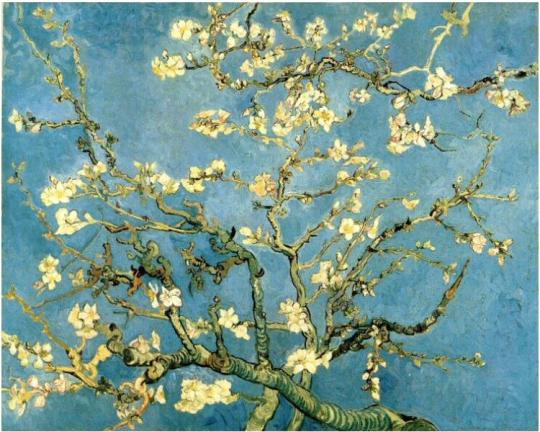
Personally I think the most beautifull painting of him was this one:
He made it when he heard about the birth of his nephew who was named after him. Still in the asylum but really happy for his brother!
“How glad I was when the news came… I should have greatly preferred
him to call the boy after Father, of whom I have been thinking so much
these days, instead of after me; but seeing it has now been done, I
started right away to make a picture for him, to hang in their bedroom,
big branches of white almond blossom against a blue sky.”
Oh I have sucb rants about how “good” art comes while suffering.
No.
look at me.
The idea of the “suffering artist” comes from bunch of alcholic, drug abusing, womanizers trying to justify their bad life choices as some sort of artistic angst.
IT IS 100% BULLSHIT
Take your meds, get your therapy, be happy, and live life
The art will be there.
it’s true that i wrote a higher volume of words when i was untreated. that’s because i was using writing to avoid my life. i spend more time these days on self-care. but the words i do write are of much higher quality, and my craft in plotting and organizing, collaboration and research, has gone through the roof.
i used to just put my head down for 16 hours and pound out ten thousand words from a pit of misery, and shove them in a file named with a keymash to collect dust. now i spend 4 hours on research and planning, an hour talking to my collab partner, and an hour writing a thousand words that are structural and focused and advance the project, then go have a nice bath and text my friends pictures of my cat. my work day’s less than half as long and infinitely more productive.
(and in case you’re imagining those 10k misery files were some kind of De Profundis, no, they were mostly porn.)
i am a MUCH better writer now that i’m on meds that work and have had some years of good counselling.
you won’t lose your creativity if you get help, darlings. that’s YOU. it’s not the disease. it’s yours. you’re the artist. what makes you better isn’t suffering, it’s practice, and you’ll practice more and easier when you’re happier.
This whole idea that suffering is what makes the art is baffling to me. I do MUCH LESS work, let alone quality work, when I’m hitting a low point. It’s like creating anything is a struggle. When I’m doing well is when I can freely write and paint and craft, and the quality of work is present.
My complete and total inability to keep anything clean or tidy for any amount of time is a symptom of my depression. I may never be able to do this. It’s important that I remember that and forgive myself when I clean something out (like my car) and it ends up trashed within a week.
Depression IS A DISABILITY. Requiring accommodations is okay.
Medications don’t make you better, they don’t cure your depression. They serve as an aid. Their purpose is to help you get to everyone else’s minimal level of functioning.
Depression can cycle through periods of inactivity. This doesn’t mean it’s gone away.
The reason I don’t feel like other people understand me is because … well … other people DON’T understand me. They can’t. They don’t have my disability.
Paranoia is par for the course.
Depression can and will interfere with your physical mobility. Forgive yourself when you can’t physically do something.
It’s entirely possible that I may never be able to live by myself. I can’t take care of myself. I need help to do it. And that’s okay.
As someone who suffers from depression and who experiences all these things as well I think this is important and needs to be reblogged. Depression is a very difficult thing, not only for people who suffer from it, but for everyone who knows a depressed person. My family doesn’t know how to deal with it, my friends try their very best to support me and I have tried to pretend I was fine until I was in ninth grade.
Everything makes so much more sense
Depression is a disease of the brain. The brain is an organ. When organs are not functioning properly, you are advised to see a doctor and get help. So why is it so hard to understand that the brain can suffer as well, and that we need help for it?
The brain controls the body. A sick brain means a sick body.
…. Shit.
Don’t disregard it as just sadness. Depression is life threatening.
The day I rebuked someone for saying “depression is in your head” with the comeback “Yes. And there’s an organ in your head called the brain – or at least in MY head, sounds to me like you don’t have one at the present moment – and a brain is a physical component of the body, therefore depression is a Physical ailment”…
that day was the day I took my first step toward accepting it as a disability and forgiving myself for having to live with something so stigmatized
and;
when people attribute depression to being “all in your head,” what they’re really doing is connecting your illness to an expectation of sufferers being virtuous and having enough willpower, almost making it an issue of personal integrity, as if fostering and growing those is the only – or even the most effective – “cure,” and if you’re weak in those areas and not persevering hard enough, then it’s a moral failing
it’s not
My former boss once asked me if I was sure the depression wasn’t “only” in my head.
And I said, “Yes. That’s why they call it a mental illness.”
Just because you can’t see it doesn’t mean it isn’t there.
Individuals with autism spectrum disorder (ASD) often find it difficult
to look others in the eyes. This avoidance has typically been
interpreted as a sign of social and personal indifference, but reports
from people with autism suggests otherwise. Many say that looking others
in the eye is uncomfortable or stressful for them – some will even say
that “it burns” – all of which points to a neurological cause. Now, a
team of investigators based at the Athinoula A. Martinos Center for Biomedical Imaging
at Massachusetts General Hospital has shed light on the brain
mechanisms involved in this behavior. They reported their findings in a Nature Scientific Reports paper.
“The
findings demonstrate that, contrary to what has been thought, the
apparent lack of interpersonal interest among people with autism is not
due to a lack of concern,” says Nouchine Hadjikhani, MD, PhD, director
of neurolimbic research in the Martinos Center and corresponding author
of the new study. “Rather, our results show that this behavior is a way
to decrease an unpleasant excessive arousal stemming from overactivation
in a particular part of the brain.”
The key to this research
lies in the brain’s subcortical system, which is responsible for the
natural orientation toward faces seen in newborns and is important later
for emotion perception. The subcortical system can be specifically
activated by eye contact, and previous work by Hadjikhani and colleagues
revealed that, among those with autism, it was oversensitive to effects
elicited by direct gaze and emotional expression. In the present study,
she took that observation further, asking what happens when those with
autism are compelled to look in the eyes of faces conveying different
emotions.
Using functional magnetic resonance imaging (fMRI),
Hadjikhani and colleagues measured differences in activation within the
face-processing components of the subcortical system in people with
autism and in control participants as they viewed faces either freely or
when constrained to viewing the eye-region. While activation of these
structures was similar for both groups exhibited during free viewing,
overactivation was observed in participants with autism when
concentrating on the eye-region. This was especially true with fearful
faces, though similar effects were observed when viewing happy, angry
and neutral faces.
The findings of the study support the
hypothesis of an imbalance between the brain’s excitatory and inhibitory
signaling networks in autism – excitatory refers to neurotransmitters
that stimulate the brain, while inhibitory refers to those that calm it
and provide equilibrium. Such an imbalance, likely the result of diverse
genetic and environmental causes, can strengthen excitatory signaling
in the subcortical circuitry involved in face perception. This in turn
can result in an abnormal reaction to eye contact, an aversion to direct
gaze and consequently abnormal development of the social brain.
In
revealing the underlying reasons for eye-avoidance, the study also
suggests more effective ways of engaging individuals with autism. “The
findings indicate that forcing children with autism to look into
someone’s eyes in behavioral therapy may create a lot of anxiety for
them,” says Hadjikhani, an associate professor of Radiology at Harvard
Medical School. “An approach involving slow habituation to eye contact
may help them overcome this overreaction and be able to handle eye
contact in the long run, thereby avoiding the cascading effects that
this eye-avoidance has on the development of the social brain.”
The
researchers are already planning to follow up the research. Hadjikhani
is now seeking funding for a study that will use magnetoencephalography
(MEG) together with eye-tracking and other behavioral tests to probe
more deeply the relationship between the subcortical system and eye
contact avoidance in autism.
“So now that neurotypical scientists have said so, can we stop forcing Autistic people to – For fuck’s sake.”
one of the more valuable things I’ve learned in life as a survivor of a mentally unstable parent is that it is likely that no one has thought through it as much as you have.
no, your friend probably has not noticed they cut you off four times in this conversation.
no, your brother didn’t realize his music was that loud while you were studying.
no, your bff or S.O. doesn’t remember that you’re on a tight deadline right now.
no, no one else is paying attention to the four power dynamics at play in your friend group right now.
a habit of abused kids, especially kids with unstable parents, is the tendency to notice every little detail. We magnify small nuances into major things, largely because small nuances quickly became breaking points for parents. Managing moods, reading the room, perceiving danger in the order of words, the shift of body weight….it’s all a natural outgrowth of trying to manage unstable parents from a young age.
Here’s the thing: most people don’t do that. I’m not saying everyone else is oblivious, I’m saying the over analysis of minor nuances is a habit of abuse.
I have a rule: I do not respond to subtext. This includes guilt tripping, silent treatments, passive aggressive behavior, etc. I see it. I notice it. I even sometimes have to analyze it and take a deep breath and CHOOSE not to respond. Because whether it’s really there or just me over-reading things that actually don’t mean anything, the habit of lending credence to the part of me that sees danger in the wrong shift of body weight…that’s toxic for me. And dangerous to my relationships.
The best thing I ever did for myself and my relationships was insist upon frank communication and a categorical denial of subtext. For some people this is a moral stance. For survivors of mentally unstable parents this is a requirement of recovery.
People with sensory processing disorders like fibromyalgia and other chronic pain diseases have the same experience. Until I started talking to people with ADHD, I didn’t realize it wasn’t normal to spend every waking minute feeling your clothes against your skin or cataloging the changes in sound and light and smell. It wasn’t until I watched Elementary and saw the characters around Sherlock not noticing sensory details around them that he picks up that I realized it’s not normal for brains to do this.
Unlike folk with ADHD, though, I never had this experience full blown until I was in my twenties. It build gradually over about a decade, and I thought I’m just getting older. I didn’t have these issues as a young child, so my lack of focus in my mid-20s had to be age-related, not ADHD, right?
And that’s how you trick yourself into thinking you’re normal for years. It’s easier than admitting difference, even as you carefully pick out only silk and pure cotton clothes, wash everything (including yourself) in unscented soap, and eat only a handful of foods (mostly sugar, because it’s boring and you don’t have to think about it much).
Spoonies, pay attention: if you can’t focus, it may not just be the pain. What else is your brain, primed for pain signals, now also processing without end?
so i’ve been thinking a lot about tumblr’s “anti-recovery” mindset and come to the conclusion that a lot of it is actually anti-wellness.
some people can’t recover. for example, i have ADHD and autism and i’ll never recover because there’s nothing to recover from – it’s hard-wired in my brain from the day i was born.
but wellness isn’t about forcing yourself to be neurotypical. wellness is about being content and satisfied and trying to be your best self – and for a lot of us that is not neurotypical!
speaking of my personal experience with ADHD and autism that i just mentioned, for me, wellness would be minimizing symptoms i dislike and that are harmful to me or other people (executive dysfunction, lack of focus, erratic behavior, etc.) while maximizing and appreciating the symptoms of my neurodivergence i love (ADHD makes me creative and colorful! autism makes me passionate about the things i love and strive to know everything about them!)
so really i think a big part of it is understanding the difference. if your neurodivergence is something you can recover from (i have many other diagnoses i believe are recoverable) and you want to recover that’s great! but you don’t need to be neurotypical to be well, to be satisfied and happy and your best self.
neurodivergence isn’t bad. people aren’t bad for being neurodivergent. but we should encourage people to find good ways to be happy and satisfied and use their brains to help them, not hurt them





 Holding the Bowl