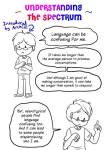
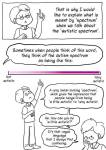
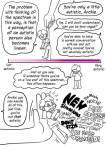
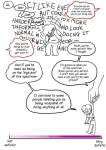

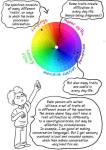
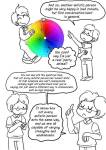
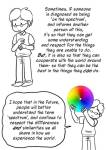
Source: Comic Redesigns the Autism Spectrum to Crush Stereotypes: http://themighty.com/2016/05/rebecca-burgess-comic-redesigns-the-autism-spectrum

Devotional blog dedicated to the Goddess Sigyn offering support to those who are "holding the bowl" within difficult relationships.
Source: Comic Redesigns the Autism Spectrum to Crush Stereotypes: http://themighty.com/2016/05/rebecca-burgess-comic-redesigns-the-autism-spectrum

Anhedonia – not finding pleasure in things you normally take pleasure in – is a symptom of depression.
When depressed, you will also be reluctant to start things, and won’t find things appealing.
This sets up a nasty vicious cycle where ‘life feels bleak’ -> ‘nothing sounds fun’ -> do nothing -> don’t have fun -> ‘Hey I’m not having fun, life really is pretty bleak right now’ -> More depressed.
The way to break that cycle is to do things that you enjoy. Doing things solely for the sake of having fun is an important part of handling depression. Not only does it keep you from getting more depressed, but it can make you go ‘Hey I’m having a really nice day’ and give you bouncy energy to do productive things with.
I get so focused on all the things that need doing that I forget that when depressed, doing things solely because they’re fun is the practical thing to do if I want to get thing done.
There is a difference between procrastination and having trouble activating. If there’s a thing you need to do and you know you aren’t going to be able to do it now, do something fun, and afterwards you will have better odds of actually doing the thing.
If you find yourself in the situation in the picture, pick something that you are intellectually aware you would find fun if you were feeling better and start doing it.’ This means that you are focusing on something other than *sigh* and playing a game can make you feel productive, put ‘life is good!’ and ‘I can succeed at things!’ chemicals into a brain that is sorely in need of them.
A couple weeks ago when I couldn’t even find any interest in reading fanfic, I eventually managed to start playing a random RPG and felt much better a few hours later.
i certainly wasn’t expecting anything close to actual, halfway decent advice that might help some folks out when i threw this little Funne Picture out into the wild, but that’s nice. thank you. i’m not sure if i’ll ever break this little cycle for more than a few hours, but .. yeah man. it’s just a little nice to see folks trying to help other folks out on posts of mine instead of the usual terrible nonsense
Exactly what I needed right now.
Easy to parse version:
Anhedonia is a symptom of depression, it’s not finding enjoyment in things that once made you happy.
If you find yourself in this situation, pick something that you KNOW you would find fun or enjoyable.
When you’re depressed, the best thing to do is do things BECAUSE they’re fun, it’ll help motivate you more.
Thank you I did need to hear that!
A part of being an adult is living with regret and not allowing it to consume you. The older you get, the more mistakes you’ve made, opportunities you’ve missed, people you’ve disappointed. And every day you have to remind yourself to be kind and forgiving of yourself. You accept and love the you from the past and understand that it’s all a part of the process. Then you move on and live your best life, knowing now as old as you feel today, you’ll never be this young again.
Busting Schizophrenia Myths!
- “Aren’t schizophrenic people dangerous-” No. Violence towards other people isn’t a symptom of schizophrenia, nor is it common in schizophrenic people. That’s not to say that no one with schizophrenia has ever been violent because of their psychosis, but it isn’t a symptom of or in the diagnostic criteria for the illness, and schizophrenic people in general are no more likely to be violent than anyone else.
- “Isn’t that when you have multiple personalities-” No. Schizophrenia isn’t about having multiple personalities – that’s called Dissociative Identity Disorder and is a completely different mental illness. Schizophrenic people might hear one or more voices in their heads and may feel like their actions or thoughts are being controlled by other people/outside forces, but this isn’t the same as having several personalities as it’s always the schizophrenic persons own personality which reacts to these distressing experiences.
- “Isn’t schizophrenia when you’re psychotic like when you hear voices and stuff-” Yes, but schizophrenia isn’t “just” about experiencing psychosis (hallucinations, disorganized thinking/speech/behavior and delusions), it also consists of what’s called negative symptoms (lack of energy, lack of motivation, social isolation, lacking or inappropriate emotional responses, lack of ability to feel pleasure) and cognitive symptoms (impaired memory, impaired concentration, learning difficulties, executive dysfunction and impaired working memory). Schizophrenia is a complex mental illness and psychosis is only 1/3 of what schizophrenic people struggle with.
- “You can’t recover from schizophrenia, right-” Not true. 25% of the people diagnosed with schizophrenia are symptom free within 5-10 years of being diagnosed with the illness and up to 80% improve with ongoing treatment and support. Schizophrenia isn’t necessarily a life sentence, and while you can’t EXPECT to recover from schizophrenia and while there’s no known cure, recovery is possible for many people with the right treatment.
- “Shouldn’t schizophrenic people be locked up-” No. Schizophrenic people are people just like everyone else, and we have the right to the same human rights and the same freedom as other people. We might need to be hospitalized for our own safety sometimes, but we have as much of a right to be a part of and interact with society as everyone else.
- “Real schizophrenic people don’t know they’re sick, right-” Some don’t, but at least 45% of schizophrenics are aware that they’re suffering from schizophrenia, so a person being aware that they’re schizophrenic and having insight into their illness/knowing that what they’re experiencing isn’t real or normal isn’t a sign that they aren’t really sick.
- “What if schizophrenic people just have special powers-” I’m not going to deny you your right to your spiritual beliefs, but I’m going to insist that you don’t force them onto me or any other schizophrenic person. Just like I’m not gonna show up at a Christians door saying that God isn’t real just because I’m an atheist, you don’t get to tell a schizophrenic person that they can see into other dimensions or talk to spirits. You risk triggering or worsening our illness by sharing your spiritual or religious speculations, so don’t bring them up. Ever.
- “Aren’t schizophrenic people dangerous if they don’t take their meds-” No. Anti psychotic meds are heavy medication that impacts your life in many ways, and taking them should always be a free choice. Some people would rather live with their psychosis than take anti psychotic medication, and this doesn’t automatically make them a danger to anyone.
I would really appreciate if non schizophrenic people would consider boosting this post as schizophrenia is a very misunderstood and stigmatized mental illness and I want this post to show up on as many dashes as possible.
This may just be my experience as an autistic person, but the kids I’ve nannied whose parent’s complain of ‘bad awful in cooperative selfish autistic behavior’ are… Not like that? At all?
Like, for example, I cared for a kid for a while who was nonverbal and didn’t like being touched. Around six years old? Their parent said that they were fussy and had a strict schedule, and that they had problems getting them to eat. Their last few nannies had quit out of frustration.
So, I showed up. And for the first little while, it was awkward. The kid didn’t know me, I didn’t know them, you know how it is. And for the first… Day and a half, maybe? I fucked up a few times.
I changed their diaper and they screamed at me. I put the TV off and they threw things. Not fun, but regular upset kid stuff.
Next time, I figured, hell, I wouldn’t like being manhandled and ordered around either. Who likes being physically lifted out of whatever it is they’re doing and having their pants yanked off? Fucking few, that’s who.
Next time, I go, ‘hey, kiddo. You need a new diaper?’ and check. ‘I’m gonna go grab a new one and get you clean, okay?’ ‘Wanna find a spot to lay down?’ ‘Alright, almost done. Awesome job, thanks buddy’.
I learned stuff about them. They liked a heads up before I did anything disruptive. They didn’t mind that I rattled of about nothing all day. They didn’t like grass or plastic touching their back. They were okay with carpets and towels. They liked pictionary, and the color yellow, and fish crackers, and painting. They didn’t look me in the face (which was never an issue- I hate that too, it fucking sucks) but I never had reason to believe that they were ignoring me.
Once I learned what I was doing wrong, everything was fine. Did they magically “”“become normal”“” and start talking and laughing and hugging? No, but we had fun and had a good time and found a compromise between what I was comfortable with and what they were comfortable with. (For the record, I didn’t magically sailor-moon transform into a socially adept individual, either. In case anyone was wondering.)
I don’t like eye contact. It’s distracting and painful and stresses me out.
They didn’t like eye contact either.
Is eye contact necessary to communication? No. So we just didn’t do it.
Was there ever a situation where I HAD to force them to drop everything and lay down on the lawn? No. So the thirty second warning came into play, and nobody died.
“But they never talked!”
No, they didn’t. And they didn’t know ASL, and they didn’t like being touched.
So you know what happened?
My third day in, they tugged on my shirt. ‘Hey monkey, what’s up?’ I asked. And they tugged me towards the kitchen. ‘oh, cool. You hungry?’. They raised their hands in an ‘up’ gesture. ‘you want up? Cool.’ and I lifted them up. They pointed to the fridge. I opened it. They grabbed a juice box out of the top shelf, and pushed the door closed again. ‘oh sweet, grape is the best. You are an individual of refined taste.’ I put them down and they went back to their room to play Legos.
“But they didn’t say please or thank you!” “But you should be teaching them communication skills!” “But!” Lalalalala.
1. The entire interaction was entirely considerate and polite. I was never made uncomfortable. I was made aware of the problem so that I could help them solve it. There was no mess, no tears, no bruises, no shouting.
2. Did my brain collapse into a thousand million fragments of shattered diamond dust out of sheer incomprehension? No? Then their communication skills were fine. Goal realized, solution found, objective complete. They found the most simple and painless way to communicate the situation and then did it.
Kids are not stupid. AUTISTIC kids are not stupid.
I’m willing to bet real cash money that the real reason the last few nannies had quit had a million times more to do with their own ability to cope, not the kid’s.
To this day, that was the most relaxed and enjoyable job I’ve ever had.
And I know I don’t speak for everyone. All kids are different. All adults are different. But in my time and experience, pretty much 95% of all my difficulties with children come from ME not being understanding enough. Every single “problem child” I’ve worked with turned out to be a pretty cool person once I started figuring out how to put my ego aside and let them set the pace.
Again, not speaking universally, here. I’m just saying. Sometimes social rules are bullshit, you know? People are people
Have you ever read an article about the study that found that teaching the parents to cope with autistic kids yields better results than other therapies? Because this is exactly what they were talking about.
It’s all about adjusting to the needs of the kid you got, and not wrapping the kid around your needs, wants, and expectations.
I take school shootings very personally. Here is why.
Researchers have found a genetic mutation that links Ehlers-Danlos Syndrome (#EDS), Postural Orthostatic Tachycardia Syndrome (#POTS), and Mast Cell Activation Syndrome (#MCAS)
http://ow.ly/2FcO30i8IrR
One Gene Mutation Links Three Mysterious, Debilitating Diseases
Here’s a thought I had about how therapy & treatment works (vs how many people imagine it works). This is based on my experience with depression and chronic illness, but I hope it applies more broadly as well.
Imagine you have to take a road trip on a deserted road alone. Halfway through the trip your engine starts to splutter and the car breaks down. What do you do?
A lot of people imagine that therapy and treatment is like calling a mechanic to come and fix your car for you. You make the call, and then you just have to wait around until the mechanic has fixed the problem, and your car is good as new! Unfortunately, it doesn’t work like that. There is no on-call mechanic. No-one is able to fix this car except for you.
Instead, it’s like you pull a toolbox out of the trunk, pop open the hood, and dial up the mechanic on the phone. You have to try and describe the problems as clearly as possible, and follow the advice they give you as well as you can.
Sometimes you won’t understand the advice, and you’ll need them to explain it again or suggest something else. Sometimes you’ll do what they say and the car still won’t run, and they won’t be able to explain why, only give you something new to try. Sometimes you’ll think you fixed the problem and start driving, and the car will break again two minutes down the road. No matter what happens, it’s going to be hard and messy and frustrating work.
But at the end of it, not only will your car be running again, but you’ll know how to fix it now. Which isn’t to say that you’ll never need another mechanic again, but next time you get stuck, it’ll be that little bit easier to handle.
So keep at it everyone, and good luck on your journeys!
Your periodic reminder that in people who have been subject to threats and punishment for having emotional responses or ‘inappropriate’ facial expressions, panic attacks look different.
They may look like the person has become calmer and less involved, dismissive, even. Some people become intensely subservient and silent. Some become catatonic.
Panic doesn’t always involve screaming, crying, and obvious signs of distress. It involves an extreme form of the person’s fear response – which can be altered by circumstance, ability, and what they’ve learnt to fear.
Which is to say, it’s not your place to decide someone isn’t having a panic attack, when they’ve told you that’s what’s happening.
Yes, absolutely this. I get quiet and withdrawn when I’m having a panic attack. A quiet panic attack is still a panic attack.
It me.
I tend to have “slow moving” panic attacks. Like it slowly takes over my body and brain. But it ends with me very shut down, except for my brain, which is endlessly looping.
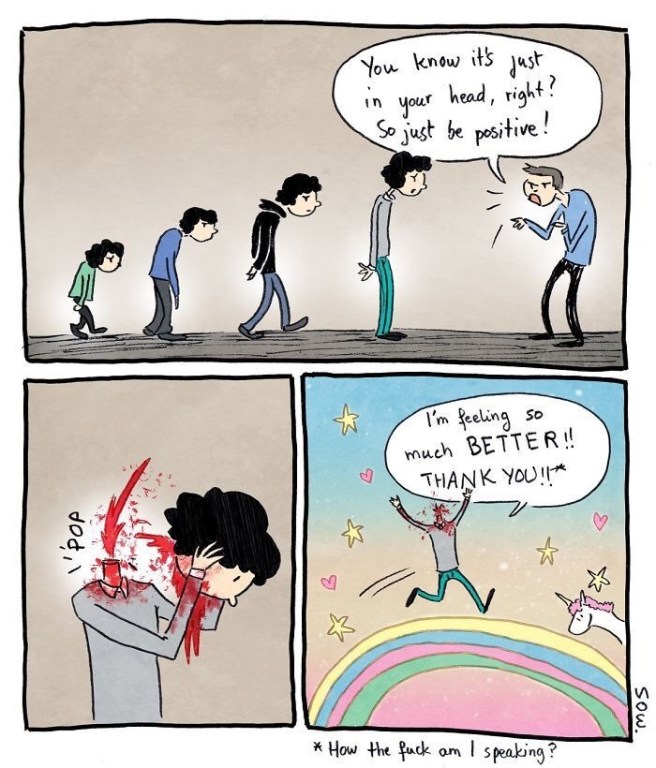
Art by: Sow Ay
“Mental Illness Recovery Series” book contains 100 true life stories of people all around the world battling daily with their mental disorders. It’s an inspirational book 📖, that gives rise to the silenced truth of mental illness and the exhausting, but noble journey of recovery.
🌏📚 Where to buy it 🙂 = http://awakesociety.com/mental-illness-recovery-book/ 🌏📚
_____________________________
🗣Tell me why you love the book via email mlgaston1@gmail.com with the subject: BOOK
REVIEW..Thank you ☺️
STOP THE STIGMA 🤗
 Holding the Bowl