THANK YOU

Devotional blog dedicated to the Goddess Sigyn offering support to those who are "holding the bowl" within difficult relationships.
if there’s anything i’ve learned about dealing with mental illness, especially depression, it’s never about having one big breakthrough and then living happily ever after. i think i expected that from myself which only caused me to hate myself more when relapses happened.
but what it is -actually- about is saving yourself over and over, picking yourself back up after each fall and not letting it keep you beat. and that’s not a hopeless thought. it’s freeing to know that recurring depression is perfectly normal, and i am not a failure when it kicks me in the teeth. so long as im surviving and seeking help, i am still winning. you HAVE to redefine what success in mental illness means in order to stop beating yourself up.
Hey so like has anyone ever had basically an anxiety attack without the anxiety part?
Like I have all the physical stuff – heart beating too hard, chest feels tight, shaking slightly, etc. – but I’m not like…upset about anything? At all? And nothing has happened that would provoke this?
Of course the weirdness of it is now *adding* an emotional anxiety component to things, joy of joys. But that definitely came second.
Yes, husband has this happen. Sometimes it’s a building thing… little anxieties, things he’s not actively worried about, but that have him on higher alert. They pile up and he starts having a panic attack over literally nothing, except it’s not really nothing, it’s just that it’s not any one thing in particular. Sometimes it’s a response to stimuli he doesn’t consciously recognize – for instance, if the door is open, it aggravates his agoraphobia. But he may not realize it is… he just passes the open door and his body starts responding to it even though he’s not actually thinking about the thing.
Okay, so I’ve seen waaaaaaay too many posts lumping autistics in with mental illness groups and it’s not cool because they are completely different.
Mental illness is the equivalent of a PC with a virus. It is a working computer with its own personality that the virus has attacked and affected in its own unique way. My depression and anxiety are not a part of me and I do not like them and they change the way I think/feel/act from my ‘normal’.
Autism is the equivalent of a Mac or Linux in a world of PCs. PCs think you’re defective because you appear to be a PC with a virus but in reality you’re a WHOLE OTHER OPERATING SYSTEM with all the strengths and weaknesses of any other, that just happens to be different from the majority of computers. But being a Mac is not a problem in the same way that being a PC with a virus can be a problem.
Macs can get viruses–autistics can have mental illnesses, and people with mental illnesses can be autistic. But the two are not synonymous. We do not have the same terminology or community or anything. This doesn’t mean that it’s not okay to learn how to cope with mental illness or even be proud of it.
Some people are treated for or recover from mental illness. You cannot change being autistic. You cannot treat being autistic. You cannot recover from autism.
You cannot spend a lifetime trying to turn a Mac into a PC. You should learn how to protect and love both Macs and PCs.
a good thing to do for your friends with anxiety disorders: if you have a question you need to ask them or something you need to tell them, explain the subject of the question/the statement in the same message as your opening one!
so basically: instead of saying “can i ask you a question?” and sending just that (which, as a person with an anxiety disorder, makes my anxiety go into hyperdrive) go “can i ask you a question about ___?”
it’s a little thing but honestly few things make me anxious like “i have a question for you” or “there’s something i need to tell you” without immediate explanation. thanks!
If you know someone who’s depressed, please resolve to never ask them why. Depression isn’t a straightforward response to a bad situation; depression just is, like the weather. Try to understand the blackness, lethargy, hopelessness, and loneliness they’re going through. Be there for them when they come through the other side.
It’s hard to be a friend to someone who’s depressed, but it’s one of the kindest, noblest, and best things you’ll ever do.
Disabilities and chronic conditions often require difficult and time-consuming self care.
For instance:
- People who are paralyzed have to pay very close attention to their skin to avoid dangerous pressure sores
- People with CF have to do a lot of breathing treatments
- A lot of people have to keep track of a very complicated medication schedule
- Or any number of other things
A lot of medical complications are preventable with the right self care. But no one manages perfect self care, because self care is hard, and people are human and nobody is perfect.
Making a mistake that leads to an injury that was theoretically preventable sometimes pisses off doctors. It’s also something that people sometimes feel very ashamed of. This can be a deterrent to getting medical care.
It’s not right that it’s this way. You don’t have to be perfect to deserve medical care. Sometimes you make mistakes and need treatment. That’s part of the human condition, and it doesn’t mean you’re somehow less deserving.
Nondisabled people injure themselves doing careless things all the time. People who fall off bikes in a moment of carelessness and break bones get to have medical treatment without facing that kind of hate. So do people who burn themselves cooking. Doctors are capable of understanding that people make mistakes and get hurt — and people with disabilities deserve this understanding just as much as anyone else.
Everyone who needs medical care deserves it. Including people who make mistakes. Including people with disabilities who make mistakes. You don’t have to be perfect at self care to deserve treatment.
Rigorous attention to self care is important. So is medical support for needs that arise, including as the result of mistakes.
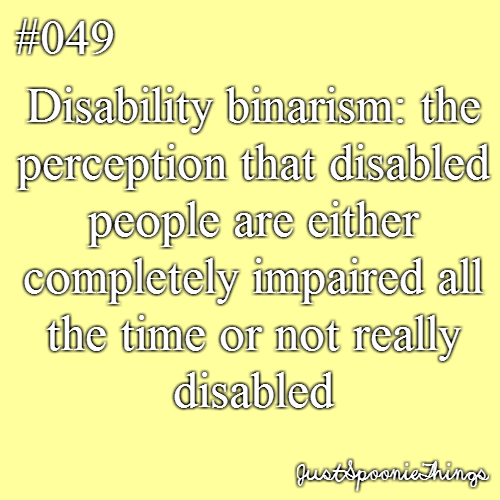
#049 – Disability binarism: The perception that disabled people are either completely impaired all the time or not really disabled (submitted by anonymous)
1. Find someone whom you trust that you can share your feelings with – and be real about the pain and different battles that you face. It’s crucial that you don’t just keep your feelings to yourself as you’ll find that they resurface – and they won’t just go away.
2. Share with others who have also walked the road of grief and loss. Although each person’s journey is different and unique, it often helps to listen to others who’ve faced loss. You’ll learn from their experience and what they did to cope.
3. Take time away from sadness – and try to focus on some happy, funny memories of good times you once shared. Be thankful for these memories – but also take the time to consider and be grateful for what you have today. (Note: Distraction is important as you can’t just live with pain.)
4. Allow yourself to cry and to express the way you feel. It’s normal and it’s healthy when dealing with a loss. It usually brings relief and it can help us process pain … and releasing strong emotions can help us to move on.
(Note: If you find it hard to cry, express yourself in other ways – through painting, music or, perhaps, through journaling.)5. Try and do what you can to establish new routines. When a loved one dies, life can never be the same. But changing old routines can help us start over again – and build a different future, without that person there.
6. Build time for self-care into your daily routine. Set aside 20 minutes to relax and unwind … You could listen to some music, or take a bubble bath. It’s important that you nurture and take care of yourself, and you do what is needed to reduce excessive stress.
7. Recognise that there are likely to be other losses, too. You need to mourn for them as well – as they contribute to your pain.
8. Be patient, understanding and gentle with yourself. The road you walk through grief is unpredictable and hard. You’re on a roller coaster that’s always changing course. But things will change in time – and you will learn to smile again.
While this is written primarily for those who have experienced the death of someone who was close to them, I think that a lot of the tips it would also serve for any type of loss (such as a difficult breakup, losing a job, some other major setback in life) as well.

 Holding the Bowl