Here’s a thought I had about how therapy & treatment works (vs how many people imagine it works). This is based on my experience with depression and chronic illness, but I hope it applies more broadly as well.
Imagine you have to take a road trip on a deserted road alone. Halfway through the trip your engine starts to splutter and the car breaks down. What do you do?
A lot of people imagine that therapy and treatment is like calling a mechanic to come and fix your car for you. You make the call, and then you just have to wait around until the mechanic has fixed the problem, and your car is good as new! Unfortunately, it doesn’t work like that. There is no on-call mechanic. No-one is able to fix this car except for you.
Instead, it’s like you pull a toolbox out of the trunk, pop open the hood, and dial up the mechanic on the phone. You have to try and describe the problems as clearly as possible, and follow the advice they give you as well as you can.
Sometimes you won’t understand the advice, and you’ll need them to explain it again or suggest something else. Sometimes you’ll do what they say and the car still won’t run, and they won’t be able to explain why, only give you something new to try. Sometimes you’ll think you fixed the problem and start driving, and the car will break again two minutes down the road. No matter what happens, it’s going to be hard and messy and frustrating work.
But at the end of it, not only will your car be running again, but you’ll know how to fix it now. Which isn’t to say that you’ll never need another mechanic again, but next time you get stuck, it’ll be that little bit easier to handle.
So keep at it everyone, and good luck on your journeys!
Friendly reminder that Vincent van Gogh willingly checked himself into an asylum so that he could get better, resulting in him creating some of the most iconic paintings of his entire career, done in the asylum, when he was being treated 24/7, because he finally didn’t have to struggle with his demons and could instead focus on his muse, WHICH WERE TWO DIFFERENT THINGS!
Remember this little insignificant painting?
How about this one?
Check this one out:
All of these and more were painted in the asylum when he was receiving treatment for his mental illnesses and I know I just said that but I said it again and I’m saying it a third time until you dramatic abled assholes understand!
VINCENT VAN GOGH
– KNEW THAT HE WAS MENTALLY ILL
– WANTED TO CHANGE THAT
– WENT TO AN ASYLUM
– GOT THE HELP HE NEEDED
– PAINTED SOME ICONIC MASTERPIECES AS A RESULT!
SO DON’T YOU DARE COME OUT HERE WITH THIS, “I WISH I WAS DEPRESSED SO I COULD BE AS CREATIVE AS VAN GOGH” BULLSHIT BECAUSE EVEN HE KNEW THAT HIS DEMONS WERE HARMING HIS WORK, AND MORE IMPORTANTLY, HIS HEALTH, AND HE DID EVERYTHING WITHIN HIS POWER TO FIGHT THEM EVERY SINGLE DAY OF HIS LIFE, UNTIL THEY ENDED UP WINNING!
This is also incredibly important for any creative persons dealing with mental illness, and their parents.
Receiving mental help improves your craft, not hurt it. Before getting put on medication for the first time to treat my mental illnesses, my mom expressed to me how she’s worried about my getting treatment because of my art. Regardless, your mental health should be more important anyway, but, honestly, it’s a lot harder to produce good art when you struggle getting out of bed, let alone creating masterpieces. When you’re in more health, improving your craft comes much easier!
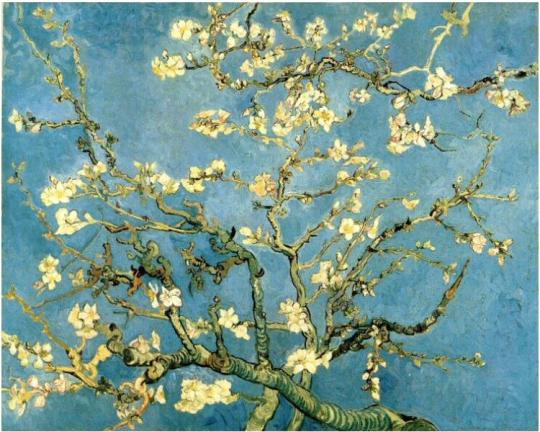
Personally I think the most beautifull painting of him was this one:
He made it when he heard about the birth of his nephew who was named after him. Still in the asylum but really happy for his brother!
“How glad I was when the news came… I should have greatly preferred
him to call the boy after Father, of whom I have been thinking so much
these days, instead of after me; but seeing it has now been done, I
started right away to make a picture for him, to hang in their bedroom,
big branches of white almond blossom against a blue sky.”
Oh I have sucb rants about how “good” art comes while suffering.
No.
look at me.
The idea of the “suffering artist” comes from bunch of alcholic, drug abusing, womanizers trying to justify their bad life choices as some sort of artistic angst.
IT IS 100% BULLSHIT
Take your meds, get your therapy, be happy, and live life
The art will be there.
it’s true that i wrote a higher volume of words when i was untreated. that’s because i was using writing to avoid my life. i spend more time these days on self-care. but the words i do write are of much higher quality, and my craft in plotting and organizing, collaboration and research, has gone through the roof.
i used to just put my head down for 16 hours and pound out ten thousand words from a pit of misery, and shove them in a file named with a keymash to collect dust. now i spend 4 hours on research and planning, an hour talking to my collab partner, and an hour writing a thousand words that are structural and focused and advance the project, then go have a nice bath and text my friends pictures of my cat. my work day’s less than half as long and infinitely more productive.
(and in case you’re imagining those 10k misery files were some kind of De Profundis, no, they were mostly porn.)
i am a MUCH better writer now that i’m on meds that work and have had some years of good counselling.
you won’t lose your creativity if you get help, darlings. that’s YOU. it’s not the disease. it’s yours. you’re the artist. what makes you better isn’t suffering, it’s practice, and you’ll practice more and easier when you’re happier.
This whole idea that suffering is what makes the art is baffling to me. I do MUCH LESS work, let alone quality work, when I’m hitting a low point. It’s like creating anything is a struggle. When I’m doing well is when I can freely write and paint and craft, and the quality of work is present.
What helps your medical condition might not help other people
What you are comfortable doing to help heal yourself might not be in other people’s comfort zones
The choices you make medically may not be the same choices other chronically ill/disabled/nuerodivergent people make
Respect each other’s medical choices and don’t press them to try something just because it helped you; they might not be comfortable with it and it may not even benefit them.
We have enough adversity from the able-bodied community assuming we all need yoga and vegan diets, please try not to add to that when speaking to your fellow disabled friends.
I used to really worry that medications would harm my creativity and it’s part of why I resisted taking them. It hasn’t. If anything it’s allowed me to be more focused and able to complete things. My imagination hasn’t changed just because I’m on anti-depressants.
a lot of my family didnt want me to start medications because they thought it would impact my ability to create, and I believed them.
Now im getting better and better with my art because i dont have to fight through the brainfog or the constant panic attacks and can dedicate my energy to my work.
Antidepressents didnt take my emotions away, they made them easier to handle.
also Van Gogh was literally in an asylum receiving mental health treatment when he painted ‘Starry Night’. It was one of the most stable & productive periods of his life, despite the fact that wasn’t hugely effective treatment, because they didn’t really have modern understandings of what things work on mental illness. Like, you know. Medication.
This is why we don’t romanticize mental illness or chronic disease.
ALSO because I am reading a book of his letters right now, Van Gogh himself addressed the idea that the best art came from pain and said that his art tended to suffer when his depression was hitting pretty hard. So don’t even pull that shit where you give his untreated depression credit for his art. Van Gogh would have hated that, and if antidepressants/better treatment of mental illness HAD existed then we might have even more of his work now.
We might have more of his work now because if he access to anti depressants he might not have killed himself.
no offense but this is literally the most neurotypical thing i have ever seen
Uhhhh… no.
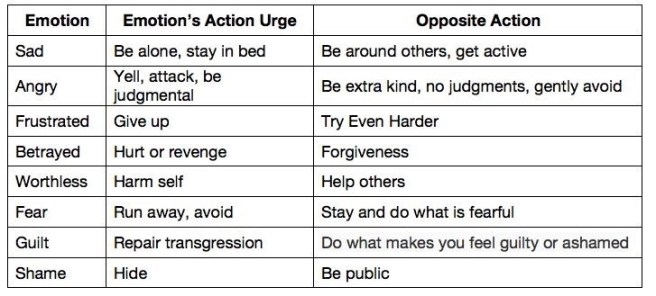
This is what they teach you in therapy to deal with BPD and general depression.
When I got out of the hospital after hurting myself a second time, I got put into intensive outpatient program for people being released from mental hospitals as a way to monitor and help transition them into getting them efficient long-term care.
This is something they stressed, especially for people with general depression. When you want to stay at home and hide in your bed, forcing yourself to do the opposite is what is helpful. For me, who struggles with self harm- “I want to really slice my arm up. The opposite would be to put lotion on my skin (or whatever would be better, like drawing on my skin) the opposite is the better decision.” It doesn’t always work because of course mental health isn’t that easy, but this is part of what’s called mindfulness (they say this all the time in therapy)
Being mindful of these is what puts you on the path to recovery. If you’re mindful, you are able to live in that moment and try your best to remember these better options.
I swear to god, I don’t get why some people on this website straight up reject good recovery help like this because either they a)have never been in therapy so don’t understand in context how to use these coping tactics. Or b)want to insist that all therapists and psych doctors are neurotypical and have zero idea what they are talking about. (Just so ya know, they teach this in DBT, the therapy used to help BPD. The psychologist who came up with DBT actually had BPD, so….a neurotypical women didn’t come up with this.)
I have clinical OCD and for me, exposure therapy–a version of “do the opposite”–has been fundamental. I’ve had huge improvement in the last year, but I’m 100% clear that if I hadn’t done my best to follow this protocol I’d be fucked. I have a lot of empathy for that moment when you’re just too tired to fight and you check the stove or you wash your hands or go back to the office at midnight to make sure the door is locked. But the kind of therapeutic approach outlined above has been crucial for me.
It’s hard to do. I’ve weathered panic attacks trying to follow this protocol. But I’ve gotten remarkable results. I was afraid to touch the surfaces in my house, okay? I was afraid to touch my own feet, afraid to touch my parrot–deliberately exposing myself to “contamination” has helped me heal. I can’t speak for people with other issues, but this has helped my anxiety and OCD.
I feel that tumblr, in an effort to be accepting of mental illness, has become anti-recovery. Having a mental illness does not make you a bad person. There is nothing morally wrong with having a mental illness anymore than more than there’s something morally wrong with having the flu. However, if you’re “ill” physically or mentally, something is wrong in the sense that you are unwell and to alleviate that you should try to get better. While there is not “cure” for mental illness, there are ways to get better.
There was a post on tumblr where someone with ADHD posted about how much you can get done when you focus and was attacked for posting about being “nuerotypical” – when she was posting about the relief she got from being on an medication to treat her illness.
I saw another post going around tumblr that said something along the line of “you control your thoughts, why not choose to have happy thoughts” which again was shot down as “nuerotypical” but while you don’t have control over what thoughts come into your mind, you absolutely can and should choose to have happy thoughts. In DBT we call this “positive self talk”.
I’m in DBT to help treat PTSD stemming from child abuse. The abuse and abandonment I experienced destroyed my self esteem and created a lot of anxiety over upsetting other people. DBT has taught me to recognize when my thoughts are distorting realty ‘no one likes you’ and answer back ‘plenty of people like you, you don’t need everyone to like you, especially if the relationship doesn’t make you happy’, to respond to the thought ‘I’m so worthless’ with ‘you’re really great and have accomplished something’
And it’s not easy to challenge your thoughts, it’s a skill that’s learned and it’s hard to force yourself to think something that doesn’t seem authentic or even seems wrong to think – it’s hard to be encouraging towards yourself when you hate yourself – but you force yourself to be aware of your thoughts and push back when you fall into unhealthy patterns
That isn’t “so neurotypical” that’s recovery.
Not shaming mental illness doesn’t mean shaming RECOVERY.
Pro-Recovery isn’t anti-disability.
Do not shame healthy behaviors as “neurotypical”.
Learning healthy behaviors and taking steps to treat mental illness and disorders including taking medication if that’s what works for you is important. You shouldn’t be ashamed if you have mental illness, but you shouldn’t say ‘well I’m not neurotypical therefor I can’t do anything to get better’ – while there is no cure for mental illness, there is a lot you can do to get better, to function better, to manage your mental illness and be safer, happier, and healthier for it.
When I contracted PTSD my therapist first confirmed I has been traumatized then asked me to speak about the specific moments that stuck with me the most. I had to directly acknowledge the memories I wanted to avoid in order to make my brain realize it wasn’t happening anymore.
—
When my depression was so bad I couldn’t bare any positive comments about myself or compliments, my therapist made a point to end each session with a compliment that I had to accept and thank her for. At the time I hated myself so much it could physically HURT, but she worked to ease me into it.
—
When we discovered I live almost constantly dissociated, my therapist worked with me to move back into my body fir a five-minute period. This is commonly a coping mechanism for Autistic people and others with sensory issues, and I had started doing it at a young age to handle stimulation on a day-to-day basis. The reason why I had to learn to stop it is because when my head and body didn’t feel connected, I couldn’t stop the physical affects of anxiety; I couldn’t calm my body down, and the anxiety would escalate to panic. The sensation was AWFUL when I returned into my body – it was like grabbing a live wire and I hated every second, but I’m better for it. I learned to ground myself.
—
Unfortunately, the recovery process can mean directly challenging bad thoughts and feelings which SUCKS but in the long run, it may actually help you. You might not be in a place to do it right now, and it sounds scary and awful, but there are ways to do it safely and beneficially!
Disabilities and chronic conditions often require difficult and time-consuming self care.
For instance:
People who are paralyzed have to pay very close attention to their skin to avoid dangerous pressure sores
People with CF have to do a lot of breathing treatments
A lot of people have to keep track of a very complicated medication schedule
Or any number of other things
A lot of medical complications are preventable with the right self care. But no one manages perfect self care, because self care is hard, and people are human and nobody is perfect.
Making a mistake that leads to an injury that was theoretically preventable sometimes pisses off doctors. It’s also something that people sometimes feel very ashamed of. This can be a deterrent to getting medical care.
It’s not right that it’s this way. You don’t have to be perfect to deserve medical care. Sometimes you make mistakes and need treatment. That’s part of the human condition, and it doesn’t mean you’re somehow less deserving.
Nondisabled people injure themselves doing careless things all the time. People who fall off bikes in a moment of carelessness and break bones get to have medical treatment without facing that kind of hate. So do people who burn themselves cooking. Doctors are capable of understanding that people make mistakes and get hurt — and people with disabilities deserve this understanding just as much as anyone else.
Everyone who needs medical care deserves it. Including people who make mistakes. Including people with disabilities who make mistakes. You don’t have to be perfect at self care to deserve treatment.
Rigorous attention to self care is important. So is medical support for needs that arise, including as the result of mistakes.
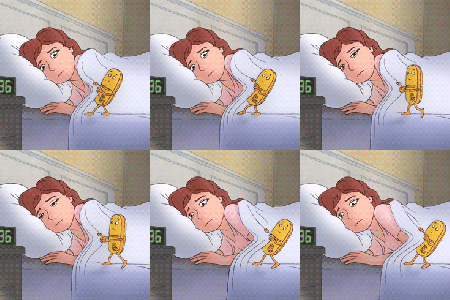
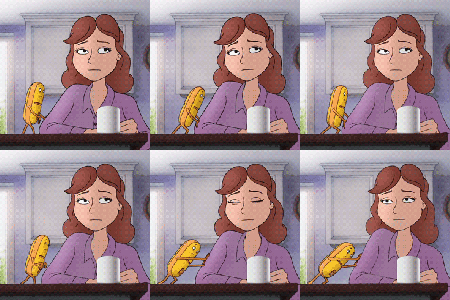
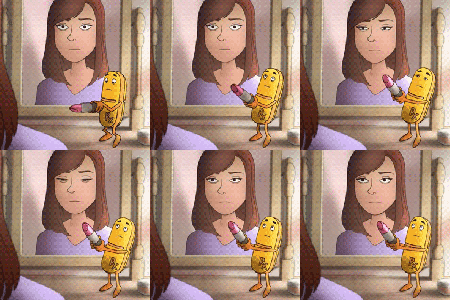
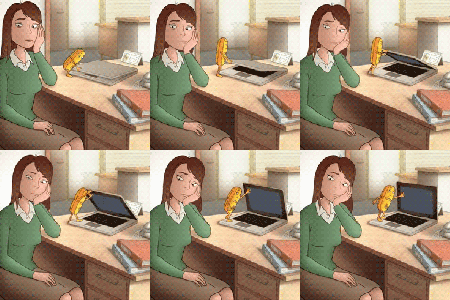
help I’m having emotions about a cartoon antidepressant trying to be useful
DID YOU GUYS SERIOUSLY GIF AN ABILIFY COMMERCIAL
yes but look at it, it cares about her and just wants to help her be able to function. It’s like “I know you’re sad. here, I’ll help you.”
LIKE OKAY THOUGH can I explain why this is exceedingly brilliant?? Because when anti-depressants work right, that’s what they DO. They don’t make you happy or emotionless or unhealthy in any way, they make you FUNCTIONAL. They make it so that a depressed person who can barely get out of bed can start to support themselves again and more importantly, start to THINK for themselves again without the permeating presence of depression.
Depression is a cyclical disease, that tells you to think a certain way, and, because you’re depressed, you generally believe it, and then things get worse and worse. The ONLY thing anti-depressants do is to STOP that cycle in its tracks!!Which is something to be ecstatic about and celebrated, even if you don’t realize it at the time, because when you’re depressed, getting out of bed is climbing Mount Everest. Antidepressants help stop that cycle so that one day soon, getting out of bed can JUST be getting out of bed. They don’t even expedite the recovery process in most cases, they just make recovery POSSIBLE IN THE FIRST PLACE. So this little guy is portrayed with a fuckton more accuracy than I ever expected from a commercial.







 Holding the Bowl