
You don’t have to be grateful that it isn’t worse.
read that.
read it again, and again, and again.
somebody, somewhere, always has it worse than you. there is one person on this planet that has it the worst of all, and that person is NOT the only person allowed to be unhappy with their lot.
if things are bad for you, they are bad for you. period.
This goes for trauma as well. A lot of times survivors get trapped in a cycle of minimizing/diminishing their trauma because “other people have it worse” – but there is no hierarchy of trauma. There is no ranking system for which traumas are “better” or “worse.” Your trauma is valid. Period.
IMPORTANT TRUTHS.
As a therapist, lemme just say: almost every trauma survivor I’ve ever had has at some point said “But I didn’t have it as bad as some people” and then talked about how other types of trauma are worse. Even my most-traumatized, most-abused, most psychologically-injured clients say this.
The ones who were cheated on, abandoned, and neglected say this. The ones who were in dangerous accidents/disasters say this. The ones who were horrifyingly sexually abused say this. The ones who were brutally beaten say this. The ones who were psychologically tortured for decades say this. What does that tell you? That one of the typical side-effects of trauma is to make you believe that you are unworthy of care.
Don’t buy into it, because it’s nonsense. It doesn’t matter if someone else had it “worse.” Every person who experiences a trauma deserves to get the attention and care they need to heal from it.
I hear this from clients and other therapists. Trauma is trauma because it’s traumatic *to you*. You deserve care and connection.
Tag: trauma
Are You Dissociating?
Dissociating is one of the most common responses to abuse and trauma. It involves feeling numb, detached or unreal and (while it happens to everyone once in a while) is experienced more frequently and severely in survivors. Dissociating people vary widely in symptoms and may experience any or all of the things from the following list.
You may be dissociating if you:
- find yourself staring at one spot, not thinking anything
- feel completely numb
- feel like you’re not really in your body, like you’re watching yourself in a movie.
- feel suddenly lightheaded or dizzy
- lose the plot of the show or conversation you were focused on
- feel as if you’re not quite real, like you’re in a dream
- feel like you’re floating
- suddenly feel like you’re not a part of the world around you
- feel detached and far away from other people, who may seem mechanical or unreal to you
- are very startled when someone/something gets your attention
- completely forget what you were thinking just a moment ago
- suddenly cover your face or react as if you’re about to be hurt for no reason
- can’t remember important information about yourself, like your age or where you live
- find yourself rocking back and forth
- become very focused on a small or trivial object or event
- find that voices, sounds or writing seem far away and you sometimes have trouble understanding them.
- feel as if you’ve just experienced a flashback (perhaps rapidly) but you can’t remember anything about it.
- perceive your body as foreign or not belonging to you
(likes and reblogs always taken as support)
To my anon asking about dissociation. I hope you see this.
I thought dissociation was only when I have straight up out of body experiences turns out I’m dissociated like 99% of the time lmso
As it turns out, I dissociate rather a lot. Mostly when I’m stressed, but also because of exhaustion or pain. Too bad the latter two are pretty much standard operating procedure for me.
jfc I must dissociate like 90% of the time
Actually the other day I had an interesting period of derealisation, I still can’t work out what made me have that “is this a dream, I can’t tell” thing going on, whether it was a smell or the way the light was falling or what. I felt completely disconnected temporally. As if I could be walking my dog for a hundred years.
Of course maybe I’d accidentally stepped into Alfheimr for a moment, and time really WAS meaningless.
1. Trauma permanently changes us.
This is the big, scary truth about trauma: there is no such thing as “getting over it.” The five stages of grief model marks universal stages in learning to accept loss, but the reality is in fact much bigger: a major life disruption leaves a new normal in its wake. There is no “back to the old me.” You are different now, full stop.
This is not a wholly negative thing. Healing from trauma can also mean finding new strength and joy. The goal of healing is not a papering-over of changes in an effort to preserve or present things as normal. It is to acknowledge and wear your new life — warts, wisdom, and all — with courage.
2. Presence is always better than distance.
There is a curious illusion that in times of crisis people “need space.” I don’t know where this assumption originated, but in my experience it is almost always false. Trauma is a disfiguring, lonely time even when surrounded in love; to suffer through trauma alone is unbearable. Do not assume others are reaching out, showing up, or covering all the bases.
It is a much lighter burden to say, “Thanks for your love, but please go away,” than to say, “I was hurting and no one cared for me.” If someone says they need space, respect that. Otherwise, err on the side of presence.
3. Healing is seasonal, not linear.
It is true that healing happens with time. But in the recovery wilderness, emotional healing looks less like a line and more like a wobbly figure-8. It’s perfectly common to get stuck in one stage for months, only to jump to another end entirely … only to find yourself back in the same old mud again next year.
Recovery lasts a long, long time. Expect seasons.
4. Surviving trauma takes “firefighters” and “builders.” Very few people are both.
This is a tough one. In times of crisis, we want our family, partner, or dearest friends to be everything for us. But surviving trauma requires at least two types of people: the crisis team — those friends who can drop everything and jump into the fray by your side, and the reconstruction crew — those whose calm, steady care will help nudge you out the door into regaining your footing in the world. In my experience, it is extremely rare for any individual to be both a firefighter and a builder. This is one reason why trauma is a lonely experience. Even if you share suffering with others, no one else will be able to fully walk the road with you the whole way.
A hard lesson of trauma is learning to forgive and love your partner, best friend, or family even when they fail at one of these roles. Conversely, one of the deepest joys is finding both kinds of companions beside you on the journey.
5. Grieving is social, and so is healing.
For as private a pain as trauma is, for all the healing that time and self-work will bring, we are wired for contact. Just as relationships can hurt us most deeply, it is only through relationship that we can be most fully healed.
It’s not easy to know what this looks like — can I trust casual acquaintances with my hurt? If my family is the source of trauma, can they also be the source of healing? How long until this friend walks away? Does communal prayer help or trivialize?
Seeking out shelter in one another requires tremendous courage, but it is a matter of life or paralysis. One way to start is to practice giving shelter to others.
6. Do not offer platitudes or comparisons. Do not, do not, do not.
“I’m so sorry you lost your son, we lost our dog last year … ” “At least it’s not as bad as … ” “You’ll be stronger when this is over.” “God works in all things for good!”
When a loved one is suffering, we want to comfort them. We offer assurances like the ones above when we don’t know what else to say. But from the inside, these often sting as clueless, careless, or just plain false.
Trauma is terrible. What we need in the aftermath is a friend who can swallow her own discomfort and fear, sit beside us, and just let it be terrible for a while.
7. Allow those suffering to tell their own stories.
Of course, someone who has suffered trauma may say, “This made me stronger,” or “I’m lucky it’s only (x) and not (z).” That is their prerogative. There is an enormous gulf between having someone else thrust his unsolicited or misapplied silver linings onto you, and discovering hope for one’s self. The story may ultimately sound very much like “God works in all things for good,” but there will be a galaxy of disfigurement and longing and disorientation in that confession. Give the person struggling through trauma the dignity of discovering and owning for himself where, and if, hope endures.
8. Love shows up in unexpected ways.
This is a mystifying pattern after trauma, particularly for those in broad community: some near-strangers reach out, some close friends fumble to express care. It’s natural for us to weight expressions of love differently: a Hallmark card, while unsatisfying if received from a dear friend, can be deeply touching coming from an old acquaintance.
Ultimately every gesture of love, regardless of the sender, becomes a step along the way to healing. If there are beatitudes for trauma, I’d say the first is, “Blessed are those who give love to anyone in times of hurt, regardless of how recently they’ve talked or awkwardly reconnected or visited cross-country or ignored each other on the metro.” It may not look like what you’d request or expect, but there will be days when surprise love will be the sweetest.
9. Whatever doesn’t kill you …
In 2011, after a publically humiliating year, comedian Conan O’Brien gave students at Dartmouth College the following warning:
“Nietzsche famously said, ‘Whatever doesn’t kill you makes you stronger.’ … What he failed to stress is that it almost kills you.”
Odd things show up after a serious loss and creep into every corner of life: insatiable anxiety in places that used to bring you joy, detachment or frustration towards your closest companions, a deep distrust of love or presence or vulnerability.There will be days when you feel like a quivering, cowardly shell of yourself, when despair yawns as a terrible chasm, when fear paralyzes any chance for pleasure. This is just a fight that has to be won, over and over and over again.
10. … Doesn’t kill you.
Living through trauma may teach you resilience. It may help sustain you and others in times of crisis down the road. It may prompt humility. It may make for deeper seasons of joy. It may even make you stronger.
It also may not.
In the end, the hope of life after trauma is simply that you have life after trauma. The days, in their weird and varied richness, go on. So will you.
1. Trauma permanently changes us.
This is the big, scary truth about trauma: there is no such thing as “getting over it.” The five stages of grief model marks universal stages in learning to accept loss, but the reality is in fact much bigger: a major life disruption leaves a new normal in its wake. There is no “back to the old me.” You are different now, full stop.
This is not a wholly negative thing. Healing from trauma can also mean finding new strength and joy. The goal of healing is not a papering-over of changes in an effort to preserve or present things as normal. It is to acknowledge and wear your new life — warts, wisdom, and all — with courage.
2. Presence is always better than distance.
There is a curious illusion that in times of crisis people “need space.” I don’t know where this assumption originated, but in my experience it is almost always false. Trauma is a disfiguring, lonely time even when surrounded in love; to suffer through trauma alone is unbearable. Do not assume others are reaching out, showing up, or covering all the bases.
It is a much lighter burden to say, “Thanks for your love, but please go away,” than to say, “I was hurting and no one cared for me.” If someone says they need space, respect that. Otherwise, err on the side of presence.
3. Healing is seasonal, not linear.
It is true that healing happens with time. But in the recovery wilderness, emotional healing looks less like a line and more like a wobbly figure-8. It’s perfectly common to get stuck in one stage for months, only to jump to another end entirely … only to find yourself back in the same old mud again next year.
Recovery lasts a long, long time. Expect seasons.
4. Surviving trauma takes “firefighters” and “builders.” Very few people are both.
This is a tough one. In times of crisis, we want our family, partner, or dearest friends to be everything for us. But surviving trauma requires at least two types of people: the crisis team — those friends who can drop everything and jump into the fray by your side, and the reconstruction crew — those whose calm, steady care will help nudge you out the door into regaining your footing in the world. In my experience, it is extremely rare for any individual to be both a firefighter and a builder. This is one reason why trauma is a lonely experience. Even if you share suffering with others, no one else will be able to fully walk the road with you the whole way.
A hard lesson of trauma is learning to forgive and love your partner, best friend, or family even when they fail at one of these roles. Conversely, one of the deepest joys is finding both kinds of companions beside you on the journey.
5. Grieving is social, and so is healing.
For as private a pain as trauma is, for all the healing that time and self-work will bring, we are wired for contact. Just as relationships can hurt us most deeply, it is only through relationship that we can be most fully healed.
It’s not easy to know what this looks like — can I trust casual acquaintances with my hurt? If my family is the source of trauma, can they also be the source of healing? How long until this friend walks away? Does communal prayer help or trivialize?
Seeking out shelter in one another requires tremendous courage, but it is a matter of life or paralysis. One way to start is to practice giving shelter to others.
6. Do not offer platitudes or comparisons. Do not, do not, do not.
“I’m so sorry you lost your son, we lost our dog last year … ” “At least it’s not as bad as … ” “You’ll be stronger when this is over.” “God works in all things for good!”
When a loved one is suffering, we want to comfort them. We offer assurances like the ones above when we don’t know what else to say. But from the inside, these often sting as clueless, careless, or just plain false.
Trauma is terrible. What we need in the aftermath is a friend who can swallow her own discomfort and fear, sit beside us, and just let it be terrible for a while.
7. Allow those suffering to tell their own stories.
Of course, someone who has suffered trauma may say, “This made me stronger,” or “I’m lucky it’s only (x) and not (z).” That is their prerogative. There is an enormous gulf between having someone else thrust his unsolicited or misapplied silver linings onto you, and discovering hope for one’s self. The story may ultimately sound very much like “God works in all things for good,” but there will be a galaxy of disfigurement and longing and disorientation in that confession. Give the person struggling through trauma the dignity of discovering and owning for himself where, and if, hope endures.
8. Love shows up in unexpected ways.
This is a mystifying pattern after trauma, particularly for those in broad community: some near-strangers reach out, some close friends fumble to express care. It’s natural for us to weight expressions of love differently: a Hallmark card, while unsatisfying if received from a dear friend, can be deeply touching coming from an old acquaintance.
Ultimately every gesture of love, regardless of the sender, becomes a step along the way to healing. If there are beatitudes for trauma, I’d say the first is, “Blessed are those who give love to anyone in times of hurt, regardless of how recently they’ve talked or awkwardly reconnected or visited cross-country or ignored each other on the metro.” It may not look like what you’d request or expect, but there will be days when surprise love will be the sweetest.
9. Whatever doesn’t kill you …
In 2011, after a publically humiliating year, comedian Conan O’Brien gave students at Dartmouth College the following warning:
“Nietzsche famously said, ‘Whatever doesn’t kill you makes you stronger.’ … What he failed to stress is that it almost kills you.”
Odd things show up after a serious loss and creep into every corner of life: insatiable anxiety in places that used to bring you joy, detachment or frustration towards your closest companions, a deep distrust of love or presence or vulnerability.There will be days when you feel like a quivering, cowardly shell of yourself, when despair yawns as a terrible chasm, when fear paralyzes any chance for pleasure. This is just a fight that has to be won, over and over and over again.
10. … Doesn’t kill you.
Living through trauma may teach you resilience. It may help sustain you and others in times of crisis down the road. It may prompt humility. It may make for deeper seasons of joy. It may even make you stronger.
It also may not.
In the end, the hope of life after trauma is simply that you have life after trauma. The days, in their weird and varied richness, go on. So will you.
Catherine Woodiwiss, “A New Normal: Ten Things I’ve Learned About Trauma” (via thepeacefulterrorist)

Not every survivor remembers the date it happened. However, for the ones that do, these dates can be terrifying reminders of the past.
Personally, my traumaversary is Oct 29th. I started making plans for how to handle it 3 months in advance. Planning ahead, as far as you can, is probably a good thing to do.
Before Hand:
If you’re in college, talk to your professors. See if you can be excused from class that day, complete work due that day ahead of time, stuff like that.
If you’re able to, see if you can take off work that day, or if nothing else, just give a heads up to your boss that you may not be at your best.
Remove temptation. If you’re worried you may hurt yourself that day, go ahead and get rid of the things you could do so with. Even if it is only asking a friend to hold on to them until you’re feeling better. This is not a sign of weakness, it is not you being a burden. It is you realizing that it probably isn’t going to be a good day and you don’t want to relapse if you can help it. It is a big step, and I am super proud of you.
See if people are willing to check in with you. Whether it be a phone call, a text, a facebook chat, or coming to hang out with you- it is nice to know that people are going to be there for you on that day.
Prepare. Make food before hand or have things that can be mircrowaved, have ‘easy’ clothing sets ready, You may surprise yourself and that day be perfectly okay- but it’s better to have things on hand just in case.
Leave nice notes for yourself. Or have a friend help you. Especially if you think the day is going to be really rough. Having a note on the fridge, the bathroom mirror, the door… Little ‘remember, you can make it through this. I believe in you’ and various things can wonderful.
The Day of:
Be kind to yourself. It isn’t your fault if you’re upset or angry or spend all day crying. It isn’t your fault. There is nothing /wrong/ with you for reacting. You are a human being who has been through terrible trauma and anyone who judges you for how you heal is ignorant and cruel. There is also nothing wrong with you if the day goes perfectly well and you aren’t affected at all. It doesn’t mean that what happened wasn’t terrible. It just means you’re at a different place in your journey.Know that you’re in control. You’re allowed to be alone that day if you want. You’re allowed to surround yourself with friends. You’re allowed to go out in public. You’re allowed to stay at home. Do not feel like you have to do one thing or another. Your main concern on this day should be you. Even if you make plans, you’re allowed to change them. Just because you decide a week in advance that you’re going to do plan A doesn’t mean that you aren’t allowed to throw that to the wind and do something else on that day.
Memorialize it. Now this is a personal choice, not everyone -wants- to make their trauma dates into memorials and that is a-okay. But for a lot of us, it is about taking back that day and turning it into something new. Get a tattoo. Plant a tree. Go sky diving. Go to a theme park and ride roller coasters all day. Anything that you could look back on that date and go ‘I did it.’
Self Care. Take a day for self care. Watch terrible romantic comedies/sci-fi flicks/horror movies all day. Take a bubble bath. Spend time with friends who love you. Drink your favorite tea/coffee. Go to the humane shelter and pet dogs/cats. Whatever it is that you think would make you feel better? Do it.
Make something. Follow your own emotions with it. Paint. Draw. Sculpt. Even if you’ll later destroy it. Even if you finish it- you immediately rip it apart or set it on fire. At least you got it out of your system.
Give back. I know plenty of survivors who choose to spend their anniversaries volunteering in one way or another. Go through your closet and donate old clothes to a shelter that helps survivors. Make a care package with a letter to donate to a women’s shelter- pass on encouragement and advice.
Whatever you choose to do, in whatever combination- be easy on yourself. Take a moment every now and then to check in with yourself, and ask if you’re okay.
No matter what, I want you all to remember that I believe in you. You made it through the trauma, and you can make it through this. And I’m not saying that to silence your pain.
Your pain is valid. Your hurt is valid. You are valid.
Take care of yourself, okay?
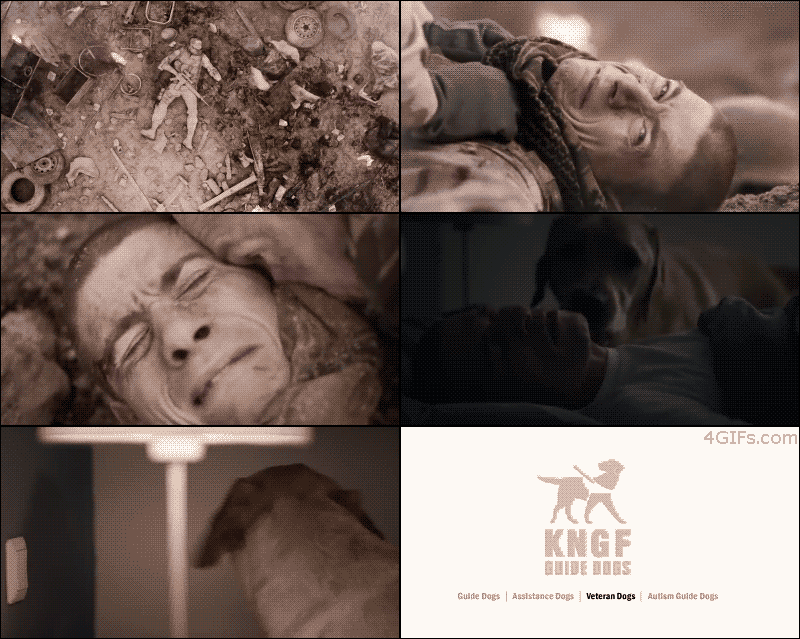
There was a split second there where his like, “wait, what? bro what are you doing?”
On more serious note, PTSD dogs for veterans are so fucking therapeutic. They’re like the one person you can spill your guts to and never worry about ever being judged or have that secret divulged. There are times when I definitely prefer the company of a dog over a human.
Therapy animals save lives.
These dogs are even still so much more amazing. They check rooms before their handler enters, so they can clear it to help the person feel safe. Like in the gif, they are there when panic attacks or nightmares occur, to be something for the person to help ground themselves on, or yes just to turn on the lights. Even more amazing, many people are able to reduce their medication when they have a PTSD service dog there to help them. These dogs are useful for not just veterans, but also victims of abuse, accident trauma, natural disasters, and others. Their training allows them to be useful in situations where medical assistance is needed, as well. Some PTSD dogs are trained to recognize repetitive behaviours in handlers, and signal the handler to break the repetition and stopping the behaviour and possibly injury.
Service dogs in general are just awesome. Remember to respect any that you see out in public. They are not there for you to walk up to and play with, even the puppies!
 Holding the Bowl