“As I’ve become more aware of myself and my standpoint as a disabled person, I’ve become more aware of how many otherwise progressive causes ignore us. For example, in academia, critical theory often leaves out issues of disability from the triad of race, class, and gender, even though disability weaves its way through all of them. I was shocked when I realized that theories built on an awareness of the devaluation and stigmatization of bodily difference often ignore the category into which everyone might someday fit: disability. But perhaps that is exactly why disability is left out. Most people feel such fear and vulnerability about the possibility of becoming disabled that they simply want to push it out of their minds.
In the popular media, so-called “body positivity” campaigns leave out disability to a remarkable extent. The body about which we are supposed to feel positive is nearly always the able body. That body might be fat or thin, white or black, Hispanic or Asian, tall or short, rich or poor, but it is almost always able.”
[Cover Image: Photograph depicts model Jillian Mercado, she is a Latina woman who uses a wheelchair. She is against a brick wall. Her hair is in a blonde updo. She is wearing a black shirt with white letters and a black jacket. She also has on a sheer purple skirt and red flat shoes. Her hands are in her lap.]
“One of the best examples,” Jackson said, “ is that at the end of WWII some librarians decided that they wanted to put books on tape for people who lost their vision. Those were the first audiobooks. And today, there’s Audible.com, there’s Amazon, there are so many uses for audiobooks outside of those who are visually impaired.”
There are dozens more examples. Under Armor recently acquired the patent for a one-handed zipper. NPR added transcripts to their site for the hearing-impaired, and their traffic increased 7%. Inclusivity is a good business move.
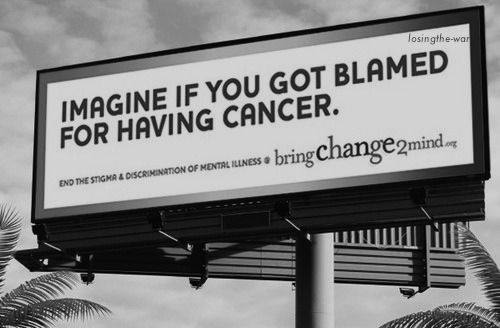
If you don’t have a mental illness – whether it’s depression or alcoholism or an anxiety disorder – you’ve probably never been confronted with these questions: How do you call in sick when your mental illness prevents you from work? What do you say when you go back to work after an extended absence because of your mental illness?
When you have to answer these questions, you realize how much stigma there is about mental illness.
This is the greatest thing I have ever seen. People do not understand that mental illnesses, such as depression, are actual chemical imbalances in your body. They are not brought on by choice. My dad was diagnosed with depression. He was so ashamed of it that he hid it from me and my brothers. A month later, he killed himself. The stigma that comes with mental illness made my Dad embarrassed to talk to his own kids about this problem because he felt like less of a man.
Erase the stigma. The more we talk about mental illness, the less likely it will end in suicide.
Please reblog.
I can’t even express how much i love this, and I wish everyone at my school could see this. because I am so tired of being judged for something i can’t control.


 Holding the Bowl