If you’ve got persistent/chronic illnesses and/or fatigue, you have permission to be tired. You have permission to not get all the things done right now. You have your own time you do things within, and it is perfectly okay to take that time and move at your pace and rest when needed.
Even when things are going well and exciting stuff is happening! Even when you feel that now that things are taking a turn for the better, your energy and spoons should be going up too! You don’t have to recover and be full of energy automatically, you’re not lazy if you have to rest. If your bones and muscles say “nope” then it is okay for you to decide that it’s time to stop, regardless of how nice a day it is, regardless if it seems like the perfect time to do a given chore. Don’t feel obligated to spend your time on work just because you feel like you should be busy.
My husband gave me an idea ages ago, and I wanted to actually put it into motion. So today, I give you the ‘Being Visible’ line of shirts.
The goal of Being Visible is to allow people with mental illness, or other invisible illnesses, to help make people aware of their coping abilities on any given day by using the simple image of a battery at various charging levels:
Low charge – low ability to function ‘normally’ or perform daily tasks. May need assistance or frequent breaks Medium charge – diminished, but capable of performing routine or simple tasks during the day. Some assistance may be needed. Full charge – able to perform daily tasks with little to no assistance or reduction in speed, effort, etc. Little to no assistance needed.
These images will be placed front and centre of various T-shirt/tank top designs, to enable wearers to non-verbally alert people around them of their limitations, if they so choose. Of course, as ability levels change, so too can the shirts. On the back of the shirt is the simple text line ‘Being Visible’ above the rod of Asclepius, the common symbol for medicine.
75% of the proceeds will go to the American Foundation for Suicide Prevention. The remaining 25% will go towards my ability to purchase several units of each shirt for my own use.
You can find the shirts at the links listed below. The target goal is 75 units each.
One of the most important things I’ve learned as a Real Adult™ is the importance of a job half done.
Today I did a load of dishes, wiped off my stove, and swept the kitchen floor. Did I do the best job, or finish every dish? No! My stove still has that caked on caramel that I need to bust out an SOS pad to take care of, one of our big pots is still sitting in the sink, and somehow a kitty kibble unearthed itself while I was wiping down the stove (?? how??).. but the kitchen looks a LOT better. It’s once again an inhabitable, usable space.
Parents, bosses, teachers, even my own self, harp upon absolute perfect completion of a task as the be all and end all of a job well done, but god damn, my kitchen isn’t terrible because I took the time to improve it. Little steps, especially when you’re struggling, are important. They mean a LOT. They are a sign that you won, if only in that brief moment, and they make getting all the other stuff done so much easier later on down the road.
This is literally the only way that chronically-depressed me can accomplish anything.
if you can only muster enough energy to half-ass something, remember, half an ass is better than none at all
remember too that if you half-ass something now that means in future you will need less ass to complete it later, and future you will also be saved.
My son and I both had rough days yesterday, and right before bedtime,
my wife and I were talking to him about good days and bad days, limits,
and why at a certain point we all start to feel overwhelmed and fall
apart. I considered bringing up spoon theory, but thought it would be a bit too abstract for him. So instead, I started talking about about Captain America’s shield.
Because
in general, every day has good stuff and bad stuff. And just like Cap,
we all have a shield we can use to deflect some of the bad stuff and
keep it from getting to us. But sometimes there’s too much stuff to
block it all, and Cap gets hurt. We all have bad days like that
sometimes, where there’s just too much.
What makes life trickier
is that your shield can change size. If you’re hungry or overtired, your
shield might shrink down to the size of a saucer, which makes it harder
to deflect anything. On the other hand, if you’ve had a good night’s
sleep, gotten some good exercise, and had fun with your friends, you
could end up with a super-shield that’s as big as you are. (Or even a
full suit of Iron Man armor. We went off on a tangent at this point,
wondering why Tony doesn’t go to Wakanda and make an Iron Man suit out
of vibranium.)
As a metaphor, Cap’s shield worked well. We talked
about why something might not bother you one day, but the same thing
might really get to you on another, depending on how big your shield is
that day, and how much else you’ve been trying to deflect. It also
seemed to be a good way of talking about self-care, and ways to
strengthen your shield so it wouldn’t shrink or crack.
Don’t know if it will be helpful to anyone else, but it was a good conversation with my son, so I figured I’d put it out there.
it’s sort of ironic that the original article on spoon theory costs so many spoons to read, so i decided to write a brief summary for people who need it
spoon theory is an analogy
in it, spoons = energy
you get [x] number of spoons a day ([x] amount of energy), & doing things costs [x] number of spoons ([x] amount of energy)
for example, you get 10 spoons today; getting up costs 1, making food costs 2, making a phone call costs 2, watching a tv episode costs 2, etc
the purpose of spoon theory is to explain to abled/healthy people what being disabled/chronically ill is like, in a way they might find easier to understand
it highlights how little energy disabled/chronically ill people have when compared to abled healthy people, how much more energy things can cost, & how careful they have to be in prioritising what they spend that energy on
disabled/chronically ill people also use it as a way of talking about their energy levels
if you say “i’m low on spoons”, you’re not just saying you’re low on energy; you’re saying you’re low on energy because you’re disabled/chronically ill
for this reason, abled healthy people don’t get to say “i’m low on spoons”
I think that really depends on 3 things – 1) if you have a fenced back yard, 2) how much exercise your dog needs, and 3) how much well-trained / well-behaved the dog is.
Personally, I have a small, non-shedding dog who is low-energy / doesn’t need much exercise, and he isn’t hard for me to care for unless I’m having a pretty severe pain day. He wasn’t house-trained when I adopted him, and house-training a dog takes a lot of energy (at least it does for a person with already really limited energy).
People won’t always let you do this, but you meet a pup & fall in love it’s worth asking if you can take it home with you on a trial basis to see how the dog meshes with your home / schedule / etc.
My original plan was to train him to fetch things for me if I didn’t have the energy to get them myself. That hasn’t worked so well. He’s clever, though, so I have hope.
He does need to be walked every day but he doesn’t mind if I can only manage a short walk. It keeps me active and gets me out of the house and these are, most days, good things. His bags of food are heavy, so I need help with that often. If I’m not feeling well he lies with me and makes me feel better.
It’s basically a breed thing. A larger dog will be stronger, but giant breeds need less exercise. Little dogs can be energizer bunnies. Older dogs might be spoonies themselves, so if you’re looking at a shelter that’s a factor. Short walks for them, but still get them out often because they need the change of scenery. (Balance that with the fact that they will cost more at the vet and will die sooner.)
Puppies will take all your energy. They have to be trained, and their energy doesn’t dissipate for a couple of years. You’re better off with an adult dog who has calmed down a bit and knows all the basics. Puppies are cute and all but they don’t understand “no” and you’ll be running after them saving things from their chewing for a while.
It’s very important that they’re well-behaved on a lead. They’ll pull you off your feet otherwise and hurt your arms. If you can get an adult dog who is already well-behaved on a lead, great; if you’re getting a puppy, really focus early on on this so when he’s bigger he won’t be a pain.
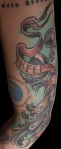
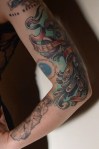
I’m Ender, and this is my tattoo. I’ve had chronic pain since I was around twelve years old. Two years ago, I was diagnosed with Fibromyalgia. Three weeks ago, my Mother told me she has the gene for Ehlers-Danlos Syndrome, that my Grandmother did, and that I likely do as well. She was right. Two weeks ago, I was diagnosed with EDS.
Every step of the way, the chronic pain and invisible illness community has been there for me. It’s remarkable. I’ve never turned towards a group of complete strangers who have responded to me with nothing but love, understanding, and open arms. When I’m having a bad day, literally all it takes is a moment to reach out, to connect, and to feel the support of this community to know I’m going to be okay.
I got this tattoo from Teresa Sharpe on the TV show “Best Ink”. She touched my heart with her own understanding, and the fact that she truly wanted to give me an amazing tattoo for being strong enough to go on the show is plain to see when looking at her work. I’ll never forget the experience.
Keep your spoons close, friends. And know that even when you feel you’re down to your last, you’ve got a spare tucked away in your sleeve somewhere.




 Holding the Bowl