
Tag: sensory overload

Guys this is very important
Okay so I’m sure you’ve all heard of the quiet place project. Well if not I am going to tell you because it has stopped me from doing serious damage more than once.
So part one, you’ve got the comfort spot
This gem right here is where you can literally create a 100% anonymous username and just absolutely spill your guts. Then people can read it and give you advice, and it honestly is so helpful. Because the other people on it are in the same situations as you, and they understand. You can comment and give advice on other peoples posts too, and it’s just really great.
Number 2 is the thoughts room.
This little beauty is similar to the comfort spot. Except instead of posting your thoughts, you type them into the box and then when you press enter they disappear and turn into stars against the blue sky. There is a whole bunch of different languages to choose from at the start, so if English is not your first language then you can probably find it here. There is the most comforting music that plays in the background as well, which is so great.
Next we got the quiet room
Which is so good for panic related things because it silences all of your other tabs and when you make it full screen it talks to you very calmly and then literally forces you stop for just 30 seconds and do nothing and just breathe.
Okay, so this is my actual favourite, it’s called the dawn room
The dawn room is so great for stopping you from self harming. It begins by telling you that its going to be alright, then it asks you to write something about someone you love. After that messages from other people, just like you, appear on the screen, one after the other, and the background slowly become brighter and happier. This page has genuinely stopped me from hurting myself more times than I can count. I’m not suggesting that it will work for everyone, but it is an absolute gem.
Finally, there is a page called It will be okay
This page runs for about 5 minutes, and it is basically a typing simulator that tries to convince you that everything is going to be alright. It is very calming, and good for lonely times.
I can honestly say that this website has done me so so much good. I appreciate it with every bit of my being.
Therapeutic Compression CRIB or TODDLER Size Bed Sheet for kids with Autism, ADHD and Insomnia
Holy cow, so y’all. A lot of us have sensory issues. A friend of mine has a toddler who is basically me when it comes to this sorta thing. A lot of OTs recommend weighted blankets but those are 1. expensive to try (I mean WHAT IF THEY DON’T WORK?) 2. HOT.
Now, I haven’t tried these myself because after decades of trial and error I have found what works for me (and I’m claustrophobic…so these frighten me as much as they fascinate lol), but I will tell you that my friend is RAVING about them on facebook. Her toddler has been sleeping through the night finally without getting under his fitted sheet with all his stuffed animals and blankets) and he is taking actual naps. A weighted blanket didn’t work for them (and they were fortunate to be able to borrow one), but these are much more economical.
These are listed for Crib and toddler beds, but
They make up to a king size.
That’s right. 40 bucks compared to the hundred plus I see for most weighted blankets (and those aren’t even adult sized).
Now, we know tumblr doesn’t like to allow linked posts in the search results so if y’all could pass this around that would be great. These sheets have already changed the life of a family I know, I’m sure they’d help others.
Therapeutic Compression CRIB or TODDLER Size Bed Sheet for kids with Autism, ADHD and Insomnia
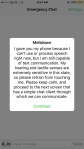
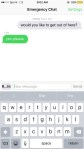
hello! I don’t know if anyone has already made a post about this before, but I just stumbled upon this app made specifically for when you’ve gone into a nonverbal anxiety attack!!!
it was made by Jeroen De Busser who is an autistic computer science student.
the app is really easy to use! all you do is open it and hand your phone to someone you need to communicate with during an attack but physically cannot, and it shows this cool little alert for the person to read, and then it takes them to an easy to use chat (that looks a lot like texting! except both of you are communicating using the same device).
the alert message is completely customizable and you can have it say whatever you need!
the app is called Emergency Chat and it’s available in the Apple Store and google play store.
I highly recommend it to anyone who might need it 🙂
OH MY GOD?!?!?? BOOST
That’s so bootiful!
thank you so much for this because i never know what to do when i cant talk to people and they just start trying to ask me questions and its really hard to force myself to say i cant talk and stuff. im definately getting this right now
[Image Descriptions:
All slides have a light blue background, and the text is written in blue rectangles with rounded corners.
Slide 1: The title is in white text inside a dark blue circle that is centred in the slide.
Sensory Overload And how to cope
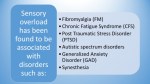
Slide 2: The header is in a dark blue rectangle and white text, and the body is in a pale blue rectangle and black text.
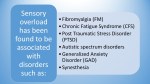
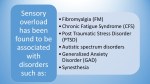
Sensory overload has been found to be associated with disorders such as:
- Fibromyalgia (FM)
- Chronic Fatigue Syndrome (CFS)
- Post Traumatic Stress Disorder (PTSD)
- Autistic spectrum disorders
- Generalized Anxiety Disorder (GAD)
- Synesthesia
Slide 3: The text is in three pale blue rectangles that
go horizontally across the slide. All use black text. The last
rectangle has four smaller dark blue rectangles with white text inside
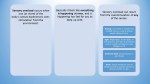
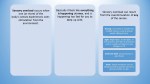
it for the four points. The text is centred in all of the rectangles.Sensory overload occurs when one (or more) of the body’s senses experiences over-stimulation from the environment.
Basically it feels like everything is happening at once, and is happening too fast for you to keep up with.
Sensory overload can result from the overstimulation of any of the senses.
Hearing: Loud noise or sound from multiple sources, such as several people talking at once.
Sight: Bright lights, strobe lights, or environments with lots of movement such as crowds or frequent scene changes on TV.
Smell and Taste: Strong aromas or spicy foods.
Touch: Tactile sensations such as being touched by another person or the feel of cloth on skin.
Slide 4: A heading in two light blue rectangles with black
text, followed by a table with a dark blue first row that has white
text, and then alternating pale blue and white rows with black text.
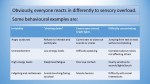
(The table is not really a table, it is just a four-column list.)Obviously, everyone reacts in differently to sensory overload.
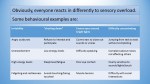
Some behavioural examples are:
Irritability — “Shutting down” — Covers eyes around bright lights — Difficulty concentrating
Angry
outbursts — Refuses to interact and participate — Covers ears to close
out sounds or voices — Jumping from task to task without completing
Overexcitement — Low energy levels — Difficulty speaking — Compains about noises not effecting others
High energy levels — Sleepiness/fatigue — poor eye contact — Overly sensitive to sounds/lights/touch
Fidgeting and restlessness — Avoids touching/being touched — Muscle tension — Difficulty with social interactionsSlide 5: The header is in a dark blue box with pointy
corners and white text. The body is in a pale blue box with pointy
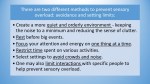
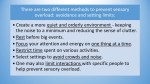
corners and black text.There are two different methods to prevent sensory overload: avoidance and setting limits:
- Create a more quiet and orderly environment – keeping the noise to a minimum and reducing the sense of clutter.
- Rest before big events.
- Focus your attention and energy on one thing at a time.
- Restrict time spent on various activities.
- Select settings to avoid crowds and noise.
- One may also limit interactions with specific people to help prevent sensory overload.
Slide 6: This looks the same as the last slide except the text in the header is black.
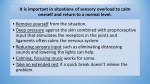
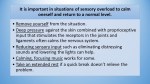
It is important in situations of sensory overload to calm oneself and return to a normal level.
- Remove yourself from the situation.
- Deep pressure against the skin combined with proprioceptive input
that stimulates the receptors in the joints and ligaments often calms
the nervous system.- Reducing sensory input such as eliminating distressing sounds and lowering the lights can help.
- Calming, focusing music works for some.
- Take an extended rest if a quick break doesn’t relieve the problem.
Slide 7: Four light blue rectangles with rounded corners, stacked one above the other, with black text.
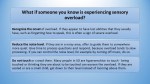
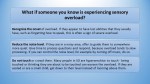
What if someone you know is experiencing sensory overload?
Recognize the onset of overload. If they appear to
have lost abilities that they usually have, such as forgetting how to
speak, this is often a sign of severe overload.Reduce the noise level. If they are in a noisy area,
offer to guide them somewhere more quiet. Give time to process
questions and respond, because overload tends to slow processing. If you
can control the noise level, for example by turning off music, do so.Do not touch or crowd them. Many people in SO are
hypersensitive to touch – being touched or thinking they are about to be
touched can worsen the overload. If they are seated or are a small
child, get down to their level instead of looming above them.Slide 8: Similar to previous slide, only with three rectangles instead of four.
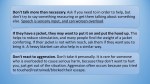
Don’t talk more than necessary. Ask if you need to
in order to help, but don’t try to say something reassuring or get them
talking about something else. Speech is sensory input, and can worsen
overload.If they have a jacket, they may want to put it on and put the hood up. This
helps to reduce stimulation, and many people find the weight of a
jacket comforting. If their jacket is not within reach, ask them if they
want you to bring it. A heavy blanket can also help in a similar way.Don’t react to aggression. Don’t take it personally.
It is rare for someone who is overloaded to cause serious harm, because
they don’t want to hurt you, just get out of the situation. Aggression
often occurs because you tried to touched/restrained/blocked their
escape.Slide 9: Similar to previous slide, only with two rectangles instead of three.
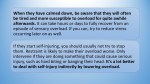
When they have calmed down, be aware that they will often be tired and more susceptible to overload for quite awhile afterwards. It
can take hours or days to fully recover from an episode of sensory
overload. If you can, try to reduce stress occurring later on as well.If they start self-injuring, you should usually not try to stop them.
Restraint is likely to make their overload worse. Only intervene if
they are doing something that could cause serious injury, such as hard
biting or banging their head. It’s a lot better to deal with self-injury indirectly by lowering overload.Slide 10: The header is in a dark blue rectangle with white
text, and the other text is in a row of five dark blue circles with
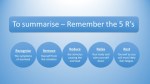
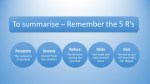
white text. The text is centred in all shapes.To summarise – Remember the 5 R’s
Recognise
The symptoms of overloadRemove
Yourself from the situationReduce
the stimulus causing the overloadRelax
Your body and calm yourself downRest
Yourself as you will most likely feel fatigue.]
Sensory Overload And How To Cope
Sensory overload has been found to be associated with disorders such as:
- Fibromyalgia (FM)
- Chronic Fatigue Syndrome (CFS)
- Post Traumatic Stress Disorder (PTSD)
- Autistic spectrum disorders
- Generalized Anxiety Disorder (GAD)
- Synesthesia
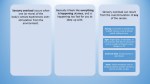
Sensory overload occurs when one (or more) of the body’s senses experiences over-stimulation from the environment.
Basically it feels like everything is happening at once, and is happening too fast for you to keep up with.
Sensory overload can result from the over stimulation of any of the senses.
Hearing: Loud noise or sound from multiple sources, such as several people talking at once.
Sight: Bright lights, strobe lights, or environments with lots of movement such as crowds or frequent scene changes on TV.
Smell and Taste: Strong aromas or spicy foods.
Touch: Tactile sensations such as being touched by another person or the feel of cloth on skin.
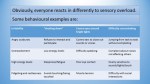
Obviously, everyone reacts in differently to sensory overload.
Some behavioural examples are:
Irritability – “Shutting down” – Covers eyes around bright lights – Difficulty concentrating
Angry outbursts – Refuses to interact and participate – Covers ears to close out sounds or voices – Jumping from task to task without completing
Overexcitement – Low energy levels – Difficulty speaking – Compains about noises not effecting others
High energy levels – Sleepiness/fatigue – poor eye contact – Overly sensitive to sounds/lights/touch
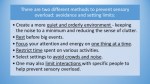
Fidgeting and restlessness – Avoids touching/being touched – Muscle tension – Difficulty with social interactionsThere are two different methods to prevent sensory overload: avoidance and setting limits:
- Create a more quiet and orderly environment – keeping the noise to a minimum and reducing the sense of clutter.
- Rest before big events.
- Focus your attention and energy on one thing at a time.
- Restrict time spent on various activities.
- Select settings to avoid crowds and noise.
- One may also limit interactions with specific people to help prevent sensory overload.
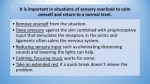
It is important in situations of sensory overload to calm oneself and return to a normal level.
- Remove yourself from the situation.
- Deep pressure against the skin combined with proprioceptive input that stimulates the receptors in the joints and ligaments often calms the nervous system.
- Reducing sensory input such as eliminating distressing sounds and lowering the lights can help.
- Calming, focusing music works for some.
- Take an extended rest if a quick break doesn’t relieve the problem.
What if someone you know is experiencing sensory overload?
Recognize the onset of overload. If they appear to have lost abilities that they usually have, such as forgetting how to speak, this is often a sign of severe overload.
Reduce the noise level. If they are in a noisy area, offer to guide them somewhere more quiet. Give time to process questions and respond, because overload tends to slow processing. If you can control the noise level, for example by turning off music, do so.
Do not touch or crowd them. Many people in SO are hypersensitive to touch – being touched or thinking they are about to be touched can worsen the overload. If they are seated or are a small child, get down to their level instead of looming above them.
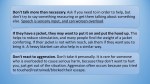
Don’t talk more than necessary. Ask if you need to in order to help, but don’t try to say something reassuring or get them talking about something else. Speech is sensory input, and can worsen overload.
If they have a jacket, they may want to put it on and put the hood up. This helps to reduce stimulation, and many people find the weight of a jacket comforting. If their jacket is not within reach, ask them if they want you to bring it. A heavy blanket can also help in a similar way.
Don’t react to aggression. Don’t take it personally. It is rare for someone who is overloaded to cause serious harm, because they don’t want to hurt you, just get out of the situation. Aggression often occurs because you tried to touched/restrained/blocked their escape.
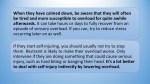
When they have calmed down, be aware that they will often be tired and more susceptible to overload for quite awhile afterwards. It can take hours or days to fully recover from an episode of sensory overload. If you can, try to reduce stress occurring later on as well.
If they start self-injuring, you should usually not try to stop them. Restraint is likely to make their overload worse. Only intervene if they are doing something that could cause serious injury, such as hard biting or banging their head. It’s a lot better to deal with self-injury indirectly by lowering overload.
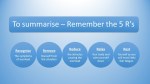
To summarise – Remember the 5 R’s
Recognise
The symptoms of overloadRemove
Yourself from the situationReduce
the stimulus causing the overloadRelax
Your body and calm yourself downRest
Yourself as you will most likely feel fatigue.]
Sensory Overload and how to cope.
(click on images to zoom)
So important.
I also find I can get SO from thinking too much, like brain-over-stimulation. Though that is kinda like audio input for me because of the way I think. After all, my go-to overload thought is “quiet please, make it stop”.
thank you for posting this, i needed it
This is wonderful and so needed
My last SO situation I had allodynia all over, and all the skin sensory input just destroyed my ability to think.
Sensory Overload and how to cope.
(click on images to zoom)
this is very good advice. being autistic, i’m susceptible to overload, and do my best to keep my environment restful so i’m better able to deal with the outside world when i need to, but sometimes shit happens. the number one thing i wish people knew about overload is: don’t get between me and the door. usually i catch it in time to politely excuse myself ‘for a cigarette’ but sometimes, like if i get cornered one of those people who stands too close and wears too much perfume and talks too loud and completely ignores disengagement signals, i can end up in a hurry to get away from the stimulus, and even a little panicky. so like… don’t block my path on my way out, okay?
also, don’t follow me outside and keep talking. don’t try to participate in my spindown. don’t demand reassurance every thirty seconds. don’t make it about you. i’ve got this. i don’t need your help. i just need you to stop making it worse.
 Holding the Bowl