
“you can’t let your mental health affect everything” sorry. my bad. i forgot that even though my mental illness is In My Brain, which does Everything for me, that’s not an excuse for my mental health affecting everything i do. so sorry.
Tag: perspectives
I think one of the worst parts of having a chronic disease is how it sometimes just breaks you.
You can have several bad days in a row and handle it fine; then one day you lose it because you’ve gone so long taking it that you eventually get to a point where you just can’t do it anymore.
You’ll try to open the dryer door and can’t.
You’ll be cold and won’t be able to get warm. The kind of cold where you can’t get warm so you want to put your blanket in the dryer for half hour but you can’t open the damn door.
You feel grateful for any help you have, but you wish you didn’t need it in the first place.
No one tells you when you get sick that you will have days that don’t just test your pain levels or your patience, they will literally test your very will to get through the day.
“you have so much to live for”
“but you’re smart/funny/beautiful/talented—you know that, right?”
“you matter, don’t ever forget that”
congratulations, i already fucking know.
here’s the issue with my personal experience with depression: i have a very logical way of approaching things and can fully understand, believe, and comprehend one thing while emotionally disagreeing with it.
*applauds* Well put.
What I want to say about depression
- the fact that a person is still alive doesn’t mean they’re fine
- the fact that a person still goes to school or job doesn’t mean they’re fine
- the fact that a person smiles to you, tells jokes to you, argues with you doesn’t mean they’re fine
- when a person is telling you, they are depressed and/or want to die, it doesn’t mean they’re lying or trying to attract your attention
Quite often depressed people aren’t able to express their real emotions right.
One day you will lose them and will ask yourself a question, what was wrong and what did you missed.I’m actually very happy to see this.
I’ve dealt with a lot of erasure outside my immediate physical household; particularly from my In-Laws, who are convinced I’m somehow just making it all up so I don’t have to work, or some other blather like that. The thing is, when you have depression? It’s not just working that’s suddenly a chore; it’s the things that other people take for granted. Getting out of bed, doing your hair, making those phonecalls. Each one is a mountain to be climbed, and how many Everests can even a NORMAL person scale in a day? To say nothing of someone who didn’t have the drive to begin with, just because they literally feel that miserable.
I tell people depression is like if you were Sysiphus pushing the boulder uphill; only the hill is icy and the boulder ain’t exactly a pebble and you’re probably doin’ that shiz in the dark.
This hit almost every feels limb out of the relevancy tree.
It’s not like it’s a big deal though, just casually crying over here. I didn’t know how much I needed to see this.
- Just because I lived through that date doesn’t mean I’m fine.
- Just because I’m still in college, and still doing rather well grade-wise, doesn’t mean I’m fine.
- Just because I can roll out the sarcasm while working during shop hours, just because I’m still going into the E-shop and working, doesn’t mean I’m fine.
- Just because I can laugh, smile, and – dare I say it – enjoy a tv show or movie with a friend doesn’t mean I’m fine.
How do you handle Chronic Fatigue? I have endometriosis and I deal with the fatigue… I just don’t know what to do anymore. I feel like such a useless part of society.
whatshouldwecallchronicillness:
Emily’s plan to deal with fatigue:
1. Meds.
2. Try to stay active, or at least stimulated in my brain
3. Adapt my life to conserve energy
3. Cry when somedays every effort still doesn’t work. Then pick myself back up and try again the next day. :0)
After Alzheimer’s Diagnosis
‘The Stripping Away Of My Identity’
Greg O’Brien talks about how his life has changed in the five years since he was diagnosed with early-onset Alzheimer’s disease. “More and more I don’t recognize people,” he says…
Wellbutrinversary
At Patheos Ride the Spiral, Nornoriel Lokason talks about his experience with antidepressants and the rhetoric that taking medication is a “crutch”.
“Even Thor needs Mjollnir to fight giants.”
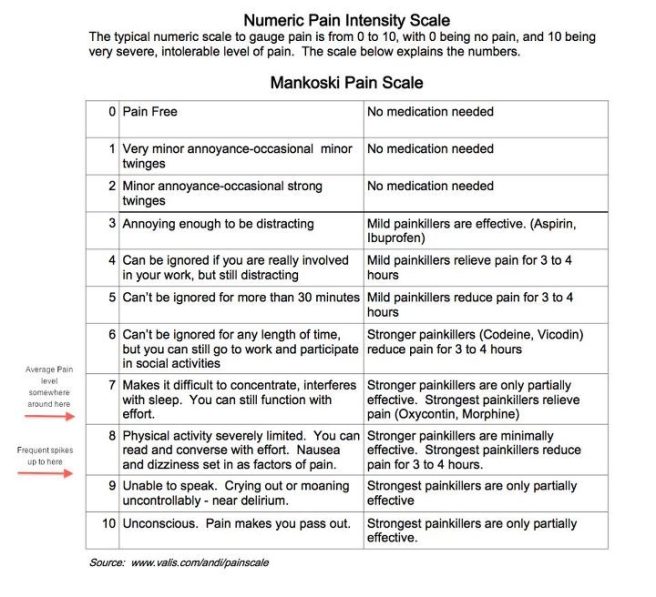
Mankoski Pain Scale
Mankoski devised this pain scale to help describe the subjective
experience of pain in more concrete terms to her doctors and family. Please
feel free to use it and distribute it with attribution.0 – Pain Free
1 – Very minor annoyance – occasional minor twinges.
No medication needed.2 – Minor Annoyance – occasional strong twinges.
No medication needed.3 – Annoying enough to be distracting.
Mild painkillers take care of it. (Aspirin, Ibuprofen.)4 – Can be ignored if you are really involved in your work, but still
distracting.
Mild painkillers remove pain for 3-4 hours.5 – Can’t be ignored for more than 30 minutes.
Mild painkillers ameliorate pain for 3-4 hours.6 – Can’t be ignored for any length of time, but you can still go to work and
participate in social activities.
Stronger painkillers (Codeine, narcotics) reduce pain for 3-4 hours.7 – Makes it difficult to concentrate, interferes with sleep. You can still
function with effort. Stronger painkillers are only partially effective.8 – Physical activity severely limited. You can read and converse with
effort. Nausea and dizziness set in as factors of pain.
Stronger painkillers are minimally effective. Strongest painkillers reduce
pain for 3-4 hours.9 – Unable to speak. Crying out or moaning uncontrollably – near delirium.
Strongest painkillers are only partially effective10 – Unconscious. Pain makes you pass out.
Strongest painkillers are only partially effective.
————————————————————————————————————
Copyright © 1995, 1996 , . Right to copy with attribution
freely granted. The information contained herein written and copyright by
andi@… ( Mankoski)
==========================I’m an 8 most days. Today it’s a heavy 8.
I find there’s too big of a jump from 7-8. It goes from still functional to completely disabled in one number.
I live at an 8, occasionally a 7.5 on a better day, and an 8.5 on days where I freak out my husband so much he threatens to take me to the ER. Occasionally I even reach 9.
Also, people with chronic pain/chronic illness will experience pain differently from someone who is healthy and only occasionally suffers from some sort of low-number acute pain. For example, I have been living at an 8 for two years straight, and then before that a solid 7 for two years, and before that I was in pain too, but it was more manageable (between a 4-6). So, I’ve lived with some level of chronic pain for most of my life and have become accustomed to it, whereas if someone who hardly ever experiences higher-number pain were to suddenly feel what I feel on one of my worst days, they would find it much more jarring and might even number it higher than I did. Similarly, if I’m only experiencing pain at a 6, I’ll ignore it, because my pain level is normally higher than that, but if a healthy person were at a 6 they would already consider themselves to be in a substantial amount of pain.
I also have many different types of pain in my body caused by different things, and they are not all synchronized at the same pain level all the time. I always think of my pains as having auditory volume. Sometimes one pain is loud (let’s estimate an 8) while a different pain I’m experiencing simultaneously is quieter (let’s say a 5). So in my opinion you should always have to specify a pain level for over all pain and then numbers for each individual offender.
I created this pain scale. Back in 1994, when I was using the name Mankoski and living as a female, I wrote this painscale and published it on an early internet-based endometriosis support community. Since then it’s taken on a life of its own. It’s been published countless places both online and in print, been used in academic pain studies and burn units, been refined and shared and branched out to so many places that a web search for “Mankoski” gets my pain scale as the first several hits.
In the twenty years since I wrote it, I’ve made drastic changes in my life, not the least of which is ditching that name and that gender. I still have endometriosis, mostly dormant now thanks to testosterone. And I still have chronic pain.
If I had it to do over, there are changes I’d make to this pain scale. I agree with the comments above that it’s not fine-grained enough between 7 and 8. And I wish I’d called it the McCallum Pain Scale, instead of using my ex-spouse’s name. But I’m still incredibly proud of it. I’m glad it’s something that can help people. And I’m glad that out of my own experience of living with chronic pain and disability, something good has come.
Thank you. I’ve found this immensely helpful, and discussed this a bunch (prolly how you found me) and im kinda honored to play a part in keeping it alive
Kindof a bummer it’s got your old name attached, but i’d be happy to rewrite/edit my posts to include a more accurate attribution.
For me, a usual day is about a 6, and a good day is a three. I do get days below that, but they are rare. Bad days are mostly 7-8, with the occasional 9 where I hope that I can pass out due to the exhaustion of being in that much pain.
This sort of pain scale is valuable because so many of them give you no idea of what level means what. A doctor will say “10 is the worst pain you can imagine” and in comparison people scale things down. So what might have been an 8 gets called a 6 because people have different capacities for imagining pain, I guess. Idk, I had a lot of trouble with it when I had appendicitis.
Now with fibro, I record my pain levels daily. I use this scale to help me work out where I’m at; it’s been very helpful. Again like the above scale it’s not for everyone but it helps me because otherwise I’d have no idea. Most good days for me are a 2, bad days usually a 4 or a 5. I’m lucky. I do get spikes up near a 7 or 8 in particular body parts at particular times, but it rarely lasts more than a couple of hours so I don’t log the entire day at that level.
What’s been interesting for me as my fibro’s been getting worse over the last couple of years is that you really do get used to the pain and what may have been a 3 becomes a 2. So important that healthcare providers understand that when it comes to chronic pain.
Strangers Assume My Girlfriend Is My Nurse
I was recently out on a dinner date with my lovely girlfriend, Anna, when a stranger approached to have a friendly conversation. He said he was a huge fan of my column, and then turned to my girlfriend and asked, “Are you his sister?”
 Holding the Bowl