i saw this post earlier about therapists and it reminded me of my old therapist paul, who in my opinion is one of the greatest men alive and who did not put up with my bullshit for even one second
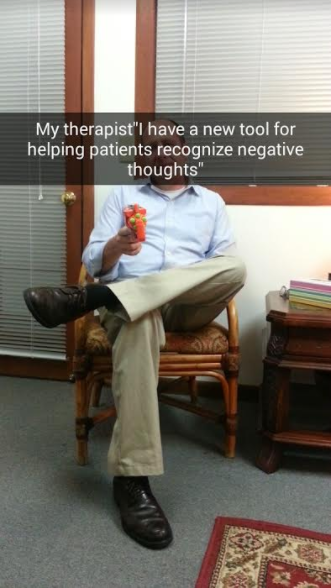
anyway i go in to see paul one week in the summer of 2016, and i’m doing my usual bullshit which consists of me talking shit about myself, and paul is staring at me, and then he cuts me off and says that he’s got a new tool for helping people recognize when they’re using negative language, and gets up and goes over to his desk
and i’m like alright hit me with that sweet sweet self-help article my man, because i’m a linguistic learner and whenever paul’s like here i have a tool for you to use it’s pretty much always an article or a book or something
paul opens a drawer, takes something out, and turns back around. i stare.
i say, paul.
is that a nerf gun.
yeah, says paul.
i say, are you gonna shoot me with a nerf gun in this professional setting.
he happily informs me that that’s really up to me, isn’t it. and sits back down. and gestures, like, go ahead, what were you saying?
and i squint suspiciously and start back up about how i’m having too much anxiety to leave the house to run errands, like it was a miracle to even get here, like i’ve forgone getting groceries for the past week and that’s so stupid, what a stupid issue, i’m an idiot, how could i–
a foam dart hits me in the leg.
i go, hey! because my therapist just shot me in the leg. paul blinks at me placidly and raises an eyebrow. i squint again.
i say, slowly, it’s– not a stupid issue, i’m not stupid, but it’s frustrating me and i don’t want it to be a problem i’m having.
no dart this time. okay. sweet.
so the rest of the hour passes with me intermittently getting nailed with tiny foam darts and then swearing and then fixing my language and, wouldn’t you know it, i start liking myself a little more by the end of the session, which is mildly infuriating because paul can tell and he’s very smug about it
anyway i leave his office and the lady having the next appointment walks in and i hear what’s all over the floor? and paul very seriously says cognitive behavioral therapy tools.
The “I won’t hesitate, bitch” vine but @ friends who don’t love themselves
Mental Illness is isolating in and of itself, but i’ve always felt further detached and embarrassingly “other” in the sense that I seem to experience my illness in far messier, more inconvenient ways than others I know struggling with similar diagnosis. Struggling with mental illness can make you feel disconnected from the general public in the sense that they don’t know what it is to face a large portion of your daily life, but it’s infinitely more disheartening to feel that you can’t relate to other people who are supposed to understand your struggle. My experience is exhausting and inconvenient, it is not a woman wrapped in a sweater staring out her window with a mug of tea in an anti-depressant commercial. My experience is sloppy and cumbersome, it seems too ugly to share with the world and too divergent from the experience of those close to me to share with my friends, so I keep it to myself. It occurs to me that perhaps the reasons I have kept the full extent of my illness so far away from the public eye is the reason I have no representations of illness to relate to, perhaps this is precisely how others around me feel about their struggle. It’s taken me most of adult life to realize that this struggle is not something that I asked for and not something to be ashamed of in the way that I have been. These self-portraits are an attempt to frankly and unashamedly represent the positions that my mental illness puts me in on a daily basis, easy to look at and otherwise.
Have you been having a rough go of things? No clue where to go, or who you can talk to? -Don’t want to bother anyone?-
Windsor has a Community Crisis hotline. And you don’t have to be on the brink of suicide to use it. I called them earlier to help stop a panic attack from happening. The man on the other line was compassionate, kind, and followed my babbling no matter where the conversation went. He laughed with me. He made me laugh.
We don’t even know each other’s names.
But that man, on the other line, helped me. We talked about random things, mental things, dogs, cats, gadgets.
So thank you, kind sir. You made the turmoil of this entire day more bearable.
519-973-4435. If you’re ever lost, they WILL be there.
the fact that a person is still alive doesn’t mean they’re fine
the fact that a person still goes to school or job doesn’t mean they’re fine
the fact that a person smiles to you, tells jokes to you, argues with you doesn’t mean they’re fine
when a person is telling you, they are depressed and/or want to die, it doesn’t mean they’re lying or trying to attract your attention
Quite often depressed people aren’t able to express their real emotions right. One day you will lose them and will ask yourself a question, what was wrong and what did you missed.
I’m actually very happy to see this.
I’ve dealt with a lot of erasure outside my immediate physical household; particularly from my In-Laws, who are convinced I’m somehow just making it all up so I don’t have to work, or some other blather like that. The thing is, when you have depression? It’s not just working that’s suddenly a chore; it’s the things that other people take for granted. Getting out of bed, doing your hair, making those phonecalls. Each one is a mountain to be climbed, and how many Everests can even a NORMAL person scale in a day? To say nothing of someone who didn’t have the drive to begin with, just because they literally feel that miserable.
I tell people depression is like if you were Sysiphus pushing the boulder uphill; only the hill is icy and the boulder ain’t exactly a pebble and you’re probably doin’ that shiz in the dark.
This hit almost every feels limb out of the relevancy tree.
It’s not like it’s a big deal though, just casually crying over here. I didn’t know how much I needed to see this.
Just because I lived through that date doesn’t mean I’m fine.
Just because I’m still in college, and still doing rather well grade-wise, doesn’t mean I’m fine.
Just because I can roll out the sarcasm while working during shop hours, just because I’m still going into the E-shop and working, doesn’t mean I’m fine.
Just because I can laugh, smile, and – dare I say it – enjoy a tv show or movie with a friend doesn’t mean I’m fine.
It wasn’t a war or a fight. Those things have rules. This was more like Aaron getting in the ring with the Mohammed Ali of cancers, and smiling for round after round after he got his teeth knocked out and his face rearranged.
Nora’s been documenting Aaron’s tumor for two and a half years now. Beautifully, openly, sometimes lightly, always poignantly. As she puts it, “It’s not a cancer story, it’s a love story. With some cancer.” You can start that story from the beginning over here.
Aaron passed away yesterday. Our condolences to all those he leaves behind. We’re in awe of your strength, and we’re grateful for this record of your love.
When should you disclose medical conditions to a date? When is illness too much for a relationship to survive?
One major issue chronically ill people face in dating is disclosure. The question of when to share the illness with a prospective partner fills online forums, videos, articles, blogs, conferences, and discussions. Sharing too soon may scare the person off and sharing too late may lead to a lack of trust.
The symptoms were hardly noticeable at first. In fact, had Meryl Comer not been a veteran TV news reporter, she might have missed the subtle changes in her husband’s behavior. Even then, she chalked up his sudden lack of focus and lightning-quick temper to job stress: Harvey Gralnick had a prestigious position as a physician and chief of hematology/oncology research at the National Institutes of Health. Two years and countless medical exams later, Comer’s husband finally was diagnosed with early-onset Alzheimer’s. By that time, the disease had already scrambled their lives and dashed their dreams. Gralnick was 57; Comer was just 50.
If Alzheimer’s is about forgetting, Comer’s just released book, Slow Dancing with a Stranger, is about bearing witness to everything Alzheimer’s took from her husband and her family. Equally important, it’s a call to action for women who, as caregivers, are most often Alzheimer’s second victim. What distresses Comer is that there are no better options for women today around care than there were 20 years ago. There are still no disease-modifying drugs or treatments for Alzheimer’s, a fatal neurodegenerative disease that has no cure.
















 Holding the Bowl