cleverandengagingtitlegoeshere:
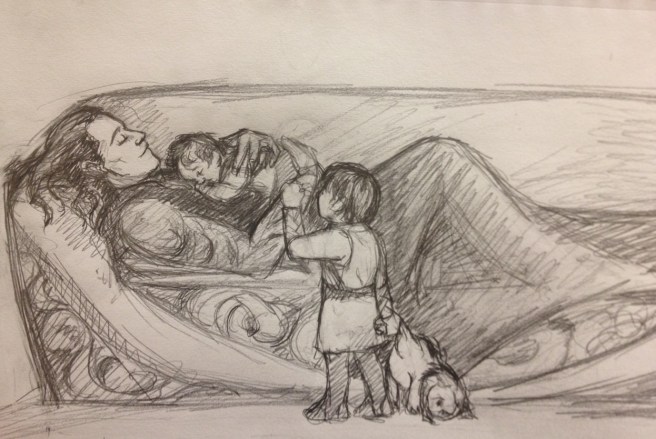
Napping, dad-style!

Devotional blog dedicated to the Goddess Sigyn offering support to those who are "holding the bowl" within difficult relationships.

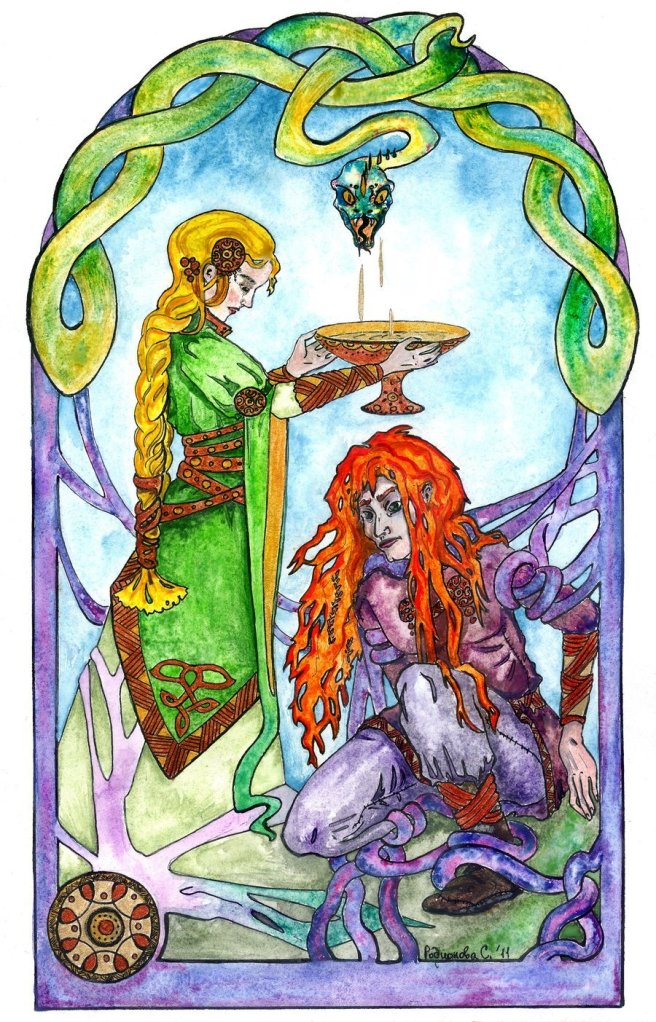
The bound Loki with his wife, Sigyn, who is capturing poison in a bowl so that it does not hit and harm her husband. However when she empties her bowl, drops of poison falls from the snake’s mouth and hits Loki causing him to whither in pain. His pain is said to be shown in the form of earthquakes here in Midgard.
Honor Her by honoring Her children.
Pour out offerings to Vali.
Remember the anguish of the wolf,
Who was not wolf-born.
Look at what the Aesir have done.Pour out offerings to Narvi;
call Him on the beach,
where seagulls crest,
and crestaceans scutter
across sliding sands
as the moon drops its guard beneath the horizon.
Remember the child,
slaughtered before childhood’s end.Honor Sigyn by honoring Her husband.
Praise His name
and allow no ill word of slander
to cross your lips
if you seek Her blessings.Honor Sigyn by seeking out the lonely,
the lost, the hurting, the broken.
Take it upon yourself
to weave a thread of brightness into their world
to relieve some measure of their grief
in whatever simple ways you can.Honor Sigyn by honoring those She loves.
When you have done these things,
then and only then, pour out offerings to Her.
Then and only then, seek out Her sacred places.
Then and only then, think yourself worthy of Her attention.
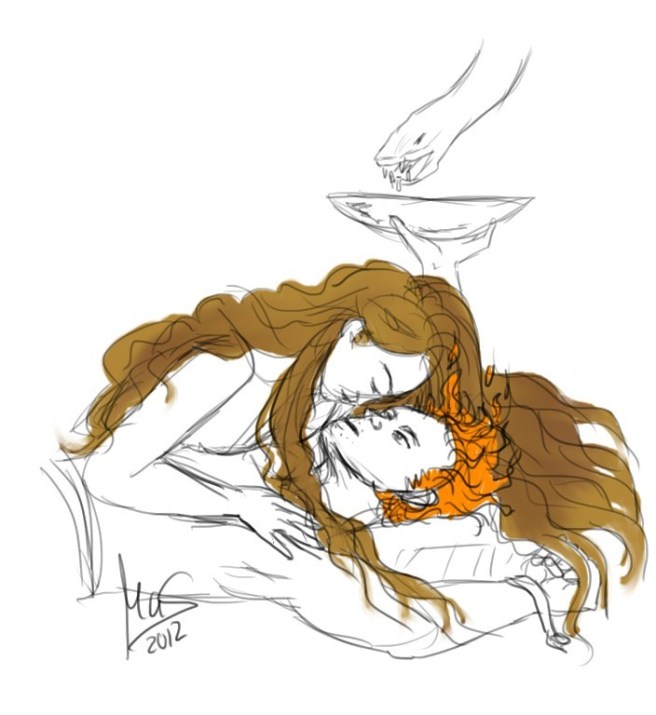
Sigyn and Loki
I just wanted to draw a different version of the Punishment of Loki.
Hi anon.
For some people who are going through a rough patch, spells and charms like that are a way to hold onto something that can help. But for many more of those, they don’t help, or they are ineffective bandages.
We each have different ways of dealing with mental illnesses, and we need to make our community more open to the many ways that we approach the issue.
I think a good first step is making room for people to be open and safe about talking about mental illness. We need room for education – and education from people who actually have these illnesses or personality disorders! Without this, we will continue to get ineffective bandages. By opening the road for communication, by reducing shame around admitting illness or the problems we are facing, we open the road for better answers to our problems. So the first step we need is open communication.
And don’t think that’s easy! It’s easy on paper, but it’s hard to achieve in communities. Often, without meaning to, we demonize people by saying they are ‘crazy’ or they ‘have problems’ or ‘need to see a therapist’.
I want you to imagine a community that has people who can actually help people get therapy if that is what they need. (And that sort of thing can never and should never come from anons or someone who do not know. If it does, it’s just more ableism and shaming.)
I don’t want to clog this ask with ways to open up communication, though, so I’m going to try to get back to your question.
The second step in actually helping each other is acknowledging that we have different needs. Some people will be able to use spells to hold them through a tough time. Other people need therapy for a short time period to help them through. Other people need long term therapy, or perhaps lifelong. Others need medication. Some people need friends that they can talk to and be honest and open with. Others will need to pursue herbal healing.
We cannot demonize any of these methods. If we truly want to help people, we can’t demonize therapy or medication – or herbal healing or spiritual healing. We do need to make sure that whatever a person is using is actually helping them.
The third step is communal activism. What this means is:
- we keep an eye on each other to make sure people are doing okay – and this means everyone! We have to look out for each other.
- helping people get the resources they need – when you’re depressed or otherwise sick, getting to those resources can be almost if not actually impossible
- we support those who are dealing with illness – in a way they are comfortable with. This means not forcing people to be public about their experiences, and it also means not silencing people.
- if local, we have to make sure that our community members are being treated fairly by the medical establishment and step in to help them if they are not. We cannot let people be hurt when they are seeking help.
- and, finally, we don’t let people use mental illness as an excuse for abusive behavior. We have to make sure that we do not give a pass to abuse because someone is mentally ill. If we do, we are helping no one.
To give good answers for issues like these, we have to truly understand them. We cannot treat them as ‘just in the mind’ (the mind is powerful!), nor can we dehumanize those that have mental illnesses.
To give good answers, we have to listen to each other’s stories. Which, unfortunately, we’re not there yet. We are, currently, a very fast-paced community. That is great in some cases! But when it comes to getting answers that can help us through tough times, or through tough lives, or through dark nights of the soul – fast-paced is exactly the opposite. If we want to give good answers, provide good support, we have to sit ourselves down and open our ears and hearts up to people.
(Cheesy, I know. But when someone listens to us, truly listens, that opens up paths we would never have expected.)
We can’t know your story; we can’t know what you actually need without listening to what is going on. That is how we get good answers. That is how we get more than spells.
Problem: We have ineffective aid for people struggling with mental illness and spiritual crisis.
Ideal Solution: We need people who will patiently listen to people’s lives and stories and help them work through to useful help – whether that is seeking alternative healing, medication and therapy, or something else. In most religions, this person would be a pastoral counselor. We don’t have many of those in Pagan and polytheist communities.
Suggested Solution: Share your story aloud. Talk about what you are going through, your struggles – make a public sort of diary. Do this anonymously if you do not feel safe. Attempting to network with people who have made safe space may also be helpful.
I will attempt to post links to helpful Pagan and polytheist organizations that provide counseling or support later today (4/24).
Thank you for your question, and feel free to respond back if you want to add more.
Firstly—reminder the whole blog is UPG. I feel like I haven’t said that lately. Secondly—I had no idea had anything to say about Sigyn at all; I know last time someone spoke to me about her, I had nothing to contribute. Apparently I’ve been thinking about it. Thirdly—someone tell me if it’s “Sigynsson”, “Sigynson”, or “Sigynarson” because all that happened when I went looking is I got increasingly frustrated by the lack of knowing if the matro/patronymic had a special case ending or simply used the genitive. Anyway.
+
Songbird. A wolf, or wolves. Silence and noise. Narfi’s brother and Narfi’s killer.
I keep coming back to these false dichotomies. Songbird is not exclusive wolf—not when the wolf can be a metaphor for outcast, not when the songbird is a mimic, not when the whole is given to changing shapes around a fixed point. Silence is both quiet and—in the right context—deafening. Loving a brother does not mean not killing him—I’ve talked about that, circle around it over and over and over again even as I try to pull away. Kindness can be its own cruelty, spite does not mean you can’t offer someone else compassion.
Loki’s son.
This was absolutely beautiful and just, lovely. I will have to bookmark this to come back to when I want to read about Sigyn, there is only so about her. This fits the bill so much, and its wonderful to learn of her children too.
 Holding the Bowl