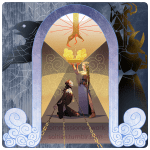
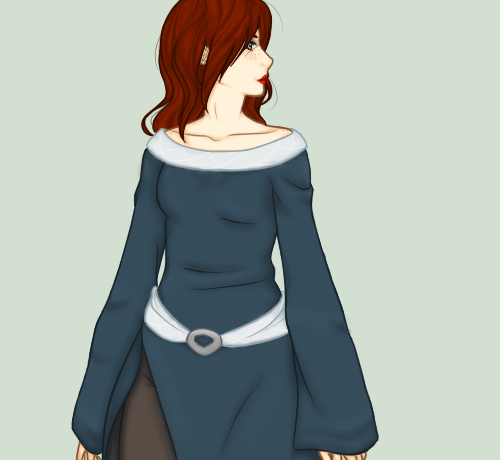
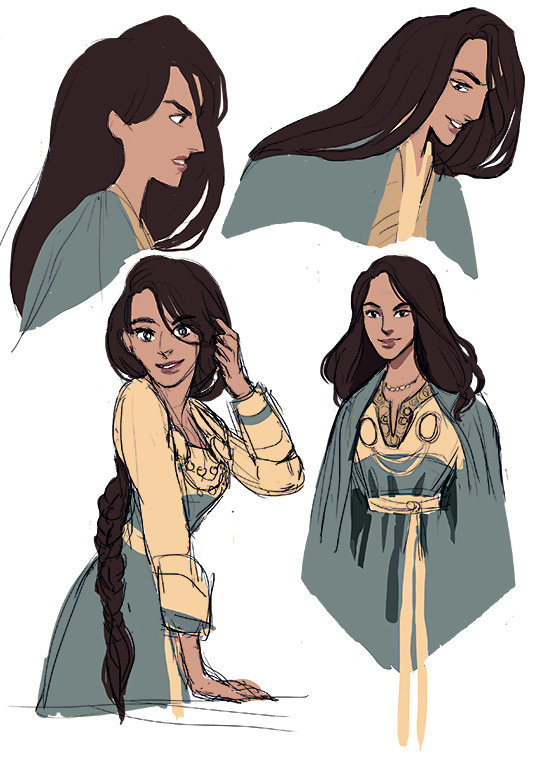
This particular drawing has rendered itself somewhat momentous to me, because at the time that my utterly lovely, patient, saint-like commissioner requested it I was seized with SO MANY visions of how to accomplish it, and drove myself crazy trying to do justice to the mythos of the situation and the very unique relationship between Loki and Sigyn that can be inferred from the glimpses of her we still have. In the end I was struck most deeply by the phrase used to describe Loki as “the burden of Sigyn’s arms”, which brought to mind a very specific sort of temperance and strength not necessarily wrought in muscle, but unwavering loyalty.
Sigyn: do you know why they call me the lady of loyal,dear?
Me: because of how you stay at Loki’s side even after he had a hand in killing Baldr and starting Ragnarök.
Sigyn: well yes, but I didn’t do that because I’m a good wife. I did it because I felt like I would betray myself if I let him suffer alone. It is important to stay true your loved ones but most importantly you must be loyal to yourself. Never let others deter you from what you think is right.even if they are your family and friends,and they have the best of intentions. What is right for them may not be right for you. Do you understand?
Me: I think so.
(and women, and fabulous people outside the gender binary)
So, this is The Theological Post I’ve Been Avoiding that I briefly referred to awhile back. This post basically serves as an explanation for why I don’t post more about specific entities I know, and one of the (complicated, manifold) reasons why D doesn’t want me connecting D-the-person as [D’s title] on the public Internet. I was going…
I should try to find the updated source post for the idea, but I found that this general idea that Nornoriel talks about in this clicked when I came across a Luciferian’s post about [what I call] the comet-shard theory [because I needed a way to refer to it]. Pretty much Everyone I interact with immediately jumped on using it because it helps my brain to understand that They’re not going to respond as carbon copies of what others have talked about (and it helps to make sense of some of the time issues I’ve run into with some Norse Deities by interacting with younger and older versions of Them).
Case in point: m’Lady Sigyn. So many people talked about Her as a Child, and I initially tried to approach Her that way, but it did not click. I didn’t know why until after the umpteenth dream of a Domme holding rope and the key to a collar, and then it was like ‘oh, okay, my comet-shard is definitely not a young, innocent child then’. It doesn’t mean I’m wrong, or anyone else is wrong; it just means that my comet-shard isn’t the same version of Sigyn that others experience. I typically have to commission stuff because I don’t get the cupcake, pastel associations, but it ultimately doesn’t make a difference for anyone but Sigyn and I.
That’s why I think Loki orbits Sigyn, not the other way around.
Even if he doesn’t realize it, Sigyn’s everything Loki searches for. She’s accepting and assuring, she really sees him, can prop him up or knock him down a few pegs when he needs it, she’s his equal, in good time and bad. Sigyn doesn’t need Loki, she has no use for manipulating or lying to him. She can stand on her own two feet just fine without him and that gives him the freedom to go on his little chaos runs. I think that also gives him the drive to earn her attention.
He may come and go, but wherever Sigyn goes Loki’s sure to be somewhere in orbit around her.
Unfortunately there really is not very much about Sigyn in Norse mythology, so it’s possible that you actually have found all of it and still feel shortchanged. In the Edda poems Sigyn is mentioned only in Völuspá, and all it says is:
Þar sitr Sigyn þeygi um sínum ver velglýjuð
There sits Sigyn (under Hveralundr, with Loki) not (yet?), of/concerning her husband, happy.
Snorri explains early in Gylfaginning that Loki is married to Sigyn and they have a son named Nari or Narvi (that is, Snorri gives both names). Váli is not mentioned at that time. Later he describes the events mentioned in Völuspá, that Loki is bound to the rock and Sigyn protects him from poison by holding a bowl over him, and this description is also found in the prose epilogue to Lokasenna.
This really is all of the remaining mythological information on Sigyn. What is especially strange and frustrating is that she actually is mentioned in early skáldic poetry in a kenning for Loki – farmr Sigynjar arma ‘burden of Sigyn’s arms’ in Haustlöng by Þjóðólfr úr Hvini, and possibly also farmr arma hapts galdrs ‘burden of the arms of the captive of magic’ in Eilífr Goðrúnarson’s Þórsdrápa (or something like that, it’s a little difficult to unpack… this is the “incantation fetter” that you see floating around, though I’m not sure how one would translate haptr, which means a captive or prisoner, that way. It’s not clear why this would refer to Sigyn).
(Edit 5/5/15: I messed up, reading hapts as the genitive of the word haptr meaning ‘captive’, following this translation of the poem, and failed to notice that it can also be hapt ‘fetter; deity’. See this post for more)
The references to her in skáldic poetry and the scene’s appearance on the Gosforth cross indicate that it was already well-known in the Viking age, but it doesn’t really tell us much more about Sigyn. A last thing I would like to add is that it is considered highly debatable whether Loki originally played a part in the myth of the death of Baldr. A lot of scholars believe that blaming Loki for Baldr’s death was a late innovation in Norse mythology, maybe not even occurring until after Christianization. If that’s true, we can’t help but wonder why exactly Loki’s binding is already known in early times, before the motivation for it. It’s also interesting to me that the image above from the Gosforth Cross appears on the same panel as a figure interpreted as Heimdallr (because he’s holding a horn) fighting a monster that is clearly not Loki. Granted, we don’t need to believe that both images are depicting things happening at the same time, and Loki is a shapeshifter, but it does seem to be evidence, even if weak, that the artist who made the Gosforth cross would have disagreed with Snorri that Heimdallr and Loki kill each other at Ragnarök.
That is about all I have to say about Sigyn as a mythological figure. If you’re interested in the meaning of names I did write a piece on why I think the meaning “victorious girlfriend” (a frequently given definition of Sigyn) is wrong on my own blog here (link). It’s a little dense but you might find it interesting.




 Holding the Bowl