
Devotional blog dedicated to the Goddess Sigyn offering support to those who are "holding the bowl" within difficult relationships.


Just a set of quick photos I did for class.
you lost all your energy before you even walked out the door? you lazy bum
That’s exactly what a monday feels like
kinda what social anxiety feels like
I’M GONNA DO IT I’M GONNA DO THE THING WITH THE PEOPLE
*gets to door*
wait never mind i need to alphabetize my sock drawerthis is what chronic illness looks like. 😦 this is what I go through every single day. Only I’m at half empty before I even get out of bed… :
exactly what chronic illness looks like. mental or physical. this is a great illustration, which perhaps people with more empathy than “you lazy bum” can relate to.
yeah this is important af




Mental Health Awareness Week from October 5-11
Even mermaids can have a mental illness, for a mermaid has no tears and therefore suffers so much more.
I’m that one person out of every five who has an invisible illness. I’m a suicide survivor. These are two reasons why I chose to per-sue Counseling Psychology in college. It’s also why I wanted to become a mermaid; not just to make myself happy, but to make others happy as well. Help raise awareness for mental illness by sharing this post.
Know that you are not alone.
TW: mental health, mental illness
By Emm Roy.
Very descriptive of my life right now. I love Emm Roy’s work no matter where I’m at with my illness.
Thank you! Always happy to hear that someone loves my work.
Ps. You deserve to have your illness taken seriously. You deserve to be treated with respect. I’m sorry that this is what you’re going through right now because you deserve so much better and I hope that you get everything you deserve in the future, but I’m proud of you for powering through and making it this far. Keep fighting the good fight.
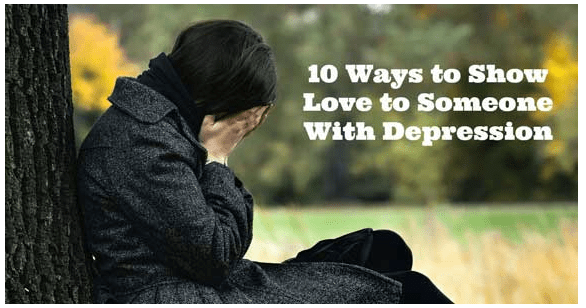
Do You Love Someone With Depression?
If you have a partner or are close to someone who struggles with depression, you may not always know how to show them you love them. One day they may seem fine, and the next they are sad, distant and may push you away. It is important that you know that as a person who is close to them and trusted by them, you can help your friend or partner have shorter, less severe bouts of depression. Mental illness is as real as physical illness (it is physical actually, read more about that here) and your partner needs you as much as they would need to be cared for if they had the flu.
Your relationship may seem one-sided during these times, but by helping your partner through a very difficult and painful affliction, you are strengthening your relationship and their mental health in the long term.
1. Help them keep clutter at bay.
When a person begins spiraling into depression, they may feel like they are slowing down while the world around them speeds up. The mail may end up in stacks, dishes can pile up in the sink, laundry may go undone as the depressed person begins to feel more and more overwhelmed by their daily routine and unable to keep up. By giving your partner some extra help sorting mail, washing dishes or using paper plates and keeping chaos in check in general, you’ll be giving them (and yourself) the gift of a calm environment. (I’m a fan of the minimalist movement because of this, you can read more about that here.)
2. Fix them a healthy meal.
Your partner may do one of two things when they are in a depressed state. They may eat very little, or they may overeat. In either case, they may find that driving through a fast food restaurant or ordering a pizza online is just easier than fixing a meal. Eating like this, or neglecting to eat will only degrade your partner’s health, causing them to go deeper into their depression. Help your loved one keep their body healthy, and their mind will follow. This is a great article that talks about the “Brain Diet” which can help the symptoms of depression, and this article talks about how our modern diet could contribute to the recent rise in depression. Here is a recipe for a trail mix that is quick to make and has mood-boosting properties.
3.Get them outside.
The benefits of getting outside for a depressed person are huge. And it is possibly the last thing on earth your partner will want to do. Take them to be somewhere in nature. Pack a picnic and lie in the sun, take a leisurely hike or plant a garden. Being barefoot in the dirt, or “earthing” helps ground the body and reverse the effects of living in a world of emf’s, and digging in soil can actually act as an antidepressant, as a strain of bacterium in soil, Mycobacterium vaccae, triggers the release of seratonin, which in turn elevates mood and decreases anxiety. Sunshine increases Vitamin D production which can help alleviate depression. My friend Elizabeth wrote an excellent post about Vitamin D and its link to depression here. For more information about other sources of Vitamin D, this is a great post as well as this.
4. Ask them to help you understand what they’re feeling.
If your partner is able to articulate what they are going through, it will help them and you better understand what you are dealing with, and may give insight into a plan of action for helping your partner. Also, feeling alone is common for a depressed person and anything that combats that feeling will help alleviate the severity and length of the depression.
5. Encourage them to focus on self-care.
Depressed people often stop taking care of themselves. Showering, getting haircuts, going to the doctor or dentist, it’s all just too hard, and they don’t deserve to be well taken care of anyway in their minds. This can snowball quickly into greater feelings of worthlessness since “Now I’m such a mess, no one could ever love me”. Help your loved one by being proactive. Tell them “I’m going to do the dishes, why don’t you go enjoy a bubble bath?” can give them the permission they won’t give themselves to do something normal, healthy and self-loving.
6. Hug them.
Studies show that a sincere hug that lasts longer than 20 seconds can release feel-good chemicals in the brain and elevate the mood of the giver and receiver. Depressed people often don’t want to be touched, but a sincere hug with no expectation of anything further can give your partner a lift.
7. Laugh with them.
Telling a silly joke, watching a comedy or seeing a stand up comedian will encourage your partner to laugh in spite of themselves. Laughing releases endorphins and studies show can actually counteract symptoms of depression and anxiety.
8. Reassure them that you can handle their feelings.
Your partner may be feeling worthless, angry and even guilty while they are depressed. They may be afraid that they will end up alone because no one will put up with their episodes forever. Reassure them that you are in the relationship for the long haul and they won’t scare you away because they have an illness.
9. Challenge their destructive thoughts.
A depressed person’s mind can be a never-ending loop of painful, destructive thoughts. “I’m unlovable, I’m a failure, I’m ugly, I’m stupid”. Challenge these untruths with the truth. “You’re not unlovable, I love you. You aren’t a failure, here are all the things you’ve accomplished.”
10.Remind them why you love them.
Look at pictures of happy times you’ve had together. Tell them your favorite things about them. Reminisce about your relationship and all the positive things that have happened, and remind your partner that you love them and they will get through this.
(via The Darling Bakers)
More people need to know this.
This is so incredibly important. I’ve seen people with depression ostracized so many times, and I cannot stress how much it means to each and every person I’ve tried to reach out to after whatever “falling-outs” they’ve had due to depression. Remember to always be compassionate and kind to all friends like this, because you never know what they’re going through.Along with these great tips, here few extra things NOT to do:
- Don’t tell them to just try to think positively. This is NOT helpful because depression is a mental illness, not just a negative outlook or a choice.
- Don’t wait for them to reach out to you. Reaching out can feel impossibly daunting for someone with depression, even if they want company badly, so try to initiate time together as much as possible.
- Don’t diminish their experiences or feelings with stuff like “Everyone has bad days” or “I used to feel like you but I got through it”. These might be intended to help but they don’t.
- Don’t make jokes about suicide or self harm around your friend, as they may be struggling with those things and feel unsupported by those around them.
- Don’t go too long without checking in. Expressing feelings can be hard when depressed, so initiate conversations by asking them how they’re doing and making yourself available as a listening ear. Don’t assume that they are okay just because they haven’t told you that they’re struggling.
OK BUT THIS IS ACTUALLY VERY TRUE
TAKE NOTES
In his only interview about the show, author Neil Gaiman tells Stephen Kelly why now was the time to adapt his and ailing friend Terry Pratchett’s apocalyptic comedy. “I want Terry to be able to enjoy this while he’s still able to enjoy it”
“Time is running out”: Neil Gaiman on why Radio 4’s Good Omens is really for Terry Pratchett
What do cold sores and Alzheimer’s disease have in common? A pair of new studies suggests there could be a link between an increased risk of Alzheimer’s and the herpes virus that gives you cold sores that erupt in or near your mouth.
Researchers from Umeå University in Sweden found that being a carrier of herpes simplex virus 1 nearly doubled a person’s risk of developing Alzheimer’s disease. In a second study, the investigators followed 3,432 people for an average of 11.3 years, and found that a reactivated herpes simplex 1 infection doubled one’s risk of developing Alzheimer’s disease.
Herpes simplex virus 1 infections are very common. The majority of the population carries herpes simplex 1, the virus responsible for most cold sores. Once you are infected, you carry the virus for life. From time to time, the virus can become active, which causes the cold sores.
We talked with Alzheimer’s specialist Jagan Pillai, MD, about the studies to find out what they mean…
There is nothing wrong with this question, and I’m glad you asked. If we want to make any claim to being part of a living tradition, we heathens need to be able to apply our beliefs in the real world. Relating to stories and to the gods are two of the best ways to do that (given, of course, that we can find ones which are applicable). I think we need to ask more questions like this.
Since medieval Icelandic literature was passed down to us through medieval Christians, any explicit example of mental illness is filtered through their worldview, informed by Roman medical tradition and not only outrageously outdated, but also not necessarily a reflection of what heathens themselves thought, so we can only make guesses. That makes examples of anything that is directly related hard to find.
Obviously you don’t necessarily have a problem with that, since you mentioned the story of Týr and Fenrir.
When it comes to stories, it’s hard for me to make solid recommendations, because I might be reacting to them completely differently from how you do. I’m not really coming up with much in terms of myths, but I know of some sagas that might be of interest to you. One of the most moving parts of Egils saga is when Egill’s son dies, and in response he attempts suicide by starvation. His daughter convinces him to transform his despair into a poetic tribute for his son, and in doing so he manages to recover. Throughout the whole story (between the extreme viking violence of course… causing a strange contrast) he shows incredible depth for a figured described in the down-to-earth style of the Icelandic sagas and has a few visceral encounters with his own emotions, but that one is definitely the most powerful in my opinion.
Another, which is maybe a little counter-intuitive for a heathen (because the main character renounces the gods as part of his recovery) is Hrafnkels saga Freysgoða (or The saga of Hrafnkell Freysgoði). Hrafnkell was a powerful chieftain but was reckless with his power and it crumbled when he was found guilty of murder. Humiliated and stripped of his property, he laid low for six years, accumulating money in trading and friends with his generosity and loyalty, having decided that his negative traits did him no good. Eventually this enables him to take back his farm and his position of authority which he keeps until he dies.
The relevance of this one is not obvious, and honestly you might get nothing out of it, but I really like Göngu-Hrólfs saga. In the beginning Hrólfr is considered by his family unlikely to ever amount to anything, and eventually he gets fed up and sets out to prove himself, but he’s still unsocial and unsure of himself but throughout the story shows an unusual amount of character development for a legendary saga (which are usually full of unchanging stock characters). Maybe it won’t help, but the story still kicks ass. (psst… message me off anon or send an email at kmfrench2 at gmail and I will show you where to find this… it won’t blow your anon because I will have no idea if it’s actually you or just someone else who sees this).
When it comes to deities, I can’t think of many that are specifically related to this, but there are quite a lot who I think cover smaller aspects of the situation. The best example of a recovery in general in Norse mythology is probably Baldr’s and Höðr’s return from Helheimr, and even Hermóðr’s treacherous but successful journey to Helheimr; their whole side of the story, and especially Baldr himself, emphasize hope on the other side of misfortune. Of course Eir is the goddess of healing according to Snorri, and she is one of several figures mentioned in Fjölsvinnsmál who seem to be helpful in recovering from illness, including for example Hlíf ‘shelter’ and Fríð ‘peace‘. When it comes to steadfastness, resolve, and alertness I always think of Heimdallr, and Thor is always an inspiration to find strength in yourself to power through a difficult situation (as well as to pick yourself up when you feel like you’ve fallen, as Thor did many times during his journey to Utgarða-Loki’s). We know from runic inscriptions that conditions like headaches were sometimes framed as opponents who could be defeated with the help of a supernatural ally like Thor, perhaps less physical ailments can be framed in a similar way. Freyja helps her worshiper Óttarr face a giantess and manifest his potential. Syn (‘denial’) may be helpful in setting up boundaries between yourself and counterproductive behavior, and Vár might be helpful in holding you to the promises you make to yourself or others. Sigyn finds herself in a terrible situation but faithfully takes up and maintains a difficult task.
Very many people with mental illness find refuge and strength in Loki, which could be for any of a number of reasons, possibly including that his struggles are in many ways unique, he is able to navigate complicated situations that others cannot, and possibly by relating to the frustration he likely feels when he is misunderstood or scapegoated. Other reasons might also have been found in UPG.
For myself, when I am feeling vulnerable and likely to direct blame or anger at myself, and feel like I need help, I usually pray to Njǫrðr. I don’t entirely know why, but it’s what I’ve done for years, and I have heard others say the same thing. He is very much a god of peace and tranquility, he can calm the sea and extinguish fires and I think he can do this in a metaphorical sense as well.
I am given to reciting strophes 3 and 4 from Sigrdrífumál from time to time:
3.
“Heill dagr!
Heilir dags synir!
Heil nótt ok nift!
Óreiðum augum
lítið okkr þinig
ok gefið sitjöndum sigr!4.
Heilir æsir!
Heilar ásynjur!
Heil sjá in fjölnýta fold!
Mál ok mannvit
gefið okkr mærum tveim
ok læknishendr, meðan lifum.”3.
Hail Day!
Hail the sons of Day!
Hail Night and her family!
With benevolent eyes
look upon us here
and give victory to those sitting!4.
Hail the Æsir!
Hail the Ásynjur!
Hail the bountiful earth!
Speech and wisdom
give to us glorious two,
and the hands of healers while we live.Of course, anything that you can draw strength from is legitimate. I hope that some of this is helpful. I would also encourage anyone reading to add something if they have any suggestions or experiences.
I also want to add that I don’t have much experience with working with addiction and I did not feel entirely confident that I am qualified to answer this, or that my own interpretations of things extended to anyone other than myself. I hope you don’t mind that I called in for backup from glegrumbles, hedendom, and myriadhallauglokadis, and I thank them for their input.
Norse Heathenry, mental illness, addiction and recovery.
For what it’s worth, I also tend to associate Sigyn with these things. Given her steadfast nature, enduring, acting as an anchor of sorts to help one get through anything, no matter how bad it gets.

‘Car Talk’ Host’s Death: How Does Alzheimer’s Disease Kill?
Tom Magliozzi, one of the hosts of the National Public Radio show “Car Talk,” died yesterday (Nov. 3) from complications of Alzheimer’s disease, according to news reports. But how does Alzheimer’s disease kill?
 Holding the Bowl