hint: if a person with clinical depression and anxiety says theyre tired …. dont tell them they have no reason to be …. bc guess what….. They Know and Its Shitty
Louder!!!
I just want to add one thing-
If you have depression or anxiety? you’re not tired for no reason.
You’re tired because you have depression/anxiety.
Not only do they both come with low energy/fatigue as a legit common side effect, but they’re both fucking /exhausting/. fighting your brain all the time? exhausting. adrenaline crashes from anxiety/panic attacks? exhausting. being on edge all the time? exhausting. plus doing things costs /more/ energy when you have those mental illnesses.
You’re not tired for no reason, you’re tied because you have an illness that makes you tired.
More on Tumblr’s importance for community/self-care from the
Guardian, this story in relation to mental health support and information.
Interesting that the Guardian notices, while U.S.-based mainstream papers
largely don’t.
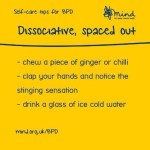
Dissociating is one of the most common responses to abuse and trauma. It involves feeling numb, detached or unreal and (while it happens to everyone once in a while) is experienced more frequently and severely in survivors. Dissociating people vary widely in symptoms and may experience any or all of the things from the following list.
You may be dissociating if you:
find yourself staring at one spot, not thinking anything
feel completely numb
feel like you’re not really in your body, like you’re watching yourself in a movie.
feel suddenly lightheaded or dizzy
lose the plot of the show or conversation you were focused on
feel as if you’re not quite real, like you’re in a dream
feel like you’re floating
suddenly feel like you’re not a part of the world around you
feel detached and far away from other people, who may seem mechanical or unreal to you
are very startled when someone/something gets your attention
completely forget what you were thinking just a moment ago
suddenly cover your face or react as if you’re about to be hurt for no reason
can’t remember important information about yourself, like your age or where you live
find yourself rocking back and forth
become very focused on a small or trivial object or event
find that voices, sounds or writing seem far away and you sometimes have trouble understanding them.
feel as if you’ve just experienced a flashback (perhaps rapidly) but you can’t remember anything about it.
perceive your body as foreign or not belonging to you
(likes and reblogs always taken as support)
To my anon asking about dissociation. I hope you see this.
I thought dissociation was only when I have straight up out of body experiences turns out I’m dissociated like 99% of the time lmso
My son and I both had rough days yesterday, and right before bedtime,
my wife and I were talking to him about good days and bad days, limits,
and why at a certain point we all start to feel overwhelmed and fall
apart. I considered bringing up spoon theory, but thought it would be a bit too abstract for him. So instead, I started talking about about Captain America’s shield.
Because
in general, every day has good stuff and bad stuff. And just like Cap,
we all have a shield we can use to deflect some of the bad stuff and
keep it from getting to us. But sometimes there’s too much stuff to
block it all, and Cap gets hurt. We all have bad days like that
sometimes, where there’s just too much.
What makes life trickier
is that your shield can change size. If you’re hungry or overtired, your
shield might shrink down to the size of a saucer, which makes it harder
to deflect anything. On the other hand, if you’ve had a good night’s
sleep, gotten some good exercise, and had fun with your friends, you
could end up with a super-shield that’s as big as you are. (Or even a
full suit of Iron Man armor. We went off on a tangent at this point,
wondering why Tony doesn’t go to Wakanda and make an Iron Man suit out
of vibranium.)
As a metaphor, Cap’s shield worked well. We talked
about why something might not bother you one day, but the same thing
might really get to you on another, depending on how big your shield is
that day, and how much else you’ve been trying to deflect. It also
seemed to be a good way of talking about self-care, and ways to
strengthen your shield so it wouldn’t shrink or crack.
Don’t know if it will be helpful to anyone else, but it was a good conversation with my son, so I figured I’d put it out there.
Oh hey look, something that ISN’T TOTAL FUCKING BULLSHIT 😀
… Step 1. Realize that you should exercise. Step 2 ? Step 3. HEALTH!
When you’re depressed, that question mark can be a barely navigable labyrinth of garbage fires fueled by physical and mental exhaustion, self-loathing, defeat, and frustration. The last time I found myself trying to hack through that mess during a particularly dark period, I started to come up with my own list of bare-bones, practical tips to help me face the idea of moving again. Now I’m sharing them, in case they might help someone else in a similar position. I stress the word “might.” If you’re depressed, the last thing you need is another a-hole telling you what you should do. But if you’re looking for somewhere to start, I’ve been there too.
First heading? “You don’t have to exercise.” I love this entire piece. It’s going on facebook, that’s how much I love it. A+
“The perfect body is a breathing one. Anything that serves those ends is worth considering. Everything else is noise.”
Friends, family members and loved ones of learning disabled and mentally ill people need to have a working knowledge of what Executive Dysfunction is, and respect the fact that it is a prominent feature of that person’s psychology and life.
Executive Dysfunction is best known as a symptom of autism and ADHD, but it also features in depression, anxiety disorders schizophrenia, OCD (which by the way is also an anxiety disorder), personality disorders; etc, a whole myriad of mental illnesses and disabilities can result in executive dysfunction.
Years ago when I was like 14 and had recently learned of my autism diagnosis, I watched a youtube interview between autistic people, and an autistic woman said something along these lines:
“Sometimes, a lightbulb will burn out, but I cannot change it. I have the physical capability to change the lightbulb, and I want to change the lightbulb, and I know I need to do it, but because of my autism I just don’t do it. So the lightbulb remains unchanged for weeks. Sometimes people have to change the lightbulb for me.”
When she said that I related so much, because constantly throughout my whole life I have wanted and needed to do things with my wanting and needing being akin to my spurring an extremely stubborn horse who refuses to move. For the first time I learned that I wasn’t just “lazy”, I had a condition that prevented me from doing things as easily as other people can, but unfortunately it took me years since then to understand that.
Imagine that you are a horserider, but your horse is entirely unwilling to move even if you want to move. You dig in your heels, you raise the reins, but the horse refuses to respond. Your wants and needs are the rider, and your executive functions (the parts of your mind responsible for getting things done) are the horse.
I think it’s incredibly dangerous for neurotypical loved ones to not understand, or be aware of, or respect executive dysfunction. Neurotypical can assume that we are just being lazy, careless, selfish or difficult, when in reality we want to do the thing but our brains prevent us from consistently and reliably doing the thing.
That misinterpretation can lead to toxic behavior and resentment on the part of the loved one, which will harm us emotionally and do us a lot of damage gradually over time.
That damage can take the form of internal self-criticism, complicating executive dysfunction even further and making it worse.
UnitedHealth Group is offering free mental health services to anyone in the country who was emotionally affected by the shooting at Pulse in Orlando – even if you don’t have health insurance.
Optum will operate a 24/7 helpline, and users can speak to a trained mental health professional for as long as they need. Individuals can call toll-free at 866-342-6892. The company is also providing access to their benefits site, which contains mental health information like professional tips on how to manage anxiety.
“The helpline can be an easy, accessible way for people to reach out,” William Bonfield, chief medical officer of OptumHealth Behavioral Solutions, told The Huffington Post. “It can provide support, an opportunity to talk and help a person decide if mental health treatment may be helpful.”
Please please please take advantage of this if you need it! Mental healthcare is so important but can be so freaking expensive, and processing Pulse might take a lot out of you. That’s okay – help is out there. And if you’re looking for someone LGBTQ-specific to talk to, the Trevor Project and Trans Lifeline are available for you too.
There’s also SAMHSA’s Disaster Distress Helpline! The Disaster Distress Helpline is a national hotline dedicated to providing year-round immediate crisis counseling for people who are experiencing emotional distress related to any natural or human-caused disaster.
This toll-free, multilingual, and confidential crisis support service is available to all residents in the United States and its territories. Stress, anxiety, and other depression-like symptoms are common reactions after a disaster. Call 1-800-985-5990 or text TalkWithUs to 66746 to connect with a trained crisis counselor.
Kristen Bell is one of the most recent stars to push past stigma and declare her depression and anxiety worth talking about.
And for that, I am thrilled.
It means that once again, there is another person, who seems so ‘normal,’ finally showcasing that, HELLO THERE, this is a real thing. And it knows no boundaries.
As a person who has had mental health issues for quite some time, diagnosed or not, I can basically agree 100% with this. And I wish, I wish, with all my might, that between her efforts and mine, and the efforts of all those other anxious or depressed souls out there, we can finally feel alive.
I want the anxious Plain Janes with no ‘big’ accomplishments to stand up with me, and say ‘I’m still here despite it all.’
I want the hard-working and depressed people to stand up with us, and declare ‘This isn’t shameful.’
I want my bipolar friends who fight internal demons to rally and shout ‘We’re people, too.’
I want my schizophrenic sisters and brothers to get together and yell from the rooftops that ‘We’re MORE than medication.’
Because we are.
We are MORE than this. We are MORE than medication, therapy, and doctor’s visits.
If you know a person in your life with a mental illness (I guarantee you do,) I want you to challenge yourself. Don’t get overwhelmed, but spend some time with them. Get to know their demons, and what they fight with every day. The things that make them struggle. The thoughts they have against their own selves.
I know from personal experience that just going to a counsellor doesn’t cut it. I need time to process my feelings, work through them, and count my victories. Sometimes that means someone points them out for me. Sometimes that means someone has to tell me over a dozen times a day that I am special. That I am okay. That I am loved, wanted, insert-positive-adjective-here. Sometimes that means that I need to just tell someone, anyone, that despite it all, it’s hard to live. I feel lonely. I feel afraid. I feel weak.
I can’t even hold back the tears coming down my face anymore. I’m so scared. But I’m doing this anyway, like I’ve done for the past year or more. (When did I start this, again?)
I am done hiding. I don’t want to hide anymore. If you still need space, though, take it. I’ll be a sounding board for anyone who’s struggling, because I’ve been there. I might not know how your story is going, but I will be a post to lean on if you need me.
We’re in this together, no matter how alone we feel.


 Holding the Bowl