Can you call up a therapist and be like “hi, I’m therapist shopping”? Can you schedule an appointment with a therapist and then be like “actually I have some questions and I want to spend part of this appointment talking about your practice and whether or not it is garbage?”? Are you expected to phone interview/screen your therapists if you are shopping around for a therapist?
If you’re seeing one therapist are you supposed to/not supposed to tell them if you start seeing another therapist? Is it possible to cheat on your therapist?
I know this one! Or, at least, I know a way to do it, because I’ve done it.
1) When you call them up (or email them, which I prefer, because PHONE, EW), you ask if they’re taking new patients.
2) If they say yes, say something along the lines of “Great! I’m looking for a new therapist. Would it be possible for me to schedule an appointment so we can see whether we’d be a good fit for one another?”
IF THEY SAY NO, THEY DON’T DO ‘INTERVIEWS’: they’re a dick, you don’t want them anyway, don’t bother to make an appointment
3) Assuming everything is a go, head over to the appointment. Bring your notebook, pen, and questions. Also, if possible, have a very brief rundown prepared of what you’d like to accomplish with your therapy (or even what you think your biggest issues are).
4) Introduce yourself. Reiterate that you want to see if the two of you would be a good fit, so [a nice little social laugh or smile here, while holding up your notebook] you brought questions.
IF THEY DON’T LIKE THAT: they’re a dick, you don’t want them anyway, cut the meeting short
5) Give the rundown of what you want, what your issues are, whatever. See how they react.
IF YOU FEEL WEIRD AT ALL ABOUT THEM: they may not be a dick, but if you don’t feel comfortable with them, then it’s going to be a shit therapeutic relationship
6) Ask your questions — about their therapeutic approach, why they entered the field, whether they feel comfortable working with *your* needs (I, for instance, specifically told my awesome therapist that I needed her to tell me absolutely nothing about her personal life or experiences — as much as possible, I needed a blank wall to bounce things off of. It’s been years now, and I THINK she’s seen at least a couple of episodes of Doctor Who. I THINK. That’s all I’ve got. It’s amazing).
AGAIN, IF YOU FEEL WEIRD ABOUT THEM: go with your gut — your therapy is not the time or place to try and soldier through
7) By this point, you’ve probably hit the 45 minute mark, and you’ll know if you want to see this person again.
IF YES, say that this was a really great meeting, and you’d like to set up a regular appointment.
IF NO, say “Thanks for meeting with me.” If it wasn’t too terrible, feel free to add in whatever social niceties you want to lessen the blow (“I have appointments with a few other people, still, but thank you again!”), or you could just skedaddle as soon as possible.
IF YOU’RE NOT SURE, go a bit heavier with the social nicety: “I still have appointments with a few other people, but I really enjoyed our meeting. I’ll let you know as soon as possible if I’d like to schedule another one. Thanks again!”
Regarding current therapists: If they’re toxic, get rid of ‘em before you even start interviewing others. Nobody needs that kind of garbage. Otherwise, you could keep seeing them while you interview others, and then the second you find one you like (and you schedule your next appointment), get rid of your current one. You don’t have to say why — just say that you’d like to cancel future appointments. Do it over email, if you want. If you like them, you can tell them that you just need something different now, but that you “really appreciate all the work we’ve done together” or something. If you don’t like them, just cancel. They don’t need to know jack.
IF YOUR CURRENT THERAPIST SAYS SHIT ABOUT YOUR LEAVING — and I mean anything other than a positive hope for you in the future — then they were a dick and you were right to find someone else. Who needs passive-aggressive bullshit from a therapist? Nobody, that’s who.
So that’s my philosophy/style with regard to therapist shopping — I may be completely wrong, but it’s worked for me so far. Good luck!
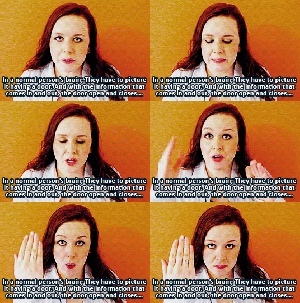
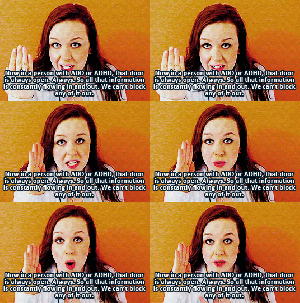
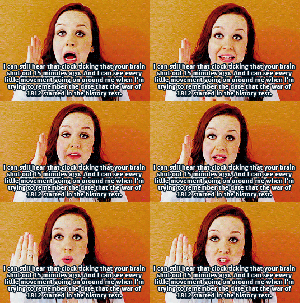
People with sensory processing disorders like fibromyalgia and other chronic pain diseases have the same experience. Until I started talking to people with ADHD, I didn’t realize it wasn’t normal to spend every waking minute feeling your clothes against your skin or cataloging the changes in sound and light and smell. It wasn’t until I watched Elementary and saw the characters around Sherlock not noticing sensory details around them that he picks up that I realized it’s not normal for brains to do this.
Unlike folk with ADHD, though, I never had this experience full blown until I was in my twenties. It build gradually over about a decade, and I thought I’m just getting older. I didn’t have these issues as a young child, so my lack of focus in my mid-20s had to be age-related, not ADHD, right?
And that’s how you trick yourself into thinking you’re normal for years. It’s easier than admitting difference, even as you carefully pick out only silk and pure cotton clothes, wash everything (including yourself) in unscented soap, and eat only a handful of foods (mostly sugar, because it’s boring and you don’t have to think about it much).
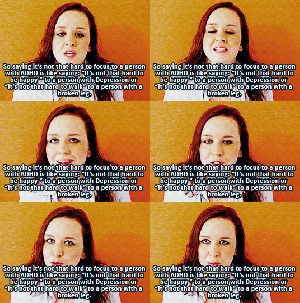
Spoonies, pay attention: if you can’t focus, it may not just be the pain. What else is your brain, primed for pain signals, now also processing without end?
Friends, family members and loved ones of learning disabled and mentally ill people need to have a working knowledge of what Executive Dysfunction is, and respect the fact that it is a prominent feature of that person’s psychology and life.
Executive Dysfunction is best known as a symptom of autism and ADHD, but it also features in depression, anxiety disorders schizophrenia, OCD (which by the way is also an anxiety disorder), personality disorders; etc, a whole myriad of mental illnesses and disabilities can result in executive dysfunction.
Years ago when I was like 14 and had recently learned of my autism diagnosis, I watched a youtube interview between autistic people, and an autistic woman said something along these lines:
“Sometimes, a lightbulb will burn out, but I cannot change it. I have the physical capability to change the lightbulb, and I want to change the lightbulb, and I know I need to do it, but because of my autism I just don’t do it. So the lightbulb remains unchanged for weeks. Sometimes people have to change the lightbulb for me.”
When she said that I related so much, because constantly throughout my whole life I have wanted and needed to do things with my wanting and needing being akin to my spurring an extremely stubborn horse who refuses to move. For the first time I learned that I wasn’t just “lazy”, I had a condition that prevented me from doing things as easily as other people can, but unfortunately it took me years since then to understand that.
Imagine that you are a horserider, but your horse is entirely unwilling to move even if you want to move. You dig in your heels, you raise the reins, but the horse refuses to respond. Your wants and needs are the rider, and your executive functions (the parts of your mind responsible for getting things done) are the horse.
I think it’s incredibly dangerous for neurotypical loved ones to not understand, or be aware of, or respect executive dysfunction. Neurotypical can assume that we are just being lazy, careless, selfish or difficult, when in reality we want to do the thing but our brains prevent us from consistently and reliably doing the thing.
That misinterpretation can lead to toxic behavior and resentment on the part of the loved one, which will harm us emotionally and do us a lot of damage gradually over time.
That damage can take the form of internal self-criticism, complicating executive dysfunction even further and making it worse.
edited for easier reading!
I think about this a lot, because I have to. In my own life, as a parent who struggles with executive dysfunction and yet has to teach a child basic life skills, it’s important to know my blind spots and learn to function around them. He’s watching me and learning from my example, so I have to do my best to explain what I can’t always do, and try to do it anyway.
Executive function is such a fundamental and yet hidden trait. It is in charge of reasoning, flexibility, problem solving, planning, and execution/prioritization of necessary steps in any action.
Each task is never one task. Take changing the lightbulb – from beginning to end, it’s a series of steps that must be put in proper order:
Notice light bulb is burnt out.
Recognize that it can be fixed by putting in a new light bulb
Remember where new light bulbs are stored
Go to light bulb storage area
Select new one
Find stool or chair to stand on
Take out old bulb, put in new one
Screw in bulb
Replace chair or stool to previous spot
Throw away old bulb
That’s not even all of them, but it’s a good enough summary for now. There are hidden stumbling blocks in every single step.
A burnt out bulb may go unrecognized as a problem – there’s two other bulbs in the room, it’s a little dimmer, so what? It might take all three burning out before you see it as a problem.
Maybe you forgot where the bulbs are, because it’s been a while. Searching the house is a task you put off, because it’s messy/disorganized/big/you have other more pressing matters. The bulb can wait.
You find the bulb storage, but you’re out of new ones. You have to shop. You’re busy, you put it off until the next time you shop, by which time you’ve forgotten you need a light bulb. Repeat cycle.
You’ve been depressed for a while, or maybe you’re just a messy person. A stack of important documents is on the chair you’d use to stand on to get to the bulb. You know if you move those documents you’ll forget where they are, and it’s tax stuff/homework/your mom’s birthday card, and you can’t forget that. The bulb gets put aside until you deal with those things. But you don’t want to deal with them now, so the bulb waits.
Throwing out the bulb requires safe disposal so that you don’t break it and accidentally cut yourself, or someone else in your home. You have no idea how to safely dispose of it. You put off changing the bulb until you figure out what to do with the old one.
On and on and on. Each step requires problem solving, prioritization, and reasoning. These are the hidden processes that go on in our minds every single moment of every day. Difficult tasks build up, compounding the problem of completing others, until each action requires ten more before you can solve the minor problem you started with. Changing a light bulb ends in a night of doing your taxes. Doing the dishes ends in standing in the dish soap aisle at the grocery story for a half hour trying to figure out which soap to buy for the dishwasher.
When a simple action requires the same effort from you as the most complex, abstract problem-solving…. to put it mildly, you’re fucked. Every day tasks require exhausting mental gymnastics.
So, be kind to the person who can’t seem to change a light bulb. There’s a lot that can stand in the way.
this is such a good addition to my post
Important info!
“Difficult tasks build up, compounding the problem of completing others, until each action requires ten more before you can solve the minor problem you started with. Changing a light bulb ends in a night of doing your taxes. Doing the dishes ends in standing in the dish soap aisle at the grocery story for a half hour trying to figure out which soap to buy for the dishwasher.”
My husband gave me an idea ages ago, and I wanted to actually put it into motion. So today, I give you the ‘Being Visible’ line of shirts.
The goal of Being Visible is to allow people with mental illness, or other invisible illnesses, to help make people aware of their coping abilities on any given day by using the simple image of a battery at various charging levels:
Low charge – low ability to function ‘normally’ or perform daily tasks. May need assistance or frequent breaks Medium charge – diminished, but capable of performing routine or simple tasks during the day. Some assistance may be needed. Full charge – able to perform daily tasks with little to no assistance or reduction in speed, effort, etc. Little to no assistance needed.
These images will be placed front and centre of various T-shirt/tank top designs, to enable wearers to non-verbally alert people around them of their limitations, if they so choose. Of course, as ability levels change, so too can the shirts. On the back of the shirt is the simple text line ‘Being Visible’ above the rod of Asclepius, the common symbol for medicine.
75% of the proceeds will go to the American Foundation for Suicide Prevention. The remaining 25% will go towards my ability to purchase several units of each shirt for my own use.
You can find the shirts at the links listed below. The target goal is 75 units each.
There have been articles making the rounds again that psychologists are suggesting a certain someone has a severe mental illness.
Again. This is happening again. This spread of information and headlines, and clickbait, and general tomfoolery surrounding mental illness is once again making my disappointment in humanity rise.
First, it was the armchair doctors on social media saying ‘He’s crazy, he’s clearly got issues, he must have [insert dx here]’ Then, it was the preliminary rounds of ‘Psychologists are suggesting that he has a mental illness.’ Now, it’s ‘Psychologists are suggesting that he has a severe mental illness.’
How about….and I know this is super unheard of….
WE CUT THAT SHIT OUT?
I don’t care whether or not he has a mental illness. I do care if he gets help, sure. But this….this whole idea that we can explain away the horrible things he’s done or said or blundered up with ‘mental illness’ is absurd. Or, if you’re not using it to explain his horrible behaviour, you’re using it to exemplify his lack of fitness to do his job.
BOTH OF THESE LINES OF THINKING CAUSE HORRIBLE PROBLEMS.
So, let’s start from the beginning. Psychologists, as medical professionals, should really fucking know better than to throw out even the suggestion of a diagnosis to the press, knowing full well the horrible stigma that still surrounds mental illness to this day. On top of that, as medical professionals, it’s kinda rude to be talking about someone, regardless of how high-profile they are, in a medical context outside of the context of their care. You don’t see oncologists blasting that so-and-so probably has cancer all over the press, so why are you broadcasting very real illnesses like they’re some kind of joke?!
Furthermore, mental illness is not an indication of someone’s ability to say or do horrible things. I’ve been in a fight like this before, and it’s really not fun. Not only does using mental illness as a catch-all for horrible behaviour endanger the victims of said person’s horrible behaviour (or at least fail to vindicate and acknowledge the harm said person is doing with the aforementioned behaviour,) it also removes accountability from the person in question, especially one with blame-shifting tendencies. ‘Oh, he doesn’t know what he’s doing, he’s mentally ill.’ This line of reasoning suggests that mentally ill people are unpredictable, volatile, and a danger to others. This is not always the case, and it’s a dangerous precedent to set, much like the HIV/AIDS crisis in the 80s [people being avoided for fear of contagion/people avoiding mentally ill people for fear of harm, people generating horrible stereotypes because of an illness that’s still misunderstood…]
On to the next point. Mental illness does not mean an inability to do one’s job. Ever. Full stop. Next question, please. High profile duties sure do require a lot of stamina, both physically and mentally. But DO NOT TELL ME that mental illness precludes someone from being a capable, functional member of society. I will shred you with my WORDS. Mental illness, much like any other illness, will set limits for each individual with a diagnosis. Some people have lower limits than others, and THAT IS OKAY. But to suggest that the reason someone is unfit because of a hypothetical diagnosis just fuels the hate fire that is mental health stigma, and I will fight to the death to make sure that that slows down or ends.
I’ve experienced workplace discrimination because of my limits that are caused by mental illness and self-care. Do you have any idea how demoralising that is? It makes it WORSE. I was passed up for promotions, told it’s useless to try, and not taken seriously when I had legitimate concerns about how things were being done. Eventually, the amount of nonsense I was dealing with came to a head, and I was forced to resign or risk my health.
People are already not listening when we try and make mental health a serious and valid issue, and this is NOT helping. It’s an insult to the movement that vies and pushes for mental illness to be treated the way it deserves to be treated in society; as a medical condition, a quirk/downfall/dysfunction/pick-a-word of one of the most important organs in the human body. Articles floating around in the news about how readily someone can be slapped with the label of mentally ill sends more people away from help and care, because they are afraid of what will happen if people find out.
Cut.that.shit.out.
Treat mentally ill people as people, ask them what their needs are, remember that they are more than medication and therapy and the doctors on their prescription labels. They are people, who deserve respect from a society that’s lambasting them without even acknowledging the harm.
Sometimes depression is apathy. It is staring at the roof for hours and it noticing the time ticking by. It is clicking ‘next episode’ while not knowing what has happened for the last two seasons. It is reading page after page as the words fall out of your head with every flip. It is eating exclusively cereal for days at a time.
Sometimes depression is sadness. It overwhelms your soul like a tsunami, making you lurch in the darkness and gasp for breath like it is a butterfly just out of reach. It is sobbing in the shower over nothing in particular. It is concocting irrationally sad hypotheticals in which your loved ones die or leave you or stop caring and you are alone.
Sometimes depression is frustration. It is the stack of rotting dishes in the sink that you know you have to clean but you cannot bring yourself to stand up let alone scrub. It is wanting to tear your hair out from self hatred and pent up anger at your brain which has put you in this position. It is the unanswered messages from people who care which drive you mad in the night as you can’t string the right words together in the right order to do them justice.
Sometimes depression is absent. It is bursts of energy and productivity, designed to trick you into thinking that the light of the end of the tunnel is right there, before it throws you down another dark corridor. It is waking up feeling peppy and bright and energetic, allowing to get on with you life and be happy for an instant, but meeting you at the end of the day like a circling vulture ready to pick apart every choice you made and feast on your mistakes.
Sometimes depression is pathetic. It is feeling accomplished when you get out of bed in the mid-afternoon. It is streaming tears as you struggle to swallow slimy packet noodles. It is pushing away those who love you and support you because loneliness is paramount, and the depression must be fed, must be appeased, must be put before everything.
Sometimes depression is comforting. It is an old friend with open arms and a warm bed, ready and willing to pull you under, to keep you floating in its dark waters, to fill your lungs with its greyscale and preserve you as a message to the rest.
Sometimes depression is unsatisfactory. It is hope-crushing routine designed to keep your spirit in orbit. It is unchecked to-do lists and unfinished projects. It is fleeting dreams which never got the run needed to take off.
Sometimes depression is pressure. It is a physical presence looking over your shoulder, looming, predicting failure and ensuring it is correct. It is tightness in your chest for no reason. It is headaches and stomachaches and heartaches and aches that wrack your body for any sign of resistance, to draw it out and destroy it.
Depression is multifaceted. It is an enemy like any other, complete with weaknesses which can be exploited until it has been conquered. Do not let it win. Seek help, surround yourself with a positive support network, remember that you are not alone, and you will beat this ❤
I used to really worry that medications would harm my creativity and it’s part of why I resisted taking them. It hasn’t. If anything it’s allowed me to be more focused and able to complete things. My imagination hasn’t changed just because I’m on anti-depressants.
a lot of my family didnt want me to start medications because they thought it would impact my ability to create, and I believed them.
Now im getting better and better with my art because i dont have to fight through the brainfog or the constant panic attacks and can dedicate my energy to my work.
Antidepressents didnt take my emotions away, they made them easier to handle.
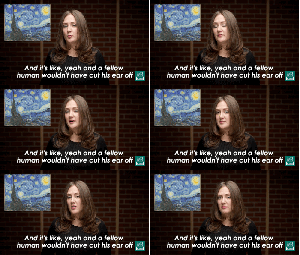
also Van Gogh was literally in an asylum receiving mental health treatment when he painted ‘Starry Night’. It was one of the most stable & productive periods of his life, despite the fact that wasn’t hugely effective treatment, because they didn’t really have modern understandings of what things work on mental illness. Like, you know. Medication.
This is why we don’t romanticize mental illness or chronic disease.
ALSO because I am reading a book of his letters right now, Van Gogh himself addressed the idea that the best art came from pain and said that his art tended to suffer when his depression was hitting pretty hard. So don’t even pull that shit where you give his untreated depression credit for his art. Van Gogh would have hated that, and if antidepressants/better treatment of mental illness HAD existed then we might have even more of his work now.
Everything everyone said above me x1000000. I have done so much more art /with/ medication, than when I’m curled up in bed almost unable to move or feel. This is less ‘what he created’ and more ‘what other beauty might we have seen?’















 Holding the Bowl