spacemomnephmoreau:

kosmonauttihai:

rollerskatinglizard:

ceekari:

stayhungry-stayfree:

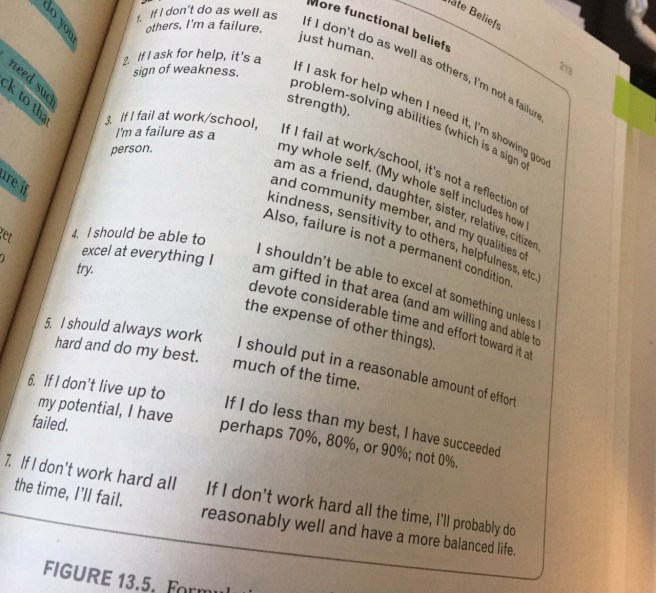
This is a really helpful page in my CBT textbook for tackling some of the maladaptive beliefs we often hold. The first column lists the rules and assumptions we often may tell ourselves, while the second column is a more functional belief. Just thought I would pass this along. Be kind to yourselves, friends❤

Oh my god, number 5. And 6, and 7.

I frigging needed that.

Failure is not a permanent condition.

The text on the image:

  1. Maladaptive belief: 

    If I don’t do as well as others, I’m a failure.
    More functional belief:

    If I don’t do as well as others, I’m not a failure, just human.

  2. Maladaptive belief:  If I ask for help, it’s a sign of weakness.
    More functional belief: If I ask for help when I need it, I’m showing good problem-solving abilities (which is a sign of strength).
  3. Maladaptive belief:  If I fail at work/school, I’m a failure as a person.
    More functional belief:

    If I fail at work/school, it’s not a reflection of my whole self. (My whole self includes how I am as a friend, daughter, sister, relative, citizen, and community member, and my qualities of kindness, sensitivity to others, helpfulness, etc.) Also, failure is not a permanent condition.

  4. Maladaptive belief:  I should be able to excel at everything I try.
    More functional belief: I shouldn’t be able to excel at something unless I am gifted in that area (and am willing and able to devote considerable time and effort toward it at the expense of other things.
  5. Maladaptive belief:  I should always work hard and do my best.
    More functional belief: I should put in a reasonable amount of effort much of the time.
  6. Maladaptive belief:  If I don’t live up to my potential, I have failed.
    More functional belief: If I do less than my best, I have succeeded perhaps 70%, 80%, or 90%; not 0%.
  7. Maladaptive belief:  If I don’t work hard all the time, I’ll fail.
    More functional belief:

    If I don’t work hard all the time, I’ll probably do reasonably well and have a more balanced life.

Many of my girls need to accept this.

lysikan:

geekdawson:

one of the more valuable things I’ve learned in life as a survivor of a mentally unstable parent is that it is likely that no one has thought through it as much as you have. 

no, your friend probably has not noticed they cut you off four times in this conversation. 

no, your brother didn’t realize his music was that loud while you were studying. 

no, your bff or S.O. doesn’t remember that you’re on a tight deadline right now.

no, no one else is paying attention to the four power dynamics at play in your friend group right now.  

a habit of abused kids, especially kids with unstable parents, is the tendency to notice every little detail. We magnify small nuances into major things, largely because small nuances quickly became breaking points for parents. Managing moods, reading the room, perceiving danger in the order of words, the shift of body weight….it’s all a natural outgrowth of trying to manage unstable parents from a young age. 

Here’s the thing: most people don’t do that. I’m not saying everyone else is oblivious, I’m saying the over analysis of minor nuances is a habit of abuse. 

I have a rule: I do not respond to subtext. This includes guilt tripping, silent treatments, passive aggressive behavior, etc. I see it. I notice it. I even sometimes have to analyze it and take a deep breath and CHOOSE not to respond. Because whether it’s really there or just me over-reading things that actually don’t mean anything, the habit of lending credence to the part of me that sees danger in the wrong shift of body weight…that’s toxic for me. And dangerous to my relationships. 

The best thing I ever did for myself and my relationships was insist upon frank communication and a categorical denial of subtext. For some people this is a moral stance. For survivors of mentally unstable parents this is a requirement of recovery. 

If it wasn’t stated outright – it wasn’t said.

Workbooks and Self-Help Books for Mental Illnesses & Symptoms

opheliabpd:

Hello everybody! I was just thinking about how I always recommend people who can’t get therapy to use workbooks, so I thought I’d make a quick list of some you could look at. I’m not comfortable recommending books for things I have not struggled with (like, if I was looking at the description of a book on OCD I’d have no idea if it was good or not) but I think I’ve covered a lot. Some of these are series which have workbooks for specific disorders like bipolar, etc., if you want to find some. Plus, you don’t have to be diagnosed with something to use a workbook if you think it’ll help you.

Workbooks are sometimes made to be done in conjunction with therapy, or something like that, but anyone can still get something out of them if you put in regular work and try to apply the skills.

I’ve linked them all the Amazon because they’re usually cheaper on there.

For reference: DBT = dialectical behaviour therapy, CBT = cognitive behavioural therapy, ACT = acceptance and commitment therapy


Anxiety, Depression, and Intrusive Thoughts

Borderline Personality Disorder

Interpersonal Problems

Anger

Trauma and PTSD

Self Harm

General Emotional Issues/Multiple Disorders

ube-makaveli:

revan-trevelyan:

Sometimes the help you need isn’t the help you want. Call 1-800-273-8255 if you’re thinking of suicide.

This comic meant a whole lot to me. It was sincere in its depiction and treated the issue through the eyes of a grounded person. Not some godly hero saying everything is better than it seems, but a person trying his best before bringing her somewhere who can actually help.

What to do if your parents refuse to let you have access to mental healthcare

abusedkidproblems:

If you have the ability to pay for it, are close enough to one, and can get transport there and back a lot of grad schools that have psych programs offer therapy for cheap so that the students can get in the hours they need. University of Louisville for example offers therapy for $15 a session.

If you are able to do this and are prescribed medicine, but your parents won’t help you pay for it this post gives you several ways to pay for your meds.

However, if you are not able to get these services there are ways that you can help manage your mental illness on your own.

For starters you can use shitborderlinesdo‘s diagnostic checklists or this list of self-screening quizzes to try and figure out what exact disorder(s) you may have. From their you can work with self help tools that will be geared towards what you have.

CBT and DBT are two of the most common types of therapy. Here is a post that explains a little bit about the differences between the two and ACT.

CBT self-help tools

DBT self-help tools

Other helpful tools

Not sure if there is a minimum age to use it or not (couldn’t find anything on the site) but Maven Clinic offers mental health (and other medical) appointments online. It’s not free (appointments range from about $20-$70)), but they do send out freebie codes from time to time. There is also a forum community where you can ask general questions as well. 

transgenderteensurvivalguide:

Lee says:

I made a mental health page! I’m copying the current contents of that page below so it’s rebloggable. I’m still working on the page; this is the first reveal of it, but it isn’t fully complete. If there’s anything you’d like to see added, send an ask!


Getting help:

Grounding:

Breathing:

Distress tolerance:

Emotion:

Self-talk and thinking:

Self-care:

Relaxation and mindfulness:

Anxiety:

Specific types of anxiety:

Stress:

Depression:

Panic attacks:

Dissociation:

Obsessions and compulsions:

Paranoia:

Flashbacks:

Self-esteem:

Impulsivity and mania:

Abuse:

Trauma:

Eating disorders:

Additional resources/info:

Apps:

spacedogprincess:

jerseyfiredragon20:

thewhaleridingvulcan:

crystalsoulslayer:

I always hate it when people are all “so do you go to school, or are
you working, or” and I either have to

  • make up some lie, or
  • eventually get
    around to “I am not working because of depression/anxiety,” and
    subsequently have to deal with whatever bullshit-riddled and completely
    unsolicited opinions on mental illness this stranger feels obligated to
    share with me.

So my therapist was like, “You don’t have to do either.
You can just say you haven’t worked in a while because you’re recovering
from an illness.”

I tried it when the home inspector was here today, and it fucking worked.
He was like, “oh, I’m sorry, are you doing better now,” and I’m like
yeah, and don’t worry, it’s not contagious, awkward laugh, and we moved
on.

MY THERAPIST. IS A GENIUS. Because it is an
illness, so it’s not a lie to say that, and it’s also none of his
business to know specifically what it is, and I clearly don’t want to
give more details, so we should move on from this topic. MY THERAPIST IS A GODDAMN GENIUS.

Dude I needed this. I never know what to say when people ask if I work because I’m severely disabled and don’t work.

REBLOG TO SAVE A LIFE HOLY SHIT

To add, this works on job interviews too.  I once had to answer the ‘so whats up with this gap of 8 months in your resume where you were unemployed?” and I just said I had suffered an illness and I needed time to recover.

It’s easy enough, not a lie, and puts them on edge enough that they usually don’t go digging.

cream-and-stars:

descantforhope:

almostdrchelsearar:

themidwifeisin:

PSA

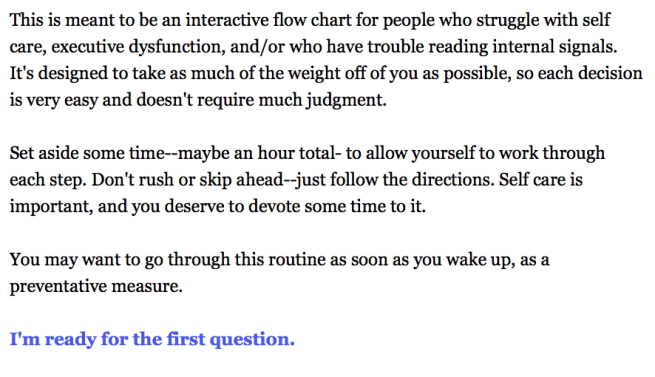
You feel like shit is a website set up to help you get out of that funk/improve things just enough to not feel horrible and miserable all the time.  It’s amazing.

Whether you struggle with mental health problems all the time or whether this is a new/temporary state for you, this guide is an easy and judgement-free self-care tool.

PLEASE TRY IT OUT!  Really!  You just click through the questions to answer and follow simple instructions that in the end, ideally, will help you to feel more comfortable and stable on a daily basis. 

Good luck!  Have fun!

Wow this self-care took is incredible.

I’m feeling ok right now and am about to settle into bed (but this was scheduled hence the early morning post) but I flipped through it for awhile just to see what it is like and holy crap it’s like a choose-your-own-adventure of self-care activities that not only aims to engage you in positive feel good behaviors but also tries to match its suggestions to your level of energy/ability/can even.

I think I am going to use this definitely when I am having a bad time but maybe also try to incorporate it into my life on at least a weekly if not a daily or semi-daily basis.

This is super super awesome!

Adding this to my resource list.

I LOVE this. Love this.