
Okay, here’s a good list to pass around. It took me several years to even think about looking up the symptoms of depression, and I think it would have done my good to just be presented with them when I was in my teens, but no one told me…. so, here they are.
- Feelings of helplessness and hopelessness. A bleak outlook—nothing will ever get better and there’s nothing you can do to improve your situation.
- Loss of interest in daily activities. No interest in former hobbies, pastimes, social activities, or sex. You’ve lost your ability to feel joy and pleasure.
- Appetite or weight changes. Significant weight loss or weight gain—a change of more than 5% of body weight in a month.
- Sleep changes. Either insomnia, especially waking in the early hours of the morning, or oversleeping (also known as hypersomnia).
- Anger or irritability. Feeling agitated, restless, or even violent. Your tolerance level is low, your temper short, and everything and everyone gets on your nerves.
- Loss of energy. Feeling fatigued, sluggish, and physically drained. Your whole body may feel heavy, and even small tasks are exhausting or take longer to complete.
- Self-loathing. Strong feelings of worthlessness or guilt. You harshly criticize yourself for perceived faults and mistakes.
- Reckless behavior. You engage in escapist behavior such as substance abuse, compulsive gambling, reckless driving, or dangerous sports.
- Concentration problems. Trouble focusing, making decisions, or remembering things.
- Unexplained aches and pains. An increase in physical complaints such as headaches, back pain, aching muscles, and stomach pain.
I’d like to add that in my experience, and from what I’ve heard from others, if the depression has been going on unnoticed for a long time, you won’t have noticed these ‘changes’, they’ll have snuck up on you and become an unremarkable part of your life…
Along with the concentration problems is psychomotor disruptions – either you’re agitated and constantly moving your hands, flicking your fingers, pulling your hair… or you’re clumsy, like you’re surrounded by cotton wool and your extremities are further away than they used to be, so things like writing and walking become really difficult.
Tag: mental health
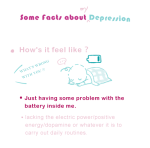
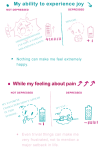


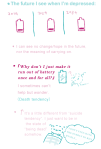

some thoughts about my depression.
my mum asked yesterday so i did this for her.
it may not apply to all people with depression, because different person can have different symptoms.
Yeah….. This sums it up


About 2.6 percent of American adults – nearly 6 million people – have bipolar disorder, according to the National Institute of Mental Health (NIMH). But the disease, characterized by significant and severe mood changes, is still dangerously misunderstood.
Bipolar disorder is vastly different from the normal ups and downs of everyday life, but many have co-opted the term to refer to any old change in thoughts or feelings. The mood swings in someone with bipolar disorder, sometimes also called manic depression, can damage relationships and hurt job performance. It has been estimated that anywhere from 25 to 50 percent of people with bipolar disorder attempt suicide at least once.
Artist Ellen Forney detailed her diagnosis with bipolar disorder in the graphic memoir Marbles: Mania, Depression, Michelangelo, and Me. Forney previously shared her story with us, specifically detailing how her bipolar disorder has affected her creative work.
Below are some poignant pages from the memoir, along with unique commentary into how these panels came to be and what they mean to Forney, in her own words… What Bipolar Disorder Really Looks Like
Mindfulness training helps Alzheimer’s patients and caregivers
Learning to focus on the present may boost quality of life not only for dementia patients but also those who struggle to care for them
Mindfulness training helps Alzheimer’s patients and caregivers
Mothering with mental illness
I am a mother with mental illness – one who is raising a beautiful, caring son.
People With Down Syndrome Are Pioneers In Alzheimer’s Research
Alzheimer’s researchers are increasingly interested in people like McCowan because “people with Down syndrome represent the world’s largest population of individuals predisposed to getting Alzheimer’s disease,” says Michael Rafii, director of the Memory Disorders Clinic at UCSD.
Down syndrome is a genetic disorder that’s best known for causing intellectual disability. But it also causes Alzheimer’s. “By the age of 40, 100 percent of all individuals with Down syndrome have the pathology of Alzheimer’s in their brain,” Rafii says.
People With Down Syndrome Are Pioneers In Alzheimer’s Research






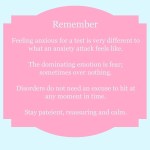

Anxiety & Helping Someone Cope.
I didn’t want to make it overwhelming or too long remember, so I kept it to the main points that benefit me greatly when I’m experiencing an attack.
40 million of Americans alone suffer with anxiety; it’s a horrid feeling when you know someone just wants to help you but you cannot even construct a simple sentence at the time, so please share this in hope that it benefits even just 1 person. Muchos love.

Mind and body: Scientists identify immune system link to mental illness
Children with high everyday levels of a protein released into the blood in response to infection are at greater risk of developing depression and psychosis in adulthood, according to new research which suggests a role for the immune system in mental illness.
The study, published today in JAMA Psychiatry, indicates that mental illness and chronic physical illness such as coronary heart disease and type 2 diabetes may share common biological mechanisms.
When we are exposed to an infection, for example influenza or a stomach bug, our immune system fights back to control and remove the infection. During this process, immune cells flood the blood stream with proteins such as interleukin-6 (IL-6), a tell-tale marker of infection. However, even when we are healthy, our bodies carry trace levels of these proteins – known as ‘inflammatory markers’ – which rise exponentially in response to infection.
Now, researchers have carried out the first ever longitudinal study – a study that follows the same cohort of people over a long period of time – to examine the link between these markers in childhood and subsequent mental illness.
A team of scientists led by the University of Cambridge studied a sample of 4,500 individuals from the Avon Longitudinal Study of Parents and Children – also known as Children of the 90s – taking blood samples at age 9 and following up at age 18 to see if they had experienced episodes of depression or psychosis. The team divided the individuals into three groups, depending on whether their everyday levels of IL-6 were low, medium or high. They found that those children in the ‘high’ group were nearly two times more likely to have experienced depression or psychosis than those in the ‘low’ group.
Dr Golam Khandaker from the Department of Psychiatry at the University of Cambridge, who led the study, says: “Our immune system acts like a thermostat, turned down low most of the time, but cranked up when we have an infection. In some people, the thermostat is always set slightly higher, behaving as if they have a persistent low level infection – these people appear to be at a higher risk of developing depression and psychosis. It’s too early to say whether this association is causal, and we are carrying out additional studies to examine this association further.”
The research indicates that chronic physical illness such as coronary heart disease and type 2 diabetes may share a common mechanism with mental illness. People with depression and schizophrenia are known to have a much higher risk of developing heart disease and diabetes, and elevated levels of IL-6 have previously been shown to increase the risk of heart disease and type 2 diabetes.
Professor Peter Jones, Head of the Department of Psychiatry and senior author of the study, says: “Inflammation may be a common mechanism that influences both our physical and mental health. It is possible that early life adversity and stress lead to persistent increase in levels of IL-6 and other inflammatory markers in our body, which, in turn, increase the risk of a number of chronic physical and mental illness.”
Indeed, low birth weight, a marker of impaired foetal development, is associated with increased everyday levels of inflammatory markers as well as greater risks of heart disease, diabetes, depression and schizophrenia in adults.
This potential common mechanism could help explain why physical exercise and diet, classic ways of reducing risk of heart disease, for example, are also thought to improve mood and help depression. The group is now planning additional studies to confirm whether inflammation is a common link between chronic physical and mental illness.
The research also hints at interesting ways of potentially treating illnesses such as depression: anti-inflammatory drugs. Treatment with anti-inflammatory agents leads to levels of inflammatory markers falling to normal. Previous research has suggested that anti-inflammatory drugs such as aspirin used in conjunction with antipsychotic treatments may be more effective than just the antipsychotics themselves. A multicentre trial is currently underway, into whether the antibiotic minocycline, used for the treatment of acne, can be used to treat lack of enjoyment, social withdrawal, apathy and other so called negative symptoms in schizophrenia. Minocycline is able to penetrate the ‘blood-brain barrier’, a highly selective permeability barrier which protects the central nervous system from potentially harmful substances circulating in our blood.
The ‘blood-brain barrier’ is also at the centre of a potential puzzle raised by research such as today’s research: how can the immune system have an effect in the brain when many inflammatory markers and antibodies cannot penetrate this barrier? Studies in mice suggest that the answer may lie in the vagus nerve, which connects the brain to the abdomen. When activated by inflammatory markers in the gut, it sends a signal to the brain, where immune cells produce proteins such as IL-6, leading to increased metabolism (and hence decreased levels) of the ‘happiness hormone’ serotonin in the brain. Similarly, the signals trigger an increase in toxic chemicals such as nitric oxide, quinolonic acid, and kynurenic acid, which are bad for the functioning of nerve cells.
makes me wonder…
Today’s Victories
When I was discharged from the hospital, I was put in an out-patient program to educate on mental health and coping strategies. One of the biggest things that our teacher, C, taught us, was that despite the things that DO go wrong, there is a success not far away.
I got inspired to start posting my daily successes, which I called ‘Victories’, before I went to sleep at night. Most days I was good about it, some days I slipped. I’m going to endeavour to write them here and start up again, because it’s inspired some of my friends. If I, a simple little lady from Canada, can inspire someone, then shit, I might as well keep on going.
So today’s victories are:
Woke up despite an exhausting night.
Made it to my counselling appointment.
Took care of the baby despite the exhaustion.
Had a fun visit with my grandmother.
Overcame some hefty grumpiness during the day.
Problem-solved an issue with the house.
How Proper Self Care Can Reduce Your Stress
With our busy lives, we sometimes forget to prioritize self care. However, taking care of yourself and pampering yourself on a regular basis is an important for stress management, your physical health and your emotional wellbeing. Learn more about why self care is important for health and stress management, and find some easy self care strategies…
 Holding the Bowl