I’ve debated writing a post like this for some time: a post that really hits the nail on the head with how I feel about the term “lying” in dementia care. So, here goes. I am fully aware that not all professionals in dementia care agree with me, and I know that this is going to annoy some of them. But, that’s okay. This needs to be talked about.
When I first started working in dementia care, I learned about Teepa Snow’s philosophy of “Redirection and Distraction,” which was part of her Positive Approach to Care technique. I also learned about Naomi’s Feil’s “Validation” technique, and began implementing what I’d learned with my residents.
One day, very early in my career, a resident of mine was asking about her husband. “Where is my husband? He was supposed to pick me up an hour ago!” she cried. Using what I’d learned, I sat down with her and began to engage. “Sounds like you miss your husband,” I offered. She looked me dead in the eye, squinted, and bit her lip. “Yeah. And I want to know where he is. Why does no one actually say anything around here?” she demanded. This shocked me. But, I did what I’d learned: I validated her feelings and asked her how she felt. I realized, though, that I hadn’t actually answered her question. I’d just redirected her.
Another time, I spent two hours trying to get a very irritated resident off of a bus. The bus had taken Eileen, one of my favorite residents, to the doctor’s office. This had not been a particularly enjoyable ride, and by the time she got back to our assisted living community, she was not in a good mood. We tried everything, but could not get this woman off the bus. I tried to redirect her. I tried to distract her. I tried to chat with her about where she’d been and even tried to explain that the bus was not going to be able to take her to her house, which is where she wanted it to go. Finally, I asked the bus driver to drive us around for a little bit. He ended up taking us to the back of the building about ten minutes later, and I told her that we “had to get off here, so that we could transfer to another bus later to eventually take her home.” Finally, hearing this, Eileen got off the bus. We went inside. My staff was thrilled that she was safely inside the building, but I was completely exhausted. I was also confused: had I done this whole thing thewrong way?
I was so confused by this—this feeling that I’d “lied” to get her to leave the bus with me—that I actually emailed Teepa Snow, who I’d met at a conference. As busy as a woman as she is, Teepa got back to me pretty quickly. “It sounds like you did the right thing. You did what you needed to do,” she replied.
That was great to hear, but it left me thinking…if that, then what? If it was okay for me to do that, but it’s technically a lie, how is that in-line with the dementia care theories I’d learned?
This was when I started developing my Embracing Their Reality theory. Teaching families and care staff to “never lie!” to people with dementia is too confusing. (See an article by Feil here.) Dementia care is a gray area, and telling people to “always do this, but not this, but sometimes this” just doesn’t work. Caregivers need real, TANGIBLE stuff they can use and apply.
If we were really sticking to the don’t-lie-thing, we would never introduce baby dolls and stuffed animals, right? I mean, that would be lying. That would be telling them that these were real, when we see them as not-real.
If you know me, you know that I’m all about the TANGIBLE. I want you to be able to use my stuff, apply it, and feel good about it. I want you to succeed in your positive dementia care.
When you embrace someone’s reality, you understand that their reality has shifted, and you must shift with it. Here’s my favorite (and very true) example:
I had a resident whose son had died a few years earlier. This was obviously devastating. In good news, she’d forgotten he died. (Hey, this is a good thing that she forgot!) One day, she came to my office. “Hey hon,” she said. “Do you know where my son is? He hasn’t called in a while.” I paused and considered this. “Where do you think he could be?” I asked. “Well…I guess he must be busy with work,” she replied. “That makes sense, he’s probably at work,” I nodded. “Can I call him?” she asked me. “Sure,” I said, and picked up my work phone. I dialed my own cell phone number and let it go to voicemail. As soon as it did, I handed her the phone. “Here, you can leave him a message,” I smiled. She left her son a voicemail on my phone. “Thanks, hon, I feel a lot better,” she nodded. It never came up again.
So here’s what I teach:
Throw out the word “lying.” Getting hung up on this word will only stress you out.
We are living in THEIR reality. Just because it’s not true for US, doesn’t mean it’s not true for them. Who are we to say what is true?
When someone asks you a direct question, find out what they believe the answer is, and then do that.
You don’t need to get creative and “make something up out of the blue,” but you do need to be able to “yes, and” your loved one with dementia. Agree and then add on.
I am not, in ANY way, dissing what the very smart people in dementia care who came before me have said. In fact, I’m respecting it because I’m building on it. I wouldn’t be doing what I’m doing today without the dementia care experts before me. But I think there’s more to dementia care than just validation/redirection/distraction/substitution/etc. I think we can all learn to embrace someone else’s reality.
I realized a little while ago (after struggling with mental illness for almost 30 years) that my approach needs to be positive, not negative.
I don’t mean positive thinking or any of that shit. I mean, if you’re mentally ill, you often frame management as “an absence of symptoms.” Which is great, if you’re talking about acne or a torn ACL or chicken pox. But if your mental illness is as pervasive as mine (anxiety with obsessional features), striving to eliminate every single symptom so that you can be “normal” is a fool’s errand. And I used to get worked up about it. One of my future in-laws likes to comment on my knee bouncing, and it wrecked my self-confidence whenever we were over at their house. “Nervous tic?” she’d ask, in front of everyone.
My current therapist is great. When I talk to her about eliminating a certain habit or tic that I have, she asks me if that tic is interfering with me living the life I want. If the answer is “yes,” then we work on eliminating it. If the answer is “no,” then we leave it be. My anxiety makes it impossible for me to go to Disneyworld. But I don’t want to go to Disneyworld, so there’s no reason for me to worry about it. I could spend all of my time trying to control all of my rituals and tics. I could exert all of my energy into social situations and “pushing my limits,” but all that is going to do is make me miserable.
Let’s reframe health as “capable of living the best life you can.”
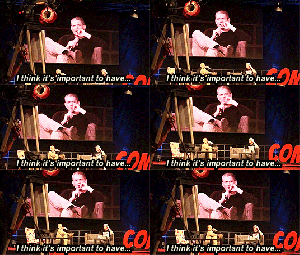
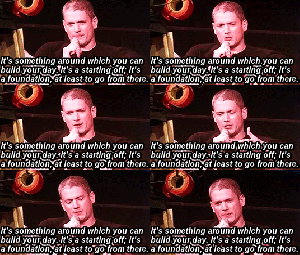
“I know you used to be depressed for a long time, and I want to know what your motivation was to change something to not live that way anymore?”
“I think it’s important to have something to do, something to look forward to, and something to love. If you have those three things in place, then…it is not a cure-all for depression…it’s not a cure-all for mental health issues…but it’s a place to hang your hat. It’s something around which you can build your day. It’s a starting off; it’s a foundation, at least…to go from there.”
– Wentworth Miller at German Comic con, 09. 12. 2017.
Note: I haven’t created or extensively reviewed any of these resources, they’re just things I’ve found online that look like they’d be useful and to my best knowledge do not cost anything. These are self help resources intended to be used in addition to and not as a substitute for medical treatment- please contact a professional if you are feeling unsafe. 🙂
my hot take as someone who has experienced the lowest of lows in terms of severe depression and anxiety and executive dysfunction: the whole “not everyone is neurotypical karen” mindset is legitimately damaging and destructive and ultimately will make you feel worse and more isolated
eating well and exercising and etc absolutely helps with mental illness. obviously it’s irritating to hear that when those things feel like impossible tasks, i get that, and i’ve been there. but forcing yourself to eat better, to walk more, to get up out of bed and shower even when you don’t want to, those things help. they clear your head. they make you feel better. they absolutely do. getting there is hard, but once you do it, it does help
rejecting any kind of help, even the most benign suggestion, from someone who is trying their best to think positively for you and shoulder the emotional burden with you, is going to make you feel worse. it’s going to make you feel that much more cut off and lonely and frustrated. i have isolated myself and ruined friendships with people because i chose to close myself off from people who were just trying to help and i convinced myself that they didn’t understand me and no one would ever understand me. what did that get me in the end? genuinely nothing. it made me feel even more alone.
in 2018 i encourage people who suffer like i have to see where people are coming from with cheesy self-care advice. they’re coming from the heart. and sometimes, doing a face mask or taking a hot bath or eating a nutritious meal or getting up to watch the sunrise or even just one yoga class can make you feel that much closer to the person you want to be. a lot of recovery from mental illness is “fake it till you make it” type shit. so don’t reject even the corniest advice because you are convinced it won’t help you. sometimes it really does. and you shouldn’t keep denying yourself even the smallest of victories because you feel like it’s easier to wallow in how bad you feel. it is so difficult to do good things for yourself and your body, but it is so rewarding
A lot of the time when people give advice intended to relieve anxiety, they suggest doing “relaxing” things like drawing, painting, knitting, taking a bubble bath, coloring in one of those zen coloring books, or watching glitter settle to the bottom of a jar.
This advice is always well-intentioned, and I’m not here to diss people who either give it or who benefit from it. But it has never, ever done shit for me, and this is because it goes about resolving anxiety in the completely wrong way.
THE WORST THING YOU CAN DO when suffering from anxiety is to do a “relaxing” thing that just enables your mind to dwell and obsess more on the thing that’s bothering you. You need to ESCAPE from the dwelling and the obsession in order to experience relief.
You can drive to a quiet farm, drive to the beach, drive to a park, or anywhere else, but as someone who has tried it all many, many times, trust me–it’s a waste of gas. You will just end up still sad and stressed, only with sand on your butt. You can’t physically escape your sadness. Your sadness is inside of you. To escape, you need to give your brain something to play with for a while until you can approach the issue with a healthier frame of mind.
People who have anxiety do not need more time to contemplate, because we will use it to contemplate how much we suck.
In fact, you could say that’s what anxiety is–hyper-contemplating. When we let our minds run free, they run straight into the thorn bushes. Our minds are already running, and they need to be controlled. They need to be given something to do, or they’ll destroy everything, just like an overactive husky dog ripping up all the furniture.
Therefore, I present to you:
THINGS YOU SHOULD NOT DO WHEN ANXIOUS
–Go on a walk
–Watch a sunset, watch fish in an aquarium, watch glitter, etc.
–Go anywhere where the main activity is sitting and watching
–Draw, color, do anything that occupies the hands and not the mind
–Do yoga, jog, go fishing, or anything that lets you mentally drift
–Do literally ANYTHING that gives you great amounts of mental space to obsess and dwell on things.
THINGS YOU SHOULD DO WHEN ANXIOUS:
–Do a crossword puzzle, Sudoku, or any other mind teaser game. Crosswords are the best.
–Write something. It doesn’t have to be a masterpiece. Write the Top 10 Best Restaurants in My City. Rank celebrities according to Best Smile. Write some dumb Legolas fanfiction and rip it up when you’re done. It’s not for publication, it’s a relief exercise that only you will see.
–Read something, watch TV, or watch a movie–as long as it’s engrossing. Don’t watch anything which you can run as background noise (like, off the top of my head, Say Yes to The Dress.) As weird as it seems, American Horror Story actually helps me a lot, because it sucks me in.
–Masturbate. Yes, I’m serious. Your mind has to concentrate on the mini-movie it’s running. It can’t run Sexy Titillating Things and All The Things That are Bothering Me at the same time. (…I hope. If it can, then…ignore this one.)
–Do math problems—literally, google “algebra problems worksheet” and solve them. If you haven’t done math since 7th grade this will really help you. I don’t mean with math, I mean with the anxiety.
–Play a game or a sport with someone that requires great mental concentration. Working with 5 people to get a ball over a net is a challenge which will require your brain to turn off the Sadness Channel.
–Play a video game, as long as it’s not something like candy crush or Tetris that’s mindless.
THINGS YOU SHOULD DO DURING PANIC ATTACKS ESPECIALLY:
–List the capitals of all the U.S. states
–List the capitals of all the European countries
–List all the shapes you can see. Or all the colors.
–List all the blonde celebrities you can think of.
–Pull up a random block of text and count all the As in it, or Es or whatever.
Now obviously, I am not a doctor. I am just an anxious person who has tried almost everything to help myself. I’ve finally realized that the stuff people recommend never works because this is a disorder that thrives on free time and free mental space. When I do the stuff I listed above, I can breathe again. And I hope it helps someone here too.
(Now this shouldn’t have to be said but if the “do nots” work for you then by all means do them. They’ve just never worked for me.)
This would’ve been great an hour ago
If your anxiety includes rapid heartbeat for no reason then it may help to exercise! It helps for me because I’m focused on whatever moves I’m doing and breathing, and it gives my heart rate a reason to be that high so that I can start the slow cooking down process and (hopefully) bring that heart rate down with it. Look up a quick cardio workout on YouTube or something and just do it in your room!
This is so, SO true.
All ‘doing something relaxing’ ever did for me was give my brain MORE free time to FREAK THE FUCK OUT.
I like how this boil down to grabbing something then tell the brains weasels to GO FETCH YOU PIECES OF SHIT
I mean.
That’s basically it tho.
YES THIS. When I was home on maternity leave with ptsd and postpartum anxiety ripping through me I made myself a list of things to do to keep myself active and busy instead of just dwelling on the awful.
Having an anxiety disorder is exhausting. It’s as if our mind is running a race it can’t win. Although, anxiety is life consuming we can learn valuable lessons from it. Through my journey to recover my mental health I have learned many things. Here are my top 10+ lessons:
My complete and total inability to keep anything clean or tidy for any amount of time is a symptom of my depression. I may never be able to do this. It’s important that I remember that and forgive myself when I clean something out (like my car) and it ends up trashed within a week.
Depression IS A DISABILITY. Requiring accommodations is okay.
Medications don’t make you better, they don’t cure your depression. They serve as an aid. Their purpose is to help you get to everyone else’s minimal level of functioning.
Depression can cycle through periods of inactivity. This doesn’t mean it’s gone away.
The reason I don’t feel like other people understand me is because … well … other people DON’T understand me. They can’t. They don’t have my disability.
Paranoia is par for the course.
Depression can and will interfere with your physical mobility. Forgive yourself when you can’t physically do something.
It’s entirely possible that I may never be able to live by myself. I can’t take care of myself. I need help to do it. And that’s okay.
Sometimes people hit a place in their life where things are going really well. They like their job and are able to be productive at it; they have energy after work to pursue the relationships and activities they enjoy; they’re taking good care of themselves and rarely get sick or have flareups of their chronic health problems; stuff is basically working out. Then a small thing about their routine changes and suddenly they’re barely keeping their head above water.
(This happens to me all the time; it’s approximately my dominant experience of working full-time.)
I think one thing that’s going on here is that there are a bunch of small parts of our daily routine which are doing really important work for our wellbeing. Our commute involves a ten-minute walk along the waterfront and the walking and fresh air are great for our wellbeing (or, alternately, our commute involves no walking and this makes it way more frictionless because walking sucks for us). Our water heater is really good and so we can take half-hour hot showers, which are a critical part of our decompression/recovery time. We sit with our back to the wall so we don’t have to worry about looking productive at work as long as the work all gets done. The store down the street is open really late so late runs for groceries are possible. Our roommate is a chef and so the kitchen is always clean and well-stocked.
It’s useful to think of these things as load-bearing. They’re not just nice – they’re part of your mental architecture, they’re part of what you’re using to thrive. And when they change, life can abruptly get much harder or sometimes just collapse on you entirely. And this is usually unexpected, because it’s hard to notice which parts of your environment and routine are load bearing. I often only notice in hindsight. “Oh,” I say to myself after months of fatigue, “having my own private space was load-bearing.” “Oh,” after a scary drop in weight, “being able to keep nutrition shakes next to my bed and drink them in bed was load-bearing.” “Oh,” after a sudden struggle to maintain my work productivity, “a quiet corner with my back to the wall was load-bearing.”
When you know what’s important to you, you can fight for it, or at least be equipped to notice right away if it goes and some of your ability to thrive goes with it. When you don’t, or when you’re thinking of all these things as ‘nice things about my life’ rather than ‘load-bearing bits of my flourishing as a person’, you’re not likely to notice the strain created when they vanish until you’re really, really hurting.
Almost two weeks after reading this, and I’m still kind of blown away at what a ridiculously fruitful definition this is. Like I had no idea that load bearing things were a thing that needed to have a word for them, but now I’m like holy shit I’m so glad that there’s now a word I can use to refer to this really important class of Thing.
This is astounding. Load-bearing. Forget spoons, this concept is wonderful. I’m going to update my Spear Theory with this.
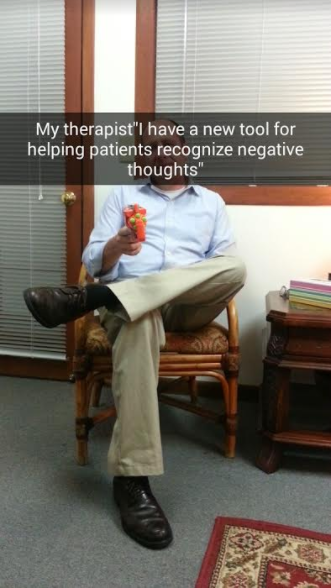
i saw this post earlier about therapists and it reminded me of my old therapist paul, who in my opinion is one of the greatest men alive and who did not put up with my bullshit for even one second
anyway i go in to see paul one week in the summer of 2016, and i’m doing my usual bullshit which consists of me talking shit about myself, and paul is staring at me, and then he cuts me off and says that he’s got a new tool for helping people recognize when they’re using negative language, and gets up and goes over to his desk
and i’m like alright hit me with that sweet sweet self-help article my man, because i’m a linguistic learner and whenever paul’s like here i have a tool for you to use it’s pretty much always an article or a book or something
paul opens a drawer, takes something out, and turns back around. i stare.
i say, paul.
is that a nerf gun.
yeah, says paul.
i say, are you gonna shoot me with a nerf gun in this professional setting.
he happily informs me that that’s really up to me, isn’t it. and sits back down. and gestures, like, go ahead, what were you saying?
and i squint suspiciously and start back up about how i’m having too much anxiety to leave the house to run errands, like it was a miracle to even get here, like i’ve forgone getting groceries for the past week and that’s so stupid, what a stupid issue, i’m an idiot, how could i–
a foam dart hits me in the leg.
i go, hey! because my therapist just shot me in the leg. paul blinks at me placidly and raises an eyebrow. i squint again.
i say, slowly, it’s– not a stupid issue, i’m not stupid, but it’s frustrating me and i don’t want it to be a problem i’m having.
no dart this time. okay. sweet.
so the rest of the hour passes with me intermittently getting nailed with tiny foam darts and then swearing and then fixing my language and, wouldn’t you know it, i start liking myself a little more by the end of the session, which is mildly infuriating because paul can tell and he’s very smug about it
anyway i leave his office and the lady having the next appointment walks in and i hear what’s all over the floor? and paul very seriously says cognitive behavioral therapy tools.
The “I won’t hesitate, bitch” vine but @ friends who don’t love themselves









 Holding the Bowl