
Inspiration to be strong,
to break chains that bind me down.
Loyalty, devotion, hard work:
Aspects I’ve grown to love of myself,
reflections of your strong, gentle hands.Hail to you, Incantation-Fetter,
For no magic binds you,
No will that is not your own can pass your gate.Lend me your strength, wise mother,
so I may follow in your path.Hail to you, fiery spirit, so beloved.
For yours is the flame that stole the Sky-Treader’s heart.
Hail to you, equal of the World-Breaker.Hail to you, goddess, guardian, guide.
Hail to you, mentor, mother, mender.Hail to you, Sigyn
Tag: goddess
Sigyn UPG
One of my strongest and earliest UPGs about Sigyn is that She loves stories. She has the biggest library, She is the happiest when someone stands up to tell a tale, She unabashedly loves children’s fic and YA and fantasy and everything.
What about you guys? Thoughts, feelings, impressions?
Enjoy simple things with total intensity. Just a cup of tea can be a deep meditation.
Sigyn, probably. (via incorrectedda)
Nightmares end. They shouldn’t end who you are.
Sigyn, probably. (via incorrectedda)
So I’ve been looking into some Norse gods, and found some interesting information about one of Sigyn’s best known kennings, “Incantation Fetter”: in that context, ‘fetter’ means either to control or to break, and ‘incantation’ of course refers to magic.
So Sigyn’s name means “Victory Woman” and her most famous nickname basically translates to “Cursebreaker”.
People can spout off all they want about Sigyn being useless, boring, etc etc, but I’d say she must have kicked some serious ass to earn those kind of monikers from a warrior culture like the Norse.
Eh, not quite. The kenning in question is galdrs hapt, which is found in Þorsdrapa stanza 3. “Hapt” does mean fetter, but it means to tie to bind something, like you see in the First Merseberg Charm. So she doesn’t break curses, she’s skilled at galdr.
The First Merseberg Charm is Old High German, not Norse. That’s not even relevant. “Might be cognates” does not mean “exactly the same”.
Well yes. But in this case, they actually are from the same root word. Proto-Germanic haftaz. Which is a cognate with Old High German hafta, Old Norse hapt/haptr, Middle Low German hacht, Old English hæft.
#There’s always got to be one #doesn’t there #And linking to Wikipedia? Really?
Your tags are not endearing. I would recommend not assuming that, if people don’t respond with a scholarly essay and citation list like some of the stuff I usually write, that they are a clueless newb.
As I said, cognate does not mean exactly the same.
As for “clueless newb”, I’m not the one using Wikipedia as a source. If you’re going to go around telling people they’re wrong, at least try producing some evidence more credible than a Wikipedia article about something in a different language. That’s like pointing at a French document to tell me I’m mistranslating a Italian phrase. Hey, they’re both descended from Latin so that makes them the same, right? Wrong.
You say I’m wrong, it’s on you to prove it. With evidence that is actually relevant and from a reputable source.
Petra Mikolić. “The God-Semantic Field in Old Norse Poetry”. Page 57.
Don’t bother replying. I have no interest in speaking to you again.
30 Days of Devotion (Sigyn)
III. Symbols and icons of this deity
As far as I am aware, the only symbol that can be pulled from the Lore is the bowl. There’s some carving that’s supposed to be of Sigyn holding the bowl over Loki, but I’ve never been drawn to it. All other symbols and icons are of a modern, more personal association between a follower and Sigyn.
Sigyn as a Child may include (pastel pink and pastel blue) butterflies, snails, sea urchins, and things that can be found on the beach (shells, starfish, etc.). Sigyn as a rebellious Teen may include blue haired imagery, leather jackets, and lighters. Sigyn as a Bride could vary on where one perceives Sigyn being married (a white dress isn’t guaranteed across the board). Sigyn as Wife could vary, as well as Sigyn as Mother. Depending on how old Narvi and Vali are perceived as being, toys and symbols for Them may work their way into Sigyn’s symbology and iconography.
A small candle flame in the darkness, orange butterflies, and a bowl can be symbols and icons for Sigyn in the Cave / Bowl Holder. Mother of Mourning may include black clothing (long, flowy dresses might be included, layers), a black shawl, a vial for catching tears, and tears. Post-Cave Sigyn could vary as well.
you think she would become a chaos goddess?
no. she would become much worse
she would stop the nine in its very tracks
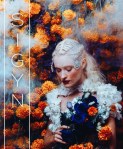

june 11: gods/goddesses of friends and family
Sigyn is Loki’s wife. She is listed amongst the Asynjur, the Goddesses of the Aesir.
She is the mother, by Loki, of Narvi and Vali. When Loki was bound in the cave as punishment for his role in Baldur’s death, Vali was turned into a wolf. He then killed his brother by tearing him apart. Narvi’s intestines were used as part of the binding securing Loki.
Sigyn, ostensibly having witnessed all of this, stayed by Loki during his punishment, holding a bowl over his face to catch the poison that dripped from a serpent the Goddess Skadhi had secured above his head. For this reason, Loki is sometimes referred to as the “Burden of Sigyn’s Arms”.
Sigyn’s name means “victory woman”.

Part of the “Binding of Loki” by Sam Flegal.
Read about the process he went through for finding the best way to convey the emotions of the moment here.
Devotional Stuff: Sigyn
- I have a variety of daily prayers that are a mix of my own work and pieces from a devotional to Her.
- I also have a variety of weekly prayers that were read while holding the bowl that are a mix of my own work and pieces from a devotional.
- In exchange for Her assistance with helping me to have something like a “regular” sleep schedule, I used to write something for Her every day – 30 Days of Devotion prompts, prompts for Her blog, prompts for a project I need to wait before sharing, etc.
- I have a sideblog shrine to Her that’s currently WIP while I fix tags and clean them out.
- I hail Her on the various days of Her holy cycle: Vanic Wheel of the Year, July’s full moon (Loki’s Capture), several other dates.
Tags: Sigyn, Sigyn as a rebellious Teen, Strength of the Mountain, Loki & Sigyn. Instead of Sigyn as a Child, see: snails, butterflies. Also: keys, tea.
– Note: Sigyn* is still being worked through and will be merged into Sigyn. Sigyn will take a while to work through because it’s a fucking long tag (because it’s now holding previous tags like Deity: Sigyn, Deity: Sigyn*, m’Lady: Sigyn, Keeper of the Keys, etc.).
 Holding the Bowl