I can’t tell you whether you’re physically disabled or if you “qualify” for cripple punk, but lots of people with chronic illnesses consider themselves physically disabled! I’m one of those people, and I’m all about cripple punk.
OK, what was major for ME to realise was that disability isn’t an all-in thing. It’s not “you’re either disabled or you aren’t”. With chronic illnesses like SEID and fibro, your level of ability is going to fluctuate. So some days you can’t reach high to get a thing down from the shelf, you need a cane for stability, you can’t walk 100m, those days you are disabled. Other days you might be a lot more physically able. I realised that the whole “No, you’re disabled or you’re not! You can’t have off days!” refrain my mind kept repeating was an aspect of internalised ableism.
Our Stories of Strength has issued a call for submissions to solicit stories for a forthcoming anthology called Living with Fibromyalgia (Fibrostrong). The editors need first and second person nonfiction (true) stories that connect emotionally and thoughtfully with other people living with FB and inspire them to transcend the diagnosis and embrace living passionately and actively.
Some disabilities are more obvious than others. Many are immediately apparent, especially if someone relies on a wheelchair or cane. But others — known as “invisible” disabilities — are not. People who live with them face particular challenges in the workplace and in their communities…
Hi spoonies, I’ve been trying out some different free, Android apps to help manage my fibromyalgia, and so far I really like 3 of them:
-Bluelight Filter. I use it to tint my phone screen with black, and that tones down all the harsh light.
-Plant Nanny. You get a cute little plant to take care of! When you drink water, you give it water, so it keeps you hydrated. It even reminds you when to drink more!
-Pain Coach. This is through web md, and is great for tracking pain levels, symptoms, triggers, goals, etc!
Let me know if there’s any that you recommend, and I hope these help you 🙂
Pain Coach is great, I don’t use it often to record stuff but I do like reading things that are all kept in one place.
I also use FibroMapp, I think it cost me a few dollars but it’s pretty good
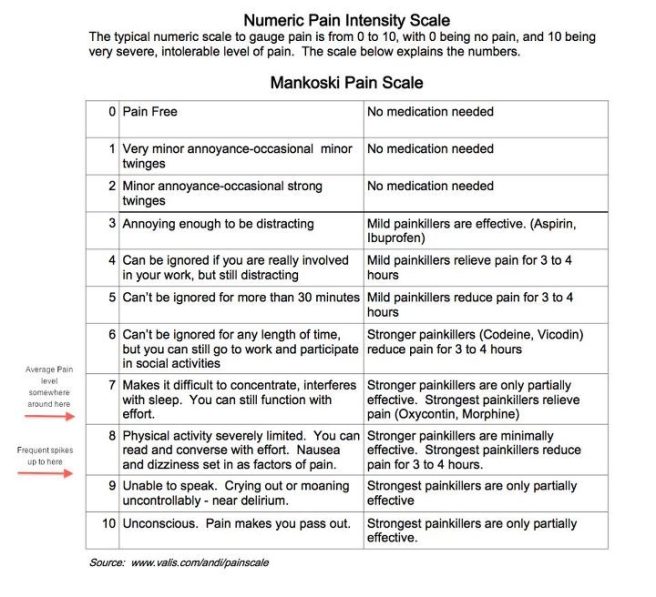
Mankoski Pain Scale Mankoski devised this pain scale to help describe the subjective experience of pain in more concrete terms to her doctors and family. Please feel free to use it and distribute it with attribution.
0 – Pain Free
1 – Very minor annoyance – occasional minor twinges. No medication needed.
2 – Minor Annoyance – occasional strong twinges. No medication needed.
3 – Annoying enough to be distracting. Mild painkillers take care of it. (Aspirin, Ibuprofen.)
4 – Can be ignored if you are really involved in your work, but still distracting. Mild painkillers remove pain for 3-4 hours.
5 – Can’t be ignored for more than 30 minutes. Mild painkillers ameliorate pain for 3-4 hours.
6 – Can’t be ignored for any length of time, but you can still go to work and participate in social activities. Stronger painkillers (Codeine, narcotics) reduce pain for 3-4 hours.
7 – Makes it difficult to concentrate, interferes with sleep. You can still function with effort. Stronger painkillers are only partially effective.
8 – Physical activity severely limited. You can read and converse with effort. Nausea and dizziness set in as factors of pain. Stronger painkillers are minimally effective. Strongest painkillers reduce pain for 3-4 hours.
9 – Unable to speak. Crying out or moaning uncontrollably – near delirium. Strongest painkillers are only partially effective
I find there’s too big of a jump from 7-8. It goes from still functional to completely disabled in one number.
I live at an 8, occasionally a 7.5 on a better day, and an 8.5 on days where I freak out my husband so much he threatens to take me to the ER. Occasionally I even reach 9.
Also, people with chronic pain/chronic illness will experience pain differently from someone who is healthy and only occasionally suffers from some sort of low-number acute pain. For example, I have been living at an 8 for two years straight, and then before that a solid 7 for two years, and before that I was in pain too, but it was more manageable (between a 4-6). So, I’ve lived with some level of chronic pain for most of my life and have become accustomed to it, whereas if someone who hardly ever experiences higher-number pain were to suddenly feel what I feel on one of my worst days, they would find it much more jarring and might even number it higher than I did. Similarly, if I’m only experiencing pain at a 6, I’ll ignore it, because my pain level is normally higher than that, but if a healthy person were at a 6 they would already consider themselves to be in a substantial amount of pain.
I also have many different types of pain in my body caused by different things, and they are not all synchronized at the same pain level all the time. I always think of my pains as having auditory volume. Sometimes one pain is loud (let’s estimate an 8) while a different pain I’m experiencing simultaneously is quieter (let’s say a 5). So in my opinion you should always have to specify a pain level for over all pain and then numbers for each individual offender.
I created this pain scale. Back in 1994, when I was using the name Mankoski and living as a female, I wrote this painscale and published it on an early internet-based endometriosis support community. Since then it’s taken on a life of its own. It’s been published countless places both online and in print, been used in academic pain studies and burn units, been refined and shared and branched out to so many places that a web search for “Mankoski” gets my pain scale as the first several hits.
In the twenty years since I wrote it, I’ve made drastic changes in my life, not the least of which is ditching that name and that gender. I still have endometriosis, mostly dormant now thanks to testosterone. And I still have chronic pain.
If I had it to do over, there are changes I’d make to this pain scale. I agree with the comments above that it’s not fine-grained enough between 7 and 8. And I wish I’d called it the McCallum Pain Scale, instead of using my ex-spouse’s name. But I’m still incredibly proud of it. I’m glad it’s something that can help people. And I’m glad that out of my own experience of living with chronic pain and disability, something good has come.
Thank you. I’ve found this immensely helpful, and discussed this a bunch (prolly how you found me) and im kinda honored to play a part in keeping it alive
Kindof a bummer it’s got your old name attached, but i’d be happy to rewrite/edit my posts to include a more accurate attribution.
For me, a usual day is about a 6, and a good day is a three. I do get days below that, but they are rare. Bad days are mostly 7-8, with the occasional 9 where I hope that I can pass out due to the exhaustion of being in that much pain.
This sort of pain scale is valuable because so many of them give you no idea of what level means what. A doctor will say “10 is the worst pain you can imagine” and in comparison people scale things down. So what might have been an 8 gets called a 6 because people have different capacities for imagining pain, I guess. Idk, I had a lot of trouble with it when I had appendicitis.
Now with fibro, I record my pain levels daily. I use this scale to help me work out where I’m at; it’s been very helpful. Again like the above scale it’s not for everyone but it helps me because otherwise I’d have no idea. Most good days for me are a 2, bad days usually a 4 or a 5. I’m lucky. I do get spikes up near a 7 or 8 in particular body parts at particular times, but it rarely lasts more than a couple of hours so I don’t log the entire day at that level.
What’s been interesting for me as my fibro’s been getting worse over the last couple of years is that you really do get used to the pain and what may have been a 3 becomes a 2. So important that healthcare providers understand that when it comes to chronic pain.
I have wanted to do this for a long time, so now as this thing called fibromyalgia is keeping me awake, it’s a good time. Yep, let’s do this.
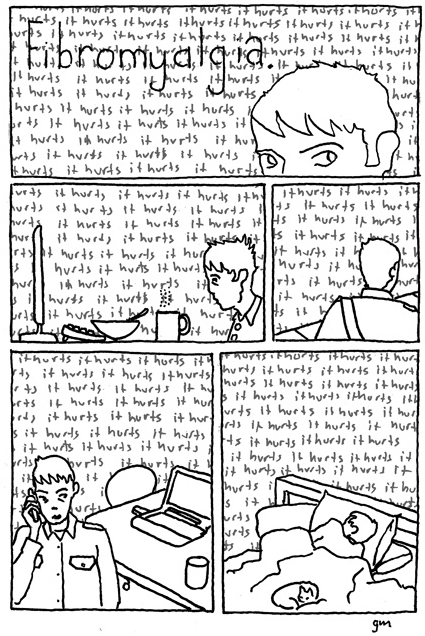
It’s something I don’t talk that much about, actually. Not because I’m ashamed or anything, it’s just like… It can be so much. The picture above pretty much shows how my body feels at times, but I wish there could be added something that look like deep knife cuts too, then it would be perfect. Unfortunately I don’t know who has made the picture. One day I want to be the model for a body art where my pains are painted on my body, maybe people would understand me then.
Most likely I’ve had fibromyalgia since I was about 21. At that point in my life, I came to a point where I was fed up with every thing and I went through a tough period of depression and a burn-out. I had no energy left and I felt numb, in both body and mind when I not felt the urge to just lay down and cry. The years before could be summed up like this; deaths in close family, a few episodes of sexual abuse from a so-called friend, bullying through the entire elementary school (don’t under-estimate the effects of late trauma), and giving everything for those I really cared about, only for getting my throat filled with shit. It’s a miracle I didn’t drop out from college, I have my boyfriend, closest friends, parents and brother to thank for that.
Eventually I got through this period, but there was something else slowly starting to appear, despite the fact that I was active and training in order to avoid what forced my mother into a passive life; fibromyalgia. I started to notice numb, aching pains wandering around my body. I got problems with concentrating. My need for sleep just grew, and often I felt tired during the day. I had some episodes of almost falling asleep while driving and it terrified me; I who love driving, and love driving to destinations far away and could do so for entire nights?? I got problems keeping a steady rhythm of day because of my messed up sleep pattern. And every morning, my body felt like it had been frozen during the night and I could use 15 minutes just to sit up in the bed. And the pains in my body just grew, they were everywhere; in muscles, joints and there was no pattern. I have a history of back problems since I’m a master in hurting myself in stupid ways (falling off horses, rugby, tripping etc) and I know what pains that can be located to different points in my back. I can go to my chiropractor and point “exactly there” when there’s a locking I can’t fix myself. But no, these pains were different.
I have no idea for how long I denied these pains. I tried to find other excuses, I refused to have the same condition as my mother. She wasn’t taken seriously by doctors in 1994, and she fought for years to find out what it was and was treated for a long list of conditions without effect, and when they finally figured out what it was, she was so badly affected that there was no way back and she hasn’t been working since 2001. I remember those days so well, it was horrible and I remember the frustration knowing there was nothing I could do for her – I was just 12, what could I do? My mother isn’t of the kind who is comforted by hugs. Instead it was better to send knowing looks and do my best to help her with the house chores when my father was at the sea.
Eventually my pains reached a level where I was desperate to find out what it was and my boyfriend and mother confronted me with the fact. This was just how it started for her, and I went to the doctor. Fortunately, he was wise enough to just send me directly to the rheumatologist, and after a painful consult, it was clear. 16 out of 18 triggerpoints, and especially my legs were bad. But here’s the good thing.
My rheumatologist was positive, and she established contact between my doctor, chiropractor and physiotherapist.
I’m not the worst case. It’s bad enough, but it could be worse. I had discovered this early and I had been taken seriously when I came to the point that I asked for help. I got stronger pain meds than I already had (1g pracetamol and 1g ibuprofen) and they help me take the worst peaks away on bad days. I have adjusted to the moderate pains, and I’ve started to do medical yoga and it helps a lot. To me, it has been all about taking the control I felt like I was losing. Sometimes my body is trembling for no reason, but I have learned to handle it through yoga. My chiropractor and physiotherapist have experience with my diagnosis and they have a “prescription” that works pretty well. Every fourth week I to them and get my spine “un-locked” to avoid more severe stuff and a carefull massage to make my shoulders relax again, since they get very stiff in bad periods because of how I tense my body.
I’m also trying something new now; LDN – low dose naltrexen. It’s originally a medicine for treating addiction, but in low doses it works as pain relieving. Long story short; it tricks your brain to produce more endorfine, a natural pain killer. Already on my fourth day now, I can feel an improvement. I take 3mg every night 23.00, so I’m really excited to see how it goes. If anybody wishes me to do so, I can update about how this goes on.
Also, being careful with what I eat. No more beefs or lamb on me, and preferably little swine. Mostly chicken, turkey and venison, plus fish, and LOTS of vegetables. It has made my stomach calm down and the bad periods are shorter.
Call me a believer, but another thing that has given me much comfort, is to grow a strong relation to Eir, the norse godess for health and healing. Some of you might know that I’m an asatruar. Yes, I worship the norse gods and powers – to me they are pictures and personifications of nature and ourselves, what happens outside and inside us. The two last years I have searched for strength and hope in Eir, and to me – it has worked. It’s not like I’m telling people to convert, but finding something you hope and believe in, might help. We all need something to hang on to in dark times, whether it is a god or a pet. Pets has also brought me much comfort, I should be fair to them too lol. to be correct, my parents’ pets. Until recently I lived in an apartment where I couldn’t have pets, and that wasn’t ideal to me, a girl with close bonds to animals and nature.health
For the first time since I got the diagnosis 06.12.13, I’m optimistic. Like, I actually believe I’ll be able to work for as long as I want. I dream of working till I’m at least 62, and about 80%. I have a job I handle pretty well. I go on walks and enjoy the outdoor life. I’ve got a silencer for my hunting rifle so my shoulder won’t ache for a week after. I’ve moved back to my childhood home. I have fandoms. I have the medicines I need. I have my concert bands. I have friends, family and the most wonderful boyfriend in the world – where would I have been without him? Not here. Somewhere bad, most likely. He has saved me in so many ways.
I don’t know where I want to go with this, really. I just felt like sharing my story. Both so people might understand what fibromyalgia is, and so that others with this diagnosis might see that there is hope. YES, sometimes it SUCKS to have this rushing through my body and I have days where I isolate myself. I have days where my body isn’t working and I have to cancel all plans. Sometimes I’m crying because my body hurts so much without reason. But maybe, with LDN, this can get better. And I have a team that does everything they can to help me, and so far they have done good. I’m way better now than what I was a year ago just after I got the diagnosis. Every day is a struggle, but then it feels the better when I win the battle and can do the things I want. My thoughts are to let this become something I can grow on, not to drag me down.
I think this rant is over for now. Who knows, I might write about this again. Let’s see.
The irony to me about that situation that we all chronically live in is the harder you try to protect the people around you from being uncomfortable with the fact that you are sick, the more invisible it becomes.





 Holding the Bowl