lexrhetoricae:

adhighdefinition:

Things You Should Never Say to People with ADHD and Why!

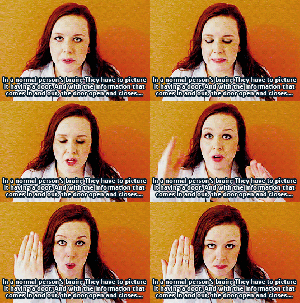
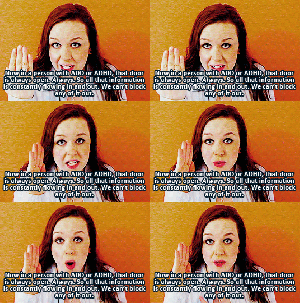
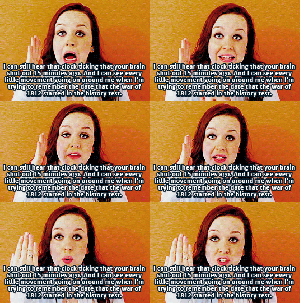
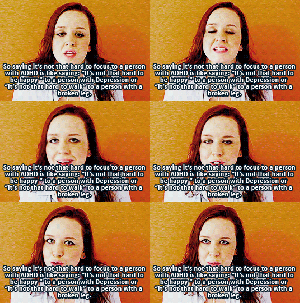
People with sensory processing disorders like fibromyalgia and other chronic pain diseases have the same experience. Until I started talking to people with ADHD, I didn’t realize it wasn’t normal to spend every waking minute feeling your clothes against your skin or cataloging the changes in sound and light and smell. It wasn’t until I watched Elementary and saw the characters around Sherlock not noticing sensory details around them that he picks up that I realized it’s not normal for brains to do this. 

Unlike folk with ADHD, though, I never had this experience full blown until I was in my twenties. It build gradually over about a decade, and I thought I’m just getting older.  I didn’t have these issues as a young child, so my lack of focus in my mid-20s  had to be age-related, not ADHD, right? 

And that’s how you trick yourself into thinking you’re normal for years. It’s easier than admitting difference, even as you carefully pick out only silk and pure cotton clothes, wash everything (including yourself) in unscented soap, and eat only a handful of foods (mostly sugar, because it’s boring and you don’t have to think about it much). 

Spoonies, pay attention: if you can’t focus, it may not just be the pain. What else is your brain, primed for pain signals, now also processing without end? 

Campaign for Visibility

sephiraallen:

ofcourseitsmyhead:

My husband gave me an idea ages ago, and I wanted to actually put it into motion. So today, I give you the ‘Being Visible’ line of shirts.

The goal of Being Visible is to allow people with mental illness, or other invisible illnesses, to help make people aware of their coping abilities on any given day by using the simple image of a battery at various charging levels:

Low charge – low ability to function ‘normally’ or perform daily tasks. May need assistance or frequent breaks
Medium charge – diminished, but capable of performing routine or simple tasks during the day. Some assistance may be needed.
Full charge – able to perform daily tasks with little to no assistance or reduction in speed, effort, etc. Little to no assistance needed.

These images will be placed front and centre of various T-shirt/tank top designs, to enable wearers to non-verbally alert people around them of their limitations, if they so choose. Of course, as ability levels change, so too can the shirts. On the back of the shirt is the simple text line ‘Being Visible’ above the rod of Asclepius, the common symbol for medicine.

75% of the proceeds will go to the American Foundation for Suicide Prevention. The remaining 25% will go towards my ability to purchase several units of each shirt for my own use.

You can find the shirts at the links listed below. The target goal is 75 units each.

Low Battery – https://teespring.com/en-GB/being-visible-low-battery#pid=95&cid=2262&sid=front

Medium Battery – https://teespring.com/en-GB/being-visible-medium-battery#pid=95&cid=6294&sid=front

Full Battery – https://teespring.com/en-GB/being-visible-full-battery#pid=95&cid=2269&sid=front

Any questions, feel free to ask. In the meantime, spread the word for me?

autisticwomanspeaks:

@actuallyadhd

[Image Descriptions:

All slides have a light blue background, and the text is written in blue rectangles with rounded corners.

Slide 1: The title is in white text inside a dark blue circle that is centred in the slide.

Sensory Overload And how to cope

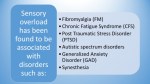
Slide 2: The header is in a dark blue rectangle and white text, and the body is in a pale blue rectangle and black text.

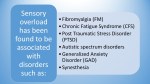
Sensory overload has been found to be associated with disorders such as:

  • Fibromyalgia (FM)
  • Chronic Fatigue Syndrome (CFS)
  • Post Traumatic Stress Disorder (PTSD)
  • Autistic spectrum disorders
  • Generalized Anxiety Disorder (GAD)
  • Synesthesia

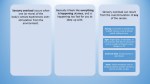
Slide 3: The text is in three pale blue rectangles that
go horizontally across the slide. All use black text. The last
rectangle has four smaller dark blue rectangles with white text inside
it for the four points. The text is centred in all of the rectangles.

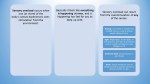
Sensory overload occurs when one (or more) of the body’s senses experiences over-stimulation from the environment.

Basically it feels like everything is happening at once, and is happening too fast for you to keep up with.

Sensory overload can result from the overstimulation of any of the senses.

Hearing: Loud noise or sound from multiple sources, such as several people talking at once.

Sight: Bright lights, strobe lights, or environments with lots of movement such as crowds or frequent scene changes on TV.

Smell and Taste: Strong aromas or spicy foods.

Touch: Tactile sensations such as being touched by another person or the feel of cloth on skin.

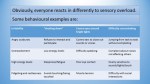
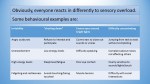
Slide 4: A heading in two light blue rectangles with black
text, followed by a table with a dark blue first row that has white
text, and then alternating pale blue and white rows with black text.
(The table is not really a table, it is just a four-column list.)

Obviously, everyone reacts in differently to sensory overload.

Some behavioural examples are:

Irritability — “Shutting down” — Covers eyes around bright lights — Difficulty concentrating
Angry
outbursts — Refuses to interact and participate — Covers ears to close
out sounds or voices — Jumping from task to task without completing
Overexcitement — Low energy levels — Difficulty speaking — Compains about noises not effecting others
High energy levels — Sleepiness/fatigue — poor eye contact — Overly sensitive to sounds/lights/touch
Fidgeting and restlessness — Avoids touching/being touched — Muscle tension — Difficulty with social interactions

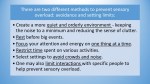
Slide 5: The header is in a dark blue box with pointy
corners and white text. The body is in a pale blue box with pointy
corners and black text.

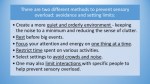
There are two different methods to prevent sensory overload: avoidance and setting limits:

  • Create a more quiet and orderly environment – keeping the noise to a minimum and reducing the sense of clutter.
  • Rest before big events.
  • Focus your attention and energy on one thing at a time.
  • Restrict time spent on various activities.
  • Select settings to avoid crowds and noise.
  • One may also limit interactions with specific people to help prevent sensory overload.

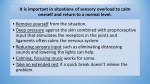
Slide 6: This looks the same as the last slide except the text in the header is black.

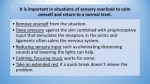
It is important in situations of sensory overload to calm oneself and return to a normal level.

  • Remove yourself from the situation.
  • Deep pressure against the skin combined with proprioceptive input
    that stimulates the receptors in the joints and ligaments often calms
    the nervous system.
  • Reducing sensory input such as eliminating distressing sounds and lowering the lights can help.
  • Calming, focusing music works for some.
  • Take an extended rest if a quick break doesn’t relieve the problem.

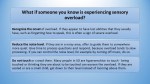
Slide 7: Four light blue rectangles with rounded corners, stacked one above the other, with black text.

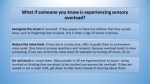
What if someone you know is experiencing sensory overload?

Recognize the onset of overload. If they appear to
have lost abilities that they usually have, such as forgetting how to
speak, this is often a sign of severe overload.

Reduce the noise level. If they are in a noisy area,
offer to guide them somewhere more quiet. Give time to process
questions and respond, because overload tends to slow processing. If you
can control the noise level, for example by turning off music, do so.

Do not touch or crowd them. Many people in SO are
hypersensitive to touch – being touched or thinking they are about to be
touched can worsen the overload. If they are seated or are a small
child, get down to their level instead of looming above them.

Slide 8: Similar to previous slide, only with three rectangles instead of four.

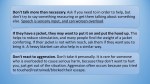
Don’t talk more than necessary. Ask if you need to
in order to help, but don’t try to say something reassuring or get them
talking about something else. Speech is sensory input, and can worsen
overload.

If they have a jacket, they may want to put it on and put the hood up. This
helps to reduce stimulation, and many people find the weight of a
jacket comforting. If their jacket is not within reach, ask them if they
want you to bring it. A heavy blanket can also help in a similar way.

Don’t react to aggression. Don’t take it personally.
It is rare for someone who is overloaded to cause serious harm, because
they don’t want to hurt you, just get out of the situation. Aggression
often occurs because you tried to touched/restrained/blocked their
escape.

Slide 9: Similar to previous slide, only with two rectangles instead of three.

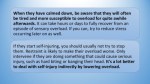
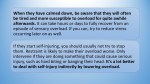
When they have calmed down, be aware that they will often be tired and more susceptible to overload for quite awhile afterwards. It
can take hours or days to fully recover from an episode of sensory
overload. If you can, try to reduce stress occurring later on as well.

If they start self-injuring, you should usually not try to stop them.
Restraint is likely to make their overload worse. Only intervene if
they are doing something that could cause serious injury, such as hard
biting or banging their head. It’s a lot better to deal with self-injury indirectly by lowering overload.

Slide 10: The header is in a dark blue rectangle with white
text, and the other text is in a row of five dark blue circles with
white text. The text is centred in all shapes.

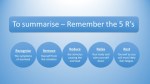
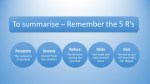
To summarise – Remember the 5 R’s

Recognise
The symptoms of overload

Remove
Yourself from the situation

Reduce
the stimulus causing the overload

Relax
Your body and calm yourself down

Rest
Yourself as you will most likely feel fatigue.]

Help, My Friend Won’t Stop Having Fibromyalgia At Me!

thatbadadvice:

Carolyn Hax, 10 Feb 2010:

Dear Carolyn: One of my friends has had fibromyalgia for the past year. It makes me sad, and so I like to find alternative treatments and cures and tell her about them. She’s gotten really annoyed with me for doing this, but I am only trying to help and I think she should be more willing to listen to what I’ve found. She has a doctor she sees regularly and takes medication, but I don’t know why she brushes it off when I give her my advice. I feel really unappreciated and am starting to wonder if she even wants to feel better. – California

Dear California,

Your friend has put you in a terrible situation, without apparent regard for the degree of injury here. Sure, she lives with a painful, chronic medical condition that affects her ability to participate in the world and yadda yadda yadda, but you feel sad and unappreciated. Where, I ask you, is justice?

Just because your friend manages her condition with the assistance of medication and a trusted medical professional of her choosing doesn’t mean she’s getting the best care available to her, which is to say, the care recommended to her by a person who can use Google. 

The bare fact is that your friend’s fibromyalgia is, fundamentally, about you. On the surface, that may seem counterintuitive–it may seem like your friend’s medical condition is solely her business, and that the management thereof is something she alone is entitled to, but that completely erases you, a person who read a thing about gluten one time, from the equation. And that isn’t fair–indeed, it’s even less fair than having fibromyalgia, which your friend could easily not have if she only read those 45 articles you just forwarded her from WebMD. 

Why would your friend brush off advice–advice you heard from not one, but probably TWO yoga teachers–about managing her medical care just because she feels more comfortable treating her condition in the manner of her own personal choosing? It’s logically because she does not want to feel better, which is a direct attack on you, personally, the individual in this situation with the heaviest possible burden to bear. 

If you stopped advising your friend about the miracle cures available according to pamphlets you picked up outside Whole Foods, who knows what might happen? She might continue to make the decisions that she feels are best for her own health, and you’ll be left with no one’s medical care to aggressively manage without their consent, an unimaginable travesty.

But the sorry truth is that we cannot fix everyone, can we?

Think for a second

nearconstantsadness:

Imagine with me.

You’re an athlete. You’re gearing up to run the next 5k in your town.

You get there, and your number’s on your chest just like everyone else. You’re at the starting line, just like everyone else.

Bam, off goes the start signal.

Suddenly, you feel a little funny. Everyone else around you is gaining a lead they shouldn’t otherwise gain. Even the little old lady who does this for fun is now almost 50 feet in front of you.

But you keep pushing, right? You’re bound to catch back up, you’re an ATHLETE.

You pump as much of your strength as you can into your legs. You’re using what feels like every ounce of effort you have in you to just get your legs moving. All the while, that lead that everyone has on you is getting bigger and bigger…

People are suddenly farther and farther away…

You keep going You have no choice. You’ve GOT to finish. And you do.

But that’s when you collapse from exhaustion. Everyone around you is looking at you now, very concerned, wondering what could possibly have gone wrong, you were fine yesterday. You looked fine even the whole time you were running! What could POSSIBLY have happened?!

You can fill in the blanks with any invisible malady you like: heart problems, asthma, fibromyalgia, sciatica, what have you. But it’s SOMETHING that nobody can see. It’s something even YOU didn’t see.

Welcome to mental illness.

EVERY DAY is that 5k. Waking up in the morning is the start signal going off, and no matter how much energy we could put into something as simple as making breakfast, suddenly everyone else around us has their day’s tasks half way done and we’re still standing in the kitchen choosing eggs or bacon as though our lives depended on it. And sometimes, it does.

Eating is a chore. Standing up is basically like asking us to climb a mountain. Taking care of ourselves is tiring. Let alone taking care of someone else, if we need to.

That collapse at the finish line of the day could be a panic attack, it could be a fit of tears, it could be the mounting and exploding feeling that you’re a failure, you’re worthless, why do you even bother. It could even be an angry and persistent suggestion that you should just kill yourself so you’re not wasting space.

And let’s not forget, we didn’t do this to ourselves. We couldn’t have predicted this, we aren’t just sitting there asking for people to pamper us, in fact sometimes that makes us feel WORSE.

And at the end of the day, quite possibly the best thing you could do is hold us, tell us it’ll be okay, and just listen.

Most often, there’s no rhyme or reason to our thoughts. I was a straight A student for a long time and if I got less than 80% on ONE test, I flipped out and resigned myself to failure. But anyone else would’ve been like ‘Sweet, I passed!’ People tell me I’m doing well at work, and I’ll just focus on that one mistake I made two weeks ago and oh well, I’ll get fired tomorrow.

We DO NOT DO THIS ON PURPOSE. And it’s not as easy as saying ‘Oh just stop being so hard on yourself.’ That’d be like asking your athlete self to just grow some new lungs/muscles/heart valves and you’ll be fine.

We know you want to help. ❤ And most of us appreciate it SO MUCH, OMG THANK YOU. But sometimes, cuddles, blanket forts and movie binges are enough to keep us going. We don’t need to talk or reason things out all the time.

deadly-voo:

be-beyond-beyond:

riseabovedefeat:

whatisdoneisinprogress:

fibr0myalgiaw0nderla17d:

:

Sensory Overload and how to cope.

(click on images to zoom)

So important.

I also find I can get SO from thinking too much, like brain-over-stimulation. Though that is kinda like audio input for me because of the way I think. After all, my go-to overload thought is “quiet please, make it stop”.

thank you for posting this, i needed it

This is wonderful and so needed

My last SO situation I had allodynia all over, and all the skin sensory input just destroyed my ability to think.

twistedingenue:

psychicpossum:

lancrebitch:

lizardtitties:

ive-lost-my-spoons:

katrinarosa:

MY FELLOW FIBRO WARRIORS (and others who experience cognitive fog)

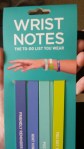
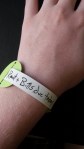
This product is so freaking cool. I got my pack at Papersource, I bet you can find them online. I know we all make lists, but really, how often do we check those lists? Not often enough.

Now your list can go on your wrist!! Hot damn.

Oh my god I need, link???????

These are the best idea ever!

oooooh

You can buy them [here]

oh my goodness, this would be great for ADHD too.