“The Specials” reality series coming to the OWN

Really not digging the title at all, but otherwise could be interesting, depending on how the rest of it is presented. 

“The Specials” reality series coming to the OWN

Rollin’ with Kristine: Local disabled woman hopes travel series makes it big, educates, inspires

Kristine Groenenboom-Newbold enjoys traveling, despite the disability that has put in her a wheelchair. But while watching travel TV shows and videos, she often is frustrated by the dearth of information about access for the disabled to those tourist destinations.

“If you call the place,” she said, “and you go, ‘Are you guys wheelchair accessible?’ They’re like, ‘Uh, we’ve got a ramp.’ OK. What does that tell me? Nothing.”

So, about a year ago, Kristine decided to create her own series and started turning her “harebrained idea” into reality.

Kristine and Thompson plan to market their series to travel TV networks and websites. Their first episode was a visit to Callaway Gardens, and their second was kayaking on the Chattahoochee River. Next, they are scheduled to visit the National Infantry Museum and the Columbus State University Oxbow Meadows Environmental Learning Center. They also want to film a horseback riding episode.

She is trying to raise $2,700 for the project, titled “Rollin’ with Kristine,” on GoFundMe.

“The idea is to laugh and have fun but also show the capabilities of a person in a wheelchair,” Kristine posted on the website. “The money is needed to pay for the filming, editing and production costs of 5 adventures. I have the crew and the idea and the abilities, I just need a little financial assistance. I promise this will be FAR BETTER than some of the stuff being aired these days!!”

Read more 

Rollin’ with Kristine: Local disabled woman hopes travel series makes it big, educates, inspires

hellacamber:

heycourtneymae:

widebooty:

alittlebitridiculous:

sizvideos:

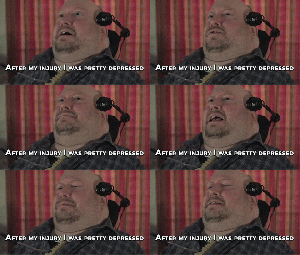
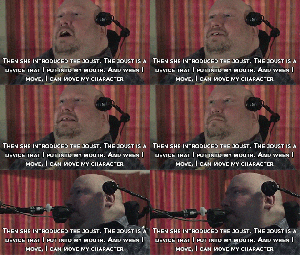
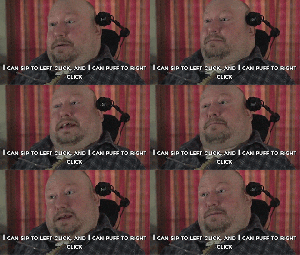
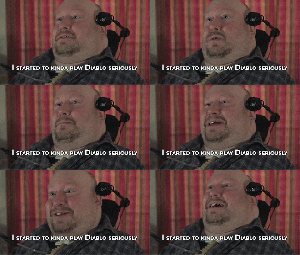
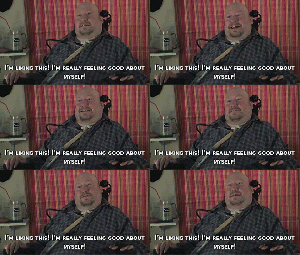
Watch the inspirational video of this quadriplegic who plays and streams Diablo 3

Follow our Tumblr – Like us on Facebook

!!!!!!!!!!!!

I’ve been watching this guy’s livestreams for a few days now. He’s super positive and really nice to all his viewers, answering everything he can. Also considering his abilities he is really good at Diablo III and WoW. Like the fact that I could have been playing WoW with people like him and getting my ass handed to me by them is part of the reason I appreciate video games as a form of therapy.

“I’m really feeling good about myself!”

This makes me SO happy. Amazing!

Technology.

livingwithdisability:

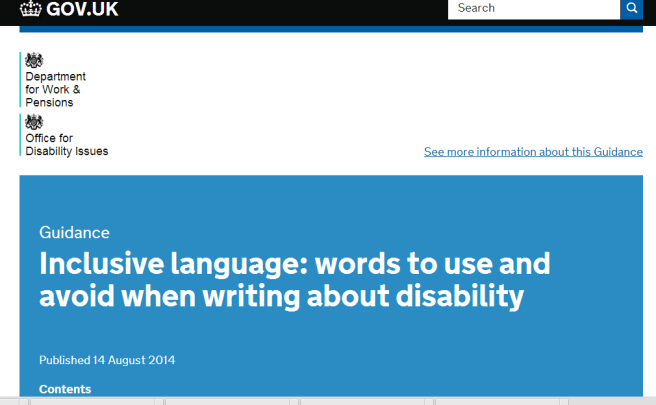
The UK Government has issued some new guidance “aimed at anyone who needs to communicate with or write about disabled people and disabilities.”, it is based on the social model of disability which is preferred by most activists in the UK:

Consider these guidelines when communicating with or about disabled people.

Language guidelines

Not everyone will agree on everything but there is general agreement on some basic guidelines.

Collective terms and labels

The word ‘disabled’ is a description not a group of people. Use ‘disabled people’ not ‘the disabled’ as the collective term.

However, many deaf people whose first language is BSL consider themselves part of ‘the deaf community’ – they may describe themselves as ‘Deaf’, with a capital D, to emphasise their deaf identity.

Avoid medical labels. They say little about people as individuals and tend to reinforce stereotypes of disabled people as ‘patients’ or unwell.

Don’t automatically refer to ‘disabled people’ in all communications – many people who need disability benefits and services don’t identify with this term. Consider using ‘people with health conditions or impairments’ if it seems more appropriate.

Positive not negative

Avoid phrases like ‘suffers from’ which suggest discomfort, constant pain and a sense of hopelessness.

Wheelchair users may not view themselves as ‘confined to’ a wheelchair – try thinking of it as a mobility aid instead.

Everyday phrases

Most disabled people are comfortable with the words used to describe daily living. People who use wheelchairs ‘go for walks’ and people with visual impairments may be very pleased – or not – ‘to see you’. An impairment may just mean that some things are done in a different way.

Common phrases that may associate impairments with negative things should be avoided, for example ‘deaf to our pleas’ or ‘blind drunk’.

Words to use and avoid

Avoid passive, victim words. Use language that respects disabled people as active individuals with control over their own lives.

Avoid

handicapped, the disabled

afflicted by, suffers from, victim of

confined to a wheelchair, wheelchair-bound

mentally handicapped, mentally defective, retarded, subnormal

cripple, invalid

spastic

able-bodied

mental patient, insane, mad

deaf and dumb; deaf mute

the blind

an epileptic, diabetic, depressive, and so on

dwarf; midget

fits, spells, attacks

Use

disabled (people)

has [name of condition or impairment]

wheelchair user

with a learning disability (singular) with learning disabilities (plural)

disabled person

person with cerebral palsy

non-disabled

person with a mental health condition

deaf, user of British Sign Language (BSL), person with a hearing impairment

people with visual impairments; blind people; blind and partially sighted people

person with epilepsy, diabetes, depression or someone who has epilepsy, diabetes, depression

someone with restricted growth or short stature

seizures

Some tips on behaviour

  • use a normal tone of voice, don’t patronise or talk down
  • don’t be too precious or too politically correct – being super-sensitive to the right and wrong language and depictions will stop you doing anything
  • never attempt to speak or finish a sentence for the person you are talking to
  • address disabled people in the same way as you talk to everyone else
  • speak directly to a disabled person, even if they have an interpreter or companion with them

Source https://www.gov.uk/government/publications/words-to-use-and-avoid-when-writing-about-disability/inclusive-language-words-to-use-and-avoid-when-writing-about-disability

How to Hire a Caregiver

Hiring a caregiver to come into your home or to provide additional care in a facility can be nerve-wracking. How do you know who to trust? How do you know who will be a good fit? This article addresses those concerns and will help guide you through the process of hiring a private caregiver… more 

How to Hire a Caregiver

Funding Sources for Home Modifications

Funding Sources for Home Modifications

Q: Why is disability history important to all Americans, but Americans with disabilities in particular?

A: History gives us the tools to think about us—whoever that us is—as being part of something bigger; we have a past, which means that we have a present and a future. Because disability has been ignored for so long, it’s important for the general public and people with disabilities to learn that it played an important part, not just because of a few important people who defined a movement, but also for how we think about things like productive labor, our healthcare system, the impact of war and how our nation establishes various hierarchies. By understanding how disabled people are defined by these experiences and often helped define them is tremendously empowering both individually and collectively.

from Why Disability History Matters, an interview of Cathy Kudlick by Alice Wong of the Disability Visibility Project (via longmoreinstituteondisability)