gentlemanbones:

handsome-princess:

huffingtonpost:

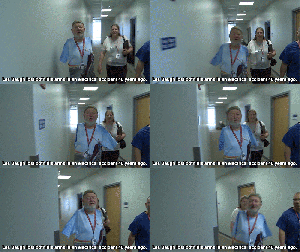
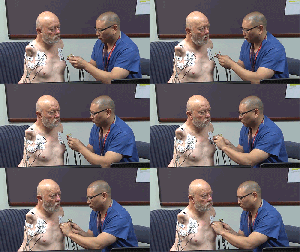
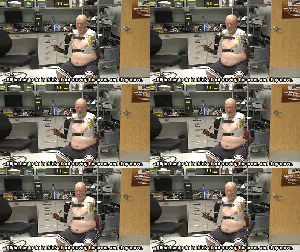
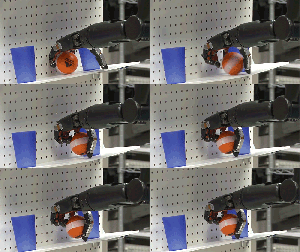
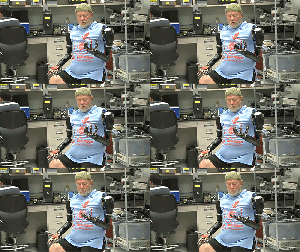
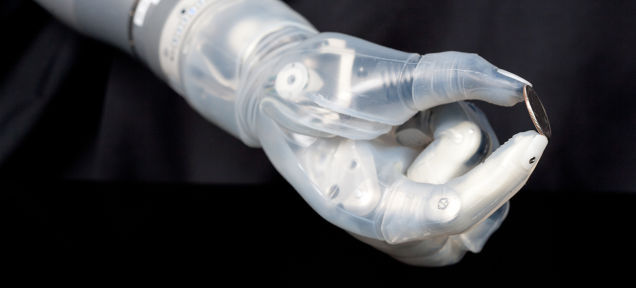
Man Successfully Controls 2 Prosthetic Arms With Just His Thoughts

Les Baugh is the first bilateral shoulder-level amputee to wear two Modular Prosthetic Limbs at once, according to the researchers. 

For more on the incredible science behind this prosthetic innovation go here. 

(GIF Source: JHU Applied Physics Laboratory)

GOD I LOVE TECHNOLOGY sometimes I really regret not going into this kind of field 

DARPA: Bringing you the cyborgs of tomorrow, today.

A way people with disabilities are often wrongly percieved as angry

realsocialskills:

Sometimes disabled people are wrong perceived as angry or hostile when they move like disabled people. It works something like this:

  • The most efficient way to do things is often not the socially accepted way to do things
  • People with disabilities often have to do things in an efficient way to be able to do them
  • In order to be perceived as calm and polite, people are often expected to move in a slow, careful way without making sudden or loud motions
  • That’s easy for most people without disabilities, and can be difficult or impossible for people with disabilities
  • Sometimes people with disabilities don’t have the motor coordination or strength to move in expected ways. Sometimes pain or illness makes them too exhausted to have the energy to move in expected ways. Sometimes, they have to move efficiently to be able to move at all.
  • People with disabilities who have to move in loud, sudden, forceful, or jerky ways are often wrongfully perceived as expressing anger, frustration, or aggression.
  • When people make loud, jerky, or sudden motions, they tend to be perceived as rude, angry, or aggressive
  • People with disabilities don’t always have the coordination to make the movements in expected ways
  • Sometimes, they have to be efficient in order to do the thing.
  • This often gets perceived as angry when it isn’t
  • This can lead to people with disabilities who are just trying to live their lives being perceived as hostile and excluded
  • When a person with a disability is moving in a jerky, sudden, or loud way, it’s important to consider the possibility that it’s disability-related rather than angry

Some concrete examples:

Dropping things:

  • In most social contexts, it’s socially expected that people who need things to be on the ground put them there without making a sudden noise

  • This generally means using your arms to slowly lower the thing to the ground
  • People with disabilities often do not have the strength or motor coordination needed to lower things this way
  • Sometimes, people who can’t rely on muscles to lower things need to drop them and rely on gravity
  • (And some people have to rely on gravity some of the time, eg: when they’re tired, at the end of a long day, when they’re in a particularly draining environment, when they’ve already had to lift and drop the thing several times that day.)
  • Gravity only goes one speed, and dropped objects tend to make noise
  • Dropping a heavy object rather than lowering it slowly is usually perceived as a sign of anger (and for people without disabilities, it’s generally intended as one).
  • People with disabilities who drop things are often not intending it as an expression of anger.
  • Often, they drop things because they need them to be on the ground and have no other realistic way of getting them there.
  • If a person with a disability is dropping heavy things rather than lowering them, it’s important not to automatically assume that they are doing this out of a show of emotions
  • Consider seriously the possibility that they’re dropping things because they need to lower them, and due to disability are not able to do so in the socially expected way.

Another example: Plugging things in:

  • The socially expected way to plug things in is to slowly push the plug into the outlet using a steady pressure
  • That requires a particular kind of strength and muscle control
  • Some people with disabilities can’t do that
  • Some people with disabilities have to rely on momentum.
  • Relying on momentum involves one sudden forceful movement. 
  • That can look like punching, and can be perceived as excessive force
  • Most people without disabilities only plug things in with that kind of force when they are angry or frustrated
  • People with disabilities often plug things in that way because it’s the only way they can do it
  • If a person with a disability uses a lot of force to plug things in, don’t assume it’s a display of emotion.
  • Consider seriously the possibility that they’re doing it that way because that’s how their body works

In general:

  • Some socially expected movements are complicated and difficult
  • Sometimes people with disabilities can’t do it in the polite way
  • Sometimes, we have to do it in a way that’s more efficient
  • That’s often perceived as rude, inconsiderate, or threatening, when it’s really just limited ability to move in expected ways
  • No amount of social skills training or knowledge of socially expected behavior will make it physically possible to move in all expected ways
  • This can result in people with disabilities being perceived as angry or displaying rage when all they’re doing is moving
  • It’s important not to automatically assume that people with disabilities who move oddly are doing it to display anger. It might just be that that’s the only reasonable way for them to do something.
  • If you understand this, you’ll be much more able to relate to people with disabilities and include people
  • (People with disabilities, like everyone else, sometimes display anger and frustration in physical ways. But they are routinely wrongly perceived as doing so. It is possible, and important, to learn to tell the difference).

tl;dr People with disabilities are often perceived as displaying rage or aggression when they’re just moving. This is because socially expected ways of moving are often very inefficient in ways that aren’t too difficult for most nondisabled people, but can be difficult or impossible for people with disabilities. It’s important to learn to tell the difference between people with disabilities moving efficiently and people with disabilities displaying anger. Scroll up for details and examples.

huffingtonpost:

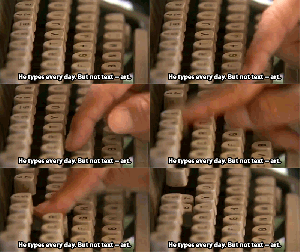
This Man With Severe Cerebral Palsy Created Mind-Blowing Art Using Just A Typewriter

Last year, 22-time Emmy award-winning reporter John Stofflet posted this news video he created for KING-TV in 2004, featuring Paul Smith and his artistic talents.

See the full video to see more of Smith’s artworks and to learn more about his inspiring story go here. 

twistedingenue:

zarhooie:

fleshcoatedtechnology:

FDA Approves First Prosthesis Controlled by Muscle Electrical Signals

Dean Kamen’s DEKA Arm is an electronic prosthetic that mimics natural arm and hand movement with an amazing level of finesse. It’s controlled by electrical signals from the wearer’s muscles. This week, the DEKA Arm became the first muscle-controlled prostheticapproved by the FDA for sale to the general public.

In the FDA study, 90% of test subjects were able to quickly adapt to using the DEKA Arm for tasks that were impossible with traditional arm prosthetics, like brushing hair and using keys and zippers.

This is a cyborg we can all support.

[FDADARPA via Engadget / Gizmodo]

BUCKY BARNES BUCKY BARNES

oh awesome, this was one of the things that influenced the prosthesis in holding on to all you carry.

livingwithdisability:

Good luck Louis, who has set up a “lifestyle marketplace” for disabled people, which will be community led and ethical.

Check it out at ethosdisability.com they launched today!

Random fact about Louis: he is currently the Men’s European record holder at 100m-800m in his T33 class for wheelchair racing. 

insanity-and-vanity:

marcgiela:

honestly students with mental disorders such as depression anxiety etc that go to school should get more recognition and support, most people have no idea of what it is to have to pick yourself up every morning and attend class even when you feel like dying

I am so proud of each & every one of you that this post applies to. You are so much stronger, more inspirational, and more resilient than you realize or give yourselves credit for

Achieving a Better Life Experience (ABLE) Act – Signed Into Law!

The ABLE Act was introduced in the US Senate and US House of Representatives on Feb. 13, 2013. On December 3, 2014, the ABLE Act passed in the US House of Representatives (404-17). Two weeks later, on December 16, the US Senate voted to pass the ABLE Act as a part of the Tax Extenders package. On Friday, December 19, 2014, the President of the United States signed the Tax Extenders package, making the ABLE Act the law of the land. 

1. What is an ABLE account?

ABLE Accounts, which are tax-advantaged savings accounts for individuals with disabilities and their families, will be created as a result of the passage of the ABLE Act of 2014. Income earned by the accounts would not be taxed. Contributions to the account made by any person (the account beneficiary, family and friends) would not be tax deductible.

2. Why the need for ABLE accounts?

Millions of individuals with disabilities and their families depend on a wide variety of public benefits for income, health care and food and housing assistance. Eligibility for these public benefits (SSI, SNAP, Medicaid) require meeting a means or resource test that limits eligibility to individuals to report more than $2,000 in cash savings, retirement funds and other items of significant value. To remain eligible for these public benefits, an individual must remain poor. For the first time in public policy, the ABLE Act recognizes the extra and significant costs of living with a disability. These include costs, related to raising a child with significant disabilities or a working age adult with disabilities, for accessible housing and transportation, personal assistance services, assistive technology and health care not covered by insurance, Medicaid or Medicare. 

For the first time, eligible individuals and families will be allowed to establish ABLE savings accounts that will not affect their eligibility for SSI, Medicaid and other public benefits. The legislation explains further that an ABLE account will, with private savings, “secure funding for disability-related expenses on behalf of designated beneficiaries with disabilities that will supplement, but not supplant, benefits provided through private insurance, Medicaid, SSI, the beneficiary’s employment and other sources.”… 

Read more:

Summary of the Act

Text of the Bill

Achieving a Better Life Experience (ABLE) Act – Signed Into Law!