nuderefsarebest:

ultrafacts:

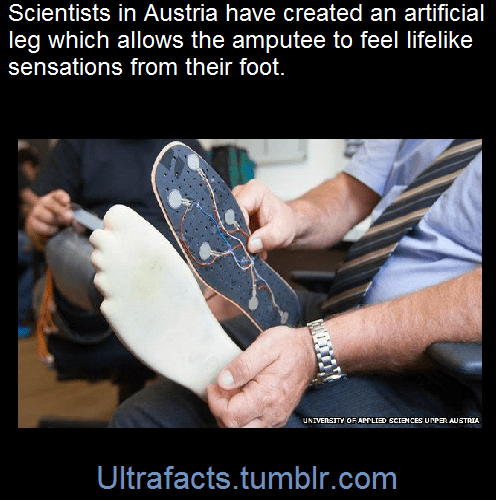
Surgeons first rewired nerve endings in the patient’s stump to place them close to the skin surface. Six sensors were fitted to the base of the foot, to measure the pressure of heel, toe and foot movement.

These signals were relayed to a micro-controller which relayed them to stimulators inside the shaft where it touched the base of the stump. These vibrated, stimulating the nerve endings under the skin, which relayed the signals to the brain.

Prof Egger said: “The sensors tell the brain there is a foot and the wearer has the impression that it rolls off the ground when he walks.”

image
image

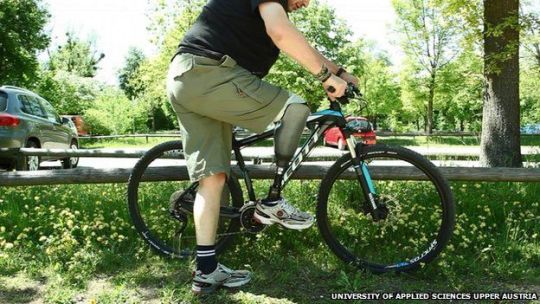
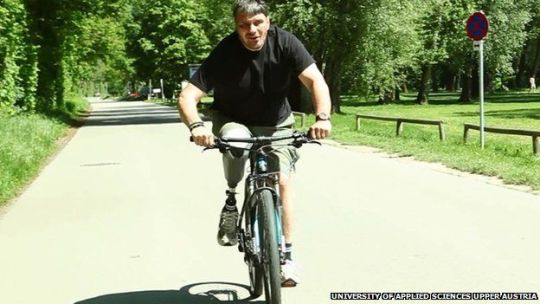
Wolfgang Ranger, a former teacher, who lost his leg after a blood clot caused by a stroke, has been testing the device for six months, both in the lab and at home.

He said: “I no longer slip on ice and I can tell whether I walk on gravel, concrete, grass or sand. I can even feel small stones.”

The 54-year-old also runs, cycles and goes climbing.

Another major benefit was a reduction in excruciating “phantom limb” pain felt by Mr Rangger for years following the amputation.

(Fact Source) for more facts, follow Ultrafacts

I shared an article from I Fucking Love Science on this a few days ago, but, it’s worth sharing again, because this is a HUGE deal. Anything that can really reduce phantom limb pain for amputees is absolutely welcome.

Avoidant Personality Disorder

onlinecounsellingcollege:

Avoidant Personality Disorder (AVPD) is a recognised disorder which is characterized by a hypersensitivity to criticism, intense self loathing and a strong desire to isolate themselves. Sufferers believe that they lack social skills, and feel they don’t know or understand “the rules”. Hence, they tend to avoid social situations to avoid the pain of rejection by others.

People in a close relationship with them often feel frustrated by the person’s tendency to pull away from them and avoid other people. They also find it hard to lead an active social life as the sufferer refuses to go to events such as family gathering, work parties and so on. Also, they may feel pressurised to cut themselves off, too, and live in a bubble with the AVPD person. This can be a source of stress for the person and the extended family.

Although people with AVPD will generally display a number of the traits outlined below, each person is unique and different. (Also, most of us display avoidant traits at times but that doesn’t mean we have AVPD).

Symptoms and traits include the following:“always” & “never” statements; blaming; catastrophizing (automatically assuming a “worst case scenario”); circular conversations (endless arguments which repeat the same patterns); “control-me” syndrome (a tendency to form relationships with people who are controlling, narcissistic or antisocial); dependency; depression; emotional blackmail; false accusations; fear of abandonment; hypervigilance; identity disturbance ( a distorted view of oneself); impulsivity; lack of object constancy (the inability to remember that people or objects are consistent and reliable over time – regardless of whether you can see them or not); low self-esteem; mood swings; objectification (treating a person like an object); panic attacks; passive aggressive behaviour; projection (attributing one’s own feelings or traits onto another); self-hatred; “playing the victim” and thought policing (trying to question, control, or unduly influence another person’s thoughts, feelings and behaviours.)

Specifically, the DSM-IV-TR, defines Avoidant Personality Disorder (AvPD) as being:

A pervasive pattern of social inhibition, feelings of inadequacy, and hypersensitivity to negative evaluation, beginning by early adulthood and present in a variety of contexts, as indicated by four (or more) of the following:

1. Avoids occupational activities that involve significant interpersonal contact, because of fears of criticism, disapproval, or rejection.
2. Is unwilling to get involved with people unless certain of being liked.
3. Shows restraint initiating intimate relationships because of the fear of being ashamed, ridiculed, or rejected due to severe low self-worth.
4. Is preoccupied with being criticized or rejected in social situations.
5. Is inhibited in new interpersonal situations because of feelings of inadequacy.
6. Views self as socially inept, personally unappealing, or inferior to others
7. Is unusually reluctant to take personal risks or to engage in any new activities because they may prove embarrassing.

A formal diagnosis must be made by a mental health professional.

seashellies:

green-witch-uprooted:

transientday:

pixiescribble:

rubyvroom:

fileundermiscellany:

garurumvn:

mutisija:

studiousmedic:

mcride:

slaygnstonhughes:

gabrielleamaris:

the-prophet18:

universaldelusion:

cutecurvycoffeebrat:

Lol savage

I no longer believe in the human race.

This is the laziest shit ever

How lazy can humans get?

Have you never met white ppl?

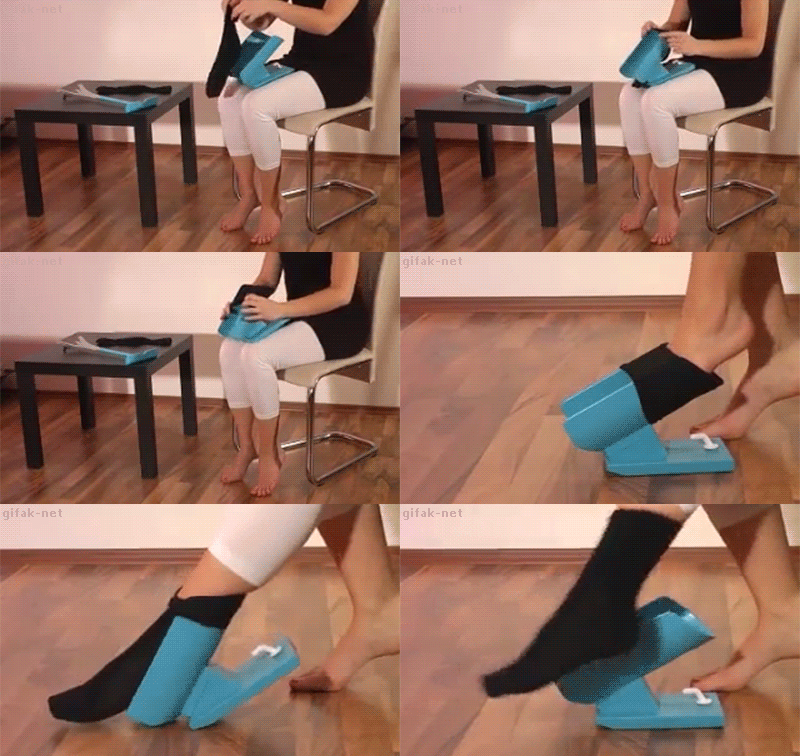
yh but if you look outside your own personal reasons for using this, laziness, it actually looks a really great and practical way to put on your socks if you have a disability that hinders you from otherwise being able so without someone there to help you 

you do realise that there are people out there who literally have to travel door to door helping elderly people, disabled people and people with chronic illnesses to put on their socks? people are paid to help put on pressure socks to help with oedema? don’t you realise that if these people could have one of these tools, these caregivers could be doing something else and that this therefore is an incredible tool designed to cater for some of the most healthcare dependent people in our society? do you guys even realise there are other people living other lives?

i really wish i had this when my spine was broken and i had to wear a medical metal corset which made bending down impossible. i had to ask my mom to help me with socks and it was kinda humiliating.

My dad spends an hour in the morning getting dressed because he has no one to help him to get his socks on because his ankle is fused. If he had this it would literally save him an hour.

“Oh but people are so lazy!”

fuck off you ableist pieces of shit

Honestly I don’t even get how you could look at this and think “lazy”. This looks like more work for an otherwise able-bodied person than just putting their sock on the regular way. It’s pretty obvious this is meant for people who have trouble bending over, like come on.

You know how people go straight to “lazy” on this? Because we’re trained to think of most accessibility modifications as lazy. The disabled = lazy message is deeply embedded in our culture.

ok no but does anyone know where to get this? my best friend and housemate is unable to put on socks due to her illnesses and this would just make her so happy being the independent laydee that she is

My grandpa would have been so happy to have this. It would have made his last years so much easier.

Wow yes look at this useful tool. Here! https://www.activeforever.com/sock-aids

This would have been amazing when I was pregnant. I got so big and was in so much pain I could no longer bend down or even pull a leg into my lap (because I didn’t have one anymore) to put my shoes and socks on.

einzwitterion:

I have ordered wallet size cards that summarize ADA (Americans with Disabilities Act) laws that apply to service animals. There are 50 in a pack, so if anyone wants some, let me know and I will send you a few! I plan to keep one or two with me when out and about so I have the resources to give anyone who is discriminating against service animals.

“The only two permissible questions are whether the animal is required
because of a disability and what work or task the animal has been
trained to perform.
Further, under these same regulations, those
inquiries cannot be made if it is readily apparent that an animal is
trained to do work or perform tasks for an individual with a disability

(for example, it is usually pretty obvious when an individual is using a
seeing-eye dog).” [Source: summary of ADA laws on service dogs from the American Bar Association]

You can’t ask to see paperwork or if the animal is registered as a service animal. There is no government-sanctioned registry of service animals, so a registered service animal is not really something that legally exists. Service animals are not required to be trained by a professional organization, they simply must be trained to perform tasks for their handler (who must have a disability).

Service animals are allowed in any public, governmental, or non-profit space provided they do not pose a threat to health and safety. For example:

  • Service animals are allowed in restaurants, but they may be excluded from restaurant kitchens if the public is also not allowed in the kitchen. Members of the public generally aren’t allowed in commercial kitchens because it poses a food safety risk, likewise service animals are not.
  • Service animals are allowed in the general areas of hospitals, including visiting patients on most wards. They are not allowed in sterile environments, such as operating rooms or burn units–the general public is also not allowed in these spaces.

A service animal that is not in the control of its handler (being aggressive to others, pooping indoors, etc) can legally be asked to be removed from the premises, but its handler must be allowed to stay without the animal and given the same service anyone else would have. The only species of animals that are covered as service animals under the ADA are dogs (any breed) and miniature horses up to 34″ tall and 100 lbs. Emotional support animals (ESAs) have some legal protections, but their right to access public spaces is not as broad as service animals. So you are legally permitted to prevent someone from bringing their emotional support bunny (or, even, dog, if it is an ESA and not a service dog trained to perform at least one task to help its handler with a disability) into your restaurant. ESAs are exempt from no-pet policies in housing and may not be charged pet fees while flying. Proving your animal is an ESA actually requires more paperwork than a service animal (you need a letter from a medical professional stating your need of the animal). 

tl;dr: I will send you ADA service animal law cards if you want them. And don’t fucking pet a working service animal. Don’t even talk to it. It is working and you are being annoying (and possibly endangering its handler.)

longmoreinstituteondisability:

chutzpadik:

(screams from the rooftops) addiction counts as a disability too, and the refusal to allow addicts access to the disability community:

  • ignores the fact that otherwise disabled people ( esp poor disabled people, trans disabled people, disabled people of color) make up a disproportionate percentage of addicts
  • says a lot about how we as a community still cater our safe spaces around the comfort of abled people
  • needs to stop .

It’s also important to remember that in the US, addicts played a crucial role in establishing disability rights.

Take, for example, the role of addicts in the 504 protests.

In 1977, over a hundred disabled people occupied the old Federal building in San Francisco. They did this to force the government to put into effect the first disability civil rights law (Section 504). The protestors were able to stay the course for 26 days until the government signed 504.

A number of community organizations supported the protest by picketing outside, providing supplies, and creating publicity. One of those organizations was Delancey Street, a residential self-help organization for drug addicts. They provided food from their café to the protestors.

Without the help of Delancey Street and other local organizations, the protestors couldn’t have stayed in the building long enough to force the government’s hand. If not for the protestors, 504 might have never been signed–or it might have been signed with watered down regulations like “separate but equal” (the exact words used by a government official) schools for disabled children. If 504 hadn’t set such a strong precedent, the Americans with Disabilities Act wouldn’t exist.

Without the work of addicts, disability rights as we know them would not exist.

The US disability community owes a lot to addicts. Exclusion from the community is no way to express gratitude.

tangleofgarlands:

infamymonster:

a-trans-goddess:

totallydeliciousnightmare:

micdotcom:

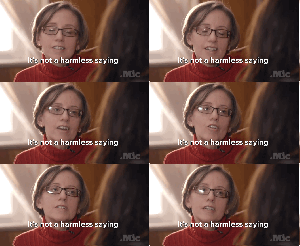
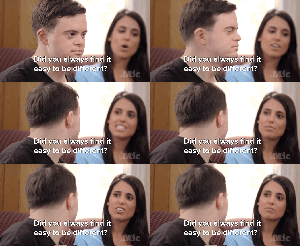
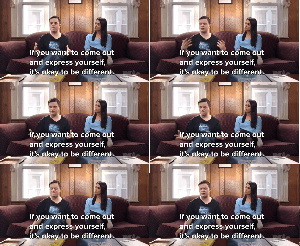
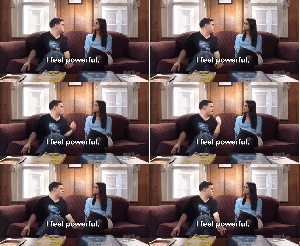
In this week’s “Flip the Script,” we’re tackling the question: When is it okay to use the word retarded? 

I use this quite regularly for no reason and I also have an uncle who has Down Syndrome, so I think I and a lot of other people around me need a friggin reality check

Yes! Please get out of the habit of using this word! It’s never okay 😦

YES PLEASE. THIS WORD DISGUSTS ME

Y E S

are chronic illnesses physical disabilities? if I have chronic fatigue (aka ME, CFIDS, SEID etc), am I physically disabled (and thus can take part in things like cpunk) or no?

deadly-voo:

chronic-illness-support:

I can’t tell you whether you’re physically disabled or if you “qualify” for cripple punk, but lots of people with chronic illnesses consider themselves physically disabled! I’m one of those people, and I’m all about cripple punk.

OK, what was major for ME to realise was that disability isn’t an all-in thing. It’s not “you’re either disabled or you aren’t”. With chronic illnesses like SEID and fibro, your level of ability is going to fluctuate. So some days you can’t reach high to get a thing down from the shelf, you need a cane for stability, you can’t walk 100m, those days you are disabled. Other days you might be a lot more physically able. I realised that the whole “No, you’re disabled or you’re not! You can’t have off days!” refrain my mind kept repeating was an aspect of internalised ableism.

safety-officer-barto:

lyinginbedmon:

hyperscraps:

vashito:

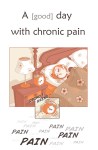
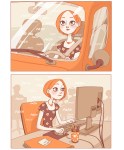
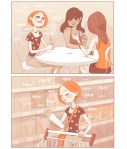
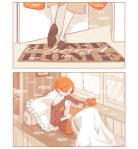
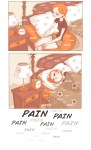
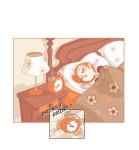
I don’t have chronic pain but this artwork is so nice to look at *^*

Just because we’re not writhing on the floor doesn’t mean we’re not hurting. We’ve just gotten really good at hiding it and functioning with it, otherwise we’d literally starve in our beds.

This also works pretty well for numerous mental disabilities, or just generally for any “invisible” disabilities.

this is the most difficult thing to explain when it comes to depression and anxiety