ghazrat:

momdusa:

jadestoybox:

eahdolls:

Check it out ghouls and mansters!
Here we bring you the first picture of Finnegan Wake (Son of a Mermaid) in his box! Are you planning on adding him to your freaky fabulous Monster High​ collection? He will be a MattelShop exclusive coming this September!

Don’t forget to follow us on Facebook for more news! www.facebook.com/iMonsterHigh

I neeeeed!

*scrolls through tumblr*

*chokes on coffee*

…I am tempted to get him just because THEY NEED TO SEE THIS KIND OF SHIT CAN BE POPULAR!

Stop referring to yourself as ‘disabled’ if you are only mentally ill

the-real-seebs:

iamatinyowl:

You are not disabled. You are an able-bodied person that benefits from ableism. You can physically accomplish everything that physically disabled people can’t. Stop using your mental illness as a way to completely dominate disability discourse.

Yes, people with mental illnesses are discriminated against, but let’s not pretend for a second that showing up to a job interview while suffering depression is anywhere near the equivalent of showing up to a job interview in a wheelchair.

As someone that has both severe mental illness and severe physical disabilities let me tell you: there is an enormous difference between not being able to go get groceries because you emotionally/psychologically can’t and because you physically cannot.

The word you are looking for is neurotypicalism. Not ableism. Unless you’re suffering from a mental illness that physically damages you, you are able-bodied. You do not deal with the same exclusion, erasure or silencing that actually physical disabled people do.

I have days, and weeks where I cannot get out of bed and that does not make my disabled. What makes me disabled is my literal, actual fucking disabilities. I’ve suffered from severe mental illness since I was young, but until two years ago I was not disabled. I was mentally ill. Learn the difference and please stop dominating disability discourse and harassing people who are actually disabled.

This is total bullshit. Like, complete, total, bullshit. I don’t think anything in it is actually true.

Disability discourse has historically been dominated by this attitude, and that’s a big part of what exacerbates disabilities that mostly involve brain function.

You say there is an “enormous difference”, but you know what? Many other people who also have both of those do not think that difference is enormous, or significant even. You are not the absolute arbiter of everyone else’s experience.

livingwithdisability:

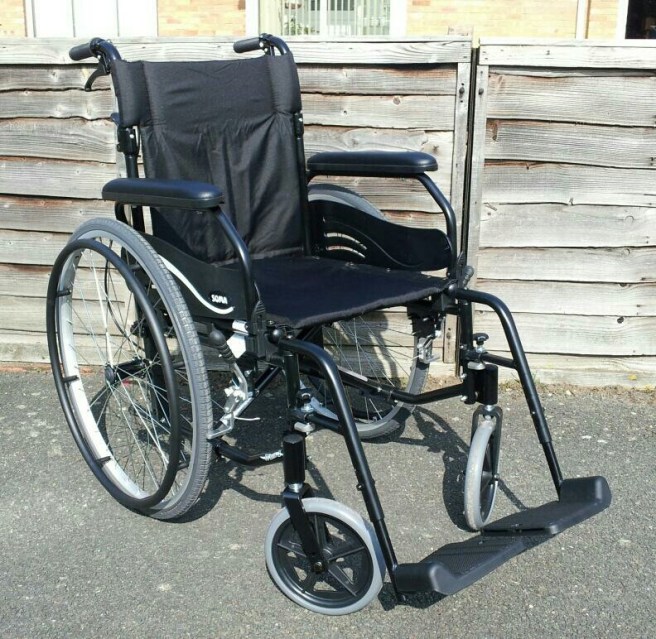
Tips for First Time Wheelchair Pushers

(this is a REBLOG from the awesome and highly recommended Latentexistence blog)

“Today my sister used a wheelchair for the first time. (We share the same inherited mitochondrial condition.) Her husband has little experience of pushing a wheelchair so I tried to give him some tips, which resulted in what I have written below. Believe it or not there is actually some skill involved in pushing a wheelchair and keeping the person in it comfortable. These are just observations from my own experience of being in a wheelchair pushed by someone else, but everyone is different. If you’re pushing a wheelchair for someone new then you should ask them if they have any preferences.

  1. Communicate. Ask if there’s anything you need to know first. NEVER touch or move a wheelchair without permission.
  2. Don’t overshoot checkouts and reception desks. If you are level, your passenger has gone too far past it.
  3. Don’t bump your passenger’s feet into people, objects or walls. Particularly in lifts.
  4. Don’t follow anyone too closely. (See previous point.) Your passenger is closer to them than you are, and seeing backsides that close gets tedious.
  5. Watch out for oddly sloping pavements, especially near dropped kerbs. The wheelchair WILL veer sideways into traffic if you are not careful.
  6. Look ahead for bumps. Dropped kerbs are often not dropped very much. Be prepared to walk a long way around via the road.
  7. Always approach bumps straight on. If you are not straight, stop and turn first.
  8. It can be easier to go backwards over bumps if the wheelchair has large wheels.
  9. Pay attention to the surface you travel over and take the smoother path. Cobbles can be painful or tiring for someone in a wheelchair.
  10. Don’t let the wheelchair run out of control. Consider taking slopes backwards so you can hold back the wheelchair. CHECK FIRST!
  11. If your passenger says stop, STOP immediately. (And, indeed, follow other instructions – see comments on original post.)
  12. Try going through heavy doors backwards so you can push the door with your body.
  13. Some wheelchairs have brakes operated by the passenger. Never assume that those brakes are on or off, always check.
  14. If someone speaks to you when they should speak to your passenger, tell them so.
  15. Be forgiving of your passenger. They have no control and that may make them grumpy. Wheelchair users: be aware that you might be shouting at your assistant more than you realise.
  16. If you’re pushing a wheelchair very far then you’ll probably want to get some gloves.

Thanks to @knitswift, @chmasu, @missnfranchised, @lisybabe on twitter”

Added tips of my own (my wife and I traveled for 3 months around Australia with a backpack and a manual chair and often use a manual chair on holidays)

 – IN ALL CASES DISCUSS THESE TIPS WITH THE WHEELCHAIR USER FIRST – 

these might also be considered ‘advanced’

a) If you will be pushing for a while try and get the handles adjusted so they are the correct height for you, it is much better for your back. 

b) Make sure the handle grips are secure and are not coming off or unscrewing.

c) Bulky bags hanging off the back can make the pusher ‘stoop’ over them, again not good for the back. Weight on the back can change the likelihood of the chair tipping over. Be aware of the dangers.

d) Leaning the chair back slightly while pushing can make it less bumpy for the passenger and easier to push. This is because inflatable back wheels are smoother than the fixed hard ones at the front suspension-wise. Similarly, tipping back very slightly when you go over bumps, manhole covers etc makes it less jarring 

e) It is easier to pull backwards on sand and other less firm surfaces, rather than push. By the sea, get down to the water’s edge where the sand is firm or look for the wooden boarded walkways.

e) If you HAVE to go down steps in a manual chair, you need to be strong and confident. If someone offers to help, 

Either: tilt the chair back, get the other person to stand in front of the chair and steady the front wheels. Tell them NOT TO LIFT THE CHAIR at the front. Lifting it is unnecessary and this makes it very hard on your back rather than rolling down one step at a time. Rest or pause after each step.

Or: If you are on your own it is better to go backwards. Take one step at a time and pause between each. Don’t attempt more than 3-4 steps. 

Obviously this is dangerous but sometimes it is unavoidable.

f) Going down steep slopes is difficult as you do not want the chair to ‘run away with you’. Go slowly in a ZIG ZAG PATTERN. This makes it less steep and you can turn pause to rest by turning the chair sideways to stop it rolling with gravity. Going backwards is also safer as mentioned above.

g) Keep well clear of the edge of the kerbs, avoid running over grills, glass, look out for mess on the pavement!

h) Get into the habit of always putting the brakes on whenever the chair is stationary.

f) Wear solid footwear with good grips, if you slide so will your companion! Be wary of sandy or stony slopes where you may slip.

g) As well as wheelchair signs, look out for signs aimed at pushchair users. Never use revolving doors at hotels. Ramps and slopes are often at the side of hotels or older buildings. 

h) Ask in shops with poor access if they have ramps. Sometimes they have portable ones. Just asking may encourage them to buy one or make changes or mention it to management.


ABLE Accounts and Projected Usage – ABLE National Resource Center

In order to get a better idea of how many individuals might be eligible for ABLE accounts and how a potential beneficiary may use the account to save for disability related expenses, we ask you to take a moment to fill out this survey. In order to better understand if you or your family member might be qualified for the program and to better understand what a qualified beneficiary can use the fund in the ABLE account for, we encourage you to watch this “ABLE Basics” informative short video prior to taking the survey: https://youtu.be/Tv8kIdAovOQ

spacegambit:

krystallkitty:

micdotcom:

Watch: This revolutionary technology is changing the world for kids born without limbs 

That’s awesome and I’m sure its way cheaper than a prosthetic, but seriously it cannot be cheap to 3d print something that big…

this one 17 year old guy 3d printed an entire arm and shoulder for himself and it cost him $250

this seven year old girl got half an arm (just like lusie in the gifs) 3d printed and it only cost $50

can we just compare that with the average price of buying a prosthetic

image

3d printing is gonna help so many people holy crap 

ROHO, Inc.: Resume production of a cushion that will save lives

Resume Production of High Profile 1R99C Serial #: 887591, manufactured on May 29, 1997 When her 1997 Roho cushion went out, Dr. Codrina Cozma discovered she could not breathe on the new Roho cushions and her mobility was restricted due to the pointed tip cell design and new material that was thinner and less elastic. Since last year, she has been experiencing skin sores, difficulty breathing, and dangerously limited mobility while trying 15 different cushions manufactured by Roho and other companies. Roho customer reviews from the past four years also indicate that the material used in Roho cushions tears easily causing serious health issues to other patients who are dependent on these cushions. 

In his 6/2/2014 email, Mr. Robert Graebe, CEO of the Roho Group, assured Codrina: “Our staff here at ROHO will be available to answer any questions your treating professional may have, and will happily fulfill any product recommendation from your seating specialist.” However, when Codrina’s seating specialist and six other clinicians requested the Roho Group to replicate her 1997 cushion because current cushions jeopardized her vital functions, Roho VP David McCausland denied the request in his 9/2/2014 letter, arguing that the chemical ingredients used in her 1997 cushion were no longer available. In subsequent emails, Mr. McCausland refused to reveal the chemical and procedural specs of the 1997 cushion which could have helped other companies produce this cushion, and he denied Dr. Cozma’s request to have the cushion replicated by Roho using the 1997 design and sizes and with currently available chemicals that would produce a material with the same chemical properties. 

Despite the fact that Codrina has spinal muscular atrophy and scoliosis, she has touched the lives of thousands of students at universities in Florida and Georgia, and she has blessed people in need who have benefited from grants from her Heaven Preview Foundation. She has also served internationally for over 20 years as a religious and medical multilingual translator. The Roho Group’s denial to resume production of a discontinued medical product leaves her with no alternatives to survive and continue her mission in the world as her medical team has not been able to find any other viable options for her. 

Codrina’s Roho story is now being circulated in the media worldwide, and people of many nations are hereby pleading with the Roho Group to resume production of a cushion that will save her life and also improve the quality of life of other patients whose needs are not being met by current Roho cushions. Resuming abandoned series has been done before at Roho according to their past patents, so this decision remains a matter of willingness for the company to address the serious medical needs of its customers. Thank you for caring enough to sign this petition! For more details and updates, please visit Codrina’s blog at www.codrinacozma.wordpress.com or contact her on Facebook.

ROHO, Inc.: Resume production of a cushion that will save lives

Some People with Disabilities ARE Prevented from Getting Married and Here’s Why

naamahdarling:

Today was a historic day for LGBT people as SCOTUS ruled to extend marriage to same-sex couples, and several transgender people born in states like Tennessee and Ohio, unable to marry because of their states refusing to change their gender marker on their birth certificates. I am celebrating for all my friends who now have the right to marry, but I cannot celebrate for myself, because I still cannot get married.

Yeah, this is becoming an issue for me.

The rules for SSI and Medicaid are set so that if you make *almost* enough to get out of poverty, they cut you off, leaving you in poverty.  You can’t work or you’ll lose your benefits, but you can’t quite live on your benefits either, and you can’t work enough to make up for it, at all.

Now add in a second person’s income on top of that.  They get access to your partner’s bank account records, they monitor their accounts, they count anything either of you makes against you – even money people give you so you can eat because the government doesn’t give you enough to not go hungry.  They punish you for money people give you to help you get by.  Just … deal with that.

They want us to starve and die young.  They honestly do.  No lie.  And they won’t even stop penalizing us for wanting to be in a legally-recognized relationship with all the safeties that provides, such as those related to access to hospitalized people, those dealing with distribution of property after death, and so on.

It’s not *illegal* for disabled people to get married, but that doesn’t mean disabled people are not *punished* for getting married.

The whole system is fucked, and I honestly despair of it ever improving, or doing so quickly enough to help me.

Some People with Disabilities ARE Prevented from Getting Married and Here’s Why