I think one of the worst parts of having a chronic disease is how it sometimes just breaks you.
You can have several bad days in a row and handle it fine; then one day you lose it because you’ve gone so long taking it that you eventually get to a point where you just can’t do it anymore.
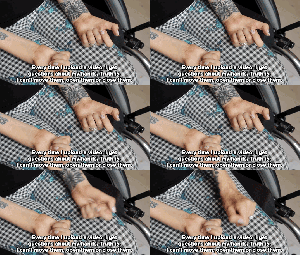
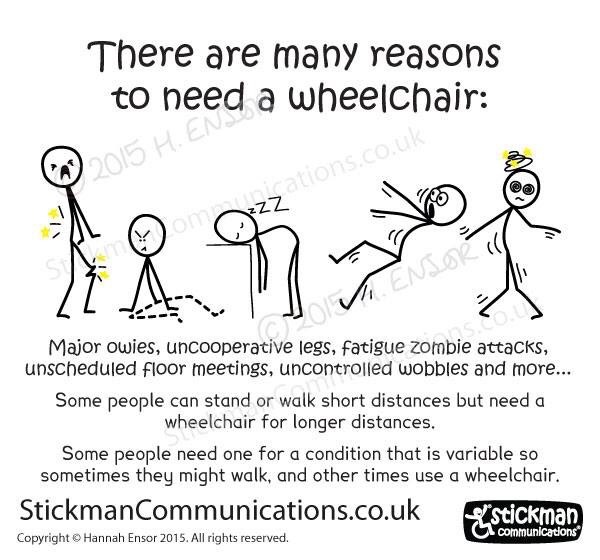
You’ll try to open the dryer door and can’t.
You’ll be cold and won’t be able to get warm. The kind of cold where you can’t get warm so you want to put your blanket in the dryer for half hour but you can’t open the damn door.
You feel grateful for any help you have, but you wish you didn’t need it in the first place.
No one tells you when you get sick that you will have days that don’t just test your pain levels or your patience, they will literally test your very will to get through the day.
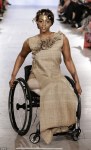
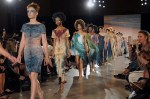
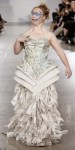
For spring 2016 FTL Moda teamed up with Global Disability Inclusion and the Christopher and Dana Reeve Foundation to raise money and showcase #FashionFreeFromConfines. The runway show featured supermodels Adriana Lima and Toni Garrn alongside models with disabilities including Leslie Irby, Rebekah Marine, Shaholly Ayers and 18 year old Australian model Madeline Stuart who has down syndrome.
when signing out forms to apply for disability / filling out a form for diagnosis
you’re supposed to fill it out as you on your worst days
like, I filled out forms that said I could do most things usually
like, my doctor added in the conditions like “yeah, they can feed themselves when not stressed” “they can do this when not stressed”
but how I should have filled it out was more like
“some days I can’t feed myself” “some days I can’t leave the house”
My doctor didn’t even know this, but I talked to someone who had worked with people with both developmental and intellectual disabilities for a number of years, and she told me to write down how it is for your bad days
this should be a thing they tell you, but it isn’t
part of the reason I didn’t get my autism diagnosis as soon as I should have is because I filled out forms wrong!
I just really want to write a book (in fact, I think that I’m going to) where the protagonist is in a wheelchair. And they live in a city where there’s a group of superheroes. And there’s a big, magical, villain because of course there is.
And since they were a young child, this protagonist has wanted nothing more than to join the group of superheroes. Like they’re a huge fan of the group and they just know that it’s their destiny to join.
And one day, when wheeling through the city, they see the group of heroes fighting the villain. And they quickly wheel over and cry, “Let me help!”
But the ‘heroes’ laugh and instead make a whole bunch of ableist remarks.
And so the protagonist has to prove themselves.
And the villain is trying to warn them to stop.
But the protagonist ends up taking their footrest off of their wheelchair and they swing it. And it hits the villain in the side of the face and the villain collapses and groans in pain.
And so the protagonist proudly smiles and turns to the group of heroes.
Because they just proved that they are strong and worthy enough.
But the group of ‘heroes’ still keeps making ableist remarks.
And the protagonist is shocked.
And meanwhile, the ‘villain’ staggers to their feet and is standing next to the protagonist’ wheelchair.
And one of the ‘heroes’ goes too far when calling the protagonist the R word.
And the protagonist and the ‘villain’ just sort of glance at one another.
And the ‘villain’ is just like, “You know…I can zap them for you…if you want.”
And the protagonist hesitates and says, “Yeah, alright!”
One fried group of heroes later, the ‘villain’ says, “Why do you think that I’m always fighting them? They’re all a bunch of assholes.”
And the protagonist sadly nods and starts to wheel away.
Then:
“Hey, do you want a job?”
The protagonist turns at the villain’s remark. And the protagonist mumbles something like, “Oh, come on. I don’t need your pity.”
And the ‘villain’ is like, “Pity!? Do I look like someone who hands out pity!? I don’t pity you! I’m kind of afraid of you, to be honest! I mean…I’m going to have a giant bruise on my face because of you.”
“Yeah…sorry…”
“Water under the bridge! So, what do you say? Do you want a job?”
And the protagonist thinks about it for a minute before shrugging.
And the ‘villain’ is all excited because they’ve wanted someone to work with them for years but no mortal is allowed to ‘step into’ their lair.
And then the ‘villain’ stops and is like, “Hang on…you can’t work with me in that.”
And they gesture to the protagonist’s wheelchair.
And the protagonist is all embarrassed.
And then the villain goes, “Because we can get you a much better wheelchair! It’ll look great! And it’ll be indestructible! And it’ll have all sorts of weapons and gadgets! Hey, how do you feel about flying…?”
And all of that is literally in the first chapter and then the rest of the story follows the two going around the city like BAMFs, forcing people to stop being ableist, one way or another. And maybe it’ll have some commentary on the scale of morality and what it truly means to be a hero and what it truly means to be a villain.
Would anyone be interested in this!?
Because I really want to write it!?
YESSSSS. ALL MY YES PLS WRITE IT
I’D READ THE SHIT OUT OF THAT YES PLEASE
OP HERE!
Man, it’s so surreal to look at this.
BECAUSE I ACTUALLY WROTE IT!
AND IT WAS JUST PUBLISHED TONIGHT!
Of course, there are some differences between the final book and this original idea. The most notable difference is that all of this takes place in the first book (it’s going to be a series!) and the whole ‘superhero’ thing is just going to be a front. There’s a few other differences as well (such as a huge plotline involving Merlin and immortal characters!)
“As I’ve become more aware of myself and my standpoint as a disabled person, I’ve become more aware of how many otherwise progressive causes ignore us. For example, in academia, critical theory often leaves out issues of disability from the triad of race, class, and gender, even though disability weaves its way through all of them. I was shocked when I realized that theories built on an awareness of the devaluation and stigmatization of bodily difference often ignore the category into which everyone might someday fit: disability. But perhaps that is exactly why disability is left out. Most people feel such fear and vulnerability about the possibility of becoming disabled that they simply want to push it out of their minds.
In the popular media, so-called “body positivity” campaigns leave out disability to a remarkable extent. The body about which we are supposed to feel positive is nearly always the able body. That body might be fat or thin, white or black, Hispanic or Asian, tall or short, rich or poor, but it is almost always able.”
[Cover Image: Photograph depicts model Jillian Mercado, she is a Latina woman who uses a wheelchair. She is against a brick wall. Her hair is in a blonde updo. She is wearing a black shirt with white letters and a black jacket. She also has on a sheer purple skirt and red flat shoes. Her hands are in her lap.]




 Holding the Bowl