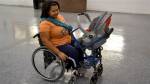
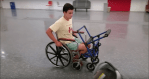

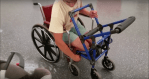
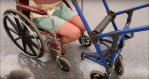


16-Year-Old Invents Wheelchair-Stroller for Paraplegic Parents
YES

Devotional blog dedicated to the Goddess Sigyn offering support to those who are "holding the bowl" within difficult relationships.

HALLOWEEN TIPS FOR FAMILIES OF CHILDREN WITH SPECIAL NEEDS
Before You Plan Your Halloween Fun
How to Make a Halloween Costume for a Child with Sensory Integration Dysfunction
Halloween Costumes for Kids in Wheelchairs
How to Make an Emergency Last-Minute Costume
Halloween on a Restricted Diet
Halloween “Trick or Treat” Cards and Sign
Treats Too Tricky? Try Some Sweet Charity
12 Ways to Use Up Halloween Candy
How Do You Celebrate Halloween With a Child With Special Needs?
Halloween With Special Needs: Tell Your Scariest Story
What Do You Do With Leftover Candy?
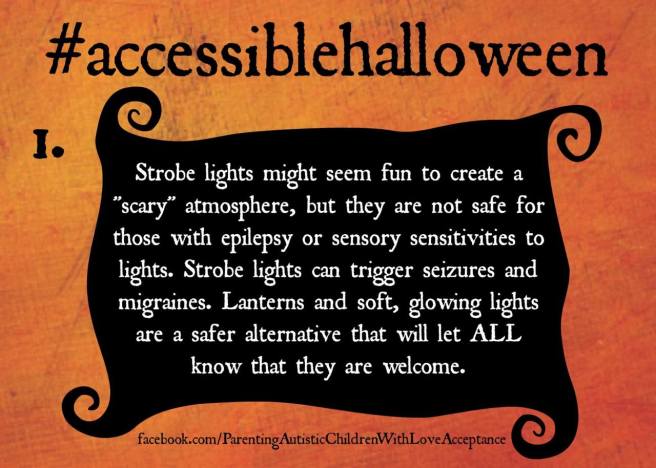
For the month of October, PACLA will be sharing information to help make Halloween safe & accessible for everyone! Autistic children deserve a #posAutive experience in an often overwhelming time of
year. We ALL do. Look for the hashtag #AccessibleHalloween, contribute your own ideas and accommodations, and share widely! The more people we reach, the more inclusive we can make this holiday. Thanks and may we all have a HAPPY and #AccessibleHalloween!Image Description: Orange textured background, with a large hashtag at the top, #accessiblehalloween, and a large number 1. A black banner stretches across the meme, with white text reading:
Strobe light might seem fun to create a “scary” atmosphere, but they are not safe for those with epilepsy or sensory sensitivities to lights. Strobe lights can trigger seizures and migraines. Lanterns and soft, glowing lights are a safe alternative that will let ALL know they are welcome.





Athlete And Model Born Without Legs Proves She Won’t Be Limited By Her Disability
“No legs, no limits.” That’s Kanya Sesser’s mantra – and every day she proves just how limitless her spirit is.
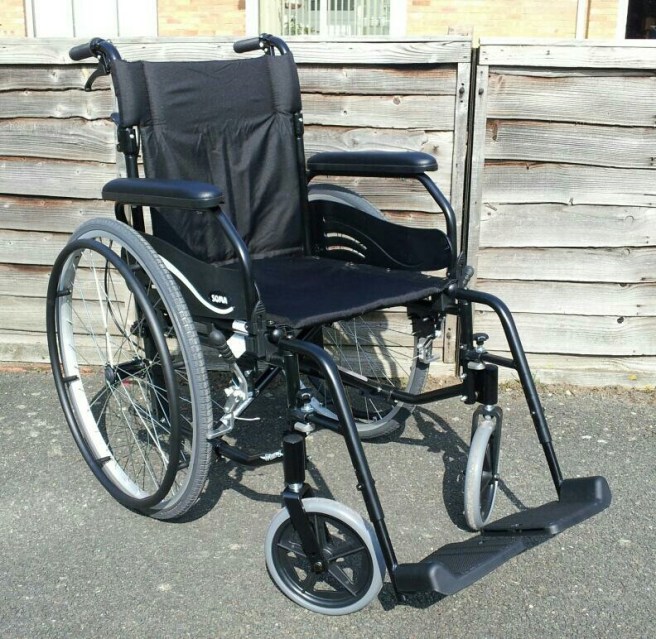
Tips for First Time Wheelchair Pushers
(this is a REBLOG from the awesome and highly recommended Latentexistence blog)
“Today my sister used a wheelchair for the first time. (We share the same inherited mitochondrial condition.) Her husband has little experience of pushing a wheelchair so I tried to give him some tips, which resulted in what I have written below. Believe it or not there is actually some skill involved in pushing a wheelchair and keeping the person in it comfortable. These are just observations from my own experience of being in a wheelchair pushed by someone else, but everyone is different. If you’re pushing a wheelchair for someone new then you should ask them if they have any preferences.
- Communicate. Ask if there’s anything you need to know first. NEVER touch or move a wheelchair without permission.
- Don’t overshoot checkouts and reception desks. If you are level, your passenger has gone too far past it.
- Don’t bump your passenger’s feet into people, objects or walls. Particularly in lifts.
- Don’t follow anyone too closely. (See previous point.) Your passenger is closer to them than you are, and seeing backsides that close gets tedious.
- Watch out for oddly sloping pavements, especially near dropped kerbs. The wheelchair WILL veer sideways into traffic if you are not careful.
- Look ahead for bumps. Dropped kerbs are often not dropped very much. Be prepared to walk a long way around via the road.
- Always approach bumps straight on. If you are not straight, stop and turn first.
- It can be easier to go backwards over bumps if the wheelchair has large wheels.
- Pay attention to the surface you travel over and take the smoother path. Cobbles can be painful or tiring for someone in a wheelchair.
- Don’t let the wheelchair run out of control. Consider taking slopes backwards so you can hold back the wheelchair. CHECK FIRST!
- If your passenger says stop, STOP immediately. (And, indeed, follow other instructions – see comments on original post.)
- Try going through heavy doors backwards so you can push the door with your body.
- Some wheelchairs have brakes operated by the passenger. Never assume that those brakes are on or off, always check.
- If someone speaks to you when they should speak to your passenger, tell them so.
- Be forgiving of your passenger. They have no control and that may make them grumpy. Wheelchair users: be aware that you might be shouting at your assistant more than you realise.
- If you’re pushing a wheelchair very far then you’ll probably want to get some gloves.
Thanks to @knitswift, @chmasu, @missnfranchised, @lisybabe on twitter”
Added tips of my own (my wife and I traveled for 3 months around Australia with a backpack and a manual chair and often use a manual chair on holidays)
– IN ALL CASES DISCUSS THESE TIPS WITH THE WHEELCHAIR USER FIRST –
these might also be considered ‘advanced’
a) If you will be pushing for a while try and get the handles adjusted so they are the correct height for you, it is much better for your back.
b) Make sure the handle grips are secure and are not coming off or unscrewing.
c) Bulky bags hanging off the back can make the pusher ‘stoop’ over them, again not good for the back. Weight on the back can change the likelihood of the chair tipping over. Be aware of the dangers.
d) Leaning the chair back slightly while pushing can make it less bumpy for the passenger and easier to push. This is because inflatable back wheels are smoother than the fixed hard ones at the front suspension-wise. Similarly, tipping back very slightly when you go over bumps, manhole covers etc makes it less jarring
e) It is easier to pull backwards on sand and other less firm surfaces, rather than push. By the sea, get down to the water’s edge where the sand is firm or look for the wooden boarded walkways.
e) If you HAVE to go down steps in a manual chair, you need to be strong and confident. If someone offers to help,
Either: tilt the chair back, get the other person to stand in front of the chair and steady the front wheels. Tell them NOT TO LIFT THE CHAIR at the front. Lifting it is unnecessary and this makes it very hard on your back rather than rolling down one step at a time. Rest or pause after each step.
Or: If you are on your own it is better to go backwards. Take one step at a time and pause between each. Don’t attempt more than 3-4 steps.
Obviously this is dangerous but sometimes it is unavoidable.
f) Going down steep slopes is difficult as you do not want the chair to ‘run away with you’. Go slowly in a ZIG ZAG PATTERN. This makes it less steep and you can turn pause to rest by turning the chair sideways to stop it rolling with gravity. Going backwards is also safer as mentioned above.
g) Keep well clear of the edge of the kerbs, avoid running over grills, glass, look out for mess on the pavement!
h) Get into the habit of always putting the brakes on whenever the chair is stationary.
f) Wear solid footwear with good grips, if you slide so will your companion! Be wary of sandy or stony slopes where you may slip.
g) As well as wheelchair signs, look out for signs aimed at pushchair users. Never use revolving doors at hotels. Ramps and slopes are often at the side of hotels or older buildings.
h) Ask in shops with poor access if they have ramps. Sometimes they have portable ones. Just asking may encourage them to buy one or make changes or mention it to management.
Carolyn Hax, 10 Feb 2010:
Dear Carolyn: One of my friends has had fibromyalgia for the past year. It makes me sad, and so I like to find alternative treatments and cures and tell her about them. She’s gotten really annoyed with me for doing this, but I am only trying to help and I think she should be more willing to listen to what I’ve found. She has a doctor she sees regularly and takes medication, but I don’t know why she brushes it off when I give her my advice. I feel really unappreciated and am starting to wonder if she even wants to feel better. – California
Dear California,
Your friend has put you in a terrible situation, without apparent regard for the degree of injury here. Sure, she lives with a painful, chronic medical condition that affects her ability to participate in the world and yadda yadda yadda, but you feel sad and unappreciated. Where, I ask you, is justice?
Just because your friend manages her condition with the assistance of medication and a trusted medical professional of her choosing doesn’t mean she’s getting the best care available to her, which is to say, the care recommended to her by a person who can use Google.
The bare fact is that your friend’s fibromyalgia is, fundamentally, about you. On the surface, that may seem counterintuitive–it may seem like your friend’s medical condition is solely her business, and that the management thereof is something she alone is entitled to, but that completely erases you, a person who read a thing about gluten one time, from the equation. And that isn’t fair–indeed, it’s even less fair than having fibromyalgia, which your friend could easily not have if she only read those 45 articles you just forwarded her from WebMD.
Why would your friend brush off advice–advice you heard from not one, but probably TWO yoga teachers–about managing her medical care just because she feels more comfortable treating her condition in the manner of her own personal choosing? It’s logically because she does not want to feel better, which is a direct attack on you, personally, the individual in this situation with the heaviest possible burden to bear.
If you stopped advising your friend about the miracle cures available according to pamphlets you picked up outside Whole Foods, who knows what might happen? She might continue to make the decisions that she feels are best for her own health, and you’ll be left with no one’s medical care to aggressively manage without their consent, an unimaginable travesty.
But the sorry truth is that we cannot fix everyone, can we?
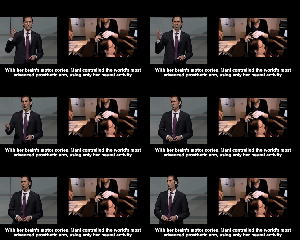
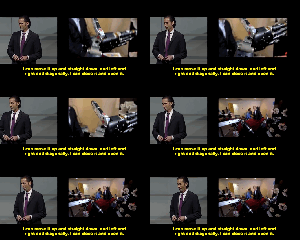
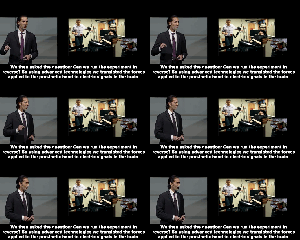
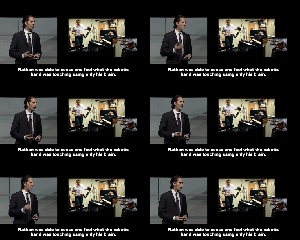
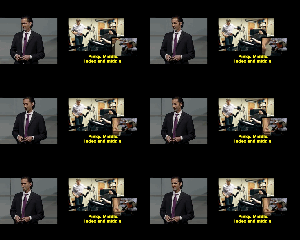
Watch: This prosthetic hand is so advanced it can actually “feel.”
This gives me chills and makes me teary-eyed for those who could benefit so greatly from this technology, including friends.
WE LIVE IN THE FUTURE AND THE FUTURE IS AMAZING. Spending too much time on the computer and on your cell phone makes this possible.



 Holding the Bowl