Like, 90% of infomercial style products were designed by/for disabled people, but you wouldn’t know that, because there is no viable market for them. THey have to be marketted and sold to abled people just so that any money can be made of off them and so the people who actually need them will have access.
I think snuggies are the one example almost everyone knows. They were invented for wheelchair users (Do you have any idea how hard it is to get a coat on and off of someone in a wheelchair? Cause it’s PRETTY FUCKIN HARD.) But now everyone just acts like they’re some ~quirky, white people thing~ and not A PRODUCT DESIGNED TO MAKE PEOPLES DAY TO DAY LIVES 10000X EASIER.
But if at any point you were to take your head out of your own ass and go “Hey, who would a product like this benefit,” that would be really cool.
This makes informational make so much sense now.
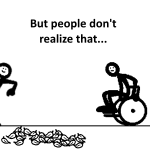
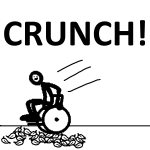
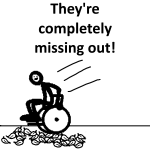
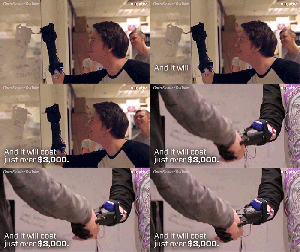
Like… of course there’s no reason for that guy to knock over that bowl of chips. However, the person it was actually designed for has constant hand tremors that would make this pretty rad, but since we don’t want to show that in a commercial, here’s an able bodied guy who can’t remember how gravity works.
Shit. Those commercials suddenly get a lot less funny when you realize it’s pretty much just people ineptly trying to mimic disability.
Or like the thing for the eggs? Like, oh, it cracks eggs perfectly, you only need one hand?
IT WAS DESIGNED FOR PEOPLE WHO ONLY HAVE THE USE OF ONE HAND.
Or the juice bottle pourer? For people who’re TOO LAZY TO POUR THEIR OWN JUICE? Or FOR PEOPLE WHO HAVE DIFFICULTY BEARING WEIGHT IN THE HANDS.
After years of wondering about this completely useless product (for able-bodied people with two useable hands who are WASHING THEIR HANDS WITH SOAP DIRECTLY AFTER TOUCHING THE PUMP OF A NORMAL STYLE SOAP DISPENSER) I think this post has finally explained to me why it exists. It’s so obvious why have Inever considered any of this before?
You will want to run away from it. Don’t. Running away will only make it worse when you’ll eventually have to face it. (And you can’t keep running forever).
You will be in a constant search to try to find ways to temporarily fix it. Alcohol, drugs, self-harm. They won’t work. They will make you feel worse; but you will want to keep using them anyway.
After a while, you might make friends with it. Get accustomed to it. (But it will still hurt).
Loneliness will come along with it. Not because you’re necessarily alone, but because you’re engulfed in something that other people cannot understand.
Some days will be better than others.
And on these days, you wonder who you really are, and what you are without it.
You will also be scared. Scared of the moment it will come back again.
You will want to disappear.
And you can, if you want to. But you will be losing all of your possibilities. There are many possibilities. The biggest of all, is that you get another better day, followed by another and another. Don’t lose that possibility. (I almost lost my possibility, but I didn’t, and it came true).
I appreciated this point about prioritizing the social model of disability, over the medical model, which Laura Bates explains in Everyday Sexism:
Medical Model of Disability: “…a person is disabled by their impairment (i.e. mental-health issue prevents them from getting a job, or a physical impairment restricts their ability to access certain venues)…”
Social Model of Disability: “…it is not the impairment in itself but the lack of accessibility created by our [ableist] society that makes a person disabled (i.e. our stigma around mental health issues prevents that person from getting a job, or a lack of adequate measures to make a venue fully accessible prevents certain people being able to enter).”
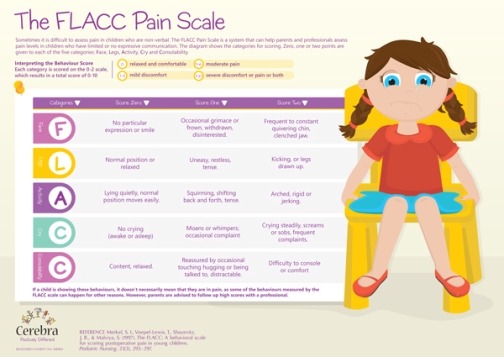
Resource pdf. Downloadable guide to help parents of children with severe intellectual and/or communication difficulties understand how pain may affect their child.
It does so by explaining possible causes of pain in children with intellectual disability, presenting information about how pain may be shown by children who cannot tell us they are in pain and discussing the effects of untreated pain.
People love to talk about whether or not disabled people can work
but if you can work just fine and your disability is destroying your ability to have a life outside of work (because work takes all your energy and more)
Dead silence. Nobody cares.
File this under, oh you can be active for 4 hours? You can work part-time. Um no, I have to get ready for work (30 min) get to work (15 min) get home from work (15 min) feed myself all day (30 min) maintain myself, my home and my life (15 min, yeah right), which leaves 15 min for work and absolutely nothing else.
This is so accurate, back after I’d relapsed I wanted to try and go in for one class at school so I could still stay in contact with the education system. I let slip during a meeting that I managed to drag myself to that I could manage about 4 hours of activity a week, which the teacher sprang on to mean I was being lazy for just trying to get to 1 hour class. Never matter that it was 30 minutes travel, that I would have to get washed and dressed, that I would probably still need to recover for 3 days from it.
Far too often abled people see the things they do easily as “non activities”, they don’t realise that for many disabled people these things have to be carefully planned and measured, and sometimes they simply can’t be done.
reblog bc the non activities thing seems really important words
I get X number of pain-free steps per day right now, which means that, for large conventions (like SDCC), I need to be in a mobility device. I had someone ask if I used up my steps every day before transferring to the scooter, and look surprised and a little horrified when I said “no, I save them so I can go to the bathroom unassisted.” Like, they had never considered that walking is involved in peeing.
!
Reblogging for the important point that the term “activity” may mean something very different and much broader for a disabled person with a chronic pain or fatigue related condition compared to its meaning for a non disabled person. If you’re tired enough, simply sitting up in a chair rather than lying in bed is an activity that drains energy otherwise usable for other things. A thing I knew from other people with pain and fatigue related conditions, but worth reinforcing for followers who didnt know or had forgotten.







 Holding the Bowl