In response to the question, “Do you have any suggestions on talking to doctors about pain? I’m going to see my doctor in a few days so I could use some tips and getting my point across.”
Anybody who’s ever tried to explain their experience of bodily pain to someone else knows that it’s difficult. Pain is subjective to each person, and absolutely nobody can feel our physical pain but us. This doesn’t mean that we shouldn’t try to communicate to others that we are having a life-changing problem, though; this just means that we should learn how to communicate about it effectively in order to receive the most empathy, compassion, and appropriate treatment(s) possible. How do we do that?
Figure out if your pain is acute or chronic Acute pain is short-term and often intense. Chronic pain lasts for longer than 3 months and can be just as intense, if not more so. Try to journal and see if you can list all you know about your own pain’s history, and go into your appointment with this list (as well as a list of your questions and concerns) so that you feel confident and don’t forget anything important to you. How long has it lasted? Is it the result of a specific event that you can pinpoint?
Find vivid phrases to describe what your pain feels like When I was first going in to see a doctor for chronic hip pain, I found the phrase, “I feel like I just slammed my hip against a table.” Easy to understand, as well as almost feel yourself, right? Make it clear that this is something that needs and deserves treatment. Women often get taken less seriously than men when seeking pain treatment, as do racial minorities. Advocate for yourself as best you can.
Learn the typical words that describe pain (as well as what parts of the body are affected by it) Sometimes, in dealing with pain, you’ll be experiencing different types of pain in different places. Read this page in order to understand what people actually mean when they say they’re having a “dull” pain, as well as other terms like “raw”, “stiff”, and so on. In addition, find a nice picture of the human body on Google, if you’re struggling to figure out the name of the approximate region where you’re hurting. I like this one because it has both the Latin and the English words, as well as the front and back of the body.
List which everyday activities are compromised by your pain Certain pain syndromes, if it turns out that you have a more widespread chronic pain disorder rather than an acute pain, have life activities that are known to be affected in most people who have it. Journal about them. You’re often required to list these on patient intake forms, anyway, so this will speed up your process of filling out that paperwork.
If you’re science-y, read up on pain This is mainly for the anatomy and physiology nerds out there. Two very readable articles from WebMD: Pain basics (1 page) | Pain classifications (3 pages)
List every single symptom you’re experiencing (even the ones that you think can’t possibly be connected to each other) Think about every part of the body. Is anything going on that didn’t in the past? I know that this can be hard, and even distressing, because it can give us a reason to grieve, but as much as you can, push through your discomfort with it. What makes them worse? Better? Bring this list with you to your appointment so that you can’t possibly forget any of them when you’re on the spot. The more your practitioner knows, the better.
Go into your appointment with a pain scale of your choosing (because not all pain scales are created equally, nor do they necessarily mean the same thing to different people) What is your pain on good days? What is it on bad days? I personally like the Mankoski Pain Scale because it talks about the daily life impacts of your pain, as well as the kind of medication that might help. Of course, it will be up to you and your practitioner ultimately to decide what kind of treatment you will get, but knowing, for example, that you’ve tried ibuprofen and it hasn’t worked is a helpful piece of information.
I wish you the absolute best in your appointments, friends. Know that you’ve even got an entire community behind you here on Tumblr! We’ve got your back and understand you more than you could possibly know. We’re called spoonies (people who have chronic illnesses that limit our energy). Here’s a masterpost of spoonie community-related stuff, (and how about another?), and a world map of spoonies to remind you that you are never alone! And, if you get diagnosed with something in particular, here’s a list of Tumblr bloggers that identify with particular diagnoses (and, chances are, there are others out there just like you)! Be well, and please ask any questions you need to.
While I’m sure there are people too lazy to spin a fork, keep in mind people like this person who may be suffering from arthritis or a neurological disease or nerve damage or a thousand other conditions that might impair their ability to do things as simple as spin a fork to eat spaghetti.
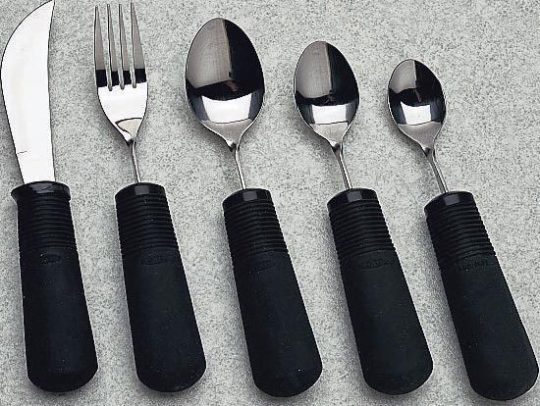
These are used with people who can’t grip well:
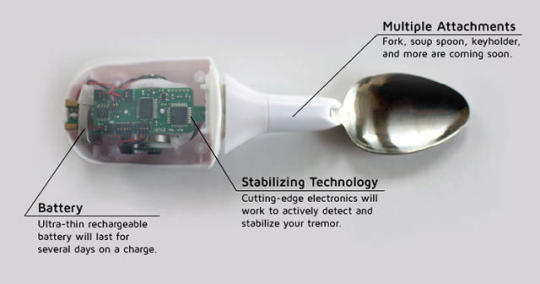
This is for Parkinsons’s:
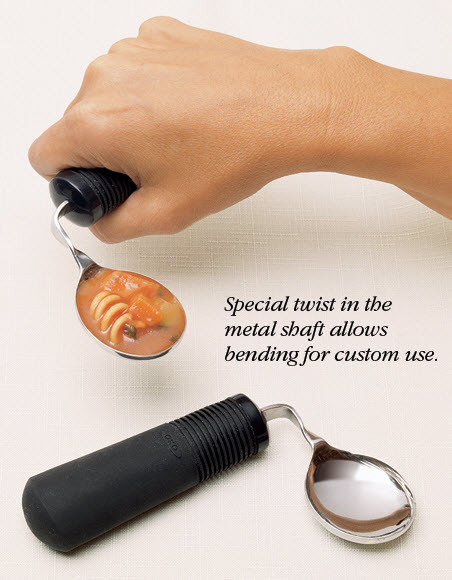
For people who can’t even bend their joints:
Here’s a product that guides your hand from your plate to your mouth
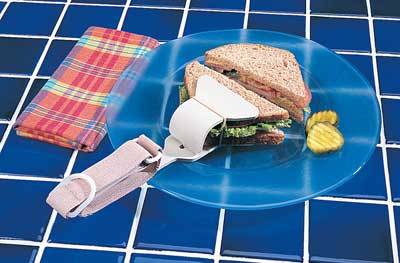
This one holds a sandwich
Like I get it. I used to see things like the fork and think “that’s fuckin’ lazy” or that product that holds a gallon and you just tip it and pour. But then I started working around the disabled and impaired and found out that these products aren’t meant for lazy people, they’re meant for people who need help.
So maybe next time you see something, instead of thinking “Wow, are people that lazy?” just be grateful that you’re able to do the things you do every day and take for granted, like being able to feed yourself and wipe your own ass because you have enough coordination and bendy joints to do it.
HEAR FUCKING HEAR
I have nerve damage and degenerating joints in my hands (I’m only 38 dammit) and I would cut a bitch for that spaghetti fork, people have no clue how hard that movement is, no fucking clue
for that same reason, those jokes about “they’re so dumb you gotta wonder who ties their shoes for them” that shit ain’t funny either
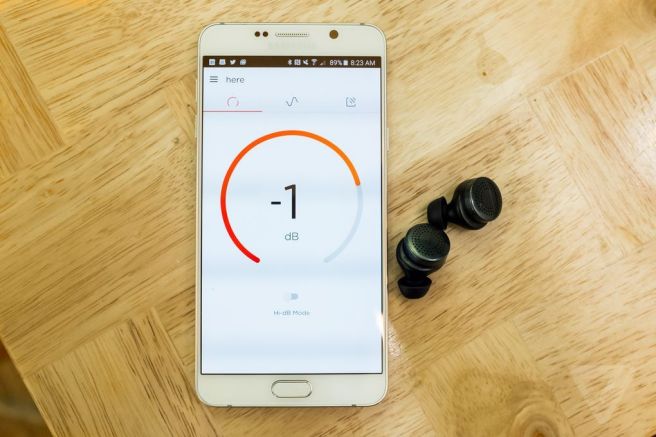
New earbuds that let you turn up or down the sounds around you.
But is not just about volume, you can also raise or lower the bass or adjust specific frequencies.
They also have preset filters that you can use to cancel out crowd noise or enhance the sound a concert venue.
“Riding on a bus? Just tap the “Bus” profile to drown out the low frequency hum. Walking around in a city? Tap the “City” or “Crowd” filters to tune out the murmurs and shouts. (There are also some crazier effects like “Echo” and “Fuzz.”)”
These have been created for the mass market but will have specific benefits to disabled people who want to block out sounds or for those who have hearing impairments.
“When you show up for a flight at an airport, the Here app could automatically suggest you switch to that profile. If you always set it to office mode at a certain location, the earbuds could start suggesting that filter when you arrive. Kraft’s ideas for Here go even farther than that, and they start to sound almost sinister. “I sometimes sit here with [the decibel setting at] +6 with just the door open and eavesdrop on the office, it’s kind of amazing,” Kraft jokes. “You can hear, like, the little conversations that you’re not supposed to hear.“The Here earbuds seem ready to tackle these everyday situations, but Kraft says they’re meant for more aggressive settings like live concerts, or the hustle and bustle of a big city.”
Called the Here Active Listening System by Doppler Labs, there is currently a waiting list to buy them.
You have to prepare to be emotionally ready to handle normal test results when you’re secretly hoping the tests will show something and you’ll have an answer.
Nurse: The tests were clear! 😀
Me: 🙂
Me: 😐
Me:
Me: 😦
Me: Well…. so what could it be? What… what do I do now?
Instead of telling disabled kids “you can do anything you want if you put your mind to it,” I think we should tell them, “the things you are capable of doing matter.”
A person can’t live on an increasingly strained hope that someday they’ll be good enough, especially if all you ever do is tell them who they are and what they do now is worthless.
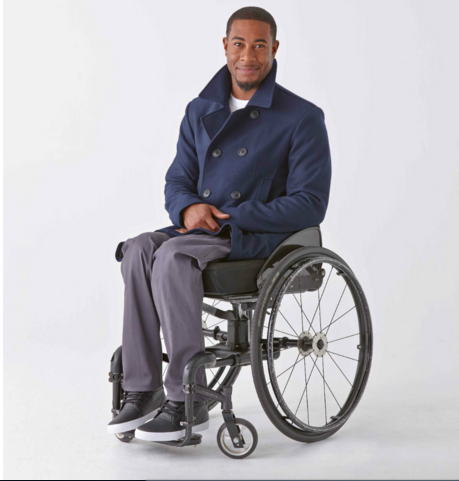
“We believe wheelchair users should have access to the same styles and trends everyone else has, without ever having to compromise comfort.
Our clothing has signature cuts and styles to fit a seated body shape, falling and draping naturally without interfering with wheelchair mechanics. We use top-quality fabrics that look beautiful and feel luxurious.
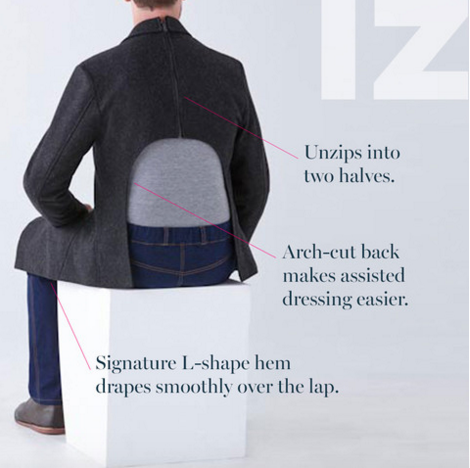
Our Easy Zip Back option in coats is just one way that we’re making layering up and staying warm easier than ever. Discreet zippers in the back mean that Easy Zip Back coats separate into two individual pieces.
Our signature ‘L-Shape’ means that IZ coats have the length you need over your lap while looking sleek and clean so you don’t sacrifice your style.”
The IZ Collection goes up to a 2X and has a wide range of masculine and feminine clothes.
They look gorgeous, but be prepared. They are expensive.
Carrie Fisher and Gary – Star Wars: The Force Awakens Premiere at Leicester Square on December 16, 2015 in London.
So, this is important. Carrie Fisher has an invisible illness and disability – severe mental illness – and she’s been really open about it. Open to the point where she has her service animal Gary out on the press tours.
Yeah, a service animal. Not a guide dog, a therapy dog. Fisher has almost died because of her illness – and the reason she could DO Star Wars is because she has accommodations that work for her.
Everyone is talking about how Gary has stolen the show – but he is *important*. He is working. He is what she needs to go out and do this shit.
Next time someone with a disability asks for you to do something simple to accommodate them I want you to think of this. This is Princess Leia and this is her accommodation for her illness.
Ten years ago, I was about to get sick I cannot remember it I cannot remember waking up at 7am, 5 days in a row Week after week after week I don’t remember if it was easy but I remember it was possible I cannot remember when nothing ached When if I didn’t walk, it was because I was lazy Not because I couldn’t
I cannot remember When taking a shower Was relaxing Instead of exhausting
I cannot remember When I wasn’t a burden When I was fun And energetic And up for anything And no one had to slow down or miss out Because of me
I cannot remember How it is to remember When I didn’t need to write anything down And didn’t break promises And didn’t forget my own name When I knew all the words I needed When everyone said How eloquent I was I can remember everyone said it But I can’t remember being it
I cannot remember Being upright all day And never lying down Or counting the hours From painkiller to painkiller
I cannot remember Reading page after page for hours For fun And understanding every word Without reading a line twice over Or three times, or five And without feeling like a failure
I cannot remember No pain I cannot remember it What did I do? Did I walk faster? Or further? Did I stay out all night? Or did I just sit around? Without knowing that one day Just sitting around would be all there was And even then The pain wouldn’t end
I cannot remember Having energy instead of pain I cannot remember Concentration and memory And still knowing how my sentence had started When I got to the end
Two thirds of my life, I was healthy And I cannot remember






 Holding the Bowl