Supernatural: Misha Collins on launching a support network for fans | EW.com

justanotheridijiton:

After 11 seasons on the air, Supernatural not only has one of the most loyal fan bases on television, but it also has one of the most active. From winning EW’s Fanuary to helping multiple charity campaigns to succeed, the SPN Family is a close-knit community, and it’s one that actors Misha Collins, Jensen Ackles, and Jared Padalecki care about deeply.

All three actors have worked on charity campaigns in the past, but now, the actors are launching a campaign aimed to specifically provide the fandom with support.

“We have this interesting exposure to our fandom in the form of conventions, where we go and we meet fans face-to-face pretty much every other weekend,” Collins says. “And we have occasion to meet thousands and thousands of Supernatural fans and at every event, every one of us encounters as many as a dozen people who share really heart-rending stories about self-harm or addiction or depression or suicide attempts. We see a lot of people with tattoos of semicolons on themselves – the semicolon is where the author could’ve chosen to end a sentence but instead chose to carry it on so it’s a very potent symbol for somebody who’s struggled with near-death situations and forged on.”

And after years of hearing those stories, Collins has partnered with his fellow actors to launch The SPNFamily Crisis Support Network, a community support system to help fans cope with mental health issues such as depression, self-injury, and addiction.

Specifically, Collins and Ackles have recently launched You Are Not Alone, a T-shirt campaign from which proceeds will help launch the support network. Furthermore, they’re working with a number of nonprofits to get the network off the ground. “The nonprofit Random Acts is housing this network in partnership with two other nonprofits, IMAlive and To Write Love of Her Arms, which are helping us,” Collins says. “They have experience in this realm so they’re helping us build it in a an efficacious way.”

And in doing so, they’re hoping to create a space for fans to turn to one another in times of need. “For whatever reason, it seems to be something that is prevalent, or at least bubbles to the surface in our fandom. It’s just something that seems to be affecting a lot of people,” Collins says, adding, “I think one of the big problems that people face when they’re struggling with these things is not knowing where to turn. But if you are part of a community and you know that that community is offering help in a certain way and it’s something that you know is there, I think it might be really helpful. Anyway, that’s what me and Jared and Jensen thought.”

And after about six months of working on pulling everything together, The SPNFamily Crisis Support Network is becoming a reality. “We have psychologists, psychiatrists, therapists, and so far, about 1,500 people have volunteered to help man the hotlines,” Collins says, noting that part of the network is fans being trained to help fans, but that’s only after each person who volunteers is thoroughly vetted and trained.

But for now, this is just the beginning. “I’m really excited to actually see this thing hit the ground,” Collins says.

Supernatural airs Wednesdays at 9 p.m. ET on The CW.

Supernatural: Misha Collins on launching a support network for fans | EW.com

Depression is hard to understand, because it is not a consistent state. Depression is rather like a virus, but like a virus, it has its manageable days and its acute, life-threatening flare-ups. You can be in a depression and still laugh at a friend’s joke or have a good night at dinner or manage low-level functioning. You grocery shop and stop to pet a puppy on the corner, talk to friends in a café, maybe write something you don’t hate. When this happens, you might examine your day for clues like reading tea leaves in a cup: Was it the egg for breakfast that made the difference? The three-mile run? You think, well, maybe this thing has moved on now. And you make no sudden moves for fear of attracting its abusive attention again.

But other times…

Other times, it’s as if a hole is opening inside you, wider and wider, pressing against your lungs, pushing your internal organs into unnatural places, and you cannot draw a true breath. You are breaking inside, slowly, and everything that keeps you tethered to your life, all of your normal responses, is being sucked through the hole like an airlock emptying into space. These are the times Holly Golightly called the Mean Reds.

I call it White Knuckling it.

Miles and Miles of No Man’s Land, Libba Bray (via babybirched)

“But the stigma of depression is that it comes with the sense that you shouldn’t have it to begin with. That it is self-indulgence or emotional incompetence rather than actual illness.”

(via keeperofthehouse)

“When it’s White Knuckle Time, you will have to remind yourself to stand in the middle of the subway platform, well away from the edge.”

“There is an undertow to depression. It doesn’t take you all at once. It leaves you with some false sense that you are coping. That you are in control. That you have the shore still well in sight, until, at some point, you raise your head to find yourself all alone, battered by rough seas with absolutely no idea which way you should swim.”

(via indigo-inferno)

roachpatrol:

@ teens because i’ve gotten a lot of asks along the lines of ‘i think i’ve got depression/anxiety/a personality disorder but my parents and teachers and counsellors just say it’s teen angst and won’t help and won’t get me to a therapist and i’m so tired and scared’. 

your primary emotional state should not be exhaustion, sadness, fear, or stress. seriously, even if you’re an adolescent. ‘teen angst’ is an awful dismissal of how emotional distress is a natural human reaction to the circumstances we force teens into: long work hours, few rewards, routine privacy invasion, unjust punishments, gruelingly unhealthy sleep schedules and food, and rigid prison-like social systems.

in addition to this, somewhere between half and three-fourths of mental illnesses show up before age 18. this leaves tons of people struggling for years to manage symptoms, alone, until they’re adults and it stops being so ‘normal’ for them to be miserable. or, you know, they treat themselves with drugs, abusive relationships, or suicide, and then everyone is like ‘why did this happen???’. 

you are not supposed to be in constant pain. you’re not even supposed to be in frequent pain. take your mental health seriously. 

jumpingjacktrash:

takealookatyourlife:

I think the most fundamental misunderstanding of depression comes from the fact people think we aren’t making enough “happy chemicals” which is why they think if we did things that produce these chemicals (excercise/nutrition etc) then we would be fixed. 

But the way depression actually works is that our brains do produce happy chemicals – it just soaks them all up before we feel the benefit. So no matter how many more chemicals we get our brain to make, it will never be better, because that isn’t the problem. There is no amount of willpower that will be able force our internal organs to learn how to uptake more serotonin. “Happy pills” do not create more happy chemicals, they allow your brain to recognise what it is already producing. 

Having depression isn’t a personality trait or a personal failure, it’s an illness that needs to be managed. 

this. it’s like we’re unable to digest sugar, and everyone’s immediate reaction is to throw cookies at us. no that isn’t the problem you guys stop.

smashfold:

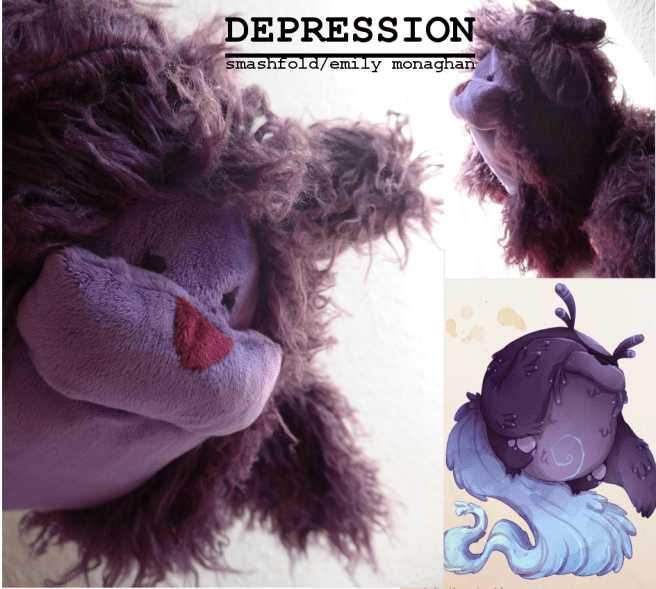
Introducing: Depression!

This is the third in a series of plushies based on mental health conditions. The Depression monster is saggy and lethargic, weeping constantly and transfering its feeling to others as some relief from its own pain. I love the way that everything in this design is turned-downwards – it’s a slump in fabric form! The Depression plush is one big huggable ball of fluff, and warming and soft to hold, with elongated arms which can cover up its eyes and glomp onto things. My own experience of Depression is very close to Toby’s concept – it feels like something heavy and soft clinging to the back of my head, making everything more sluggish.

Depression is made of minky and luxury, tangled faux-fur. This plush contains no wire for maximum huggability. The plush isn’t quite as spherical as the image – mostly to save you guys on postage.costs, as the extra bulk was adding a lot to the toy’s weight, but the slightly sleeker design gives the finished product the look of a creature trying to curl up and hide.

Real Monsters

The Real Monsters were created in 2013 by Toby Allen,
and envisaged mental health conditions as monsters who literally
followed you around. Cute yet also kind creepy, who wouldn’t want an
Anxiety of their very own to hold, or a floompy Depression critter? I am
currently partnering with him to bring them to life as limited edition
plushies.

Depression will be slumping its way to your postbox in the autumn.

Until then – as always – shares, watches, and reblogs make this happen.

Emily: Tumblr | Email | DeviantArt | WordPress | Facebook | Twitter |

Toby: Tumblr | Email

Understanding depression in a friend or family member

onlinecounsellingcollege:

– Depression is a serious condition. Don’t underestimate the seriousness of depression. Depression drains a person’s energy, optimism, and motivation. Your depressed loved one can’t just “snap out of it” by sheer force of will.

– The symptoms of depression aren’t personal. Depression makes it difficult for a person to connect on a deep emotional level with anyone, even the people he or she loves most. In addition, depressed people often say hurtful things and lash out in anger. Remember that this is the depression talking, not your loved one, so try not to take it personally.

– Hiding the problem won’t make it go away. Don’t be an enabler. It doesn’t help anyone involved if you are making excuses, covering up the problem, or lying for a friend or family member who is depressed. In fact, this may keep the depressed person from seeking treatment.

– You can’t “fix” someone else’s depression. Don’t try to rescue your loved one from depression. It’s not up to you to fix the problem, nor can you. You’re not to blame for your loved one’s depression or responsible for his or her happiness (or lack thereof). Ultimately, recovery is in the hands of the depressed person.

Signs that your friend or family member may be depressed

· He or she doesn’t seem to care about anything anymore.

· He or she is uncharacteristically sad, irritable, short-tempered, critical, or moody.

· He or she has lost interest in work, sex, hobbies, and other pleasurable activities.

· He or she talks about feeling “helpless” or “hopeless.”

· He or she expresses a bleak or negative outlook on life.

· He or she frequently complains of aches and pains such as headaches, stomach problems, and back pain.

· He or she complains of feeling tired and drained all the time.

· He or she has withdrawn from friends, family, and other social activities.

· He or she is either sleeping less than usual or oversleeping.

· He or she is eating either more or less than usual, and has recently gained or lost weight.

· He or she has become indecisive, forgetful, disorganized, and “out of it.”

· He or she is drinking more or abusing drugs, including prescription sleeping pills and painkillers.

How to talk to a loved one about depression

Sometimes it is hard to know what to say when speaking to a loved one about depression. You might fear that if you bring up your worries he or she will get angry, feel insulted, or ignore your concerns. You may be unsure what questions to ask or how to be supportive.

If you don’t know where to start, the following suggestions may help. But remember that being a compassionate listener is much more important than giving advice. Encourage the depressed person to talk about his or her feelings, and be willing to listen without judgment. And don’t expect a single conversation to be the end of it. Depressed people tend to withdraw from others and isolate themselves. You may need to express your concern and willingness to listen over and over again. Be gentle, yet persistent.

Ways to start the conversation:

· I have been feeling concerned about you lately.

· Recently, I have noticed some differences in you and wondered how you are doing.

· I wanted to check in with you because you have seemed pretty down lately.

Questions you can ask:

· When did you begin feeling like this?

· Did something happen that made you start feeling this way?

· How can I best support you right now?

· Do you ever feel so bad that you don’t want to be anymore?

· Have you thought about getting help?

Remember, being supportive involves offering encouragement and hope. Very often, this is a matter of talking to the person in language that he or she will understand and respond to while in a depressed mind frame.

What you can say that helps:

· You are not alone in this. I’m here for you.

· You may not believe it now, but the way you’re feeling will change.

· I may not be able to understand exactly how you feel, but I care about you and want to help.

· When you want to give up, tell yourself you will hold of for just one more day, hour, minute — whatever you can manage.

· You are important to me. Your life is important to me.

· Tell me what I can do now to help you.

Avoid saying:

· It’s all in your head.

· We all go through times like this.

· Look on the bright side.

· You have so much to live for why do you want to die?

· I can’t do anything about your situation.

· Just snap out of it.

· What’s wrong with you?

· Shouldn’t you be better by now.

Source: http://www.helpguide.org/mental/living_depressed_person.htm (abridged)