Here’s a thought I had about how therapy & treatment works (vs how many people imagine it works). This is based on my experience with depression and chronic illness, but I hope it applies more broadly as well.
Imagine you have to take a road trip on a deserted road alone. Halfway through the trip your engine starts to splutter and the car breaks down. What do you do?
A lot of people imagine that therapy and treatment is like calling a mechanic to come and fix your car for you. You make the call, and then you just have to wait around until the mechanic has fixed the problem, and your car is good as new! Unfortunately, it doesn’t work like that. There is no on-call mechanic. No-one is able to fix this car except for you.
Instead, it’s like you pull a toolbox out of the trunk, pop open the hood, and dial up the mechanic on the phone. You have to try and describe the problems as clearly as possible, and follow the advice they give you as well as you can.
Sometimes you won’t understand the advice, and you’ll need them to explain it again or suggest something else. Sometimes you’ll do what they say and the car still won’t run, and they won’t be able to explain why, only give you something new to try. Sometimes you’ll think you fixed the problem and start driving, and the car will break again two minutes down the road. No matter what happens, it’s going to be hard and messy and frustrating work.
But at the end of it, not only will your car be running again, but you’ll know how to fix it now. Which isn’t to say that you’ll never need another mechanic again, but next time you get stuck, it’ll be that little bit easier to handle.
So keep at it everyone, and good luck on your journeys!
ALWAYS REBLOG WHEN YOU SEE SOMETHING LIKE THIS PLEASE; ITS SO MUCH MORE THAN IMPORTANT TO PEOPLE. IT MEANS EVERYTHING TO SOMEBODY AND EVEN THOUGH YOU MIGHT NOT SEE THIS IN THE SAME LIGHT, SOMEONE MIGHT. INFACT YOU REBLOGGING THIS COULD STOP SOMEONE TAKING THEIR LIFE TONIGHT.
Seriously thank you.
Please reblog. I love every single one of you. You’re not alone.
Okay so I’m sure you’ve all heard of the quiet place project. Well if not I am going to tell you because it has stopped me from doing serious damage more than once.
This gem right here is where you can literally create a 100% anonymous username and just absolutely spill your guts. Then people can read it and give you advice, and it honestly is so helpful. Because the other people on it are in the same situations as you, and they understand. You can comment and give advice on other peoples posts too, and it’s just really great.
This little beauty is similar to the comfort spot. Except instead of posting your thoughts, you type them into the box and then when you press enter they disappear and turn into stars against the blue sky. There is a whole bunch of different languages to choose from at the start, so if English is not your first language then you can probably find it here. There is the most comforting music that plays in the background as well, which is so great.
Which is so good for panic related things because it silences all of your other tabs and when you make it full screen it talks to you very calmly and then literally forces you stop for just 30 seconds and do nothing and just breathe.
Okay, so this is my actual favourite, it’s called the dawn room
The dawn room is so great for stopping you from self harming. It begins by telling you that its going to be alright, then it asks you to write something about someone you love. After that messages from other people, just like you, appear on the screen, one after the other, and the background slowly become brighter and happier. This page has genuinely stopped me from hurting myself more times than I can count. I’m not suggesting that it will work for everyone, but it is an absolute gem.
This page runs for about 5 minutes, and it is basically a typing simulator that tries to convince you that everything is going to be alright. It is very calming, and good for lonely times.
I can honestly say that this website has done me so so much good. I appreciate it with every bit of my being.
Friendly reminder that Vincent van Gogh willingly checked himself into an asylum so that he could get better, resulting in him creating some of the most iconic paintings of his entire career, done in the asylum, when he was being treated 24/7, because he finally didn’t have to struggle with his demons and could instead focus on his muse, WHICH WERE TWO DIFFERENT THINGS!
Remember this little insignificant painting?
How about this one?
Check this one out:
All of these and more were painted in the asylum when he was receiving treatment for his mental illnesses and I know I just said that but I said it again and I’m saying it a third time until you dramatic abled assholes understand!
VINCENT VAN GOGH
– KNEW THAT HE WAS MENTALLY ILL
– WANTED TO CHANGE THAT
– WENT TO AN ASYLUM
– GOT THE HELP HE NEEDED
– PAINTED SOME ICONIC MASTERPIECES AS A RESULT!
SO DON’T YOU DARE COME OUT HERE WITH THIS, “I WISH I WAS DEPRESSED SO I COULD BE AS CREATIVE AS VAN GOGH” BULLSHIT BECAUSE EVEN HE KNEW THAT HIS DEMONS WERE HARMING HIS WORK, AND MORE IMPORTANTLY, HIS HEALTH, AND HE DID EVERYTHING WITHIN HIS POWER TO FIGHT THEM EVERY SINGLE DAY OF HIS LIFE, UNTIL THEY ENDED UP WINNING!
This is also incredibly important for any creative persons dealing with mental illness, and their parents.
Receiving mental help improves your craft, not hurt it. Before getting put on medication for the first time to treat my mental illnesses, my mom expressed to me how she’s worried about my getting treatment because of my art. Regardless, your mental health should be more important anyway, but, honestly, it’s a lot harder to produce good art when you struggle getting out of bed, let alone creating masterpieces. When you’re in more health, improving your craft comes much easier!
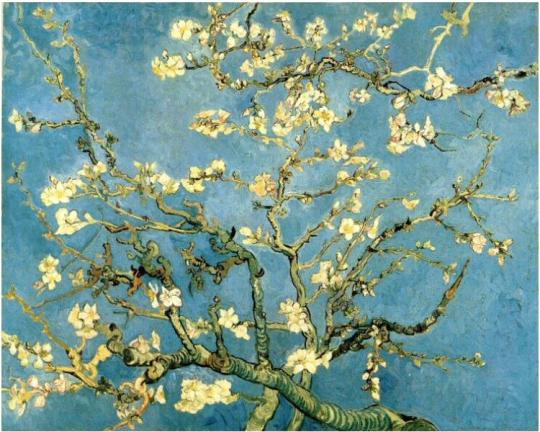
Personally I think the most beautifull painting of him was this one:
He made it when he heard about the birth of his nephew who was named after him. Still in the asylum but really happy for his brother!
“How glad I was when the news came… I should have greatly preferred
him to call the boy after Father, of whom I have been thinking so much
these days, instead of after me; but seeing it has now been done, I
started right away to make a picture for him, to hang in their bedroom,
big branches of white almond blossom against a blue sky.”
Oh I have sucb rants about how “good” art comes while suffering.
No.
look at me.
The idea of the “suffering artist” comes from bunch of alcholic, drug abusing, womanizers trying to justify their bad life choices as some sort of artistic angst.
IT IS 100% BULLSHIT
Take your meds, get your therapy, be happy, and live life
The art will be there.
it’s true that i wrote a higher volume of words when i was untreated. that’s because i was using writing to avoid my life. i spend more time these days on self-care. but the words i do write are of much higher quality, and my craft in plotting and organizing, collaboration and research, has gone through the roof.
i used to just put my head down for 16 hours and pound out ten thousand words from a pit of misery, and shove them in a file named with a keymash to collect dust. now i spend 4 hours on research and planning, an hour talking to my collab partner, and an hour writing a thousand words that are structural and focused and advance the project, then go have a nice bath and text my friends pictures of my cat. my work day’s less than half as long and infinitely more productive.
(and in case you’re imagining those 10k misery files were some kind of De Profundis, no, they were mostly porn.)
i am a MUCH better writer now that i’m on meds that work and have had some years of good counselling.
you won’t lose your creativity if you get help, darlings. that’s YOU. it’s not the disease. it’s yours. you’re the artist. what makes you better isn’t suffering, it’s practice, and you’ll practice more and easier when you’re happier.
This whole idea that suffering is what makes the art is baffling to me. I do MUCH LESS work, let alone quality work, when I’m hitting a low point. It’s like creating anything is a struggle. When I’m doing well is when I can freely write and paint and craft, and the quality of work is present.
My complete and total inability to keep anything clean or tidy for any amount of time is a symptom of my depression. I may never be able to do this. It’s important that I remember that and forgive myself when I clean something out (like my car) and it ends up trashed within a week.
Depression IS A DISABILITY. Requiring accommodations is okay.
Medications don’t make you better, they don’t cure your depression. They serve as an aid. Their purpose is to help you get to everyone else’s minimal level of functioning.
Depression can cycle through periods of inactivity. This doesn’t mean it’s gone away.
The reason I don’t feel like other people understand me is because … well … other people DON’T understand me. They can’t. They don’t have my disability.
Paranoia is par for the course.
Depression can and will interfere with your physical mobility. Forgive yourself when you can’t physically do something.
It’s entirely possible that I may never be able to live by myself. I can’t take care of myself. I need help to do it. And that’s okay.
As someone who suffers from depression and who experiences all these things as well I think this is important and needs to be reblogged. Depression is a very difficult thing, not only for people who suffer from it, but for everyone who knows a depressed person. My family doesn’t know how to deal with it, my friends try their very best to support me and I have tried to pretend I was fine until I was in ninth grade.
Everything makes so much more sense
Depression is a disease of the brain. The brain is an organ. When organs are not functioning properly, you are advised to see a doctor and get help. So why is it so hard to understand that the brain can suffer as well, and that we need help for it?
The brain controls the body. A sick brain means a sick body.
…. Shit.
Don’t disregard it as just sadness. Depression is life threatening.
The day I rebuked someone for saying “depression is in your head” with the comeback “Yes. And there’s an organ in your head called the brain – or at least in MY head, sounds to me like you don’t have one at the present moment – and a brain is a physical component of the body, therefore depression is a Physical ailment”…
that day was the day I took my first step toward accepting it as a disability and forgiving myself for having to live with something so stigmatized
and;
when people attribute depression to being “all in your head,” what they’re really doing is connecting your illness to an expectation of sufferers being virtuous and having enough willpower, almost making it an issue of personal integrity, as if fostering and growing those is the only – or even the most effective – “cure,” and if you’re weak in those areas and not persevering hard enough, then it’s a moral failing
it’s not
My former boss once asked me if I was sure the depression wasn’t “only” in my head.
And I said, “Yes. That’s why they call it a mental illness.”
Just because you can’t see it doesn’t mean it isn’t there.
If you’ve got persistent/chronic illnesses and/or fatigue, you have permission to be tired. You have permission to not get all the things done right now. You have your own time you do things within, and it is perfectly okay to take that time and move at your pace and rest when needed.
Even when things are going well and exciting stuff is happening! Even when you feel that now that things are taking a turn for the better, your energy and spoons should be going up too! You don’t have to recover and be full of energy automatically, you’re not lazy if you have to rest. If your bones and muscles say “nope” then it is okay for you to decide that it’s time to stop, regardless of how nice a day it is, regardless if it seems like the perfect time to do a given chore. Don’t feel obligated to spend your time on work just because you feel like you should be busy.
Hello everybody! I was just thinking about how I always recommend people who can’t get therapy to use workbooks, so I thought I’d make a quick list of some you could look at. I’m not comfortable recommending books for things I have not struggled with (like, if I was looking at the description of a book on OCD I’d have no idea if it was good or not) but I think I’ve covered a lot. Some of these are series which have workbooks for specific disorders like bipolar, etc., if you want to find some. Plus, you don’t have to be diagnosed with something to use a workbook if you think it’ll help you.
Workbooks are sometimes made to be done in conjunction with therapy, or something like that, but anyone can still get something out of them if you put in regular work and try to apply the skills.
I’ve linked them all the Amazon because they’re usually cheaper on there.
For reference: DBT = dialectical behaviour therapy, CBT = cognitive behavioural therapy, ACT = acceptance and commitment therapy



This gem right here is where you can literally create a 100% anonymous username and just absolutely spill your guts. Then people can read it and give you advice, and it honestly is so helpful. Because the other people on it are in the same situations as you, and they understand. You can comment and give advice on other peoples posts too, and it’s just really great.
This little beauty is similar to the comfort spot. Except instead of posting your thoughts, you type them into the box and then when you press enter they disappear and turn into stars against the blue sky. There is a whole bunch of different languages to choose from at the start, so if English is not your first language then you can probably find it here. There is the most comforting music that plays in the background as well, which is so great.
Which is so good for panic related things because it silences all of your other tabs and when you make it full screen it talks to you very calmly and then literally forces you stop for just 30 seconds and do nothing and just breathe.
The dawn room is so great for stopping you from self harming. It begins by telling you that its going to be alright, then it asks you to write something about someone you love. After that messages from other people, just like you, appear on the screen, one after the other, and the background slowly become brighter and happier. This page has genuinely stopped me from hurting myself more times than I can count. I’m not suggesting that it will work for everyone, but it is an absolute gem.
This page runs for about 5 minutes, and it is basically a typing simulator that tries to convince you that everything is going to be alright. It is very calming, and good for lonely times.


 Holding the Bowl