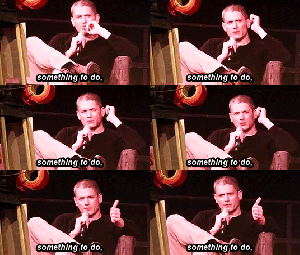
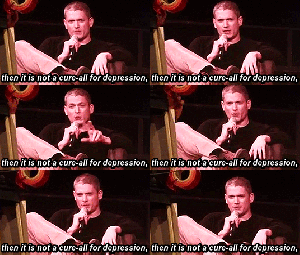
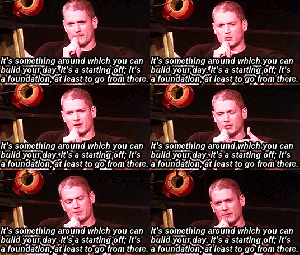
“I know you used to be depressed for a long time, and I want to know what your motivation was to change something to not live that way anymore?”
“I think it’s important to have something to do, something to look forward to, and something to love. If you have those three things in place, then…it is not a cure-all for depression…it’s not a cure-all for mental health issues…but it’s a place to hang your hat. It’s something around which you can build your day. It’s a starting off; it’s a foundation, at least…to go from there.”
– Wentworth Miller at German Comic con, 09. 12. 2017.
Tag: depression
Online Mental Health Resources
Anger & Irritability
CBT & Self help for anger
Anger problems workbook
Anger management tips & techniques
Anger & aggression management
Anger & aggressive behaviour leaflet
Controlling anger guide
Dealing with anger & impulsivity (PDF)Anxiety
Overcoming health anxiety (9 modules with workbooks)
Improving self esteem (9 modules with workbooks)
Overcoming perfectionism (9 modules with workbooks)
Mastering general anxiety & worries (11 modules with workbooks)
General self help strategies
Self help home toolkit
How to tolerate uncertainty
Applied tension technique (for those who faint at sight of blood/needles)
Self help for specific phobias
Youth anxiety self help
How to stop worrying
Flying phobia self help
General anxiety disorder self help (3 steps)
Anxiety workbook
CBT & Self help for general anxiety
CBT & Self help for phobias
CBT & Self help for health anxiety
CBT & Self help for low self esteem
CBT & Self help for stress
Anxiety & panic leaflet
Phobias leaflet
Anxiety self help guide
Health anxiety self help guide
Stress workbook
Stress management course
Hints to avoid harmful stressBipolar Disorder
Coping with Bipolar Disorder (8 modules with workbooks)
CBT & Self help for bipolar
Bipolar support & self help
Wellbeing plan for Bipolar disorder (PDF)
Bipolar disorder mood chart (PDF)Also see anger/irritability, depression, insomnia & impulsivity resources.
Borderline Personality Disorder
Overcoming distress intolerance (4 modules with workbooks)
Ten coping skills for BPD
Coping with BPD
BPD resource listAlso see CBT, DBT, self harm, anger/irritability, suicidal thoughts, impulsivity & depression resources.
Cognitive Behavioural Therapy (CBT)
7 Step self help course
CBT Based self help
CBT Worksheets & Information sheets
Free self help worksheetsConcentration & Time management
Put off procrastinating (7 modules with workbooks)
Guide for goal setting
Concentration leaflet
Sitting exams leaflet
Procrastination leafletDepression & Low mood
Coping with depression (9 modules with workbooks)
The Journal depression help
CBT & Self help for depression
Depression leaflet
Depression & low mood self help guide
Depression workbook
Dealing with depression tips
Antidepressant skills workbook (PDF)
Undoing depression: A self help site
Worry & sadness course
Depression mood chart (PDF)
Exercise to beat depression Handout 1 | Handout 2 | Handout 3 | Handout 4
Thinking your way out of depression (CBT)Dialectal Behaviour Therapy (DBT)
DBT Self help (videos, worksheets, activities etc.)
DBT Worksheets
Mindfulness
Skills Workbook
Coping & Relationship skills
Ways to manage distress right now
Letting go of emotional suffering
Mindfulness leaflet
Appraising change (PDF)
Honest communication (PDF)
Goal setting
Mindfulness in everyday life
Quick relaxation techniquesEating disorders & Body image
Overcoming body dysmorphia (7 modules with workbooks)
Overcoming disordered eating Part A | Part B (9 modules each part)
CBT & Self help for anorexia
CBT & Self help for bulimia & binge eating
Eating disorders leaflet
Eating disorders self help guide
Eating disorder coping skills
Tips & strategies for overcoming eating disordersFatigue & Chronic pain
CBT & Self help for chronic fatigue & pain
Chronic pain workbook
Restless legs syndrome self help
Treating chronic fatigue & Fibromyalgia
Chronic fatigue self help
Fatigue fighter self help
The pain toolkit (PDF)
Chronic pain patient’s guide to pain free hours (PDF)
Chronic pain survival handbook (PDF)Impulsive thoughts & behaviours
ADHD in adults: Managing impulsivity
Managing impulsive behaviours
5 Tips for changing impulsive behaviours
Impulse control strategiesInsomnia & Sleep difficulties
Getting to sleep
Sleep hygiene
CBT & Self help for sleep issues
Insomnia leaflet
Sleeping problems self help guide
Sleep problems workbook
How to sleep better
Can’t sleep?Obsessive Compulsive Disorder
How to manage obsessions
Manage your OCD at home
What to do while obsessing
Stopping your compulsions
CBT & Self help for OCD
Obsessions & compulsions self help guide
Obsessions & compulsions workbookPanic Attacks
Coping with panic attacks (12 modules with workbooks)
Self help strategies for Panic Disorder
Panic attack self help programme
CBT & Self help for Panic Disorder
Panic self help guide
Panic workbookPsychosis
CBT & Self help for psychosis
Hearing voices self help guide
Schizophrenia treatment & recovery
Self help measures for psychosis
Guided self help for psychosis (PDF)Social Anxiety
Coping with social anxiety (12 modules with workbooks)
Improving your social skills
Home management strategies for social anxiety
Improve your assertiveness (10 modules with workbooks)
CBT & Self help for social anxiety
Shyness & social anxiety self help guide
Shyness & social anxiety workbook
Shyness/Social anxiety courseSelf harm
Self harm leaflet
Self harm self help guide
Self harm alternatives & distractions
Cutting & self harm help
Self injury self help ideas
Self harm coping plan (Link at bottom of page)
Stopping self harmSuicidal thoughts
CBT & Self help for suicidal thoughts
Dealing with suicidal thoughts & feelings
Suicide: Read this first
Making a safety plan (Link at bottom of page)
Ways to help yourself when you’re feeling suicidal
What can I do if I’m feeling suicidal?
Self help for the suicidal workbook
Suicide hotlines by countryTrauma & Abuse
Self help for PTSD
CBT & Self help for PTSD
Post traumatic stress leaflet
Information for adults abused as children
Dealing with abuse guide
Post Traumatic stress self help guide
Post traumatic stress workbook
Safety & escaping domestic violence
Help for abused men
Coping with PTSD
How to recover from disasters & traumatic eventsNote: I haven’t created or extensively reviewed any of these resources, they’re just things I’ve found online that look like they’d be useful and to my best knowledge do not cost anything.
These are self help resources intended to be used in addition to and not as a substitute for medical treatment- please contact a professional if you are feeling unsafe. 🙂
Things I never knew about depression until I finally had a doctor explain the disease to me
Depression can manifest as irrational anger.
My complete and total inability to keep anything clean or tidy for any amount of time is a symptom of my depression. I may never be able to do this. It’s important that I remember that and forgive myself when I clean something out (like my car) and it ends up trashed within a week.
Depression IS A DISABILITY. Requiring accommodations is okay.
Medications don’t make you better, they don’t cure your depression. They serve as an aid. Their purpose is to help you get to everyone else’s minimal level of functioning.
Depression can cycle through periods of inactivity. This doesn’t mean it’s gone away.
The reason I don’t feel like other people understand me is because … well … other people DON’T understand me. They can’t. They don’t have my disability.
Paranoia is par for the course.
Depression can and will interfere with your physical mobility. Forgive yourself when you can’t physically do something.
It’s entirely possible that I may never be able to live by myself. I can’t take care of myself. I need help to do it. And that’s okay.
a while back someone reblogged one of my poems on tumblr with the tag “no one deserves to be atlas”
and it hit me pretty hard and i want to talk about that todaylisten, you are not a life support machine, you are not to be expected to carry someone’s organs. it is easy to fall into the rhythm of building your life around people who hope they are already dying, but that is not healthy.
i know. i am no stranger to people like this. i have known people who swallow pills with a snakejaw, who drink vodka straight without flinching and pray quietly that it’ll kill them, who smoke on their roof at 2am while crying. people who starve themselves until they can barely stand, who burn or cut or bruise their bodies because no one taught them to forgive themselves and be soft with their own skins. i have been these people.
there is only so much help you can give. if you learn anything, learn how to tell them: i am sorry, i cannot do this today. i am aching from holding the weight of your sky, please talk to a professional.
i see a mentality a lot amongst middle and high schoolers. i see it in college kids too, in some of my closest friends and in the drug dealer i talk to on weeknights. and the mentality says “if you are not willing to drop everything for me, you are toxic and a bad friend”
i understand that mental illness does a good job of making you feel isolated and it makes you scared of losing people, but realize that your support systems hurt too, and in ways that you might not even know.
listen, no teenager should have to add “keep my friends alive” to their to do list.
it can be hard to exist sometimes and it is okay to need help but you cannot place your fate in someone else’s hands. they shake just as much as yours, they are not any safer.
if you love your friends do not make them be atlas. they are not titans. they are small and afraid too.

Anhedonia – not finding pleasure in things you normally take pleasure in – is a symptom of depression.
When depressed, you will also be reluctant to start things, and won’t find things appealing.
This sets up a nasty vicious cycle where ‘life feels bleak’ -> ‘nothing sounds fun’ -> do nothing -> don’t have fun -> ‘Hey I’m not having fun, life really is pretty bleak right now’ -> More depressed.
The way to break that cycle is to do things that you enjoy. Doing things solely for the sake of having fun is an important part of handling depression. Not only does it keep you from getting more depressed, but it can make you go ‘Hey I’m having a really nice day’ and give you bouncy energy to do productive things with.
I get so focused on all the things that need doing that I forget that when depressed, doing things solely because they’re fun is the practical thing to do if I want to get thing done.
There is a difference between procrastination and having trouble activating. If there’s a thing you need to do and you know you aren’t going to be able to do it now, do something fun, and afterwards you will have better odds of actually doing the thing.
If you find yourself in the situation in the picture, pick something that you are intellectually aware you would find fun if you were feeling better and start doing it.’ This means that you are focusing on something other than *sigh* and playing a game can make you feel productive, put ‘life is good!’ and ‘I can succeed at things!’ chemicals into a brain that is sorely in need of them.
A couple weeks ago when I couldn’t even find any interest in reading fanfic, I eventually managed to start playing a random RPG and felt much better a few hours later.
i certainly wasn’t expecting anything close to actual, halfway decent advice that might help some folks out when i threw this little Funne Picture out into the wild, but that’s nice. thank you. i’m not sure if i’ll ever break this little cycle for more than a few hours, but .. yeah man. it’s just a little nice to see folks trying to help other folks out on posts of mine instead of the usual terrible nonsense
Exactly what I needed right now.
Easy to parse version:
Anhedonia is a symptom of depression, it’s not finding enjoyment in things that once made you happy.
If you find yourself in this situation, pick something that you KNOW you would find fun or enjoyable.
When you’re depressed, the best thing to do is do things BECAUSE they’re fun, it’ll help motivate you more.
Thank you I did need to hear that!
A part of being an adult is living with regret and not allowing it to consume you. The older you get, the more mistakes you’ve made, opportunities you’ve missed, people you’ve disappointed. And every day you have to remind yourself to be kind and forgiving of yourself. You accept and love the you from the past and understand that it’s all a part of the process. Then you move on and live your best life, knowing now as old as you feel today, you’ll never be this young again.

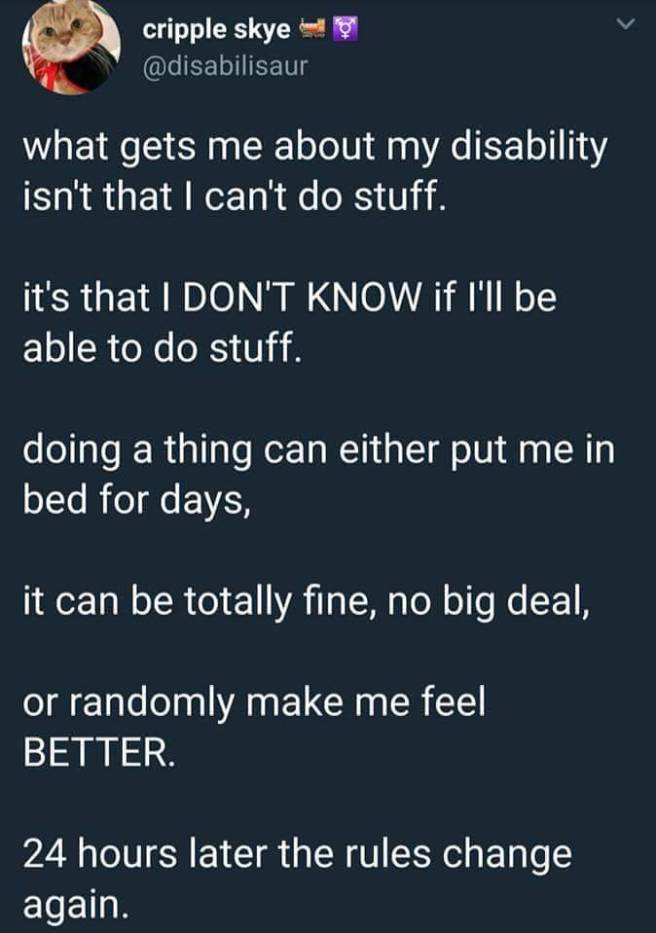
Casual reminder that disabilities are often based on the day or the unique challenges of the situation. People who need a wheelchair on most days might not on one particular day. People who use an emotional support animal may not need it 24/7. People who rely on canes may only need it when they’re having bad days. It doesn’t mean they’re faking of their disability isn’t valid. Energy levels and pain fluctuate and that’s okay.
Normalize the unpredictability of disabilities.

You are not stupid.
You are not ugly.
You are not worthless.
You are not weak.
You are not a burden.Your anxiety is lying to you.
I feel like the line between “fluffy uwu self care” and “get your shit together self care” is thinner than people seem to think. Like, sitting in a quiet space with a book and maybe some twinkly fairy lights gives me the spoons to go call my damn doctor like I’ve been meaning to. Bath bombs or shower steamers make me feel content and/or sparkly, which gives me confidence to go out in public. (Plus, I bathed.) I dye my hair funky colors so if I feel like people are staring at me I can say it’s at that instead of whatever my anxiety wants it to be.
The two are not mutually exclusive, is what I’m getting at, and I never see that mentioned, just either “self care is being nice to yourself” or “self care is kicking yourself in the ass to function for a few hours”. Kick yourself in the ass with niceness.
Gotta get your emotion-focused coping before you do your problem-focused coping.