Learning to focus on the present may boost quality of life not only for dementia patients but also those who struggle to care for them
Mindfulness training helps Alzheimer’s patients and caregivers

Devotional blog dedicated to the Goddess Sigyn offering support to those who are "holding the bowl" within difficult relationships.
Learning to focus on the present may boost quality of life not only for dementia patients but also those who struggle to care for them
Mindfulness training helps Alzheimer’s patients and caregivers
1. Trauma permanently changes us.
This is the big, scary truth about trauma: there is no such thing as “getting over it.” The five stages of grief model marks universal stages in learning to accept loss, but the reality is in fact much bigger: a major life disruption leaves a new normal in its wake. There is no “back to the old me.” You are different now, full stop.
This is not a wholly negative thing. Healing from trauma can also mean finding new strength and joy. The goal of healing is not a papering-over of changes in an effort to preserve or present things as normal. It is to acknowledge and wear your new life — warts, wisdom, and all — with courage.
2. Presence is always better than distance.
There is a curious illusion that in times of crisis people “need space.” I don’t know where this assumption originated, but in my experience it is almost always false. Trauma is a disfiguring, lonely time even when surrounded in love; to suffer through trauma alone is unbearable. Do not assume others are reaching out, showing up, or covering all the bases.
It is a much lighter burden to say, “Thanks for your love, but please go away,” than to say, “I was hurting and no one cared for me.” If someone says they need space, respect that. Otherwise, err on the side of presence.
3. Healing is seasonal, not linear.
It is true that healing happens with time. But in the recovery wilderness, emotional healing looks less like a line and more like a wobbly figure-8. It’s perfectly common to get stuck in one stage for months, only to jump to another end entirely … only to find yourself back in the same old mud again next year.
Recovery lasts a long, long time. Expect seasons.
4. Surviving trauma takes “firefighters” and “builders.” Very few people are both.
This is a tough one. In times of crisis, we want our family, partner, or dearest friends to be everything for us. But surviving trauma requires at least two types of people: the crisis team — those friends who can drop everything and jump into the fray by your side, and the reconstruction crew — those whose calm, steady care will help nudge you out the door into regaining your footing in the world. In my experience, it is extremely rare for any individual to be both a firefighter and a builder. This is one reason why trauma is a lonely experience. Even if you share suffering with others, no one else will be able to fully walk the road with you the whole way.
A hard lesson of trauma is learning to forgive and love your partner, best friend, or family even when they fail at one of these roles. Conversely, one of the deepest joys is finding both kinds of companions beside you on the journey.
5. Grieving is social, and so is healing.
For as private a pain as trauma is, for all the healing that time and self-work will bring, we are wired for contact. Just as relationships can hurt us most deeply, it is only through relationship that we can be most fully healed.
It’s not easy to know what this looks like — can I trust casual acquaintances with my hurt? If my family is the source of trauma, can they also be the source of healing? How long until this friend walks away? Does communal prayer help or trivialize?
Seeking out shelter in one another requires tremendous courage, but it is a matter of life or paralysis. One way to start is to practice giving shelter to others.
6. Do not offer platitudes or comparisons. Do not, do not, do not.
“I’m so sorry you lost your son, we lost our dog last year … ” “At least it’s not as bad as … ” “You’ll be stronger when this is over.” “God works in all things for good!”
When a loved one is suffering, we want to comfort them. We offer assurances like the ones above when we don’t know what else to say. But from the inside, these often sting as clueless, careless, or just plain false.
Trauma is terrible. What we need in the aftermath is a friend who can swallow her own discomfort and fear, sit beside us, and just let it be terrible for a while.
7. Allow those suffering to tell their own stories.
Of course, someone who has suffered trauma may say, “This made me stronger,” or “I’m lucky it’s only (x) and not (z).” That is their prerogative. There is an enormous gulf between having someone else thrust his unsolicited or misapplied silver linings onto you, and discovering hope for one’s self. The story may ultimately sound very much like “God works in all things for good,” but there will be a galaxy of disfigurement and longing and disorientation in that confession. Give the person struggling through trauma the dignity of discovering and owning for himself where, and if, hope endures.
8. Love shows up in unexpected ways.
This is a mystifying pattern after trauma, particularly for those in broad community: some near-strangers reach out, some close friends fumble to express care. It’s natural for us to weight expressions of love differently: a Hallmark card, while unsatisfying if received from a dear friend, can be deeply touching coming from an old acquaintance.
Ultimately every gesture of love, regardless of the sender, becomes a step along the way to healing. If there are beatitudes for trauma, I’d say the first is, “Blessed are those who give love to anyone in times of hurt, regardless of how recently they’ve talked or awkwardly reconnected or visited cross-country or ignored each other on the metro.” It may not look like what you’d request or expect, but there will be days when surprise love will be the sweetest.
9. Whatever doesn’t kill you …
In 2011, after a publically humiliating year, comedian Conan O’Brien gave students at Dartmouth College the following warning:
“Nietzsche famously said, ‘Whatever doesn’t kill you makes you stronger.’ … What he failed to stress is that it almost kills you.”
Odd things show up after a serious loss and creep into every corner of life: insatiable anxiety in places that used to bring you joy, detachment or frustration towards your closest companions, a deep distrust of love or presence or vulnerability.There will be days when you feel like a quivering, cowardly shell of yourself, when despair yawns as a terrible chasm, when fear paralyzes any chance for pleasure. This is just a fight that has to be won, over and over and over again.
10. … Doesn’t kill you.
Living through trauma may teach you resilience. It may help sustain you and others in times of crisis down the road. It may prompt humility. It may make for deeper seasons of joy. It may even make you stronger.
It also may not.
In the end, the hope of life after trauma is simply that you have life after trauma. The days, in their weird and varied richness, go on. So will you.
It’s here. Chronic Illness and Education
Part 1 is all about going to school when you have a chronic illness. Thank you so much to Ali for putting this together. I hope you find this helpful, and th…It’s that time of year, everyone is dreading going back to school, especially when having a chronic illness can make everything ten times harder.
Check out all three videos:
Chronic Illness and Education Part 1 – School
Chronic Illness and Education Part 2 – Home Schooling
Chronic Illness and Education Part 3 – University
Also check out these links for posts about School and University
My wonderful Spoonie little pseudo-sister, thefaultinourspoons, put together this great post for out school bound Spoonies — please give it a look! It’s fantastic, as usual!! 💙
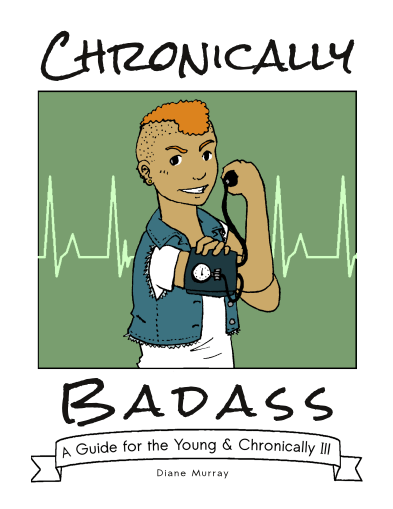
I have a really exciting Spoonie Living announcement for y’all! When I started on my 6-month medical leave from work, one of my goals was to create a zine for new spoonies, to help them hit the ground running as they begin their chronic illness experience. I’m calling it Chronically Badass, and it’s finally done!
Here’s what I cover inside:
- Spoon theory
- Getting answers
- Working with doctors
- Work & school
- Friends & family
- Reactions
- Mental health
- Coping strategies
- Online communities
- Mobility
It’s free for download right here (although you’re welcome to donate if you like), so be sure to check it out!
Please also reblog and spread the word so others can find and benefit from this zine.
Is there any way to get this without a credit card? I’d love to read it, but not sure how to get it without having a card.
Gosh, absolutely! If you set the amount to $0, the credit card thing will disappear—give it a shot 🙂
Just read this and loved it!




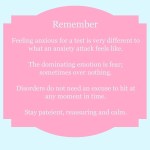

Anxiety & Helping Someone Cope.
I didn’t want to make it overwhelming or too long remember, so I kept it to the main points that benefit me greatly when I’m experiencing an attack.
40 million of Americans alone suffer with anxiety; it’s a horrid feeling when you know someone just wants to help you but you cannot even construct a simple sentence at the time, so please share this in hope that it benefits even just 1 person. Muchos love.
Taylor Swift – Shake it Off
This video is amazing. I love that she has no qualms about making a fool out of herself in front of millions of people.
Also, I’m pretty sure that that’s Fik-Shun from SYTYCD at 1:09…
Well, this is going to be stuck in my head.
When I was discharged from the hospital, I was put in an out-patient program to educate on mental health and coping strategies. One of the biggest things that our teacher, C, taught us, was that despite the things that DO go wrong, there is a success not far away.
I got inspired to start posting my daily successes, which I called ‘Victories’, before I went to sleep at night. Most days I was good about it, some days I slipped. I’m going to endeavour to write them here and start up again, because it’s inspired some of my friends. If I, a simple little lady from Canada, can inspire someone, then shit, I might as well keep on going.
So today’s victories are:
Woke up despite an exhausting night.
Made it to my counselling appointment.
Took care of the baby despite the exhaustion.
Had a fun visit with my grandmother.
Overcame some hefty grumpiness during the day.
Problem-solved an issue with the house.
I had an interesting conversation with thornedlily Sunday night/early Monday morning that I wanted to share with you guys (their permission has been granted). This metaphor was new to me but the revelation was not, even though it was new to her.
Topic was depression.
I confided to her that I can feel my depression rearing its head for another black bout. She then compared depression to a wild, unbroken young horse that you have to coax back into its stall with a carrot. I found that analogy brilliant and told her so. She laughed and then said you could go crazy with the analogy if you wanted. Like braiding glitter into the horse’s hair and keeping the spiders away from it to keep it happy.
But really, that analogy works! Depression isn’t just this dark infection that you can never walk away from. It’s flexible. It’s fluid. With depression you have to learn what ‘breed’ you have. You need to learn what triggers it to arise in you. You need to learn to resist the impulse to collapse into it and feed it along. You need to learn if and how you can head off a bout. You need to learn what proactive coping mechanism works for you be it medication, therapy, or other, or all of the above. You need to learn to open yourself up instead of shutting yourself away.
So yeah… if a glittery mane and no spiders are what tames your horse by all means break out the tinsel and braid some in. Spider-proof that stall and then close the door and walk away. At least until you can feel the wildness breaking free again.
I’m not even trying to be ablest. I’m telling you to be proactive about your depression. I learned this lesson early and from necessity. My mom is 50 and she’s just now trying to learn this lesson after living the life of an addict. The struggle I see in her trying to learn this at her age, changing her entire life, relearning everything she thought she knew about herself and her mental illness… it’s heartbreaking. I have other family that never learned it at all and they’re miserable living miserable lives. At this point they’re too deep in their misery, too used to it to try and climb out. I want to save as many people as I can from the fate of black life lived in misery. You CAN walk away from depression. Sometimes for good, and sometimes just for a little while, but you have to figure out how to tame it in the process if you let it run wild it’ll shit all over your life. I promise you, you will come out stronger for it.
Don’t believe me? Watch this.
1. Trauma permanently changes us.
This is the big, scary truth about trauma: there is no such thing as “getting over it.” The five stages of grief model marks universal stages in learning to accept loss, but the reality is in fact much bigger: a major life disruption leaves a new normal in its wake. There is no “back to the old me.” You are different now, full stop.
This is not a wholly negative thing. Healing from trauma can also mean finding new strength and joy. The goal of healing is not a papering-over of changes in an effort to preserve or present things as normal. It is to acknowledge and wear your new life — warts, wisdom, and all — with courage.
2. Presence is always better than distance.
There is a curious illusion that in times of crisis people “need space.” I don’t know where this assumption originated, but in my experience it is almost always false. Trauma is a disfiguring, lonely time even when surrounded in love; to suffer through trauma alone is unbearable. Do not assume others are reaching out, showing up, or covering all the bases.
It is a much lighter burden to say, “Thanks for your love, but please go away,” than to say, “I was hurting and no one cared for me.” If someone says they need space, respect that. Otherwise, err on the side of presence.
3. Healing is seasonal, not linear.
It is true that healing happens with time. But in the recovery wilderness, emotional healing looks less like a line and more like a wobbly figure-8. It’s perfectly common to get stuck in one stage for months, only to jump to another end entirely … only to find yourself back in the same old mud again next year.
Recovery lasts a long, long time. Expect seasons.
4. Surviving trauma takes “firefighters” and “builders.” Very few people are both.
This is a tough one. In times of crisis, we want our family, partner, or dearest friends to be everything for us. But surviving trauma requires at least two types of people: the crisis team — those friends who can drop everything and jump into the fray by your side, and the reconstruction crew — those whose calm, steady care will help nudge you out the door into regaining your footing in the world. In my experience, it is extremely rare for any individual to be both a firefighter and a builder. This is one reason why trauma is a lonely experience. Even if you share suffering with others, no one else will be able to fully walk the road with you the whole way.
A hard lesson of trauma is learning to forgive and love your partner, best friend, or family even when they fail at one of these roles. Conversely, one of the deepest joys is finding both kinds of companions beside you on the journey.
5. Grieving is social, and so is healing.
For as private a pain as trauma is, for all the healing that time and self-work will bring, we are wired for contact. Just as relationships can hurt us most deeply, it is only through relationship that we can be most fully healed.
It’s not easy to know what this looks like — can I trust casual acquaintances with my hurt? If my family is the source of trauma, can they also be the source of healing? How long until this friend walks away? Does communal prayer help or trivialize?
Seeking out shelter in one another requires tremendous courage, but it is a matter of life or paralysis. One way to start is to practice giving shelter to others.
6. Do not offer platitudes or comparisons. Do not, do not, do not.
“I’m so sorry you lost your son, we lost our dog last year … ” “At least it’s not as bad as … ” “You’ll be stronger when this is over.” “God works in all things for good!”
When a loved one is suffering, we want to comfort them. We offer assurances like the ones above when we don’t know what else to say. But from the inside, these often sting as clueless, careless, or just plain false.
Trauma is terrible. What we need in the aftermath is a friend who can swallow her own discomfort and fear, sit beside us, and just let it be terrible for a while.
7. Allow those suffering to tell their own stories.
Of course, someone who has suffered trauma may say, “This made me stronger,” or “I’m lucky it’s only (x) and not (z).” That is their prerogative. There is an enormous gulf between having someone else thrust his unsolicited or misapplied silver linings onto you, and discovering hope for one’s self. The story may ultimately sound very much like “God works in all things for good,” but there will be a galaxy of disfigurement and longing and disorientation in that confession. Give the person struggling through trauma the dignity of discovering and owning for himself where, and if, hope endures.
8. Love shows up in unexpected ways.
This is a mystifying pattern after trauma, particularly for those in broad community: some near-strangers reach out, some close friends fumble to express care. It’s natural for us to weight expressions of love differently: a Hallmark card, while unsatisfying if received from a dear friend, can be deeply touching coming from an old acquaintance.
Ultimately every gesture of love, regardless of the sender, becomes a step along the way to healing. If there are beatitudes for trauma, I’d say the first is, “Blessed are those who give love to anyone in times of hurt, regardless of how recently they’ve talked or awkwardly reconnected or visited cross-country or ignored each other on the metro.” It may not look like what you’d request or expect, but there will be days when surprise love will be the sweetest.
9. Whatever doesn’t kill you …
In 2011, after a publically humiliating year, comedian Conan O’Brien gave students at Dartmouth College the following warning:
“Nietzsche famously said, ‘Whatever doesn’t kill you makes you stronger.’ … What he failed to stress is that it almost kills you.”
Odd things show up after a serious loss and creep into every corner of life: insatiable anxiety in places that used to bring you joy, detachment or frustration towards your closest companions, a deep distrust of love or presence or vulnerability.There will be days when you feel like a quivering, cowardly shell of yourself, when despair yawns as a terrible chasm, when fear paralyzes any chance for pleasure. This is just a fight that has to be won, over and over and over again.
10. … Doesn’t kill you.
Living through trauma may teach you resilience. It may help sustain you and others in times of crisis down the road. It may prompt humility. It may make for deeper seasons of joy. It may even make you stronger.
It also may not.
In the end, the hope of life after trauma is simply that you have life after trauma. The days, in their weird and varied richness, go on. So will you.
 Holding the Bowl