Some people survive and talk about it. Some people survive and go silent. Some people survive and create. Everyone deals with unimaginable pain in their own way, and everyone is entitled to that, without judgement. So the next time you look at someone’s life covetously, remember…you may not want to endure what they are enduring right now, at this moment, whilst they sit so quietly before you, looking like a calm ocean on a sunny day. Remember how vast the ocean’s boundaries are. Whilst somewhere the water is calm, in another place in the very same ocean, there is a colossal storm.

People Survive in Different Ways | Nikita Gill (via meanwhilepoetry)

You will want to run away from it. Don’t. Running away will only make it worse when you’ll eventually have to face it. (And you can’t keep running forever).

You will be in a constant search to try to find ways to temporarily fix it. Alcohol, drugs, self-harm. They won’t work. They will make you feel worse; but you will want to keep using them anyway.

After a while, you might make friends with it. Get accustomed to it. (But it will still hurt).

Loneliness will come along with it. Not because you’re necessarily alone, but because you’re engulfed in something that other people cannot understand.

Some days will be better than others.

And on these days, you wonder who you really are, and what you are without it.

You will also be scared. Scared of the moment it will come back again.

You will want to disappear.

And you can, if you want to. But you will be losing all of your possibilities. There are many possibilities. The biggest of all, is that you get another better day, followed by another and another. Don’t lose that possibility. (I almost lost my possibility, but I didn’t, and it came true).

‘What they don’t tell you about pain.’ by Maria
(via amidstthewillowtrees)

smashfold:

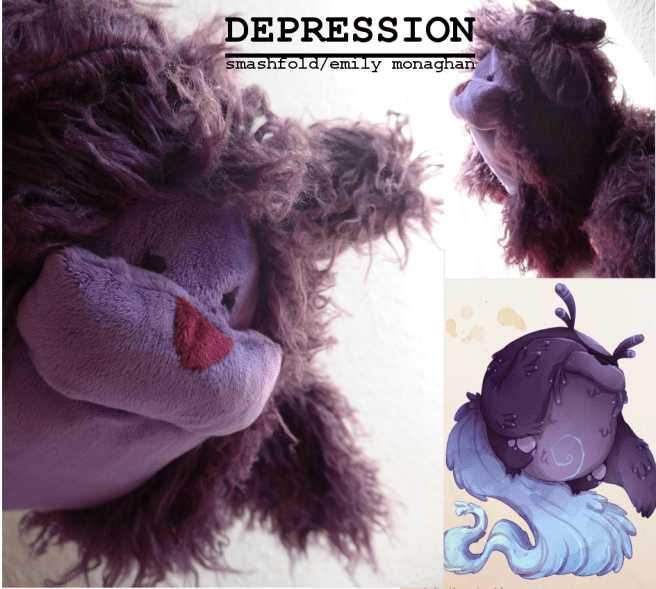
Introducing: Depression!

This is the third in a series of plushies based on mental health conditions. The Depression monster is saggy and lethargic, weeping constantly and transfering its feeling to others as some relief from its own pain. I love the way that everything in this design is turned-downwards – it’s a slump in fabric form! The Depression plush is one big huggable ball of fluff, and warming and soft to hold, with elongated arms which can cover up its eyes and glomp onto things. My own experience of Depression is very close to Toby’s concept – it feels like something heavy and soft clinging to the back of my head, making everything more sluggish.

Depression is made of minky and luxury, tangled faux-fur. This plush contains no wire for maximum huggability. The plush isn’t quite as spherical as the image – mostly to save you guys on postage.costs, as the extra bulk was adding a lot to the toy’s weight, but the slightly sleeker design gives the finished product the look of a creature trying to curl up and hide.

Real Monsters

The Real Monsters were created in 2013 by Toby Allen,
and envisaged mental health conditions as monsters who literally
followed you around. Cute yet also kind creepy, who wouldn’t want an
Anxiety of their very own to hold, or a floompy Depression critter? I am
currently partnering with him to bring them to life as limited edition
plushies.

Depression will be slumping its way to your postbox in the autumn.

Until then – as always – shares, watches, and reblogs make this happen.

Emily: Tumblr | Email | DeviantArt | WordPress | Facebook | Twitter |

Toby: Tumblr | Email

hideki16seiyuu:

cameoamalthea:

greenjudy:

pyrrhicgoddess:

thgchoir:

no offense but this is literally the most neurotypical thing i have ever seen

Uhhhh… no.
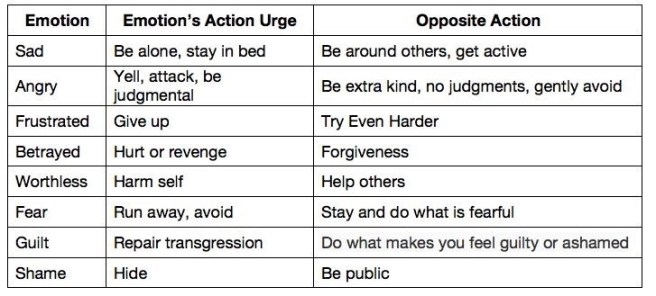
This is what they teach you in therapy to deal with BPD and general depression.
When I got out of the hospital after hurting myself a second time, I got put into intensive outpatient program for people being released from mental hospitals as a way to monitor and help transition them into getting them efficient long-term care.
This is something they stressed, especially for people with general depression. When you want to stay at home and hide in your bed, forcing yourself to do the opposite is what is helpful. For me, who struggles with self harm- “I want to really slice my arm up. The opposite would be to put lotion on my skin (or whatever would be better, like drawing on my skin) the opposite is the better decision.” It doesn’t always work because of course mental health isn’t that easy, but this is part of what’s called mindfulness (they say this all the time in therapy)

Being mindful of these is what puts you on the path to recovery. If you’re mindful, you are able to live in that moment and try your best to remember these better options.

I swear to god, I don’t get why some people on this website straight up reject good recovery help like this because either they a)have never been in therapy so don’t understand in context how to use these coping tactics. Or b)want to insist that all therapists and psych doctors are neurotypical and have zero idea what they are talking about. (Just so ya know, they teach this in DBT, the therapy used to help BPD. The psychologist who came up with DBT actually had BPD, so….a neurotypical women didn’t come up with this.)

I have clinical OCD and for me, exposure therapy–a version of “do the opposite”–has been fundamental. I’ve had huge improvement in the last year, but I’m 100% clear that if I hadn’t done my best to follow this protocol I’d be fucked. I have a lot of empathy for that moment when you’re just too tired to fight and you check the stove or you wash your hands or go back to the office at midnight to make sure the door is locked. But the kind of therapeutic approach outlined above has been crucial for me. 

It’s hard to do. I’ve weathered panic attacks trying to follow this protocol. But I’ve gotten remarkable results. I was afraid to touch the surfaces in my house, okay? I was afraid to touch my own feet, afraid to touch my parrot–deliberately exposing myself to “contamination” has helped me heal. I can’t speak for people with other issues, but this has helped my anxiety and OCD. 

I feel that tumblr, in an effort to be accepting of mental illness, has become anti-recovery. Having a mental illness does not make you a bad person. There is nothing morally wrong with having a mental illness anymore than more than there’s something morally wrong with having the flu. However, if you’re “ill” physically or mentally, something is wrong in the sense that you are unwell and to alleviate that you should try to get better. While there is not “cure” for mental illness, there are ways to get better.

There was a post on tumblr where someone with ADHD posted about how much you can get done when you focus and was attacked for posting about being “nuerotypical” – when she was posting about the relief she got from being on an medication to treat her illness. 

I saw another post going around tumblr that said something along the line of “you control your thoughts, why not choose to have happy thoughts” which again was shot down as “nuerotypical” but while you don’t have control over what thoughts come into your mind, you absolutely can and should choose to have happy thoughts. In DBT we call this “positive self talk”.

I’m in DBT to help treat PTSD stemming from child abuse. The abuse and abandonment I experienced destroyed my self esteem and created a lot of anxiety over upsetting other people. DBT has taught me to recognize when my thoughts are distorting realty ‘no one likes you’ and answer back ‘plenty of people like you, you don’t need everyone to like you, especially if the relationship doesn’t make you happy’, to respond to the thought ‘I’m so worthless’ with ‘you’re really great and have accomplished something’ 

And it’s not easy to challenge your thoughts, it’s a skill that’s learned and it’s hard to force yourself to think something that doesn’t seem authentic or even seems wrong to think – it’s hard to be encouraging towards yourself when you hate yourself – but you force yourself to be aware of your thoughts and push back when you fall into unhealthy patterns 

That isn’t “so neurotypical” that’s recovery. 

Not shaming mental illness doesn’t mean shaming RECOVERY.

Pro-Recovery isn’t anti-disability. 

Do not shame healthy behaviors as “neurotypical”.

Learning healthy behaviors and taking steps to treat mental illness and disorders including taking medication if that’s what works for you is important. You shouldn’t be ashamed if you have mental illness, but you shouldn’t say ‘well I’m not neurotypical therefor I can’t do anything to get better’ – while there is no cure for mental illness, there is a lot you can do to get better, to function better, to manage your mental illness and be safer, happier, and healthier for it. 

When I contracted PTSD my therapist first confirmed I has been traumatized then asked me to speak about the specific moments that stuck with me the most. I had to directly acknowledge the memories I wanted to avoid in order to make my brain realize it wasn’t happening anymore.

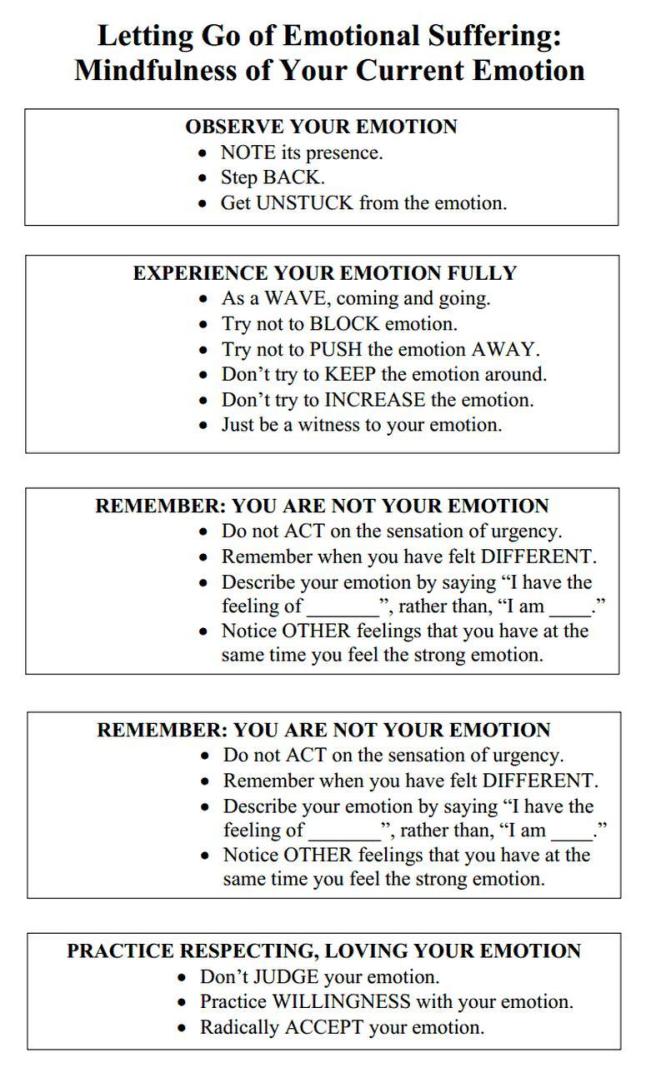
When my depression was so bad I couldn’t bare any positive comments about myself or compliments, my therapist made a point to end each session with a compliment that I had to accept and thank her for. At the time I hated myself so much it could physically HURT, but she worked to ease me into it.


When we discovered I live almost constantly dissociated, my therapist worked with me to move back into my body fir a five-minute period. This is commonly a coping mechanism for Autistic people and others with sensory issues, and I had started doing it at a young age to handle stimulation on a day-to-day basis. The reason why I had to learn to stop it is because when my head and body didn’t feel connected, I couldn’t stop the physical affects of anxiety; I couldn’t calm my body down, and the anxiety would escalate to panic. The sensation was AWFUL when I returned into my body – it was like grabbing a live wire and I hated every second, but I’m better for it. I learned to ground myself.


Unfortunately, the recovery process can mean directly challenging bad thoughts and feelings which SUCKS but in the long run, it may actually help you. You might not be in a place to do it right now, and it sounds scary and awful, but there are ways to do it safely and beneficially!

kyleehenke:

if there’s anything i’ve learned about dealing with mental illness, especially depression, it’s never about having one big breakthrough and then living happily ever after. i think i expected that from myself which only caused me to hate myself more when relapses happened.

but what it is -actually- about is saving yourself over and over, picking yourself back up after each fall and not letting it keep you beat. and that’s not a hopeless thought. it’s freeing to know that recurring depression is perfectly normal, and i am not a failure when it kicks me in the teeth. so long as im surviving and seeking help, i am still winning. you HAVE to redefine what success in mental illness means in order to stop beating yourself up.

redscoutkin:

support mentally ill ppl who have breakdowns often, support mentally ill ppl who talk about how much they hate themselves, support mentally ill ppl who sometimes say or do extreme things during breakdowns, support mentally ill ppl who have mood swings and who feel like absolute hell one minute and fine the next, support mentally ill ppl who actually show signs of being mentally ill, because if that makes you uncomfortable, then don’t say you support them.

Some things you can do to deal with grief and loss

onlinecounsellingcollege:

1. Find someone whom you trust that you can share your feelings with – and be real about the pain and different battles that you face. It’s crucial that you don’t just keep your feelings to yourself as you’ll find that they resurface – and they won’t just go away.

2. Share with others who have also walked the road of grief and loss. Although each person’s journey is different and unique, it often helps to listen to others who’ve faced loss. You’ll learn from their experience and what they did to cope.

3. Take time away from sadness – and try to focus on some happy, funny memories of good times you once shared. Be thankful for these memories – but also take the time to consider and be grateful for what you have today. (Note: Distraction is important as you can’t just live with pain.)

4. Allow yourself to cry and to express the way you feel. It’s normal and it’s healthy when dealing with a loss. It usually brings relief and it can help us process pain … and releasing strong emotions can help us to move on.
(Note: If you find it hard to cry, express yourself in other ways – through painting, music or, perhaps, through journaling.)

5. Try and do what you can to establish new routines. When a loved one dies, life can never be the same. But changing old routines can help us start over again – and build a different future, without that person there.

6. Build time for self-care into your daily routine. Set aside 20 minutes to relax and unwind … You could listen to some music, or take a bubble bath. It’s important that you nurture and take care of yourself, and you do what is needed to reduce excessive stress.

7. Recognise that there are likely to be other losses, too. You need to mourn for them as well – as they contribute to your pain.

8. Be patient, understanding and gentle with yourself. The road you walk through grief is unpredictable and hard. You’re on a roller coaster that’s always changing course. But things will change in time – and you will learn to smile again.

While this is written primarily for those who have experienced the death of someone who was close to them, I think that a lot of the tips it would also serve for any type of loss (such as a difficult breakup, losing a job, some other major setback in life) as well.