
hey tumblr
this is a great website for those of you want to start learning sign language and its not limited to just england or america, it’s sign from all over the world. simply type in the word you want to know, click the countries flag and watch the video demonstration of the sign.
i highly recommend it to you all who want to start learning but can’t afford the tuition fees. just click that sentence.
and it’s completely free.
Tag: communication
Non-verbal doesn’t mean non-thinking.
Non-verbal doesn’t mean non-feeling.
Non-verbal doesn’t mean non-communicating.
Non-verbal doesn’t mean non-human.
Social skills: noticing when repetition is communication
So there’s this dynamic:
Autistic person: The door is open!
Other person: I *know* that. It’s hot in here.
Autistic person: The door is open!
Other person: I already explained to you that it’s hot in here!
Autistic person: The door is open!
Other person: Why do you have to repeat things all the time?!
Often when this happens, what’s really going on is that the autistic person is trying to communicate something, and they’re not being understood. The other person things that they are understanding and responding, and that the autistic person is just repeating the same thing over and over either for no reason or because they are being stubborn and inflexible and obnoxious and pushy.
When what’s really happening is that the autistic person is not being understood, and they are communicating using the words they have. There’s a NT social expectation that if people aren’t being understood, they should change their words and explain things differently. Sometimes autistic people aren’t capable of doing this without help.
So, if this is happening, assume it’s communication and try to figure out what’s being communicated. If you’re the one with more words, and you want the communication to happen in words, then you have to provide words that make communication possible. For example:
Other person: Do you want the door to be closed, or are you saying something else?
Autistic person: Something else
Other person: Do you want to show me something outside, or something else?
Autistic person: Something else
Other person: Are you worried about something that might happen, or something else?
Autistic person: Worried
Other person: Are you worried that something will come in, or that something will go out?
Autistic person: Baby
Other person: She’s in her crib, and the baby gate is up. Is that ok, or is there still a problem?
Autistic person: ok
Holy fuck.
This changes everything.
*leaves for reference*
I babysat an autistic kid for a few years, it’s hard to understand how their brain works sometimes but when you click, everything pays off. patience and love, my friends.
Also works for allistics (is that the right term?) with brain fog, and other neuroatypicals.
EDIT: I deleted my example because I felt like I hijacked the autism post which wasn’t fair of me.
If someone is rude or disrespectful towards you, politely excuse yourself and walk away. It sends a clear message to the other person – that what they’ve said or done is unacceptable, and you won’t tolerate it.
Lessons Learned in Life (via onlinecounsellingcollege)
Pulling Triggers
Communicating with Children: You Make the Difference
Rule #1: Listen! Listen! Listen!
When your children want to talk, stop everything. If you continue what you were doing, they will think you don’t care and don’t have time for them. Avoid jumping in and not letting them vent or discuss their concerns, worries, and fears. In life, sometimes we all need a shoulder to cry on. At times, we don’t even want advice or comments. Other times, we just want to be heard and to feel like someone shares our pain. A silent and sympathetic ear is sometimes the best thing we can give to our children.
Here are a few words that show we are listening:
- Tell me more!
- I know.
- Wow!
- That is just awful.
- I am here.
- Go ahead; let it out.
Rule #2: Remember, there is power in choice.
When you are talking to your children, give them a choice whenever possible. Allow them to feel you are talking with them and asking them rather than talking at them and telling them. Make conversations a two-way street rather than a power struggle.
Rule #3: Avoid untrue statements and things said out of anger and frustration.
Your children will learn to listen and believe when you speak to them truthfully and calmly. Trust and respect come from honesty and sincerity. If you don’t mean it, don’t say it.
Rule #4: Be a source of encouragement.
When your children confide in you, they should feel relieved, inspired, and recharged, rather than guilty or that they are a source of disappointment to you. When they come to you with a problem or situation, offer your ear as well as words of encouragement.
The following are examples of words of encouragement:
- I know you can handle it.
- Every problem has a solution, even this.
- Think it over; you will figure this out.
- I am here to help you.
- I went through this at your age, like when…
Rule #5: Make your conversations places of comfort.
Try to step away from being the parent when listening, and put yourself in your child’s shoes. Think about how difficult the conversation may be for your child, and think before you react.
Rule #6: Avoid the 20 questions or drill routine.
Try not to take over the conversation. If children share something with you and feel like they are being scolded or like they are disappointing you, they probably will not let it happen again. As a parent, there will be times when you must address an issue your child discusses with you; be sure you address the behavior or action and not the child.
Rule #7: Make a point of being the initiator.
Out of the blue, follow up on a previous subject of interest before your child comes to you. This reinforces for your child that you care and also brings you into your child’s circle.
Rule #8: Take time to share.
A busy parent is not always the best parent. Drop everything and do something spontaneous like taking in a movie on a school night or doing homework in the park.
Rule #9: Apologize when you are wrong.
If you say something or do something you probably shouldn’t have, say you are sorry. Admit that you too are human and make mistakes.
Rule #10: Love Them!
Don’t just love them…tell them you love them. Show them affection just as you did when they were small. Bake a cake for no occasion, play a game, take a walk after dinner. Show your love by showing them there is no better time spent than with them.
9 Steps to Better Communication
Relationships don’t exist in a vacuum. They exist between two emotional human beings who bring their own past experiences, history, and expectations into it.
1. Stop and listen.
2. Force yourself to hear.
3. Be open and honest with your partner.
4. Pay attention to nonverbal signals.
5. Stay focused in the here and now.
6. Try to minimize emotion when talking about important, big decisions.
7. Be ready to cede an argument.
8. Humor and playfulness usually help.
9. Communicating is more than just talking.
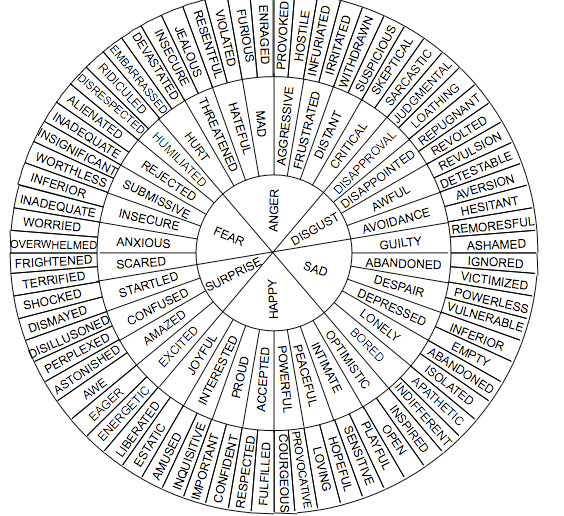
Wanted to share this helpful tool with anyone who needs it. A lot of people have a hard time putting their feelings into words and identifying what emotions they are feeling. This is called a feeling wheel. It can help you get to the core emotion you are experiencing and help you name each feeling when you’re overwhelmed with many emotions
 Holding the Bowl