yeinesomemdarre:

disasterbisexualhere:

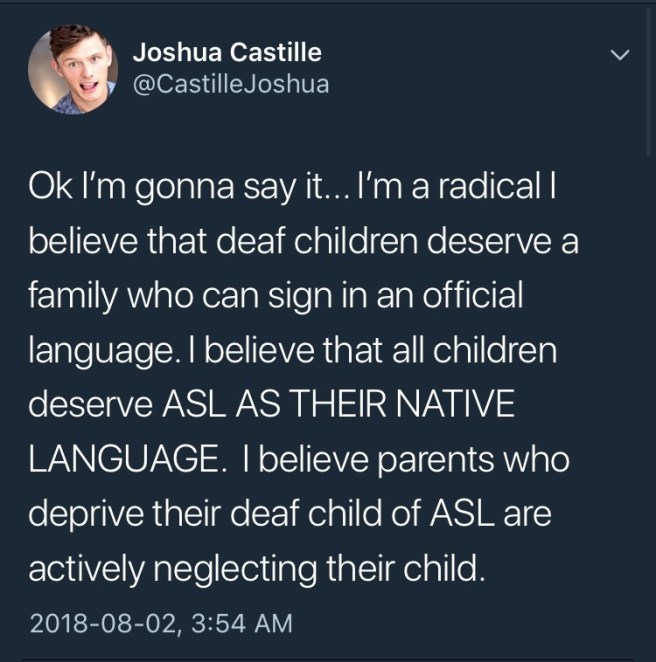
this is important!

Just a fun fact, Black ASL and other sign languages here are often dominated and marginalized by the predominance of ASL and ignorance towards minority communities.

Similar to the effects of forceful dominance of King’s English, other sign languages are facing erasure due to this.

Every Deaf child should have a signed language that fits their culture and community, and lesser known/recognized signed languages should be preserved before they are pushed out over time!!

This is outlined on the International Advocacy page of the National Association of the Deaf:

Please remember ASL isn’t the only signed language in the United States, and other signed languages deserve this much advocacy!

stevviefox:

lillyrosaura:

There’s a website where you can learn ASL on your own and it is free and the woman on there, her name is Rochelle Barlow, she runs the site and she actually is a homeschool teacher and teaches ASL. I am passing this on to you guys cause most people on here is open-minded. Well, whoever of y’all reads this will possibly ignore this but if you are a curious george like me and wants to learn ASL she’s your gal. 

Rochelle has a free program called Learn ASL in 31 days, currently I am on day 10ish or 12, (idk I’m on learning my numbers currently) but I believe this site will help people that are either curious about ASL and just wants to learn, or actually is Deaf but can’t afford to going to actual class or something, or just hard of hearing. 

I am truly in love with learning with Rochelle, she isn’t those interpreters that will talk while she signs, (and I’ve searched through Youtube how to sign but the person talking will distract me and I would get confused) and it is all in video which is a good thing. I found her through Youtube, that’s where she has all her videos. Just check out her site. You’ll like it. 

ref

brighteyedbadwolf:

samayla:

coffee-alien:

“Imagine having a child that refuses to hug you or even look you in the eyes”

Imagine being shamed, as a child, for not showing affection in a way that is unnatural or even painful for you. Imagine being forced, as a child, to show affection in a way that is unnatural or even painful for you. Imagine being told, as a child, that your ways of expressing affection weren’t good enough. Imagine being taught, as a child, to associate physical affection with pain and coercion.

As a preschool special ed para, this is very important to me. All my kids have their own ways of showing affection that are just as meaningful to them as a hug or eye contact is to you or me. 

One gently squeezes my hand between both of his palms as he says “squish.” I reciprocate. When he looks like he’s feeling sad or lost, I ask if I can squish him, and he will show me where I can squish him. Sometimes it’s almost like a hug, but most of the time, it’s just a hand or an arm I press between my palms. Then he squishes my hand in return, says “squish,” and moves on. He will come ask for squishes now, when he recognizes that he needs them.

Another boy smiles and sticks his chin out at me, and if he’s really excited, he’ll lean his whole body toward me. The first time he finally won a game at circle time, he got so excited he even ran over and bumped chins with me. He now does it when he sees me outside of school too. I stick out my chin to acknowledge him, and he grins and runs over and I lean down for a chin bump.

Yet another child swings my hand really fast. At a time when another child would be seeking a hug, she stands beside me and holds my hand, and swings it back and forth, with a smile if I’m lucky. The look on her face when I initiate the hand swinging is priceless.

Another one bumps his hip against mine when he walks by in the hallway or on the playground, or when he gets up after I’m done working with him. No eye contact, no words, but he goes out of his way to “crash” into me, and I tell him that it’s good to see him. He now loves to crash into me when I’m least expecting it. He doesn’t want anything, really. Just a bump to say “Hi, I appreciate you’re here.” And when he’s upset and we have to take a break, I’ll bump him, ask if he needs to take a walk, and we just go wander for a bit and discuss whatever’s wrong, and he’s practically glued to my side. Then one more bump before we go back into the room to face the problem.

Moral of the story is, alternative affection is just as valid and vitally important as traditional affection. Reciprocating alternative affection is just as valid and vitally important as returning a hug. That is how you build connections with these children. 

This is so goddamn important.

I verbally express affection. A LOT.

My husband… doesn’t. I don’t know why. For the longest time part of me wondered if it meant he loved me less.

At some point I told him about a thing I had done as a kid. Holding hands, three squeezes means ‘I Love You’.

Suddenly he’s telling me I Love You all the time.

Holding my hand, obviously, but also randomly.

taptaptap

on my hand, my shoulder, my butt, my knee, whatever body part is closest to him, with whatever part of him is closest to me

All the time.

More often than I ever verbally said it.

It’s an ingrained signal now, I can tap three times on whatever part of him, and get three taps back in his sleep. Apparently I do the same.

It’s made a huge difference for us.

People say things differently.

Coping Skills

ofcourseitsmyhead:

So, if you’re willing to help a friend out, I’ve realised something.
When I am at max capacity, and I cannot continue functioning at the current level of ability, I can do one of two things:

I can fall into a nonepileptic seizure
or
I can shut one or more functions down, to conserve energy

The easiest ‘function’ for me to shut down is speaking. I’ve been doing it for years, and it’s quite helpful in surviving overwhelming situations. Most recently it helped me finish grocery shopping without having a panic attack, which was super useful.

BUT

If I do this, it then leaves room for an unintended but unfortunate consequence: Nobody can converse with me. So, my husband and I picked up small, key phrases in American Sign Language so that I can still communicate back, but I don’t have to speak. It’s quicker than typing something on a screen, and I can still portray emotion fluidly and get my point across effectively as long as I’m understood.

So if you’re a friend, and you’re local, consider watching some videos on ASL. You don’t necessarily have to practice the gesticulations, but if you know the words I’m going to be using with my hands and body, it’ll help us all carry on a conversation when my voice needs a break.

And then, I won’t feel left out! 🙂

autieblesam:

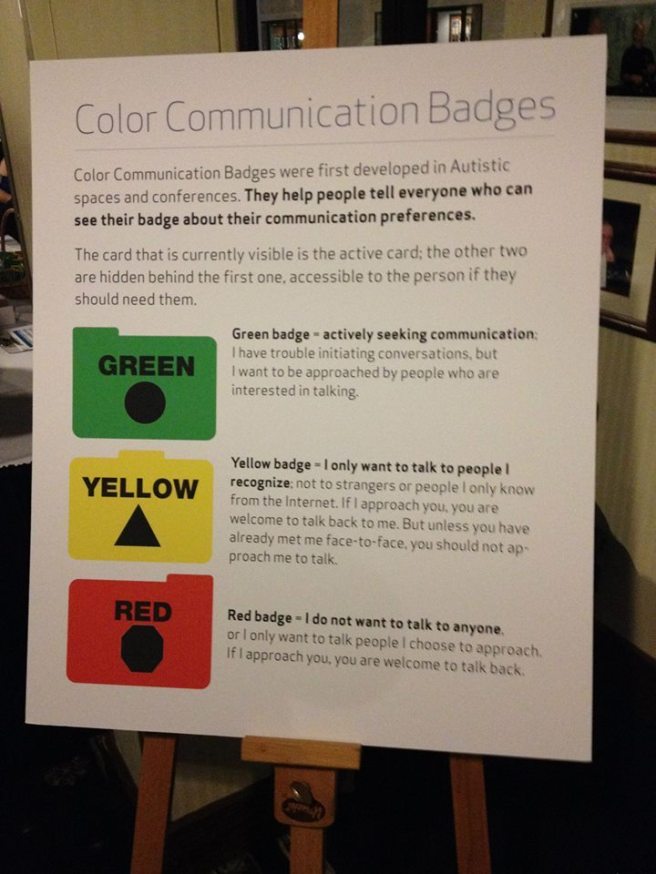
[Image is a poster explaining briefly the origin and meaning of green, yellow, and red interaction signal badges, referred to above as Color Communication Badges.]

deducecanoe:

justsjwthings:

oldamongdreams:

greencarnations:

CAN WE DO THESE AT CONS

SECONDED.

if youre not autistic or suffer from an actual disorder, dont use these. its not cute.

er… you know a lot of autistic people go to conventions, right? And people with social anxiety disorders and panic disorders? Shit if I could get away with using this at work I would. 

Hello there, justsjwthings.

I would like to introduce myself.  I refer to myself as Sam Thomas, though my legal name and how a lot of people know me is Matthew.  I am officially diagnosed autistic.

Over one week in June 2013 (last summer), I was in Washington, DC for an autism conference called the Autism Campus Inclusion (ACI) summer leadership program run by the Autistic Self-Advocacy Network for autistic college students.

If you have any question as to the truth of this, I would like to direct your attention to this YouTube video that ASAN produced promoting the above-mentioned conference.  I appear as the first person in the video and you can find more images of my face on my blog.

At this conference, not only did we use these communication badges pictured above, but we actually had the opportunity to meet Jim Sinclair, the inventor of these badges.

During the part of the conference in which Jim Sinclair gave us a history of Autism Network International (ANI)—which they were a co-founder of—they talked to us about the establishment of this particular piece of assistive technology.  Basically, it was a simple idea that seemed to fit a need and quickly became very popular among many autistic spaces for it’s practicality and ease of use.

The conference it originated from is called Autreat and is held annually by ANI. This is an autism conference that accepts Autistics and Cousins (ACs)—that is, anyone diagnosed or otherwise self-identifying with any disorder autistic or similar that may share a number of autistic traits.

There was a need.  The need was met.  This is how we can safely assume most technology either emerges or becomes popular.

We also talked about something called Universal Design and the Curb-Cutter Effect.  The Curb-Cutter Effect is when something to fit a specific need is found to create convenience in a broader area than intended.  Curb cuts allowing for wheelchair accessibility to sidewalks proved to also be convenient to anyone who may have trouble with steps or even simply a mother with a baby stroller or maybe a child with a wagon.  This is a desirable outcome with disability rights advocacy as creating convenience for non-disabled people often makes the assistive technology easier to advocate for.

In this sense, these colored communication badges could serve that Curb-Cutter effect.  Not only would this be perfectly acceptable for non-disabled people to use for convenience, but would also help to increase their effectiveness and convenience for those of us who need them.  Here are a few examples:

  • Increased popularity makes the colored communication badges more easily recognizable to the general public, making them as effective outside the above-mentioned autism conferences as inside.
  • Increase in demand would create increase in supply and availability, likely making these available to pretty much anyone and even being included with, say, the name tags you are required to wear at most cons.
  • In addition to these helping people recognize the communication state of the wearer, the wearer will be able to recognize whom they can feel more comfortable to approach.
  • Increased popularity would make these badges more acceptable for public use and less alienating to those who would wear them frequently.

This is not something that we are completely incapable of surviving without; this is something that was convenient and made our lives a lot easier.  If that can be easily shared with the general public, then what purpose does it serve not to share it?

Thank you for reading.

thathumanwiththecatears:

kuroba101:

sweet-and-tender:

lesbiandana:

hello! I don’t know if anyone has already made a post about this before, but I just stumbled upon this app made specifically for when you’ve gone into a nonverbal anxiety attack!!!

it was made by Jeroen De Busser who is an autistic computer science student.

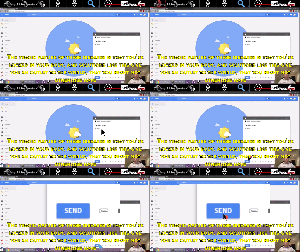
the app is really easy to use! all you do is open it and hand your phone to someone you need to communicate with during an attack but physically cannot, and it shows this cool little alert for the person to read, and then it takes them to an easy to use chat (that looks a lot like texting! except both of you are communicating using the same device). 

the alert message is completely customizable and you can have it say whatever you need! 

the app is called Emergency Chat and it’s available in the Apple Store and google play store. 

I highly recommend it to anyone who might need it 🙂

OH MY GOD?!?!?? BOOST

That’s so bootiful!

thank you so much for this because i never know what to do when i cant talk to people and they just start trying to ask me questions and its really hard to force myself to say i cant talk and stuff. im definately getting this right now

iopele:

thebibliosphere:

jambonsama:

stormingtheivory:

sizvideos:

Watch the video of this man giving away his software for free to help people with degenerative diseases communicate

but…. but…. profit motive! infinite houses!! this doesnt fit in my narrow victorian framework for understanding human nature!!

@thebibliosphere @vaspider

Oh. Oh dang. I know several people who this could help.

this genuinely makes me want to cry… I work with people who can’t communicate in traditional ways and this would help them soooooo much. I worked with a man who has since passed away, and he was fully paralyzed and ventilator-dependant so he couldn’t speak or sign, and we used an alphabet board where we’d speak the letters and he’d blink to spell out words… it was exhausting for everyone. he had a communication device like this one but it didn’t work even tho they’d spent–brave yourself–$11,000 out of pocket to buy it because the VA said it wasn’t “necessary medical equipment”… anyway, this program could’ve helped him so much and I wish it had been around a few years ago, but knowing it’s out there NOW is so awesome and if I ever meet someone like him again, I’ll know that there IS a way to help them communicate that won’t bankrupt them!

This is why behavior is communication.

butterflyinthewell:

My ‘rents and I went to Supercuts because my bangs (fringe?) needed a trim, mom needed a haircut and my dad needed haircut and a beard trim.

I’m at the back half of my sensory-hell-everything-hurts phase due to Aunt Flo’s visit, but my choice was go today or wait another month and my bangs were literally poking me in the eyes. So I went. I had my black Tangle and my No Gloom ‘Shroom. I took earplugs in a baggie too, just in case.

We get into Supercuts and it’s loud. Hair dryers, clippers, an angry yelling kid getting his first haircut(he gets a pass tho, poor kid!) while another kid– a little black girl who was probably 10 or so– played with the wooden blocks in the toybox with her parents nearby. Yeah, Supercuts has stuff to entertain kids. 

I sat off to the side by the toybox and did my head-ducked-temple-tapping routine that I do when I’m overloaded. It wasn’t enough to send me into a meltdown, but I had to really focus. I put my No Gloom ‘Shroom in my mouth and twiddled my Tangle as I angled my head to watch the kid playing with the blocks. She was cute! I don’t know what the hairstyle is called, but she had her hair done up in lots of braids that stuck out every which-way with cute ponytail holders on the ends, and the parts in her hair looked like patchwork on her scalp. (I love seeing little black girls with that hairstyle, it’s adorbs!) I also noticed she was sucking on a pink pacifier.

I put my head down again. About five seconds later the little girl came over and handed me one of the green triangle-shaped blocks. They were wood with grain on one edge, but finished smooth to prevent splinters. She jiggled the block up and down and I immediately pocketed my Tangle and rubbed my finger on the grain. Her face kept the same curious expression, but she jumped up and down like I answered a question correctly.

This kid picked up on my distress and comforted me with something that made her feel good. 

Her parents didn’t interject. They probably figured out I was autistic too by the way I acted when I sat down. I glimpsed them smiling a bit in my peripheral vision as I showed the girl how cool it felt to rub the grain-side of two triangle blocks together.

I didn’t say a word to her, I just got down on the floor beside her and lined up blocks with her. Sometimes I took the round peg shaped ones and rolled them back and forth between my hands like a kitten batting a ball around. She picked up the rectangle block and dropped it repeatedly on the little play mat like she was experimenting with all the ways she could make it land. It felt so natural, like we carried on a sensory conversation that included only us.

We didn’t look at each other at all, except to watch our hands and the blocks. We played with those blocks until it was my turn to get my bangs trimmed. 

The place got quieter when the future death metal scream kid was finished having his first haircut. NOW I could really relax all the way, just in time to put up with the unpleasantness of a bang trim. I was a lot calmer and I attribute the biggest part of that to the girl inviting me to talk to her. I gave back the block the girl gave me and jiggled her hand like she jiggled mine. It was how she said hello, so I thought I would use it to say goodbye. She slapped the floor as I got up and resumed playing like she was before.

I heard her parents praise her when I walked off to my bangs trimmed. Her parents were complimenting her for communicating with me her way instead of trying to force non-autistic interaction. They respected her behavior as meaningful rather than dismissing it as “meaningless repetitive movements”.

That’s parenting done right.