My husband gave me an idea ages ago, and I wanted to actually put it into motion. So today, I give you the ‘Being Visible’ line of shirts.
The goal of Being Visible is to allow people with mental illness, or other invisible illnesses, to help make people aware of their coping abilities on any given day by using the simple image of a battery at various charging levels:
Low charge – low ability to function ‘normally’ or perform daily tasks. May need assistance or frequent breaks Medium charge – diminished, but capable of performing routine or simple tasks during the day. Some assistance may be needed. Full charge – able to perform daily tasks with little to no assistance or reduction in speed, effort, etc. Little to no assistance needed.
These images will be placed front and centre of various T-shirt/tank top designs, to enable wearers to non-verbally alert people around them of their limitations, if they so choose. Of course, as ability levels change, so too can the shirts. On the back of the shirt is the simple text line ‘Being Visible’ above the rod of Asclepius, the common symbol for medicine.
75% of the proceeds will go to the American Foundation for Suicide Prevention. The remaining 25% will go towards my ability to purchase several units of each shirt for my own use.
You can find the shirts at the links listed below. The target goal is 75 units each.
Schwartz BioResearch offers an array of nutritional supplements helpful to managing all the symptoms in tow with chronic illness. The company promotes using a team of expert physcians and pharmacists working to ensure the supplements provided through Schwartz are “Pharmaceutical grade” supplements. These products are tested by a third party for efficacy and contain 100% safe ingredients in their…
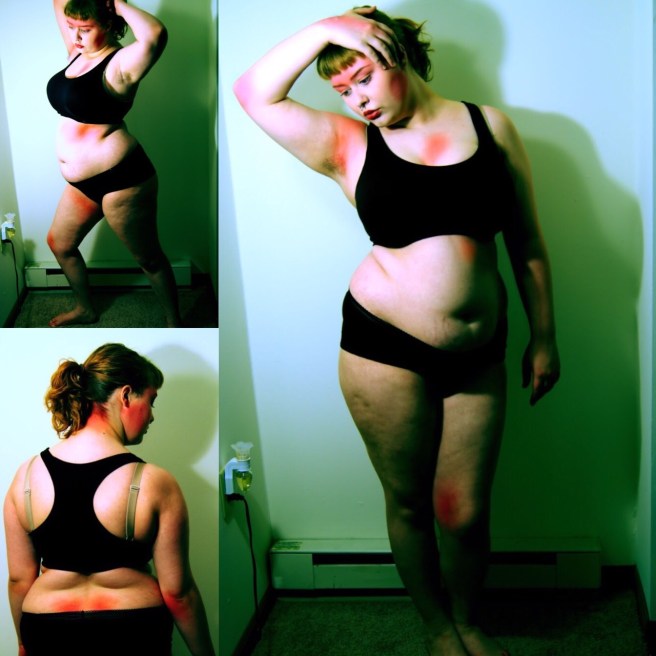
This is going to be a very vulnerable post for me, and not because I’m half naked and showing my face. This is the beginning of a photography series involving chronic illness.
In December of 2015 I was diagnosed with a genetic disorder called Ehlers Danlos Syndrome after a lifetime of health problems that never seemed connected. EDS is a collagen error in my genes meaning my collagen doesn’t form the way it’s meant to. Since collagen is the glue of the body, this means that almost everything can be affected. From Wikipedia, “Collagen provides structure and strength to connective tissue. A defect in collagen can weaken connective tissue in the skin, bones, blood vessels, and organs, resulting in the features of the disorder.” People with EDS often have chronic pain in their joints due to loose ligaments and weak muscles allowing those joints to frequently dislocate. Muscle spasms and nerve pain are also common. The pain involved with EDS is what this set of photos focuses on.
I experience chronic pain every day. I tend to keep it hidden because continually complaining about my pain will only make it harder to handle. It’s not something you can see so I know people, aka my family, have a hard time believing that it’s actually happening, especially when I push through my pain with a smile.
This set of photos is meant to help people visualize the pain I experience that they don’t get to see. It’s meant to bring an understanding that you can never know what someone may be experiencing that you can’t see.
The pink/red spots highlighted on my body are places where I experience pain regularly, most often all at the same time.
(Okay to reblog, please don’t remove the caption, 100% NOT for blogs with raunchy porn or fat fetish/feeder blogs)
thank you for sharing this. you’re brave and beautiful.
having an invisible disability is so frustrating. it’s easy to get mad at the people around me for inadvertently making my life harder, but even when they know intellectually that i have these problems – and even specifically what the problems are – they can’t SEE when i’m having a rough day, they can’t SEE when i’m having a flare-up. some days, if there’s an empty 12-pack box on the kitchen floor, i can easily pick it up and take it out to the recycling bin; some days, i can’t even step over it, and just nudging it aside with my foot makes me wince. it’s not my friends’ and family’s fault they don’t know when i’m hurting. i don’t want to guilt people for that. what i do want them to understand is that the fact my illness is invisible makes it even suckier.
i’ve taken to using my cane in public even when i’m not having a bad mobility day, because people see it and are a little bit more careful around me, so they’re less likely to do something that will give me a bad day. OP, if you don’t use a cane, you might consider starting, even if balance while walking isn’t an issue for you; people bump into you on the sidewalk a whole lot less, and don’t let their dogs jump on you. 😀
One of the most important things I’ve learned as a Real Adult™ is the importance of a job half done.
Today I did a load of dishes, wiped off my stove, and swept the kitchen floor. Did I do the best job, or finish every dish? No! My stove still has that caked on caramel that I need to bust out an SOS pad to take care of, one of our big pots is still sitting in the sink, and somehow a kitty kibble unearthed itself while I was wiping down the stove (?? how??).. but the kitchen looks a LOT better. It’s once again an inhabitable, usable space.
Parents, bosses, teachers, even my own self, harp upon absolute perfect completion of a task as the be all and end all of a job well done, but god damn, my kitchen isn’t terrible because I took the time to improve it. Little steps, especially when you’re struggling, are important. They mean a LOT. They are a sign that you won, if only in that brief moment, and they make getting all the other stuff done so much easier later on down the road.
This is literally the only way that chronically-depressed me can accomplish anything.
if you can only muster enough energy to half-ass something, remember, half an ass is better than none at all
remember too that if you half-ass something now that means in future you will need less ass to complete it later, and future you will also be saved.
Second, trigger warnings: suicide, death mention, suicide ideation
Third, this is going to be honest instead of positive, so please consider carefully if you think anything is going to trigger you and don’t read below the cut.
I pop into r/chronicpain from time to time and it can be a really gloomy place. There are a lot of people who are really desperate. I wouldn’t call them depressed, I don’t know that they are, they’re just…. they’re in a lot of pain and they want it to stop, some of them are in a place where they could lose access to their medication, and they can’t do it any more.
This post is really good. So many tips for bad days ❤
Oh god, this is absolutely incredible. There are plenty of resources that will tell you what to check in on when you’re feeling poorly, but this is the only one we’ve found that actually takes you through them step-by-step, with no executive function necessary! Bookmark this and reap the benefits 🙂
Did it and it didn’t help me any, which made me feel kind of angry. Which I guess is helpful? It makes me laugh anyway XD
In response to the question, “Do you have any suggestions on talking to doctors about pain? I’m going to see my doctor in a few days so I could use some tips and getting my point across.”
Anybody who’s ever tried to explain their experience of bodily pain to someone else knows that it’s difficult. Pain is subjective to each person, and absolutely nobody can feel our physical pain but us. This doesn’t mean that we shouldn’t try to communicate to others that we are having a life-changing problem, though; this just means that we should learn how to communicate about it effectively in order to receive the most empathy, compassion, and appropriate treatment(s) possible. How do we do that?
Figure out if your pain is acute or chronic Acute pain is short-term and often intense. Chronic pain lasts for longer than 3 months and can be just as intense, if not more so. Try to journal and see if you can list all you know about your own pain’s history, and go into your appointment with this list (as well as a list of your questions and concerns) so that you feel confident and don’t forget anything important to you. How long has it lasted? Is it the result of a specific event that you can pinpoint?
Find vivid phrases to describe what your pain feels like When I was first going in to see a doctor for chronic hip pain, I found the phrase, “I feel like I just slammed my hip against a table.” Easy to understand, as well as almost feel yourself, right? Make it clear that this is something that needs and deserves treatment. Women often get taken less seriously than men when seeking pain treatment, as do racial minorities. Advocate for yourself as best you can.
Learn the typical words that describe pain (as well as what parts of the body are affected by it) Sometimes, in dealing with pain, you’ll be experiencing different types of pain in different places. Read this page in order to understand what people actually mean when they say they’re having a “dull” pain, as well as other terms like “raw”, “stiff”, and so on. In addition, find a nice picture of the human body on Google, if you’re struggling to figure out the name of the approximate region where you’re hurting. I like this one because it has both the Latin and the English words, as well as the front and back of the body.
List which everyday activities are compromised by your pain Certain pain syndromes, if it turns out that you have a more widespread chronic pain disorder rather than an acute pain, have life activities that are known to be affected in most people who have it. Journal about them. You’re often required to list these on patient intake forms, anyway, so this will speed up your process of filling out that paperwork.
If you’re science-y, read up on pain This is mainly for the anatomy and physiology nerds out there. Two very readable articles from WebMD: Pain basics (1 page) | Pain classifications (3 pages)
List every single symptom you’re experiencing (even the ones that you think can’t possibly be connected to each other) Think about every part of the body. Is anything going on that didn’t in the past? I know that this can be hard, and even distressing, because it can give us a reason to grieve, but as much as you can, push through your discomfort with it. What makes them worse? Better? Bring this list with you to your appointment so that you can’t possibly forget any of them when you’re on the spot. The more your practitioner knows, the better.
Go into your appointment with a pain scale of your choosing (because not all pain scales are created equally, nor do they necessarily mean the same thing to different people) What is your pain on good days? What is it on bad days? I personally like the Mankoski Pain Scale because it talks about the daily life impacts of your pain, as well as the kind of medication that might help. Of course, it will be up to you and your practitioner ultimately to decide what kind of treatment you will get, but knowing, for example, that you’ve tried ibuprofen and it hasn’t worked is a helpful piece of information.
I wish you the absolute best in your appointments, friends. Know that you’ve even got an entire community behind you here on Tumblr! We’ve got your back and understand you more than you could possibly know. We’re called spoonies (people who have chronic illnesses that limit our energy). Here’s a masterpost of spoonie community-related stuff, (and how about another?), and a world map of spoonies to remind you that you are never alone! And, if you get diagnosed with something in particular, here’s a list of Tumblr bloggers that identify with particular diagnoses (and, chances are, there are others out there just like you)! Be well, and please ask any questions you need to.
You will want to run away from it. Don’t. Running away will only make it worse when you’ll eventually have to face it. (And you can’t keep running forever).
You will be in a constant search to try to find ways to temporarily fix it. Alcohol, drugs, self-harm. They won’t work. They will make you feel worse; but you will want to keep using them anyway.
After a while, you might make friends with it. Get accustomed to it. (But it will still hurt).
Loneliness will come along with it. Not because you’re necessarily alone, but because you’re engulfed in something that other people cannot understand.
Some days will be better than others.
And on these days, you wonder who you really are, and what you are without it.
You will also be scared. Scared of the moment it will come back again.
You will want to disappear.
And you can, if you want to. But you will be losing all of your possibilities. There are many possibilities. The biggest of all, is that you get another better day, followed by another and another. Don’t lose that possibility. (I almost lost my possibility, but I didn’t, and it came true).



 Holding the Bowl