
The most common cause of female infertility – polycystic ovary syndrome – may be caused by a hormonal imbalance before birth. The finding has led to a cure in mice, and a drug trial is set to begin in women later this year.
Polycystic ovary syndrome affects up to one in five women worldwide, three-quarters of whom struggle to fall pregnant. The condition is typically characterised by high levels of testosterone, ovarian cysts, irregular menstrual cycles, and problems regulating sugar, but the causes have long been a mystery. “It’s by far the most common hormonal condition affecting women of reproductive age but it hasn’t received a lot of attention,” says Robert Norman at the University of Adelaide in Australia.
THIS IS UNUSUAL CONTENT FOR MY BLOG BUT
Y’ALL THIS IS HUGE
!!!!!
Tag: chronic illness
Online Mental Health Resources
Anger & Irritability
CBT & Self help for anger
Anger problems workbook
Anger management tips & techniques
Anger & aggression management
Anger & aggressive behaviour leaflet
Controlling anger guide
Dealing with anger & impulsivity (PDF)Anxiety
Overcoming health anxiety (9 modules with workbooks)
Improving self esteem (9 modules with workbooks)
Overcoming perfectionism (9 modules with workbooks)
Mastering general anxiety & worries (11 modules with workbooks)
General self help strategies
Self help home toolkit
How to tolerate uncertainty
Applied tension technique (for those who faint at sight of blood/needles)
Self help for specific phobias
Youth anxiety self help
How to stop worrying
Flying phobia self help
General anxiety disorder self help (3 steps)
Anxiety workbook
CBT & Self help for general anxiety
CBT & Self help for phobias
CBT & Self help for health anxiety
CBT & Self help for low self esteem
CBT & Self help for stress
Anxiety & panic leaflet
Phobias leaflet
Anxiety self help guide
Health anxiety self help guide
Stress workbook
Stress management course
Hints to avoid harmful stressBipolar Disorder
Coping with Bipolar Disorder (8 modules with workbooks)
CBT & Self help for bipolar
Bipolar support & self help
Wellbeing plan for Bipolar disorder (PDF)
Bipolar disorder mood chart (PDF)Also see anger/irritability, depression, insomnia & impulsivity resources.
Borderline Personality Disorder
Overcoming distress intolerance (4 modules with workbooks)
Ten coping skills for BPD
Coping with BPD
BPD resource listAlso see CBT, DBT, self harm, anger/irritability, suicidal thoughts, impulsivity & depression resources.
Cognitive Behavioural Therapy (CBT)
7 Step self help course
CBT Based self help
CBT Worksheets & Information sheets
Free self help worksheetsConcentration & Time management
Put off procrastinating (7 modules with workbooks)
Guide for goal setting
Concentration leaflet
Sitting exams leaflet
Procrastination leafletDepression & Low mood
Coping with depression (9 modules with workbooks)
The Journal depression help
CBT & Self help for depression
Depression leaflet
Depression & low mood self help guide
Depression workbook
Dealing with depression tips
Antidepressant skills workbook (PDF)
Undoing depression: A self help site
Worry & sadness course
Depression mood chart (PDF)
Exercise to beat depression Handout 1 | Handout 2 | Handout 3 | Handout 4
Thinking your way out of depression (CBT)Dialectal Behaviour Therapy (DBT)
DBT Self help (videos, worksheets, activities etc.)
DBT Worksheets
Mindfulness
Skills Workbook
Coping & Relationship skills
Ways to manage distress right now
Letting go of emotional suffering
Mindfulness leaflet
Appraising change (PDF)
Honest communication (PDF)
Goal setting
Mindfulness in everyday life
Quick relaxation techniquesEating disorders & Body image
Overcoming body dysmorphia (7 modules with workbooks)
Overcoming disordered eating Part A | Part B (9 modules each part)
CBT & Self help for anorexia
CBT & Self help for bulimia & binge eating
Eating disorders leaflet
Eating disorders self help guide
Eating disorder coping skills
Tips & strategies for overcoming eating disordersFatigue & Chronic pain
CBT & Self help for chronic fatigue & pain
Chronic pain workbook
Restless legs syndrome self help
Treating chronic fatigue & Fibromyalgia
Chronic fatigue self help
Fatigue fighter self help
The pain toolkit (PDF)
Chronic pain patient’s guide to pain free hours (PDF)
Chronic pain survival handbook (PDF)Impulsive thoughts & behaviours
ADHD in adults: Managing impulsivity
Managing impulsive behaviours
5 Tips for changing impulsive behaviours
Impulse control strategiesInsomnia & Sleep difficulties
Getting to sleep
Sleep hygiene
CBT & Self help for sleep issues
Insomnia leaflet
Sleeping problems self help guide
Sleep problems workbook
How to sleep better
Can’t sleep?Obsessive Compulsive Disorder
How to manage obsessions
Manage your OCD at home
What to do while obsessing
Stopping your compulsions
CBT & Self help for OCD
Obsessions & compulsions self help guide
Obsessions & compulsions workbookPanic Attacks
Coping with panic attacks (12 modules with workbooks)
Self help strategies for Panic Disorder
Panic attack self help programme
CBT & Self help for Panic Disorder
Panic self help guide
Panic workbookPsychosis
CBT & Self help for psychosis
Hearing voices self help guide
Schizophrenia treatment & recovery
Self help measures for psychosis
Guided self help for psychosis (PDF)Social Anxiety
Coping with social anxiety (12 modules with workbooks)
Improving your social skills
Home management strategies for social anxiety
Improve your assertiveness (10 modules with workbooks)
CBT & Self help for social anxiety
Shyness & social anxiety self help guide
Shyness & social anxiety workbook
Shyness/Social anxiety courseSelf harm
Self harm leaflet
Self harm self help guide
Self harm alternatives & distractions
Cutting & self harm help
Self injury self help ideas
Self harm coping plan (Link at bottom of page)
Stopping self harmSuicidal thoughts
CBT & Self help for suicidal thoughts
Dealing with suicidal thoughts & feelings
Suicide: Read this first
Making a safety plan (Link at bottom of page)
Ways to help yourself when you’re feeling suicidal
What can I do if I’m feeling suicidal?
Self help for the suicidal workbook
Suicide hotlines by countryTrauma & Abuse
Self help for PTSD
CBT & Self help for PTSD
Post traumatic stress leaflet
Information for adults abused as children
Dealing with abuse guide
Post Traumatic stress self help guide
Post traumatic stress workbook
Safety & escaping domestic violence
Help for abused men
Coping with PTSD
How to recover from disasters & traumatic eventsNote: I haven’t created or extensively reviewed any of these resources, they’re just things I’ve found online that look like they’d be useful and to my best knowledge do not cost anything.
These are self help resources intended to be used in addition to and not as a substitute for medical treatment- please contact a professional if you are feeling unsafe. 🙂
Products for Chronic Pain
I chose eBay because I’m Australian and I didn’t want to give recommendations for stores that are only here. These are the ones that genuinely help me every day.
- Fake shoelaces
- Boomerang pillow
- Boomerang pillow cover
- 7 day pillbox wallet
- Wheat pack
- Ice packs
- Ear plugs
- TENS machine
- Oil diffuser
- Collapsible cane
- Migrastick
- Ugg boots
- Peppermint chewing gum (for nausea)
- Radox muscle soothe bath salts
- Magnesium gel
- Deep heat gel
- Ice gel
I encourage everybody to use The Mighty – basically Facebook for the chronically ill. You can tailor your feed to your diseases. I didn’t know who needed help with what so here are some pages on The Might about products chronic pain:
- 20 Heating Products That Can Help Relieve Pain
- 20 Products People With Fibromyalgia Swear By
- 14 Portable Heating Products That Can Help Relieve Pain
- 18 Cooling Products That Can Help Relieve Pain
- 15 Products People With Chronic Pain Swear By
- 14 Portable Cooling Products People With Chronic Illness Swear By
- 15 Sensory-Friendly Back to School Products
- 27 Products That Can Make Sleeping Easier If You Have Chronic Pain
- 24 Products That Can Make Cleaning Easier If You Have a Chronic Illness or Disability
- 16 Products to Use When Painsomnia Keeps You Up at Night
- 21 Products That Can Make Cooking Easier if You Have a Chronic Illness or Disability
- 22 Products That Can Make Your Room Cozier on Days You’re Stuck in Bed
- 14 Products That Make Your Car More Comfortable If You Have a Chronic Illness
- 22 Personal Care Products to Use If You Are Sensitive to Scents and Chemicals
- 19 Products That Can Make Showering Easier If You Have a Chronic Illness or Disability
- 16 Products That Can Make It Easier to Do Laundry With Chronic Illness
Please reblog, even if you’re not disabled, because it will help people who are.
load-bearing
Sometimes people hit a place in their life where things are going really well. They like their job and are able to be productive at it; they have energy after work to pursue the relationships and activities they enjoy; they’re taking good care of themselves and rarely get sick or have flareups of their chronic health problems; stuff is basically working out. Then a small thing about their routine changes and suddenly they’re barely keeping their head above water.
(This happens to me all the time; it’s approximately my dominant experience of working full-time.)
I think one thing that’s going on here is that there are a bunch of small parts of our daily routine which are doing really important work for our wellbeing. Our commute involves a ten-minute walk along the waterfront and the walking and fresh air are great for our wellbeing (or, alternately, our commute involves no walking and this makes it way more frictionless because walking sucks for us). Our water heater is really good and so we can take half-hour hot showers, which are a critical part of our decompression/recovery time. We sit with our back to the wall so we don’t have to worry about looking productive at work as long as the work all gets done. The store down the street is open really late so late runs for groceries are possible. Our roommate is a chef and so the kitchen is always clean and well-stocked.
It’s useful to think of these things as load-bearing. They’re not just nice – they’re part of your mental architecture, they’re part of what you’re using to thrive. And when they change, life can abruptly get much harder or sometimes just collapse on you entirely. And this is usually unexpected, because it’s hard to notice which parts of your environment and routine are load bearing. I often only notice in hindsight. “Oh,” I say to myself after months of fatigue, “having my own private space was load-bearing.” “Oh,” after a scary drop in weight, “being able to keep nutrition shakes next to my bed and drink them in bed was load-bearing.” “Oh,” after a sudden struggle to maintain my work productivity, “a quiet corner with my back to the wall was load-bearing.”
When you know what’s important to you, you can fight for it, or at least be equipped to notice right away if it goes and some of your ability to thrive goes with it. When you don’t, or when you’re thinking of all these things as ‘nice things about my life’ rather than ‘load-bearing bits of my flourishing as a person’, you’re not likely to notice the strain created when they vanish until you’re really, really hurting.
Almost two weeks after reading this, and I’m still kind of blown away at what a ridiculously fruitful definition this is. Like I had no idea that load bearing things were a thing that needed to have a word for them, but now I’m like holy shit I’m so glad that there’s now a word I can use to refer to this really important class of Thing.
This is astounding. Load-bearing. Forget spoons, this concept is wonderful. I’m going to update my Spear Theory with this.
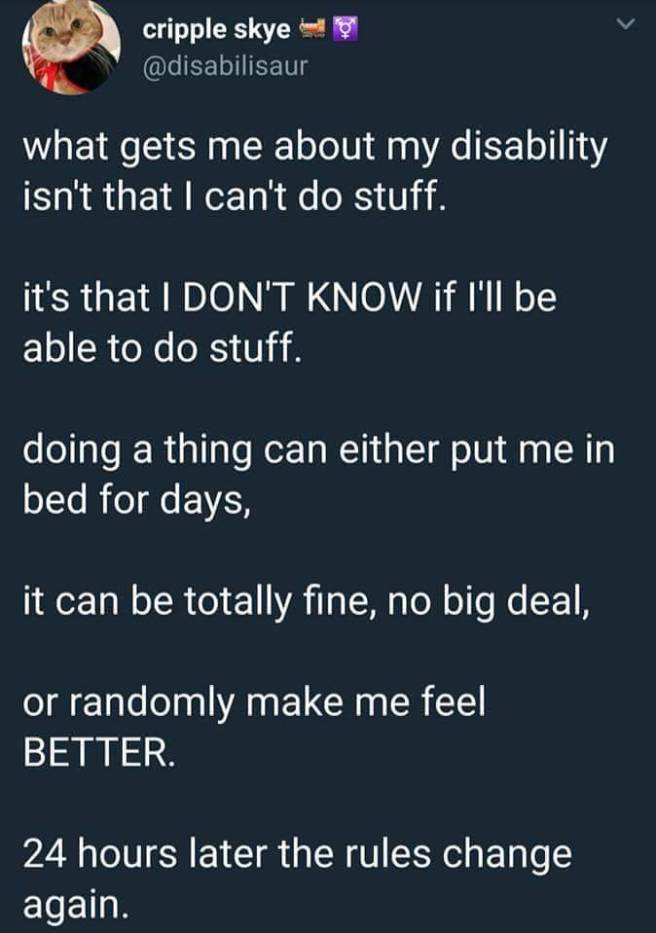
Casual reminder that disabilities are often based on the day or the unique challenges of the situation. People who need a wheelchair on most days might not on one particular day. People who use an emotional support animal may not need it 24/7. People who rely on canes may only need it when they’re having bad days. It doesn’t mean they’re faking of their disability isn’t valid. Energy levels and pain fluctuate and that’s okay.
Normalize the unpredictability of disabilities.
Spoonie and other chronic illness health reminder of the day: if all you can manage to make or eat today is “junk” food, then good job, you fed yourself. That’s the main thing. You need calories, your body needs them for energy, and you deserve to eat them, however you manage to get them. I know it’s not always ideal, but sometimes you just gotta eat.
So sick and tired of seeing “it’s really simple to eat your way healthy” posts, especially from other people with chronic health conditions who should know better. Yes, Susan, I know how simple and easy it is to make nourishing bone broth, but are you also going to stand in my kitchen for 8 hours while it simmers, do everything else I need to do today, then strain it out, clean up everything and feed it to me too? Oh you managed to make huge batches of it while you had energy and are now able to pull it out of the freezer? Well aren’t you profoundly lucky to be able to do that.
Stop shitting on people who can’t.
And if I see anymore of y’all posting “honestly people who don’t even try to eat healthily deserve to stay sick” posts I’m going to climb out of your garbage disposal like Truth hauling ass out of her well and smack you with your own ladle, so help me gods.
Stop it. You should know better than this. It’s a fucking fucked up fact that “good” food is a luxury for a lot of sick and disabled people, who are often under employed or relying on welfare to survive. It is so absolutely fucked up that not everyone can afford fresh groceries every week or has the means to cook them. But don’t you dare try to imply it’s because they’re not trying hard enough and deserve to be sick. What the fuck is wrong with you. Go sit in the corner.
I’m done spoon feeding you human decency for the day.

Hi friends, it’s Ali! I moved accounts yet again, so have reposted my spoonie masterpost. Hopefully this one will spread like wildfire like the original (: Love and spoons ❤ xx
WHAT IS A SPOONIE?A spoonie is a person, living with one or more physical or mental chronic illness or disability, that identifies with Christine Miserandino’s Spoon Theory.
SPOONIE FOUNDATION WEBSITESSPOONIE ILLNESS INFO
- 10 Things to Understand About Illnesses
- Chronic Pain Infographic
- Crohn’s Disease Infographic
- Functional Ability Scale
- Get to Know Endometriosis Infographic
- Living w/ a Chronic Illness – From the Outside Looking In
- Lupus Facts & Statistics
- Mobility Devices – When Is It Time to Upgrade?
- Mobility Devices – You Don’t Need Permission!
- Myalgic Encephalomyelitis Facts & Symptoms
- Spoonie Awareness Ribbon Colours
- Think You Might Have Ehlers-Danlos Syndrome?
- What It’s Really Like to Be Chronically Ill
- What Is Systemic Lupus Erythematosus (SLE)?
SPOONIE TIPS, HELP, & ADVICE
- A Brief Guide to Recovering From Surgery (or a flare, treatment, procedure, etc)
- Chronic Illness and Busy Schedules
- Coping Skills for Disabled and Chronically Ill Persons
- Costochondritis and Slipping Rib Syndrome Tips
- Ehlers-Danlos Syndrome Advice
- Ehlers-Danlos Syndrome Tips
- Getting a Diagnosis / Doctor’s Appointments 101
- Ice vs. Heat — What to Use When
- Holiday Spoonie Reminders
- Mankoski Pain Scale
- Nutrition and Crohn’s Disease
- POTS and Mitral Valve Prolapse Tips
- Resources for Vascular EDS
- Self-Care Ideas, Tips, and Resources
- Self Care When You Don’t Have the Spoons for Showering
- Spoonie Tips (by i-am-lost-in-the-tide)
- Spoonie Tips (by thefaultinourpoons)
- Tips for Traveling with a Chronic Illness
- TMJ Dysfunction Tips
- Yellow Dot Program
SYMPTOMS LISTS OF CHRONIC ILLNESSES
- Fibromyalgia Monster List of Possible Symptoms
- Lyme Disease Symptoms List
- Mega List of Ehlers-Danlos Symptoms
- The ME/CFS Symptoms List
SPOONIE REMEDIES & TREATMENTS
- Do It Yourself Heating Pads Quick & Easy!
- Non-Drug Treatments for Pain
- Non-Pharma Pain Management
- OTC Pain Medicine Chart
- Periodic Table of Vitamins
- Stretches That Help Your Digestion
- Treating Lupus
- Wheelchair Masterpost
SPOONIE SCHOOL-RELATED
- 504 Plan (Pre-University Accommodations)
- Chronic Illness in University
- Chronic Illness in University: Studying/Revising
- University Financial Aid / Scholarships for Disabilities
SPOONIE MISCONCEPTIONS
- “I have a chronic illness, therefore I am disabled.” not always true!
- “I’m all alone.” false! see below.
INTERACTING WITH SPOONIES
- 13 Reasons Why “But You Don’t Look Sick” Is Not a Compliment
- Please Do Not Dismiss Me
- Please Do Not Question My Activities
- Open Letters to Those Without Ehlers Danlos
- Stop Telling Me What I Need to Eat to Cure My Incurable Illness
- Things Not to Say to a Spoonie Infographic
- Things to Say to a Spoonie
- Things Able-Bodied People Need to Stop Saying
SPOONIE STRUGGLESSPOONIE CLICHÉSSPOONIE MEMESSPOONIE VIDEOSSPOONIE PETITIONSnone for the moment…
THINGS TO DO ON A LOW SPOON DAYSPOONIE DISABILITY
- Disabled Beauties
- How to Help Disabled People w/o Spending a Penny
- Making Ends Meet When You’re Disabled
- Voting While Disabled – Know Your Rights Infographic
- What Disabled Persons Mean / What Able Bodied Persons Think
SERVICE DOG RELATED
- ADA Service Dog Laws
- How to Get a Service Dog in 4 Steps
- Key Things to Know About Service Dogs
- Service Dog Companies
- Service Dog Education
- Service Dog Fraud – Quest for the Vest
AVOID ABLEISM
- Ableist Language and How to Avoid It
- Avoid Everyday Ableism
- Avoiding Ableist & Sexist Language Won’t Make Us Less Fun
- Do Not Call Someone Out For Using an Assistive Device
- Do Not Shame Disabled People
- Don’t Use Ableist Language
- Friendly Reminder – Disabled People are People
- List of Disability Terms w/ Negative Connotations
- PSA – Do Not Dehumanize Disabled People
- Reasons to Give Up Ableist Language
- Young Does Not Equal Able-Bodied
SPOONIE ITEMS
- Amazing Weighted Blankets for an amazing price!
- AmoeBAND
- Awesome Shower Chair
- Back Rx by Nada Chair (helps w/ sitting up straight & back pain)
- Electrolyte Replenisher Gluten-Free & Vegan
- Good Rx App
- Medical Alert IDs
- Mobility Aids & Decorations
- Spoonie Magazine – The Pillow Fort
- The Spoon Meter
- How to Use
- Code for ½ Spoons by hyperelasticzebra
INTERACT WITH FELLOW SPOONIESMISCELLANEOUSAWESOME SAUCE SPOONIES ♥CREDITS & OTHER INFORMATIONLast updated 25th May 2015 @ 17:10 EST
Updated when possible (updated version here ♥)
Please reblog / like only — do not edit. Thank you.
Message hyperelasticzebra to add a blog, article, or post to the list.I try my best to find as many spoonie blogs and posts to add to this as possible, but if I have missed you, your blog, or a helpful post, please let me know! I don’t always have the spoons or time to search for articles pertaining to specific illnesses.
Help Out the Creator with Medical Bills?
Click to Donate
One Gene Mutation Links Three Mysterious, Debilitating Diseases
Researchers have found a genetic mutation that links Ehlers-Danlos Syndrome (#EDS), Postural Orthostatic Tachycardia Syndrome (#POTS), and Mast Cell Activation Syndrome (#MCAS)
http://ow.ly/2FcO30i8IrR
One Gene Mutation Links Three Mysterious, Debilitating Diseases
Here’s a thought I had about how therapy & treatment works (vs how many people imagine it works). This is based on my experience with depression and chronic illness, but I hope it applies more broadly as well.
Imagine you have to take a road trip on a deserted road alone. Halfway through the trip your engine starts to splutter and the car breaks down. What do you do?
A lot of people imagine that therapy and treatment is like calling a mechanic to come and fix your car for you. You make the call, and then you just have to wait around until the mechanic has fixed the problem, and your car is good as new! Unfortunately, it doesn’t work like that. There is no on-call mechanic. No-one is able to fix this car except for you.
Instead, it’s like you pull a toolbox out of the trunk, pop open the hood, and dial up the mechanic on the phone. You have to try and describe the problems as clearly as possible, and follow the advice they give you as well as you can.
Sometimes you won’t understand the advice, and you’ll need them to explain it again or suggest something else. Sometimes you’ll do what they say and the car still won’t run, and they won’t be able to explain why, only give you something new to try. Sometimes you’ll think you fixed the problem and start driving, and the car will break again two minutes down the road. No matter what happens, it’s going to be hard and messy and frustrating work.
But at the end of it, not only will your car be running again, but you’ll know how to fix it now. Which isn’t to say that you’ll never need another mechanic again, but next time you get stuck, it’ll be that little bit easier to handle.
So keep at it everyone, and good luck on your journeys!
 Holding the Bowl