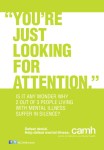
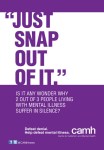
Mental Health Awareness Week from October 5-11
Even mermaids can have a mental illness, for a mermaid has no tears and therefore suffers so much more.
I’m that one person out of every five who has an invisible illness. I’m a suicide survivor. These are two reasons why I chose to per-sue Counseling Psychology in college. It’s also why I wanted to become a mermaid; not just to make myself happy, but to make others happy as well. Help raise awareness for mental illness by sharing this post.
Know that you are not alone.
Tag: awareness
A way people with disabilities are often wrongly percieved as angry
Sometimes disabled people are wrong perceived as angry or hostile when they move like disabled people. It works something like this:
- The most efficient way to do things is often not the socially accepted way to do things
- People with disabilities often have to do things in an efficient way to be able to do them
- In order to be perceived as calm and polite, people are often expected to move in a slow, careful way without making sudden or loud motions
- That’s easy for most people without disabilities, and can be difficult or impossible for people with disabilities
- Sometimes people with disabilities don’t have the motor coordination or strength to move in expected ways. Sometimes pain or illness makes them too exhausted to have the energy to move in expected ways. Sometimes, they have to move efficiently to be able to move at all.
- People with disabilities who have to move in loud, sudden, forceful, or jerky ways are often wrongfully perceived as expressing anger, frustration, or aggression.
- When people make loud, jerky, or sudden motions, they tend to be perceived as rude, angry, or aggressive
- People with disabilities don’t always have the coordination to make the movements in expected ways
- Sometimes, they have to be efficient in order to do the thing.
- This often gets perceived as angry when it isn’t
- This can lead to people with disabilities who are just trying to live their lives being perceived as hostile and excluded
- When a person with a disability is moving in a jerky, sudden, or loud way, it’s important to consider the possibility that it’s disability-related rather than angry
Some concrete examples:
Dropping things:
In most social contexts, it’s socially expected that people who need things to be on the ground put them there without making a sudden noise
- This generally means using your arms to slowly lower the thing to the ground
- People with disabilities often do not have the strength or motor coordination needed to lower things this way
- Sometimes, people who can’t rely on muscles to lower things need to drop them and rely on gravity
- (And some people have to rely on gravity some of the time, eg: when they’re tired, at the end of a long day, when they’re in a particularly draining environment, when they’ve already had to lift and drop the thing several times that day.)
- Gravity only goes one speed, and dropped objects tend to make noise
- Dropping a heavy object rather than lowering it slowly is usually perceived as a sign of anger (and for people without disabilities, it’s generally intended as one).
- People with disabilities who drop things are often not intending it as an expression of anger.
- Often, they drop things because they need them to be on the ground and have no other realistic way of getting them there.
- If a person with a disability is dropping heavy things rather than lowering them, it’s important not to automatically assume that they are doing this out of a show of emotions
- Consider seriously the possibility that they’re dropping things because they need to lower them, and due to disability are not able to do so in the socially expected way.
Another example: Plugging things in:
- The socially expected way to plug things in is to slowly push the plug into the outlet using a steady pressure
- That requires a particular kind of strength and muscle control
- Some people with disabilities can’t do that
- Some people with disabilities have to rely on momentum.
- Relying on momentum involves one sudden forceful movement.
- That can look like punching, and can be perceived as excessive force
- Most people without disabilities only plug things in with that kind of force when they are angry or frustrated
- People with disabilities often plug things in that way because it’s the only way they can do it
- If a person with a disability uses a lot of force to plug things in, don’t assume it’s a display of emotion.
- Consider seriously the possibility that they’re doing it that way because that’s how their body works
In general:
- Some socially expected movements are complicated and difficult
- Sometimes people with disabilities can’t do it in the polite way
- Sometimes, we have to do it in a way that’s more efficient
- That’s often perceived as rude, inconsiderate, or threatening, when it’s really just limited ability to move in expected ways
- No amount of social skills training or knowledge of socially expected behavior will make it physically possible to move in all expected ways
- This can result in people with disabilities being perceived as angry or displaying rage when all they’re doing is moving
- It’s important not to automatically assume that people with disabilities who move oddly are doing it to display anger. It might just be that that’s the only reasonable way for them to do something.
- If you understand this, you’ll be much more able to relate to people with disabilities and include people
- (People with disabilities, like everyone else, sometimes display anger and frustration in physical ways. But they are routinely wrongly perceived as doing so. It is possible, and important, to learn to tell the difference).
tl;dr People with disabilities are often perceived as displaying rage or aggression when they’re just moving. This is because socially expected ways of moving are often very inefficient in ways that aren’t too difficult for most nondisabled people, but can be difficult or impossible for people with disabilities. It’s important to learn to tell the difference between people with disabilities moving efficiently and people with disabilities displaying anger. Scroll up for details and examples.
help I’m having emotions about a cartoon antidepressant trying to be useful
DID YOU GUYS SERIOUSLY GIF AN ABILIFY COMMERCIAL
yes but look at it, it cares about her and just wants to help her be able to function. It’s like “I know you’re sad. here, I’ll help you.”
LIKE OKAY THOUGH can I explain why this is exceedingly brilliant?? Because when anti-depressants work right, that’s what they DO. They don’t make you happy or emotionless or unhealthy in any way, they make you FUNCTIONAL. They make it so that a depressed person who can barely get out of bed can start to support themselves again and more importantly, start to THINK for themselves again without the permeating presence of depression.
Depression is a cyclical disease, that tells you to think a certain way, and, because you’re depressed, you generally believe it, and then things get worse and worse. The ONLY thing anti-depressants do is to STOP that cycle in its tracks!! Which is something to be ecstatic about and celebrated, even if you don’t realize it at the time, because when you’re depressed, getting out of bed is climbing Mount Everest. Antidepressants help stop that cycle so that one day soon, getting out of bed can JUST be getting out of bed. They don’t even expedite the recovery process in most cases, they just make recovery POSSIBLE IN THE FIRST PLACE. So this little guy is portrayed with a fuckton more accuracy than I ever expected from a commercial.
It’s back and adorable
on a side note, I really dig the art style here
This seems really awesome. 😀 Funny, informative, and, from what I’ve learned, pretty on the money.
Can this please just be mandatory viewing material for people? This is really basic shit.
(OMG THE DOOR THING. THE DOOR THING.)
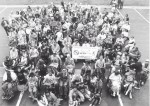
Vintage on disability rights.
Don’t let the black and white trick you. The Capitol Crawl was in 1990. This is not ancient history.
Instead of Autism Speaks, consider:
- yodeling into a can of peas (although it is not helpful, its definitely not as harmful as A$)
And then you realize that Forrest knows about his condition all along and your heart breaks a little.
a little?
A LITTLE?!Of course Forrest knows. That’s the whole point. His best “friend” spends his life calling him an idiot, people go around calling him an ~*~inspiration~*~ for living his life as usual, treating him condescendingly because they think he won’t know any different.
But he knows. Of course he knows. And he doesn’t have the words to say “fuck you all, I’m not my mental condition, I’m Forrest.”
I’d like to add that my uncle is mentally retarded (i.e. that’s his official diagnosis, it’s never been updated to “developmentally challenged” or whatever the most modern official language is) due to scarlet fever as a child and the first time he saw this movie, he cried. He’s not Forrest (although he has shaken hands with Jimmy Carter and met Ray Romano, and he held a single good job for 30 years before retiring from it), but Forrest was the first time in his entire life that he saw someone like himself onscreen.
My uncle was born in 1950 and became mentally disabled at the age of ten.
Forrest Gump came out in 1994.
After 34 years of isolation, being made fun of at work and shunned by neighbors, beaten up for being “weird” and whispered about in his community, my uncle—whose life dream was to become a preacher and who instead spray-painted locomotives for General Electric—saw someone else like himself. And he knew it.
He never read the book because he doesn’t have the mental capacity to read anything more complicated than a newspaper. When I told him there was a book—and that there’s a sequel to the book—he got really excited. Not because he could read it; not even because he’d be able to follow the story if I read it to him, but just because it exists.
There are Forrests among us. Don’t treat them the way this one was treated.
I promise you: they know.
Nobody realizes that some people expend a tremendous energy trying to be normal.
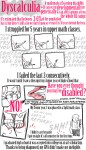
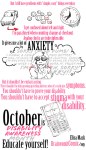
In case you didn’t know, October is learning disability awareness month! Also, you probably didn’t know I have one, since the general reaction I tend to get is “you don’t /look/ like you have a learning disability”.
That’s partially why I made this, because people seem to think you’re branded with it on your forhead when in real life it’s not like that at all—In fact, that mentality is probably what hurt my academic career for so long, because people with Dyscalculia often excel in other areas! I remember a lot if teachers/classmates/my own parents telling me to ‘just try harder’, because to them it seemed like I wasn’t applying myself. Dyscalculia is also not a ‘popular’ learning disability that’s talked about, it’s a pretty common occurance for me to have to give an explanation to others who think I’m ‘lazy’, so I figured this is a little educational as well as personal.
Those with Dyscalculia have trouble with*:
•Counting, estimating, and measuring. •Learning math facts (like addition, subtraction, multiplication, ect). •Problem-solving skills. •Concepts of time and navigation (scheduling, telling the diffrence between directions). *Among other things, but those are the most common.●Here are some Dyscalculia resources:
•Learning Disability Association of America- [ldaamerica.org/types-of-learning-disabilities/dyscalculia]
•National Center for Learning Disabilities- [ncld.org/types-learning-disabilities/dyscalculia/what-is-dyscalculia]
•Dyscalculia.Org●Think you have Dyscalculia? Test yourself (Don’t self-diagnose, bring your results to your parent/school counselor/therapist and discuss further testing)
•[cohenkadosh.psy.ox.ac.uk/test-yourself/are-you-dyscalculic]I did not know that Dyscalculia was a diagnosis that existed until a few years ago. Once I knew, it felt like I was aiming a flashlight back at my school career, finally able to see some things clearly. Ask me to read a novel and write a term paper overnight? Sure, no problem. Ask me to do a times table? Blind, near-sobbing panic.
Even now, if I have to do basic multiplication, if it’s not something that had a song from Schoolhouse Rock, I … I’m not sure I can do it.
I wish I had known that I was dyscalculic in middle and high school. And my one year of college. And the entirety of my life. Yeah, I just wish I had known dyscalculia was a thing so I could have understood my brain and not have beaten myself up over it so much. I’m happy I know now, though!
Also, in my experience, being labeled “gifted” while at the same time being neuro-atypical and undiagnosed really does a number on your sense of self.
i’m autistic, and when i’m overloaded i can lose my ability to process numbers. i also lose speech processing during overload, and since high school is stressful and classes are taught verbally, i used to go into a death spiral where if a particular class bumped me over a certan stress threshold i could never learn anything in that class again. i wasn’t diagnosed back then, and got a lot of the old “you’re so smart we don’t know why you can’t do this” crap.
like, thanks guys, i was there when you gave me the iq test, and it would be really great if folks could occasionally mention the ‘official genius’ thing in some context besides refusing to help me when i can’t do something. just for variety.
anyway, i failed algebra 1 twice. i just. could. not. do it. i was in danger of not graduating high school because i couldn’t complete my math credit, despite a B+ average in everything else. and after far too much of the ‘but you’re so smart’ crap, some bright spark in the school counseling office had this brilliant idea: “hey, jesse aces all his science courses, and physics counts for a math credit, so how about we have him take AP physics on a pass/fail basis?” i was thrown into this advanced class in an entirely new field in the middle of the semester, new teacher, new book, no clue what was going on — and i did fine. because it was science, and i knew i was good at science, so my stress threshold never tripped and i didn’t go into the death spiral. i passed and graduated, and after the final the teacher took me aside and told me i would’ve made a C+ if i’d been being graded, despite having missed the first half of the class.
i’m not trying to make a point about anyone else’s dyscalculia, btw. just felt like telling a personal story about learning disabilities.