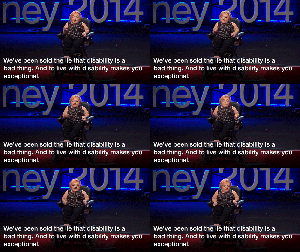
Comedian and journalist Stella Young is tired of people telling her she’s an “inspiration” just for getting up in the morning. In a hilarious, hard-hitting, and thought-provoking talk at TEDxSydney, she explains why.
Some disabilities are more obvious than others. Many are immediately apparent, especially if someone relies on a wheelchair or cane. But others — known as “invisible” disabilities — are not. People who live with them face particular challenges in the workplace and in their communities…
For most of my lifeI had heard the expression, “live in the moment” and thought I understood what it meant. After all,what free spirited thirty something doesn’t think that it means to be spontaneous or do something outlandish and never-mind the outcome or the consequences.
Fast forward a few decades and with a diagnosis of
Alzheimer’s strapped to my wife, I heard people say over and over, “live in the
moment!” To me that now meant, ‘do what you can while you can’. I thought I
understood, but I really didn’t.
Lately as Laura has been slipping so much, I think I am
finally beginning to understand. She
said something really funny the other day, and we both cracked up and were
laughing so hard we were crying. When we both had it down to some chuckling, I
wiped my eyes and said the obvious, “That was really funny.”
“What was?” she sincerely asked, still smiling broadly.
“What you just said” I replied softly. All of the
implications of her short term memory loss hit me like a ton of bricks.
“Oh, what did I say? I don’t remember.”
I wanted to wipe my eyes now for another reason. The moment of laughter that we had shared had
passed, even quicker than it came. Then I understood. Living in the moment is not
about doing anything; it’s about
absorbing those few precious seconds that you can share. Today it is laughter or reliving the flicker
of a memory. I don’t know what it will be tomorrow. It might just be the flash
of recognition when she sees me. I don’t know. But I do know that I will relish
every second of it.
I think the knee-jerk reaction I have (and probably were the article’s author is coming from as well), is because I have seen too many people lately who (under a “neurodiversity” banner) do tend to spout a message of autism being this big fluffy teddy bear that we should all embrace and be happy with. And that parents who are seeking treatments for their child (even in cases where that child desperately needs the assistance/support) are some how bad or even abusive, or that they are trying to “change” their child into someone else.
And I get too that there are actual bad parents/caregivers out there that do such things in a way that is absolutely detrimental to the person they claim to be trying to help. But there didn’t ever seem to be any distinctions made between “actual horrible people” (whose goals are in their own best interest rather than the autistic person’s best interest) and those who are legitimately trying to support that person in the best way possible.
So again, thank you for taking the time to clarify it for me. I really do appreciate it. 🙂
Thank you very much for listening 🙂
If you don’t mind, I would like to provide you with a couple more reading sources that articulate things better than me:
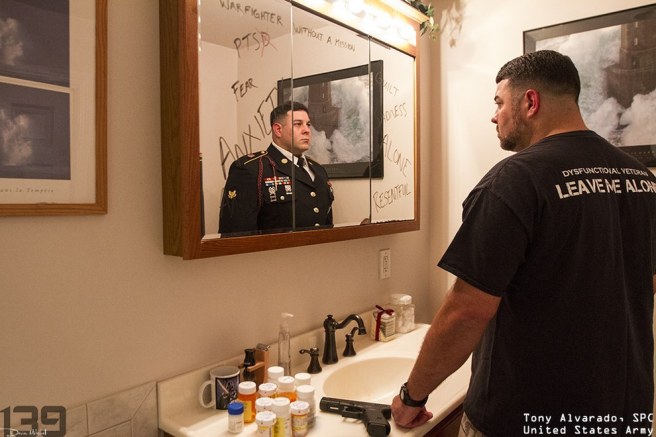
A recent study showed that roughly 22 U.S. veterans commit suicide every day — about one every 65 minutes. Photographer Devin Mitchell shared his five newest photos on the subject of suicide exclusively with BuzzFeed News.
the fact that a person is still alive doesn’t mean they’re fine
the fact that a person still goes to school or job doesn’t mean they’re fine
the fact that a person smiles to you, tells jokes to you, argues with you doesn’t mean they’re fine
when a person is telling you, they are depressed and/or want to die, it doesn’t mean they’re lying or trying to attract your attention
Quite often depressed people aren’t able to express their real emotions right. One day you will lose them and will ask yourself a question, what was wrong and what did you missed.
I’m actually very happy to see this.
I’ve dealt with a lot of erasure outside my immediate physical household; particularly from my In-Laws, who are convinced I’m somehow just making it all up so I don’t have to work, or some other blather like that. The thing is, when you have depression? It’s not just working that’s suddenly a chore; it’s the things that other people take for granted. Getting out of bed, doing your hair, making those phonecalls. Each one is a mountain to be climbed, and how many Everests can even a NORMAL person scale in a day? To say nothing of someone who didn’t have the drive to begin with, just because they literally feel that miserable.
I tell people depression is like if you were Sysiphus pushing the boulder uphill; only the hill is icy and the boulder ain’t exactly a pebble and you’re probably doin’ that shiz in the dark.
This hit almost every feels limb out of the relevancy tree.
It’s not like it’s a big deal though, just casually crying over here. I didn’t know how much I needed to see this.
Just because I lived through that date doesn’t mean I’m fine.
Just because I’m still in college, and still doing rather well grade-wise, doesn’t mean I’m fine.
Just because I can roll out the sarcasm while working during shop hours, just because I’m still going into the E-shop and working, doesn’t mean I’m fine.
Just because I can laugh, smile, and – dare I say it – enjoy a tv show or movie with a friend doesn’t mean I’m fine.
Not all disabilities are visible. That’s why it’s important to keep priority seating clear at all times. For more information on accessibility throughout the Metro system, visit www.wmata.com/accessibility
This is SO GOOD. This is a HUGE reason I don’t feel comfortable on transit.








 Holding the Bowl