stomach-vs-heart:

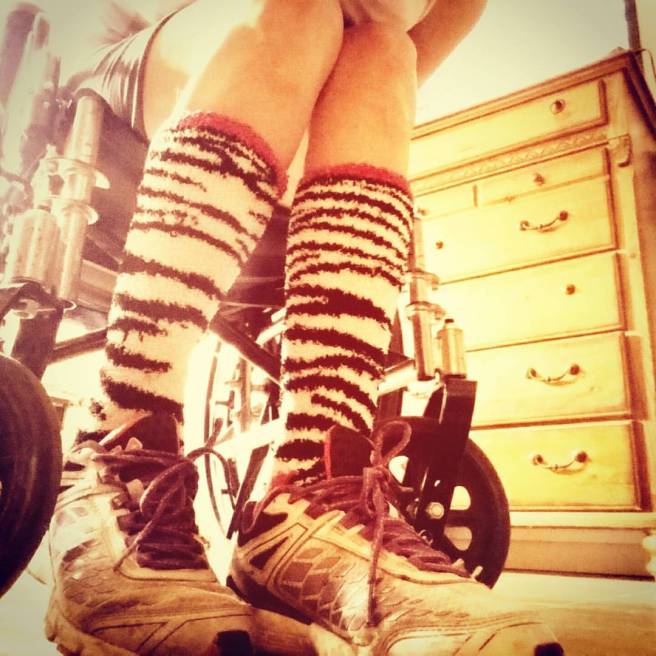
Fuzzy #zebraprint #kneelengthsocks with #pink trim ❤ ❤ ❤

The Ehlers-Danlos Syndromes is often symbolized by zebra stripes. In the early days of modern medical training, the school of thought was if you hear hoof beats, expect horses…not Zebras. Since then, this archaic philosophy harmed many of us living with EDS.

We persevere against great adversity to find a diagnosis holding the answers for lifetimes of pain and dysfunction. Still, we face countless dismissals from less educated practitioners. The Ehlers-Danlos Syndromes, particularly Hypermobility EDS, is intensely more common than once thought. Turns out, the Zebra analogy of the early days of formalized medicine is obsolete!

Even so, my Zebra peeps stake no less in our beloved mascot. The analogy shifts towards the unique characteristics to each, individual Zebra’s stripes. No two Zebra share the same stripe pattern and the same applies to those with any of the Ehlers-Danlos Syndromes. Each of us presents differently, making care management challenging to even the most seasoned practitioner.

Some of us walk, run and work…
Some of us used to…
Some of us will again…
And still, some of us never experience independent functions…

There are too many factors in calculating how different people respond to life with a chronic, progressively disabling conditions but the constant remains: Awareness improves outcomes!

Ten years ago, even with multiple pains, life threatening lab values, and distressing symptoms my doctors could never say what was causing my multisystemic dysfunction. Now, I finally know why but meet with disability because the damage can’t be undone.

This is why I can’t stop talking about EDS! I want others like my former self to know there are answers and hope for better quality of life with diagnosis. It shouldn’t be so hard but the #EDSSociety is taking great strides to ensure the awareness documentation is readily accessible for doctors who want to learn and doctors ignorant to the reality of this complex process. Finally, it’s a start & #ItsOurTime ❤
#EDSawareness #ZebraStrong #vascularehlersdanlossyndrome #pots #chronicillness #wheelchairuser #filas #knobbyknees
Magnum Opus

ofcourseitsmyhead:

Kristen Bell is one of the most recent stars to push past stigma and declare her depression and anxiety worth talking about.

And for that, I am thrilled.

It means that once again, there is another person, who seems so ‘normal,’ finally showcasing that, HELLO THERE, this is a real thing. And it knows no boundaries.

“Here’s the thing: For me, depression is not sadness. It’s not having a bad day and needing a hug. It gave me a complete and utter sense of isolation and loneliness. Its debilitation was all-consuming, and it shut down my mental circuit board. I felt worthless, like I had nothing to offer, like I was a failure. Now, after seeking help, I can see that those thoughts, of course, couldn’t have been more wrong. It’s important for me to be candid about this so people in a similar situation can realize that they are not worthless and that they do have something to offer. We all do.”

As a person who has had mental health issues for quite some time, diagnosed or not, I can basically agree 100% with this. And I wish, I wish, with all my might, that between her efforts and mine, and the efforts of all those other anxious or depressed souls out there, we can finally feel alive.

I want the anxious Plain Janes with no ‘big’ accomplishments to stand up with me, and say ‘I’m still here despite it all.’

I want the hard-working and depressed people to stand up with us, and declare ‘This isn’t shameful.’

I want my bipolar friends who fight internal demons to rally and shout ‘We’re people, too.’

I want my schizophrenic sisters and brothers to get together and yell from the rooftops that ‘We’re MORE than medication.’

Because we are.

We are MORE than this. We are MORE than medication, therapy, and doctor’s visits.

If you know a person in your life with a mental illness (I guarantee you do,) I want you to challenge yourself. Don’t get overwhelmed, but spend some time with them. Get to know their demons, and what they fight with every day. The things that make them struggle. The thoughts they have against their own selves.

I know from personal experience that just going to a counsellor doesn’t cut it. I need time to process my feelings, work through them, and count my victories. Sometimes that means someone points them out for me. Sometimes that means someone has to tell me over a dozen times a day that I am special. That I am okay. That I am loved, wanted, insert-positive-adjective-here. Sometimes that means that I need to just tell someone, anyone, that despite it all, it’s hard to live. I feel lonely. I feel afraid. I feel weak.

I can’t even hold back the tears coming down my face anymore. I’m so scared. But I’m doing this anyway, like I’ve done for the past year or more. (When did I start this, again?)

I am done hiding. I don’t want to hide anymore. If you still need space, though, take it. I’ll be a sounding board for anyone who’s struggling, because I’ve been there. I might not know how your story is going, but I will be a post to lean on if you need me.

We’re in this together, no matter how alone we feel.

hey did you know its almost schizophrenia spectrum awareness week (may 17-23)

toolassistedspeedrun:

(edited 22 oct 2015 to make the post easier to read)

i did my best to pretty this post up and cover everything but feel free to add or edit shit if you think i missed something

the szphrenia spectrum includes

  1. schizophrenia
    where you have some positive symptoms (shit like hallucinations, delusions, disordered thinking) and some negative symptoms (memory loss, lack of expression, lack of emotion, loss of motivation/pleasure and lots others) or catatonia. some szphrenics might have more psychotic symptoms, others more thought disorder symptoms, and still more can be mostly catatonic, but it can be a mix too

    just a quick tangent, catatonia is a kind of behaviour / motor abnormality and it can involve immobility, unresponsiveness, mutism, staying in uncomfortable positions for long periods of time, echolalia or echopraxia (copying movements), repetitive movements, and a lot more

  2. schizophreniform disorder
    pretty much the same except the symptoms onset way faster and havent lasted for more than a month. some people recover and others develop szphrenia from it anyway
  3. schizoaffective disorder
    when you meet criterion a for schizophrenia in the dsm-v, which is to say you have hallucinations or delusions plus negative symptoms, disorganized behaviour or catatonia, and also have mood episodes 
  4. cluster a personality disorders
    -schizoid
    disinclined to socializing and connecting with people. emotions are directed inward but arent really driven to share them intimately with anyone but an exceptional few for some. may have blunted affect or be apathetic

    -schizotypal
    unusual thought and speech, or odd experiences with / perceptions of reality. can have blunted affect. might prefer solitude and be suspicious of people. avoids having close friends and has social anxiety or paranoia. usually assign some greater meaning to coincidences or feel they are magic or psychic in a way (but not caused by “delusions” or a religion)

    -paranoid
    suspicious of other peoples motives. is hypervigilant, holds grudges, or is quick to react to perceived betrayal. usually are doubtful of whether people are really loyal to them and they read hidden meanings into things

some mythbusting and misc shit to know

  1. sch*zo is not a casual adjective, dont use it if youre not szphrenic
  2. be critical of stuff that uses psychosis- and szphrenic-coded tropes for laughs or an evil effect
    (a really common gimmick is someone talking out loud at voices in their head)
  3. we are not obligated to call our experiences hallucinations or delusions, whether or not were “delusional” isnt a reliable hallmark of our mental health
  4. a lot of us have mixed up speech and it can be really hard for us to talk. as long as you can understand us dont point it out and dont make fun of it
  5. (medication cw and doctors cw)
    dont tell us we should be on meds or seeing a doctor. antipsychotics are a fucking huge gray area with whether they actually help or hurt more and most doctors have a very stereotyped understanding of the szphrenia spectrum
    (end cw)
  6. dont force us out of our reality (“you dont actually have magic powers” “youre just anxious”)
  7. some of us get violent impulses and thats ok
  8. some of us are just straight up not into socializing dont try to “get us out of the house”
  9. sometimes we laugh or cry out of nowhere or are really blunt. sometimes we talk out loud to voices or say shit that doesnt make sense or mutter to ourselves or sit in weird positions. sometimes we do stereotypical things and its not weird or creepy

resources and other cool goodies

if you need me to clear anything up or are curious about something re: szphrenia spectrum my inbox is always open

tyvm for reading and please reblog to spread info about a spectrum of mental illnesses that are way too often just dust in the wind

autisticliving:

April is Autism Awareness Month, launched by Autism Speaks, an organization masquerading as a charity that has harmed autistic people and spread misinformation about autism for the last 10 years. Instead of supporting Autism Speaks and their campaigns, take some time out of April 2016 to educate yourself on why you shouldn’t support Autism Speaks and spread the word.

calderonbeta:

Nothing about us without us. 

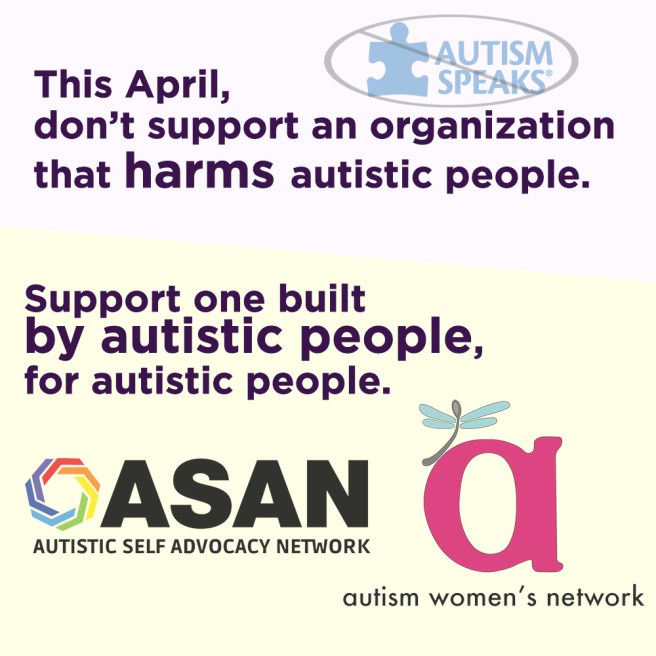
Image description:
[pale purple and yellow background with dark text]
This April, don’t support an organization that harms autistic people.
[crossed out logo for Autism Speaks]
Support one built by autistic people, for autistic people.
[logos for the Autistic Self Advocacy Network and the Autism Women’s Network]

noorannmatties:

Noorann Matties

Mental Illness is isolating in and of itself, but i’ve always felt further detached and embarrassingly “other” in the sense that I seem to experience my illness in far messier, more inconvenient ways than others I know struggling with similar diagnosis. Struggling with mental illness can make you feel disconnected from the general public in the sense that they don’t know what it is to face a large portion of your daily life, but it’s infinitely more disheartening to feel that you can’t relate to other people who are supposed to understand your struggle. My experience is exhausting and inconvenient, it is not a woman wrapped in a sweater staring out her window with a mug of tea in an anti-depressant commercial. My experience is sloppy and cumbersome, it seems too ugly to share with the world and too divergent from the experience of those close to me to share with my friends, so I keep it to myself. It occurs to me that perhaps the reasons I have kept the full extent of my illness so far away from the public eye is the reason I have no representations of illness to relate to, perhaps this is precisely how others around me feel about their struggle. It’s taken me most of adult life to realize that this struggle is not something that I asked for and not something to be ashamed of in the way that I have been. These self-portraits are an attempt to frankly and unashamedly represent the positions that my mental illness puts me in on a daily basis, easy to look at and otherwise.

einzwitterion:

I have ordered wallet size cards that summarize ADA (Americans with Disabilities Act) laws that apply to service animals. There are 50 in a pack, so if anyone wants some, let me know and I will send you a few! I plan to keep one or two with me when out and about so I have the resources to give anyone who is discriminating against service animals.

“The only two permissible questions are whether the animal is required
because of a disability and what work or task the animal has been
trained to perform.
Further, under these same regulations, those
inquiries cannot be made if it is readily apparent that an animal is
trained to do work or perform tasks for an individual with a disability

(for example, it is usually pretty obvious when an individual is using a
seeing-eye dog).” [Source: summary of ADA laws on service dogs from the American Bar Association]

You can’t ask to see paperwork or if the animal is registered as a service animal. There is no government-sanctioned registry of service animals, so a registered service animal is not really something that legally exists. Service animals are not required to be trained by a professional organization, they simply must be trained to perform tasks for their handler (who must have a disability).

Service animals are allowed in any public, governmental, or non-profit space provided they do not pose a threat to health and safety. For example:

  • Service animals are allowed in restaurants, but they may be excluded from restaurant kitchens if the public is also not allowed in the kitchen. Members of the public generally aren’t allowed in commercial kitchens because it poses a food safety risk, likewise service animals are not.
  • Service animals are allowed in the general areas of hospitals, including visiting patients on most wards. They are not allowed in sterile environments, such as operating rooms or burn units–the general public is also not allowed in these spaces.

A service animal that is not in the control of its handler (being aggressive to others, pooping indoors, etc) can legally be asked to be removed from the premises, but its handler must be allowed to stay without the animal and given the same service anyone else would have. The only species of animals that are covered as service animals under the ADA are dogs (any breed) and miniature horses up to 34″ tall and 100 lbs. Emotional support animals (ESAs) have some legal protections, but their right to access public spaces is not as broad as service animals. So you are legally permitted to prevent someone from bringing their emotional support bunny (or, even, dog, if it is an ESA and not a service dog trained to perform at least one task to help its handler with a disability) into your restaurant. ESAs are exempt from no-pet policies in housing and may not be charged pet fees while flying. Proving your animal is an ESA actually requires more paperwork than a service animal (you need a letter from a medical professional stating your need of the animal). 

tl;dr: I will send you ADA service animal law cards if you want them. And don’t fucking pet a working service animal. Don’t even talk to it. It is working and you are being annoying (and possibly endangering its handler.)