
Natania reflects on the challenges of raising two kids – one with autism and the other who is neurotypical – and the daily life struggles and triumphs that come about.
Tag: autism



Meet Cradle.
This rocking chair is named “Cradle” was designed for creating a safe, comfortable, and relaxing space in which the user can dissipate the overstimulation of their senses. The design was heavily directed by a synthesis of research into Autism and children with Rhythmic Movement Disorder (RMD) as well as safety, sustainability, function, and aesthetics. We had a strong focus creating a solution for sufferers of RMD but the chair is not exclusively for them and will bring relaxation, comfort, and calmness to anyone who uses it.

More than one percent of all children born in the United States today have autism. Some people, whom we shall politely refer to as “squealing jackasses” (we have some far more impolite terms ready), blame vaccines for the rise in cases. The real cause of this supposed autism boom is the simple fact that it was first diagnosed in 1943, so we basically only just figured out autism is a thing. We sat down with several high-functioning autistic people and asked them what our readers should know about their condition. Here’s what they said…
It’s April.
That means it’s “Autism Awareness Month,” a month created and sponsored by Autism Speaks.
Please, don’t support this month. Don’t wear a puzzle piece. Don’t “light it up blue.” Autism Speaks is a hate organization. Do not support them in any way.
Perhaps take this as an opportunity to promote Autism Acceptance Month, sponsored by the Autism Self-Advocacy Network. Listen to actual autistic people this month. Spread REAL knowledge about what autism is and how it affects those who have it.
Be a real ally for real people. Because we don’t want blue t shirts. We want acceptance.
On why it is unhealthy for parents to over-share their children’s worst moments on…
My Daughter Is A Gift, But Her Autism Is Not
Thank you for that explanation.
I think the knee-jerk reaction I have (and probably were the article’s author is coming from as well), is because I have seen too many people lately who (under a “neurodiversity” banner) do tend to spout a message of autism being this big fluffy teddy bear that we should all embrace and be happy with. And that parents who are seeking treatments for their child (even in cases where that child desperately needs the assistance/support) are some how bad or even abusive, or that they are trying to “change” their child into someone else.
And I get too that there are actual bad parents/caregivers out there that do such things in a way that is absolutely detrimental to the person they claim to be trying to help. But there didn’t ever seem to be any distinctions made between “actual horrible people” (whose goals are in their own best interest rather than the autistic person’s best interest) and those who are legitimately trying to support that person in the best way possible.
So again, thank you for taking the time to clarify it for me. I really do appreciate it. 🙂
Thank you very much for listening 🙂
If you don’t mind, I would like to provide you with a couple more reading sources that articulate things better than me:
Thank you. Will definitely take a look at them. 🙂





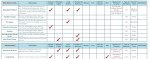

Disneyland and Walt Disney World now have guidebooks for guests with cognitive disabilities (such as autism). They include the above charts of what to expect at each attraction (strong smells, loud noises, restraint types used, duration, and more), lists of quiet areas for when you need down time, and answers to frequently asked questions, among other tips.
They are available to download in PDF format: Disneyland | Walt Disney World
If you don’t want to download a PDF (or prefer to click the download link on Disney’s site directly), here are their pages for Services for Guests with Cognitive Disabilities: Disneyland | Walt Disney World
This is awesome.
Lovely idea!
Executive Dysfunction
So this was originally a comment on a post about depression and so forth, but it actually occurred to me that it might be more helpful in a tag somewhere where someone might see it, rather than buried in 68k notes. So here’s the thing: I’m not great at explaining what executive functioning problems ARE, but I tried to explain what they feel like.
Looking at a dirty litterbox and a sink full of dishes and going “fuck this noise” and going back on tumblr feels a lot like laziness, even if you are feeling kind of like crying just looking at them. But it can also be your brain being currently incapable of putting together the steps you need to take in order to DO those things, you can’t quite put together that cleaning the litterbox is:
- Get a trash bag
- Get the litter scoop
- Get clean litter
- Open trash bag
- Move litterbox to accessible position
- Crouch down by the litterbox
- Scoop out poop and clumps
- Tie off trash bag
- Add some clean litter to box
- Put litterbox back in its original position
- Put litter scoop away
- Put clean litter away
- Throw away trash bag
When you’re having executive functioning issues, you look at the dirty litterbox and even if you don’t realize it, you can’t work out those steps, you just see the dirty litterbox and know that it needs to be clean and all those steps are mushing together into one big ball of overwhelming stress and you can’t quite figure out where to start, and it takes a LOT of mental and emotional momentum to start, and when you’re depressed or overwhelmed or whatever it can be next to impossible to GET that mental and emotional momentum.
This isn’t the best explanation of executive dysfunction, probably, but it’s the best I’ve got, and it can be awful, and it can make you feel like a lazy useless person when you’re nothing of the sort, and it’s so insidious, because when you’re NOT having these issues it’s the easiest thing in the world to subconsciously put all those steps together and get from “dirty litterbox” to “clean litterbox” without any conscious thought.
This can happen when you’re depressed, if you have ADHD or autism, if you have anxiety… there are a lot of reasons you might run into problems with your executive functioning. It can be simple things like cleaning the litterbox, it can be things you do (or try to do) regularly like your math homework, it can be something like going to the gym or cooking dinner or getting out of bed in the morning.
But the most important thing to take away from this is that there is a huge difference between “I could do this but I really don’t want to” and “I cannot do this”, and when you learn to recognize the difference, you can begin to stop calling yourself “lazy” and “useless” and “worthless” during those times when you CAN’T do this even if you want to.
Yeah, autistic people, people with depression, or ADHD, or anxiety… we can all be lazy sometimes. And that’s okay, it’s normal to be lazy sometimes. And we can still have issues with laziness. But the difference is real, and important, and I feel like not enough people outside of the autistic and maybe ADHD communities realize that this is something that they might be struggling with.
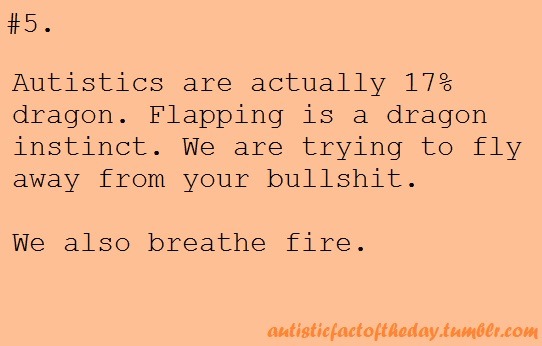
[#5. Autistics are actually 17% dragon. Flapping is a dragon instinct. We are trying to fly away from your bullshit.
We also breathe fire.]
 Holding the Bowl