1. Autism is a fundamental part of who we are and how we experience the world and it cannot be separated from who we are as people. Autism is not something which is clearly separated from our identities and our personalities – it’s something which affects every aspect of how we think about, experience and interact with the world around us. Autism isn’t something we have or something we’re suffering from, it’s something we are. For the vast majority of autistic people, autism is a part of our identity which means that despite common belief most of us prefer to be called “autistic” as opposed to “people with autism.”
Do not tell us that we only have value if we can separate our identities and our personalities from autism.
2. The vast majority of autistic people do not want a cure, we want acceptance and accommodations. Do not put your time and money into researching how to cure autism and how to prevent it, put time and money into accommodating and accepting autistic people. We do not wish to become neurotypical, we wish to change society so that we can be accommodated, accepted and included as autistic people. Our goal isn’t to become as close to neurotypical as possible, it is to get the opportunity to live happy, fulfilling lives as autistic people. It is society that needs to chance, not us.
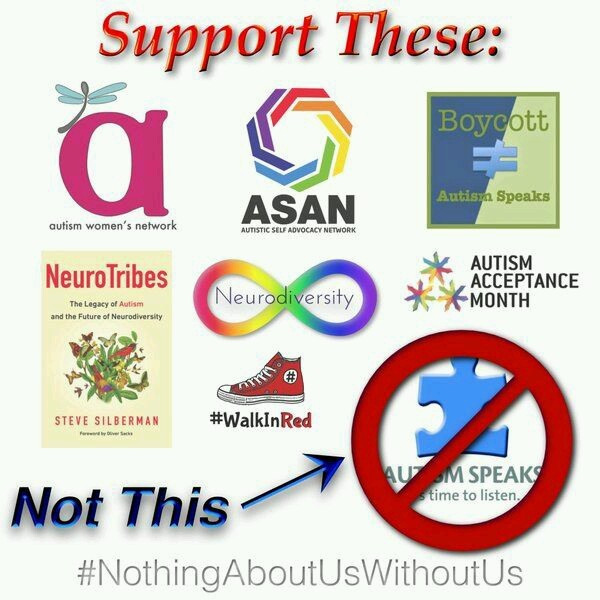
3. We do not support Autism Speaks or their campaign #LightItUpBlueand neither should you. If you want to support autistic people, check out ASAN or Autism Women’s Network instead. If you don’t know why autistic people don’t support Autism Speaks, check out the many resources linked in this post.
4. Functioning labels are at best inaccurate and at worst actively harmful.
Functioning labels (claiming that some autistic people are “high-functioning” while others are “low-functioning”) do more harm than good, not just because they aren’t able to give you an accurate impression of what supports an individual autistic person needs but because they’re mainly used to either silence or invalidate autistic people. Autistic people who speak up about the issues concerning them are labelled “high-functioning” to invalidate what they have to say as being inaccurate and irrelevant for other autistic people and so-called “low-functioning” autistic people are being silenced and spoken over because they are written off as too ‘low-functioning’ to have nuanced, relevant opinions or even communicate at all. Instead of forcing autistic people into one of two boxes, name the specific issues or strengths that you are referring to when you’re calling them low-functioning or high-functioning. Are they non-verbal? Say that instead of calling them low-functioning. Are they able to manage a job? Say that instead of calling them high-functioning.
5. Non-verbal autistic people can and do learn to communicate using other communication forms than verbal speech and they’re all individuals with their own thoughts, feelings, wants and opinions. You do not get to speak on behalf of non-verbal autistic people. You do not get to assume that you know exactly what they think, want and feel, especially not when you have never made any effort to communicate with any of them. Instead of assuming that you know what non-verbal autistic people think and feel, try listening to what they have to say by reading the words of some non-verbal autistic people such as @lysikanorAmy SequenziaorEmma Zurcher-Long.
6. Applied Behavior Analysis, the most widespread and well-known therapy for autistic children, does more harm than good. The goal of ABA therapy is to train and force autistic people into hiding their autistic traits by all means possible as if passing for neurotypical should be the goal of all autistic people regardless of what consequences it might have for their general well-being and their mental health. If you don’t see why that is a problem, check out this masterpost by @neurowonderful.
7. People diagnosed with Aspergers Syndrome are just as autistic as people diagnosed with other variants of Autism Spectrum Disorder.
Aspergers is autism and to emphasize this, aspergers and other variants of autism have been united under a broader diagnosis called “autism spectrum disorder” in the DSM-5, Back when aspergers was a separate diagnosis, the only difference between whether you got diagnosed with aspergers or autism was whether you spoke before you were three years old – something which says approximately nothing about your struggles and abilities later in life. The common misconception that aspergers and autism is two different things is just that – a misconception.
8. If you want to learn more about autism, listen to autistic people – not our parents, our siblings, our therapists our or caregivers.Autistic people are the ones who know the most about being autistic, so if you want to learn about autism we’re the ones you should ask. If you want to learn more about the different aspects of autism, @neurowonderful‘s youtube series “Ask An Autistic” is a good place to start. Here is an index over all the episodes so that you can easily find the topic you want to learn about.
You can also visit @askanautisticwhere autistic people are ready to answer whatever questions you may have about autism.
Please reblog this post. It’s time tumblr starts listening to autistic people.
I’m asking you to reblog this because I want this to go vital. I don’t just want this to be passed around inside tumblrs autistic community where we already know about and agree with all of the above statements. I want this to end up on the dashes of people who don’t know anything about autism, who haven’t thought twice about autism and autistic people during their time on tumblr – and that can only happen if you help me out.
Fact: Autistic, developmentally disabled and intellectually disabled adults can be childLIKE, but they are not children. They can have childlike qualities and like things usually associated with children, but they are still ADULTS.
Children with autism
may benefit from fecal transplants – a method of introducing donated
healthy microbes into people with gastrointestinal disease to rebalance
the gut, a new study has found.
Behavioral symptoms of autism and gastrointestinal distress often go
hand-in-hand, and both improved when a small group of children with the
disorder underwent fecal transplant and subsequent treatment.
In the study of 18 children with autism and moderate to severe
gastrointestinal problems, parents and doctors said they saw positive
changes that lasted at least eight weeks after the treatment. Children
without autism were included for comparison of bacterial and viral gut
composition prior to the study.
“Transplants are working for people with other gastrointestinal
problems. And, with autism, gastrointestinal symptoms are often severe,
so we thought this could be potentially valuable,” said Ann Gregory, one
of the study’s lead authors and a microbiology graduate student at The
Ohio State University.
“Following treatment, we found a positive change in GI symptoms and neurological symptoms overall,” she said.
The study, which appears in the journal Microbiome, was
conducted while Gregory and her adviser and co-author, Matthew Sullivan,
were at the University of Arizona. Other lead researchers on the
project are from Arizona State University and Northern Arizona
University.
The study will appear in Microbiome during the week of January 23, 2017.
The reason “problem” behaviors lessened or stopped is the autistic people weren’t experiencing tummy discomfort. A gassy, upset or crampy stomach can make it hard to tolerate other stimuli.
Imagine having a fan in your room that’s really loud and grating, but you have to deal with it because you can’t afford a new one. You have to blast your TV to hear it, you plug your free ear while talking on the phone and it’s hard to get the little nuances of music with the constant buzzing or droning noises in the background.
Then one day your friend comes over and takes the fan apart, cleans all the moving parts, oils them up and puts it back together. No more grating noise, it’s just a quiet hum again.
You can listen to your TV at a comfortable volume again. You can relax while on the phone. You can study all the little nuances in the music you listen to. No more distracting “background process” is vying for your attention.
That’s what resolving gut problems does for autistic people.
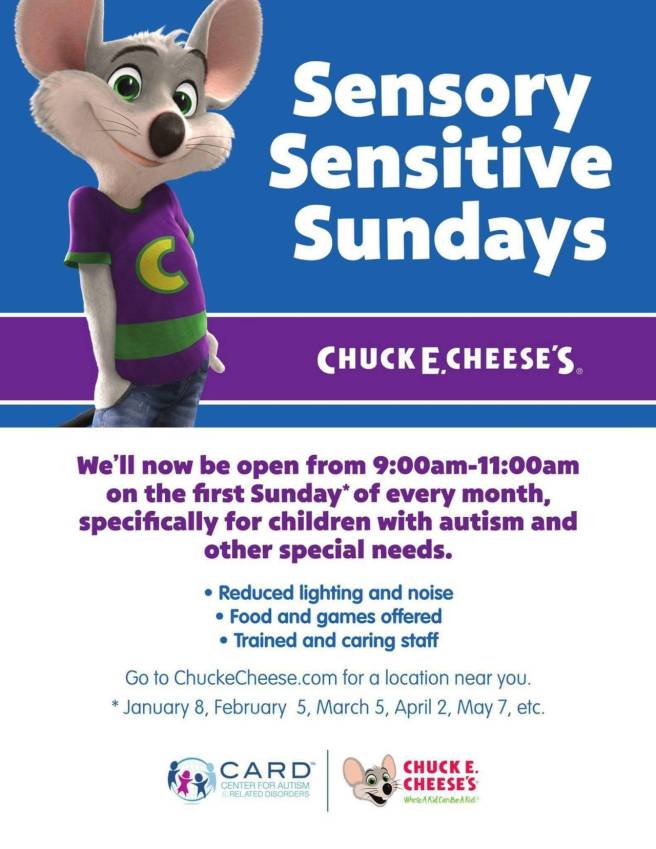
Looks like it’s only a couple of specific locations for now. Hopefully it’s something that will be offered on a much larger scale in the future. Still cool to see though.
Some better alternatives than Autism Speaks. If you really want to help autistics look into an organization that actually helps autistics. In fact, even doing absolutely nothing would be preferable to supporting Autism Speaks.
hello! I don’t know if anyone has already made a post about this before, but I just stumbled upon this app made specifically for when you’ve gone into a nonverbal anxiety attack!!!
it was made by Jeroen De Busser who is an autistic computer science student.
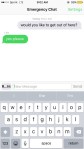
the app is really easy to use! all you do is open it and hand your phone to someone you need to communicate with during an attack but physically cannot, and it shows this cool little alert for the person to read, and then it takes them to an easy to use chat (that looks a lot like texting! except both of you are communicating using the same device).
the alert message is completely customizable and you can have it say whatever you need!
the app is called Emergency Chat and it’s available in the Apple Store and google play store.
I highly recommend it to anyone who might need it 🙂
OH MY GOD?!?!?? BOOST
That’s so bootiful!
thank you so much for this because i never know what to do when i cant talk to people and they just start trying to ask me questions and its really hard to force myself to say i cant talk and stuff. im definately getting this right now
My ‘rents and I went to Supercuts because my bangs (fringe?) needed a trim, mom needed a haircut and my dad needed haircut and a beard trim.
I’m at the back half of my sensory-hell-everything-hurts phase due to Aunt Flo’s visit, but my choice was go today or wait another month and my bangs were literally poking me in the eyes. So I went. I had my black Tangle and my No Gloom ‘Shroom. I took earplugs in a baggie too, just in case.
We get into Supercuts and it’s loud. Hair dryers, clippers, an angry yelling kid getting his first haircut(he gets a pass tho, poor kid!) while another kid– a little black girl who was probably 10 or so– played with the wooden blocks in the toybox with her parents nearby. Yeah, Supercuts has stuff to entertain kids.
I sat off to the side by the toybox and did my head-ducked-temple-tapping routine that I do when I’m overloaded. It wasn’t enough to send me into a meltdown, but I had to really focus. I put my No Gloom ‘Shroom in my mouth and twiddled my Tangle as I angled my head to watch the kid playing with the blocks. She was cute! I don’t know what the hairstyle is called, but she had her hair done up in lots of braids that stuck out every which-way with cute ponytail holders on the ends, and the parts in her hair looked like patchwork on her scalp. (I love seeing little black girls with that hairstyle, it’s adorbs!) I also noticed she was sucking on a pink pacifier.
I put my head down again. About five seconds later the little girl came over and handed me one of the green triangle-shaped blocks. They were wood with grain on one edge, but finished smooth to prevent splinters. She jiggled the block up and down and I immediately pocketed my Tangle and rubbed my finger on the grain. Her face kept the same curious expression, but she jumped up and down like I answered a question correctly.
This kid picked up on my distress and comforted me with something that made her feel good.
Her parents didn’t interject. They probably figured out I was autistic too by the way I acted when I sat down. I glimpsed them smiling a bit in my peripheral vision as I showed the girl how cool it felt to rub the grain-side of two triangle blocks together.
I didn’t say a word to her, I just got down on the floor beside her and lined up blocks with her. Sometimes I took the round peg shaped ones and rolled them back and forth between my hands like a kitten batting a ball around. She picked up the rectangle block and dropped it repeatedly on the little play mat like she was experimenting with all the ways she could make it land. It felt so natural, like we carried on a sensory conversation that included only us.
We didn’t look at each other at all, except to watch our hands and the blocks. We played with those blocks until it was my turn to get my bangs trimmed.
The place got quieter when the future death metal scream kid was finished having his first haircut. NOW I could really relax all the way, just in time to put up with the unpleasantness of a bang trim. I was a lot calmer and I attribute the biggest part of that to the girl inviting me to talk to her. I gave back the block the girl gave me and jiggled her hand like she jiggled mine. It was how she said hello, so I thought I would use it to say goodbye. She slapped the floor as I got up and resumed playing like she was before.
I heard her parents praise her when I walked off to my bangs trimmed. Her parents were complimenting her for communicating with me her way instead of trying to force non-autistic interaction. They respected her behavior as meaningful rather than dismissing it as “meaningless repetitive movements”.
Stimming is shorthand for self-stimulatory behavior. Stimming is often repetitive movements that seem purposeless on the outside, but it’s actually serving a very important purpose: regulating our nervous systems! 😀
I stim to create sensation when I feel understimulated, I stim to shut out other stimuli if I’m overstimulated, I stim to help me focus on something, I stim to express myself and sometimes I stim just for the heck of it. Sometimes I start stimming without realizing it and become conscious of myself doing it(semi-voluntary) and sometimes I choose to start doing it(voluntary).
Like right now, I just now realized I’m bouncing my leg like a jackhammer. I don’t remember starting to do it. Then I rocked backwards and forwards twice while waving my arms in the air– I chose to do that.
You might be stimming a lot and not realize it. Any action that’s repetitive can be a stim. Leg jiggling, twirling a pen, tapping your fingers, chewing the erasers off your pencils, looking at things that sparkle or are colorful, rubbing velvet or stucco, sniffing bottles of lotion, sucking on lemon slices, making random noises, listening to music or repeating the same song over and over are all forms of stimming. The list is honestly endless.
This is happy stimming mixed in with sensory seeking stimming. Trust me, you will see the happy stims because the rhythm and “size” of my happy stim movements are different than sensory seeking stim movements:
And here’s a video of visual stimming from my perspective. I like sparkly things and how moving them can make points of light appear to flow like water. Sometimes I look at it with my eyes unfocused and my imagination goes wild.
(* * * Warning: Video may induce sensory overload if you have issues with sparkle, flicker or shifting light patterns.* * *)
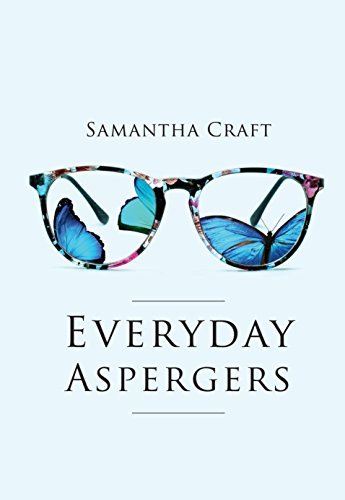
Through 150 telling journal entries, Samantha Craft presents a life of humorous faux pas, profound insights, and the everyday adventures of a female with Asperger’s Syndrome.

 Holding the Bowl