
1. Stop calling yourself an Autism Mom and making it all about you.
2. Meltdowns suck, but they’re harder on her than you. Work with her to figure out her triggers and don’t dismiss them.
3. Some types of behavioral therapy which focus on emotional regulation can be beneficial but anything that rigidly demands forced eye contact, forbids stimming, or aims to make her act “less autistic” is abusive.
4. Autism Speaks is garbage.
5. Vaccines don’t cause autism.
6. Focusing on causes and cures is both ableist and pointless.
7. Listen to and respect your kid as a valid human being.
8. Make whatever accommodations she needs to function optimally without making a big deal about it.
9. Be prepared to fight if school is unwilling to make accommodations.
10. Know your kid’s educational rights as a disabled person and make damn sure her school honors them
11. Don’t just rely on teachers and therapists to understand autism. Talk to actually autistic adults to gain a better sense of what to expect for your child’s future. Don’t know any? Follow blogs with the tag #actually autistic. And encourage your kid to do the same, especially as she gets older.
12. Your kid is capable of a lot more than you may think and she’s growing up. Stop infantilizing her and let her make mistakes.Any and all constructive feedback from the #actuallyautistic community is welcome. I’m trying to continue to grow as a supportive parent.
Tag: autism
Target Unveils Clothing For Kids With Special Needs
Here’s a story about changelings:
Mary was a beautiful baby, sweet and affectionate, but by the time she’s three she’s turned difficult and strange, with fey moods and a stubborn mouth that screams and bites but never says mama. But her mother’s well-used to hard work with little thanks, and when the village gossips wag their tongues she just shrugs, and pulls her difficult child away from their precious, perfect blossoms, before the bites draw blood. Mary’s mother doesn’t drown her in a bucket of saltwater, and she doesn’t take up the silver knife the wife of the village priest leaves out for her one Sunday brunch.
She gives her daughter yarn, instead, and instead of a rowan stake through her inhuman heart she gives her a child’s first loom, oak and ash. She lets her vicious, uncooperative fairy daughter entertain herself with games of her own devising, in as much peace and comfort as either of them can manage.
Mary grows up strangely, as a strange child would, learning everything in all the wrong order, and biting a great deal more than she should. But she also learns to weave, and takes to it with a grand passion. Soon enough she knows more than her mother–which isn’t all that much–and is striking out into unknown territory, turning out odd new knots and weaves, patterns as complex as spiderwebs and spellrings.
“Aren’t you clever,” her mother says, of her work, and leaves her to her wool and flax and whatnot. Mary’s not biting anymore, and she smiles more than she frowns, and that’s about as much, her mother figures, as anyone should hope for from their child.
Mary still cries sometimes, when the other girls reject her for her strange graces, her odd slow way of talking, her restless reaching fluttering hands that have learned to spin but never to settle. The other girls call her freak, witchblood, hobgoblin.
“I don’t remember girls being quite so stupid when I was that age,” her mother says, brushing Mary’s hair smooth and steady like they’ve both learned to enjoy, smooth as a skein of silk. “Time was, you knew not to insult anyone you might need to flatter later. ‘Specially when you don’t know if they’re going to grow wings or horns or whatnot. Serve ‘em all right if you ever figure out curses.”
“I want to go back,” Mary says. “I want to go home, to where I came from, where there’s people like me. If I’m a fairy’s child I should be in fairyland, and no one would call me a freak.”
“Aye, well, I’d miss you though,” her mother says. “And I expect there’s stupid folk everywhere, even in fairyland. Cruel folk, too. You just have to make the best of things where you are, being my child instead.”
Mary learns to read well enough, in between the weaving, especially when her mother tracks down the traveling booktraders and comes home with slim, precious manuals on dyes and stains and mordants, on pigments and patterns, diagrams too arcane for her own eyes but which make her daughter’s eyes shine.
“We need an herb garden,” her daughter says, hands busy, flipping from page to page, pulling on her hair, twisting in her skirt, itching for a project. “Yarrow, and madder, and woad and weld…”
“Well, start digging,” her mother says. “Won’t do you a harm to get out of the house now’n then.”
Mary doesn’t like dirt but she’s learned determination well enough from her mother. She digs and digs, and plants what she’s given, and the first year doesn’t turn out so well but the second’s better, and by the third a cauldron’s always simmering something over the fire, and Mary’s taking in orders from girls five years older or more, turning out vivid bolts and spools and skeins of red and gold and blue, restless fingers dancing like they’ve summoned down the rainbow. Her mother figures she probably has.
“Just as well you never got the hang of curses,” she says, admiring her bright new skirts. “I like this sort of trick a lot better.”
Mary smiles, rocking back and forth on her heels, fingers already fluttering to find the next project.
She finally grows up tall and fair, if a bit stooped and squinty, and time and age seem to calm her unhappy mouth about as well as it does for human children. Word gets around she never lies or breaks a bargain, and if the first seems odd for a fairy’s child then the second one seems fit enough. The undyed stacks of taken orders grow taller, the dyed lots of filled orders grow brighter, the loom in the corner for Mary’s own creations grows stranger and more complex. Mary’s hands callus just like her mother’s, become as strong and tough and smooth as the oak and ash of her needles and frames, though they never fall still.
“Do you ever wonder what your real daughter would be like?” the priest’s wife asks, once.
Mary’s mother snorts. “She wouldn’t be worth a damn at weaving,” she says. “Lord knows I never was. No, I’ll keep what I’ve been given and thank the givers kindly. It was a fair enough trade for me. Good day, ma’am.”
Mary brings her mother sweet chamomile tea, that night, and a warm shawl in all the colors of a garden, and a hairbrush. In the morning, the priest’s son comes round, with payment for his mother’s pretty new dress and a shy smile just for Mary. He thinks her hair is nice, and her hands are even nicer, vibrant in their strength and skill and endless motion.
They all live happily ever after.
*
Here’s another story:
Meet the Man Who Makes Broadway Autism-Friendly | Playbill
15 People on the Autism Spectrum Describe What a Meltdown Feels Like
PSA to our followers this Autism Acceptance Month:
- Use Autism **Acceptance** Month (as opposed to Autism Awareness Month).
- NO “light it up blue” or puzzle pieces. Google “Autism Speaks hate group” to learn more.
- Use red or gold instead, which are colors supported by the autistic community.
- Use identity-first language (most autistic people prefer “autistic” instead of “person with autism”), but don’t police the language of someone who prefers to be called a person with autism.
- NO scare terms like “suffering with autism” or “afflicted with autism.”
- Avoid functioning labels like “high functioning” or “low functioning.”
- If autistic voices are not at the center of your efforts, you’re doing it wrong.
- When in doubt, ASK AN AUTISTIC PERSON.
- To learn more about autism, visit autistic-run organizations like the Autistic Self Advocacy Network (ASAN) and Autism Women’s Network (AWN).








✨ happy autism acceptance month! ✨
here are my favorite autistic characters, both canon and headcanon! allistics are welcome to reblog + link to list of characters used here + link to roseytones’s post + link to some further reading
2017 Camp Registration: Return of the Lottery
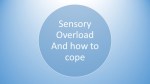
[Image Descriptions:
All slides have a light blue background, and the text is written in blue rectangles with rounded corners.
Slide 1: The title is in white text inside a dark blue circle that is centred in the slide.
Sensory Overload And how to cope
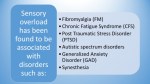
Slide 2: The header is in a dark blue rectangle and white text, and the body is in a pale blue rectangle and black text.
Sensory overload has been found to be associated with disorders such as:
- Fibromyalgia (FM)
- Chronic Fatigue Syndrome (CFS)
- Post Traumatic Stress Disorder (PTSD)
- Autistic spectrum disorders
- Generalized Anxiety Disorder (GAD)
- Synesthesia
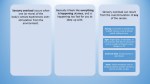
Slide 3: The text is in three pale blue rectangles that
go horizontally across the slide. All use black text. The last
rectangle has four smaller dark blue rectangles with white text inside
it for the four points. The text is centred in all of the rectangles.Sensory overload occurs when one (or more) of the body’s senses experiences over-stimulation from the environment.
Basically it feels like everything is happening at once, and is happening too fast for you to keep up with.
Sensory overload can result from the overstimulation of any of the senses.
Hearing: Loud noise or sound from multiple sources, such as several people talking at once.
Sight: Bright lights, strobe lights, or environments with lots of movement such as crowds or frequent scene changes on TV.
Smell and Taste: Strong aromas or spicy foods.
Touch: Tactile sensations such as being touched by another person or the feel of cloth on skin.
Slide 4: A heading in two light blue rectangles with black
text, followed by a table with a dark blue first row that has white
text, and then alternating pale blue and white rows with black text.
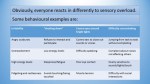
(The table is not really a table, it is just a four-column list.)Obviously, everyone reacts in differently to sensory overload.
Some behavioural examples are:
Irritability — “Shutting down” — Covers eyes around bright lights — Difficulty concentrating
Angry
outbursts — Refuses to interact and participate — Covers ears to close
out sounds or voices — Jumping from task to task without completing
Overexcitement — Low energy levels — Difficulty speaking — Compains about noises not effecting others
High energy levels — Sleepiness/fatigue — poor eye contact — Overly sensitive to sounds/lights/touch
Fidgeting and restlessness — Avoids touching/being touched — Muscle tension — Difficulty with social interactionsSlide 5: The header is in a dark blue box with pointy
corners and white text. The body is in a pale blue box with pointy
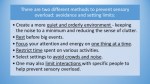
corners and black text.There are two different methods to prevent sensory overload: avoidance and setting limits:
- Create a more quiet and orderly environment – keeping the noise to a minimum and reducing the sense of clutter.
- Rest before big events.
- Focus your attention and energy on one thing at a time.
- Restrict time spent on various activities.
- Select settings to avoid crowds and noise.
- One may also limit interactions with specific people to help prevent sensory overload.
Slide 6: This looks the same as the last slide except the text in the header is black.
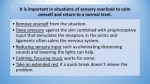
It is important in situations of sensory overload to calm oneself and return to a normal level.
- Remove yourself from the situation.
- Deep pressure against the skin combined with proprioceptive input
that stimulates the receptors in the joints and ligaments often calms
the nervous system.- Reducing sensory input such as eliminating distressing sounds and lowering the lights can help.
- Calming, focusing music works for some.
- Take an extended rest if a quick break doesn’t relieve the problem.
Slide 7: Four light blue rectangles with rounded corners, stacked one above the other, with black text.
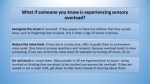
What if someone you know is experiencing sensory overload?
Recognize the onset of overload. If they appear to
have lost abilities that they usually have, such as forgetting how to
speak, this is often a sign of severe overload.Reduce the noise level. If they are in a noisy area,
offer to guide them somewhere more quiet. Give time to process
questions and respond, because overload tends to slow processing. If you
can control the noise level, for example by turning off music, do so.Do not touch or crowd them. Many people in SO are
hypersensitive to touch – being touched or thinking they are about to be
touched can worsen the overload. If they are seated or are a small
child, get down to their level instead of looming above them.Slide 8: Similar to previous slide, only with three rectangles instead of four.
Don’t talk more than necessary. Ask if you need to
in order to help, but don’t try to say something reassuring or get them
talking about something else. Speech is sensory input, and can worsen
overload.If they have a jacket, they may want to put it on and put the hood up. This
helps to reduce stimulation, and many people find the weight of a
jacket comforting. If their jacket is not within reach, ask them if they
want you to bring it. A heavy blanket can also help in a similar way.Don’t react to aggression. Don’t take it personally.
It is rare for someone who is overloaded to cause serious harm, because
they don’t want to hurt you, just get out of the situation. Aggression
often occurs because you tried to touched/restrained/blocked their
escape.Slide 9: Similar to previous slide, only with two rectangles instead of three.
When they have calmed down, be aware that they will often be tired and more susceptible to overload for quite awhile afterwards. It
can take hours or days to fully recover from an episode of sensory
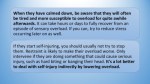
overload. If you can, try to reduce stress occurring later on as well.If they start self-injuring, you should usually not try to stop them.
Restraint is likely to make their overload worse. Only intervene if
they are doing something that could cause serious injury, such as hard
biting or banging their head. It’s a lot better to deal with self-injury indirectly by lowering overload.Slide 10: The header is in a dark blue rectangle with white
text, and the other text is in a row of five dark blue circles with
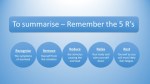
white text. The text is centred in all shapes.To summarise – Remember the 5 R’s
Recognise
The symptoms of overloadRemove
Yourself from the situationReduce
the stimulus causing the overloadRelax
Your body and calm yourself downRest
Yourself as you will most likely feel fatigue.]
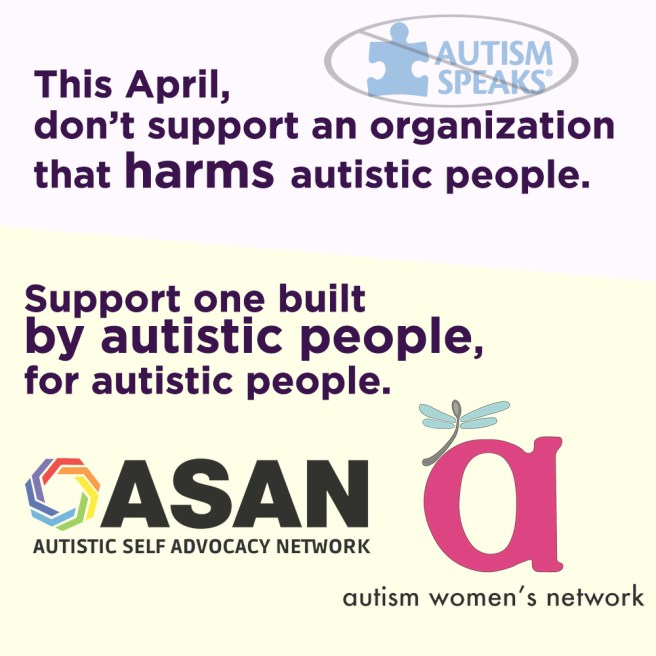
Image description:
[pale purple and yellow background with dark text]
This April, don’t support an organization that harms autistic people.
[crossed out logo for Autism Speaks]
Support one built by autistic people, for autistic people.
[logos for the Autistic Self Advocacy Network and the Autism Women’s Network]Reblogging to spread the word, cause evidence shows that Autism $peaks are classic horror movie villains.
Reblogging because I’ve always wondered who to support instead of AS.
To every friend of mine who reblogs this, thank you. It means I can trust you. ❤
 Holding the Bowl