I work in a public library and there are times a book comes through circulation that is so awesome I can’t believe I hadn’t seen it before.
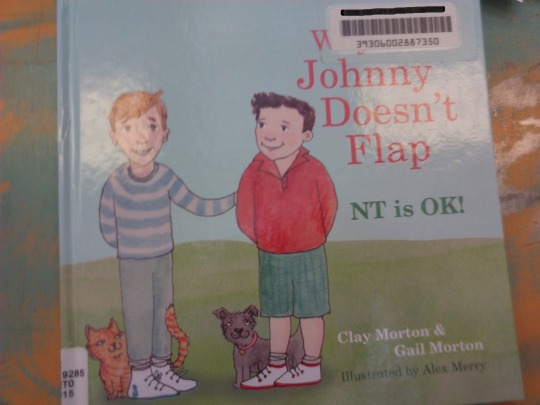
Last week I came across this lovely children’s picture book called Why Johnny Doesn’t Flap: NT is OK! by Clay Morton, Gail Morton, and illustrated by Alex Merry. (Pardon the library barcode covering part of the title here.)
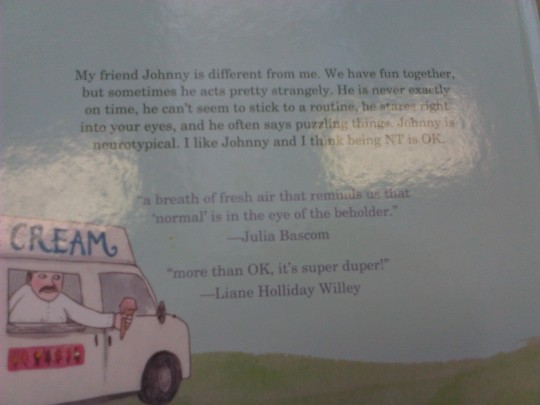
[Pictures of the front and back covers of the picture book. The back cover summary says: “My friend Johnny is different from me. We have fun together, but sometimes he acts pretty strangely. He is never exactly on time, he can;t seem to strict to a routine, he stares right into your eyes, and he often says puzzling things. Johnny is neurotypical. I like Johnny and I think being NT is OK.”]
The fact that I was seeing the term “NT” on the cover of a children’s book was enough to pique my interest. Upon further inspection, I discovered that the book is really quite lovely!
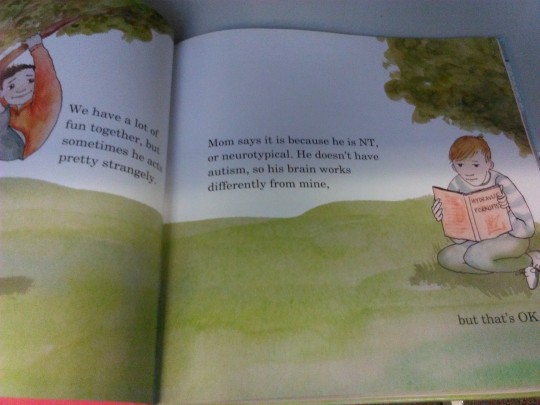
[Two page spread reads: “We have a lot of fun together, but sometimes he acts pretty strangely. Mom says it is because he is NT, or neurotypical. He doesn’t have autism, so his brain works differently from mine, but that’s OK.”]
It flips the typical “little Timmy has a special friend” narrative on its head. Instead, the narrator is an autistic boy who has an NT friend who he sometimes struggles to understand.
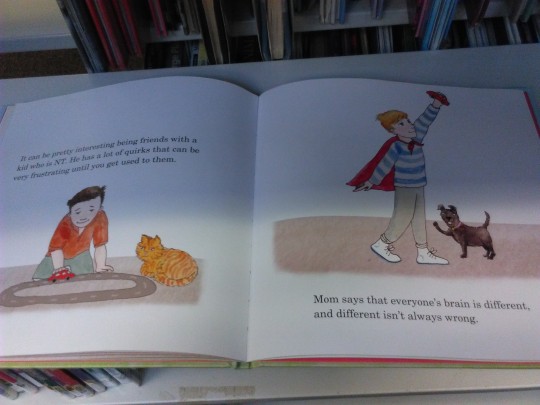
[Two page spread reads: It can be pretty interesting being friends with a kid who is NT. He has a lot of quirks that can be very frustrating until you get used to them. Mom says that everyone’s brain is different and different isn’t always wrong.”]
The book uses simple terms to describe a perspective not usually seen in any literature, let alone lit intended for children.
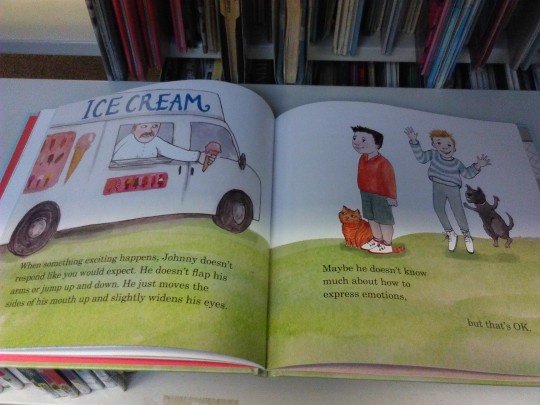
[Two page spread reads: “When something exciting happens, Johnny doesn’t respond like you would expect. He doesn’t flap his arms or jump up and down. He just moves the sides of his mouth up and slightly widens his eyes. Maybe he doesn’t know much about how to express emotions.”]
I think ultimately this flipping of the narrative is more effective in getting the message across that kids with autism are just like everyone else but with unique needs.
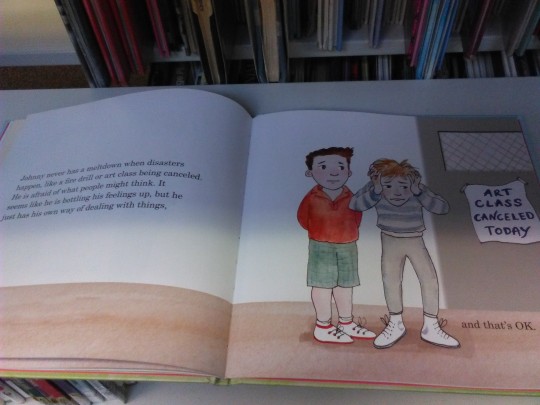
[Two page spread reads: “Johnny never has a meltdown when disasters happen, like a fire drill or art class being canceled. He is afraid of what people might think. It seems like he is bottling his feelings up, but he just has his own way of dealing with things, and that’s OK.”]
And this book is something autistic kids don’t usually have– it’s a book from their perspective! And it’s a non-offensive, matter-of-fact perspective, which is all the rarer.
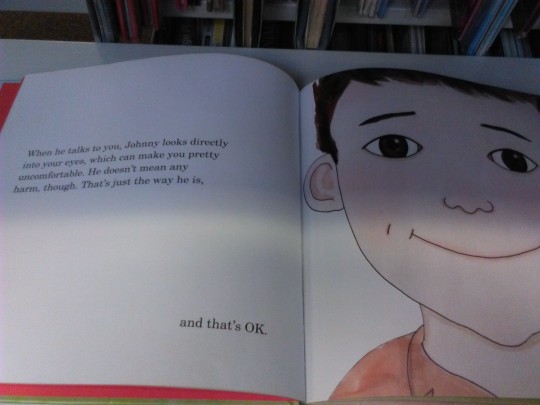
[Two pages spread reads: “When he talks to you, Johnny looks directly into your eyes, which can make you pretty uncomfortable. He doesn’t mean any harm, though. That’s just the way he is, and that’s OK.”]
It talks about things that autistic people experience and can relate to.
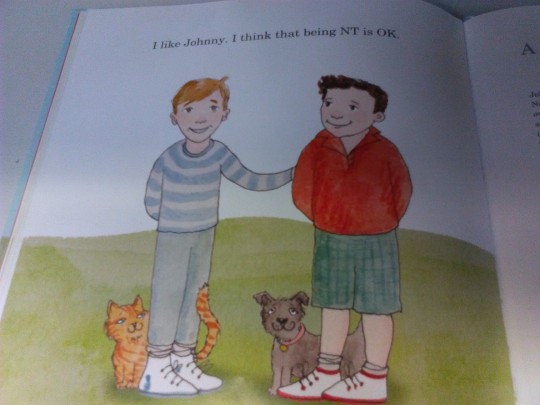
[Page reads: “I like Johnny. I think that being NT is OK.”]
How awesome is that?
OK this is kind of adorable and I kind of want it.
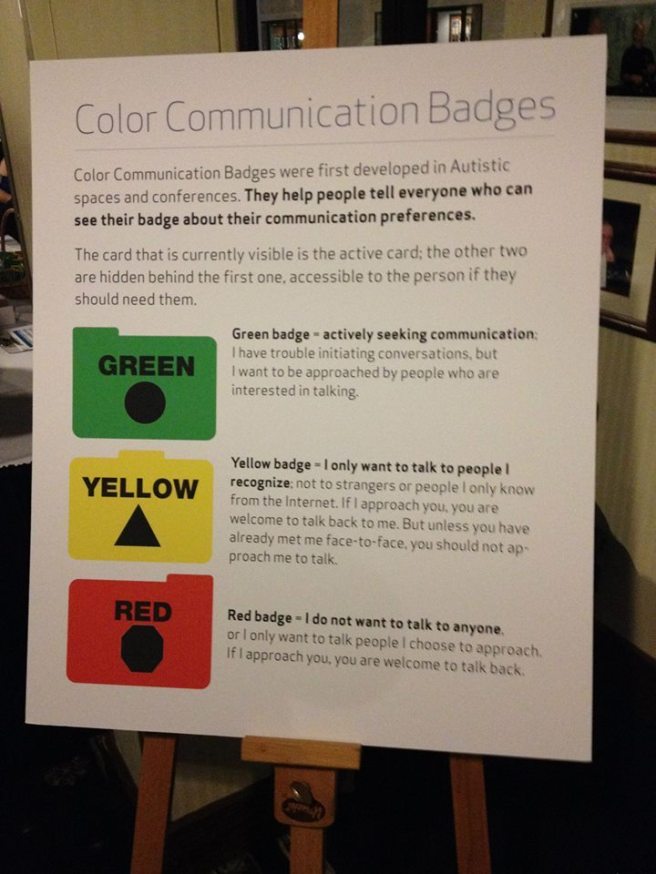
[Image is a poster explaining briefly the origin and meaning of green, yellow, and red interaction signal badges, referred to above as Color Communication Badges.]
if youre not autistic or suffer from an actual disorder, dont use these. its not cute.
er… you know a lot of autistic people go to conventions, right? And people with social anxiety disorders and panic disorders? Shit if I could get away with using this at work I would.
I would like to introduce myself. I refer to myself as Sam Thomas, though my legal name and how a lot of people know me is Matthew. I am officially diagnosed autistic.
If you have any question as to the truth of this, I would like to direct your attention to this YouTube video that ASAN produced promoting the above-mentioned conference. I appear as the first person in the video and you can find more images of my face on my blog.
At this conference, not only did we use these communication badges pictured above, but we actually had the opportunity to meet Jim Sinclair, the inventor of these badges.
During the part of the conference in which Jim Sinclair gave us a history of Autism Network International (ANI)—which they were a co-founder of—they talked to us about the establishment of this particular piece of assistive technology. Basically, it was a simple idea that seemed to fit a need and quickly became very popular among many autistic spaces for it’s practicality and ease of use.
The conference it originated from is called Autreat and is held annually by ANI. This is an autism conference that accepts Autistics and Cousins (ACs)—that is, anyone diagnosed or otherwise self-identifying with any disorder autistic or similar that may share a number of autistic traits.
There was a need. The need was met. This is how we can safely assume most technology either emerges or becomes popular.
We also talked about something called Universal Design and the Curb-Cutter Effect. The Curb-Cutter Effect is when something to fit a specific need is found to create convenience in a broader area than intended. Curb cuts allowing for wheelchair accessibility to sidewalks proved to also be convenient to anyone who may have trouble with steps or even simply a mother with a baby stroller or maybe a child with a wagon. This is a desirable outcome with disability rights advocacy as creating convenience for non-disabled people often makes the assistive technology easier to advocate for.
In this sense, these colored communication badges could serve that Curb-Cutter effect. Not only would this be perfectly acceptable for non-disabled people to use for convenience, but would also help to increase their effectiveness and convenience for those of us who need them. Here are a few examples:
Increased popularity makes the colored communication badges more easily recognizable to the general public, making them as effective outside the above-mentioned autism conferences as inside.
Increase in demand would create increase in supply and availability, likely making these available to pretty much anyone and even being included with, say, the name tags you are required to wear at most cons.
In addition to these helping people recognize the communication state of the wearer, the wearer will be able to recognize whom they can feel more comfortable to approach.
Increased popularity would make these badges more acceptable for public use and less alienating to those who would wear them frequently.
This is not something that we are completely incapable of surviving without; this is something that was convenient and made our lives a lot easier. If that can be easily shared with the general public, then what purpose does it serve not to share it?
This may just be my experience as an autistic person, but the kids I’ve nannied whose parent’s complain of ‘bad awful in cooperative selfish autistic behavior’ are… Not like that? At all?
Like, for example, I cared for a kid for a while who was nonverbal and didn’t like being touched. Around six years old? Their parent said that they were fussy and had a strict schedule, and that they had problems getting them to eat. Their last few nannies had quit out of frustration.
So, I showed up. And for the first little while, it was awkward. The kid didn’t know me, I didn’t know them, you know how it is. And for the first… Day and a half, maybe? I fucked up a few times.
I changed their diaper and they screamed at me. I put the TV off and they threw things. Not fun, but regular upset kid stuff.
Next time, I figured, hell, I wouldn’t like being manhandled and ordered around either. Who likes being physically lifted out of whatever it is they’re doing and having their pants yanked off? Fucking few, that’s who.
Next time, I go, ‘hey, kiddo. You need a new diaper?’ and check. ‘I’m gonna go grab a new one and get you clean, okay?’ ‘Wanna find a spot to lay down?’ ‘Alright, almost done. Awesome job, thanks buddy’.
I learned stuff about them. They liked a heads up before I did anything disruptive. They didn’t mind that I rattled of about nothing all day. They didn’t like grass or plastic touching their back. They were okay with carpets and towels. They liked pictionary, and the color yellow, and fish crackers, and painting. They didn’t look me in the face (which was never an issue- I hate that too, it fucking sucks) but I never had reason to believe that they were ignoring me.
Once I learned what I was doing wrong, everything was fine. Did they magically “”“become normal”“” and start talking and laughing and hugging? No, but we had fun and had a good time and found a compromise between what I was comfortable with and what they were comfortable with. (For the record, I didn’t magically sailor-moon transform into a socially adept individual, either. In case anyone was wondering.)
I don’t like eye contact. It’s distracting and painful and stresses me out.
They didn’t like eye contact either.
Is eye contact necessary to communication? No. So we just didn’t do it.
Was there ever a situation where I HAD to force them to drop everything and lay down on the lawn? No. So the thirty second warning came into play, and nobody died.
“But they never talked!”
No, they didn’t. And they didn’t know ASL, and they didn’t like being touched.
So you know what happened?
My third day in, they tugged on my shirt. ‘Hey monkey, what’s up?’ I asked. And they tugged me towards the kitchen. ‘oh, cool. You hungry?’. They raised their hands in an ‘up’ gesture. ‘you want up? Cool.’ and I lifted them up. They pointed to the fridge. I opened it. They grabbed a juice box out of the top shelf, and pushed the door closed again. ‘oh sweet, grape is the best. You are an individual of refined taste.’ I put them down and they went back to their room to play Legos.
“But they didn’t say please or thank you!” “But you should be teaching them communication skills!” “But!” Lalalalala.
1. The entire interaction was entirely considerate and polite. I was never made uncomfortable. I was made aware of the problem so that I could help them solve it. There was no mess, no tears, no bruises, no shouting.
2. Did my brain collapse into a thousand million fragments of shattered diamond dust out of sheer incomprehension? No? Then their communication skills were fine. Goal realized, solution found, objective complete. They found the most simple and painless way to communicate the situation and then did it.
Kids are not stupid. AUTISTIC kids are not stupid.
I’m willing to bet real cash money that the real reason the last few nannies had quit had a million times more to do with their own ability to cope, not the kid’s.
To this day, that was the most relaxed and enjoyable job I’ve ever had.
And I know I don’t speak for everyone. All kids are different. All adults are different. But in my time and experience, pretty much 95% of all my difficulties with children come from ME not being understanding enough. Every single “problem child” I’ve worked with turned out to be a pretty cool person once I started figuring out how to put my ego aside and let them set the pace.
Again, not speaking universally, here. I’m just saying. Sometimes social rules are bullshit, you know? People are people
Have you ever read an article about the study that found that teaching the parents to cope with autistic kids yields better results than other therapies? Because this is exactly what they were talking about.
It’s all about adjusting to the needs of the kid you got, and not wrapping the kid around your needs, wants, and expectations.
Okay, can we just pause a moment and watch Shaun “catastrophize” the car accident after Lea let him try driving? This is a real autism nuance that I have NEVER seen portrayed, but it’s one I think almost all autistic people can relate to.
Lea was teaching Shaun how to make the car peel out (burn rubber) and wasn’t specific enough about telling him to take his foot of the gas before taking it off the brakes. So he took his foot off the brake first, drove the car off the road and I think the axle or a tire got messed up because he ran over a big rock.
Lea didn’t react the way Shaun expected. She took the blame for the accident and had to calm him down because he was making a big deal out of it. But why is Shaun reacting this way to something Lea considers minor?
Answer: Autistic people are never allowed to fail the way neurotypicals are.
Neurotypicals are given a shot at something, and if they mess up they get to laugh about it / get a little embarrassed and try again.
Autistic people are given a shot at something, and if we mess up we get lectured / yelled at, the opportunity is taken away from us and we’re told “obviously you can’t do it, so why bother trying again?”
We are kept on a really short leash by the authority figures in our lives. This is especially true of autistic people such as myself who can’t live independently and need some or a lot of help every day. We’re expected to defer to caregivers as authority figures as if we’re not capable of deciding anything for ourselves or being an authority in our own lives without a “go ahead” from someone else. Some of us might need someone else to help us do the thing after we make our decision.
The reactions caregivers give to our decisions may cause us to decide the opposite of what we actually want so we don’t inconvenience them and cause a conflict– and that can feel like not having a real choice at all.
“I want thing A, but they always get mad when I want thing A, so I’ll say I want thing B instead because less social pressure.”
I’ll give a simple scenario to express what I’m talking about here. Assume the autistic person needs assistance getting dressed, and how they express what they’re saying (speech or AAC) is up to your imagination.
One day:
Autistic person: “I want to wear my red hoodie today.” Caregiver: “I haven’t sorted the laundry yet. I’m tired. Why don’t you wear the blue sweatshirt instead?” Autistic person: *Hesitant* Caregiver: *Sighs and looks annoyed* Autistic person: *Stomach gets a tight feeling; this is social pressure. Pushing against social pressure causes conflict. Conflict is painful.* Autistic person: *Conflict discomfort is unbearable, seeks to end it the quickest way possible.* Autistic person: Fine…I’ll wear the blue sweatshirt. Autistic person: *Feels defeated, like their choices don’t matter.*
Another day:
Autistic person: *Wants to wear their red hoodie.* Autistic person: *Remembers the caregiver’s response about the hoodie last time* Autistic person: *Stomach gets tight again.* Autistic person: I’ll wear my blue sweatshirt today. Caregiver: *Looks relieved.* Caregiver: Okay, let’s get you dressed.
Autistic person: *Stomach tightness goes away, but they feel defeated like their choices don’t matter.*
And what about nonverbal autistic people who need lots of daily help and can’t make their communications understood? Many of their meltdowns may be sensory, but I can betcha all the money in every bank on Earth that some of their meltdowns are from feeling like they have no say or control in their own lives. Every decision is made for them, they’re maneuvered through their day, get tugged on if they resist and then they act out explosively (ie aggression, bolting, vocalizing) because that’s the only choice they get to make that is entirely their own.
I think caregivers should present them with choices during the day, even if it’s as simple as what color shirt they wear or if they want oatmeal or a muffin for breakfast. Let them have some say in their lives. They might look at or touch the thing they want if you offer both and say they get too choose.
And hey, if it won’t hurt anything if they act like they want both, let them have both! Who cares if wearing two shirts that don’t go together looks a little silly? Who cares if they want a muffin with their oatmeal? They’re making their own choice. You can still steer them away from choices that would be dangerous while still giving them choices.
Like, don’t present them with any winter clothes in summer, and don’t offer food choices with foods that upset their stomach.
But let them have a chance to choose.
And let them have a chance to try, fail and try again.
Shaun was yelling “I want to make my own decisions!” when he had a meltdown. I wonder how many autistic people who can’t understandably express that thought are having meltdowns for the same reason.
Society teaches autistic people that we should do everything possible to not inconvenience our caregivers, but the cost of that is we feel little to no control over our lives.
The worst failure is not trying.
Let us try.
My sister isn’t autistic, but she has some autistic traits that go along with her other disabilities. This concept is so so important, because although she functions on the level of a 5 year old (she is 28), she is still a human being who has preferences. She is also extremely hard on herself when she feels like she did something incorrectly- I’m teaching her how to play the piano, and alongside that, I’m trying to teach her to be patient with herself.
2 part response!
1: It’s great that you recognize your sister’s frustration and are trying to help her be patient with herself. It sounds like the other people around her make a big deal out of her mistakes instead of noticing when she gets things right.
It’s nice to see someone trying to pick that apart and show her she IS capable.
Part 2: Mental ages are really stigmatizing and ableist. I know you didn’t mean it maliciously and may not realize why mental ages are harmful, so I hope this helps shed light on why.
Mental ages hurt disabled people because we’re treated like we’re the mental age instead of the adults we are. It results in us being treated with less respect, being treated as if we don’t know what we want and we get treated like we don’t know what we’re talking about when we do. It’s a form of infantilizing, and it’s an implication that we’re somehow “less developed” than our peers because baby / child brains are less developed than adult brains. We aren’t less developed, we just developed differently.
Mental ages get used as a shortcut, but it’s so harmful to disabled people just like functioning labels (mild / severe / high functioning / low functioning) hurt autistic people and intellectually disabled people.
Your sister may need things explained to her differently or need extra help that nondisabled 28 year olds don’t need help with, but she is still 28. She hasn’t been 5 since the year between her 5th and 6th birthdays.
I know you had zero malice behind what you said; that’s why I pointed it out so you can avoid it in the future. (Mistakes are how we learn and they help us grow.)
Good luck with your sister and I hope the piano lessons go smoothly! ^_^
huh. Interesting.
This is something I understand about myself, and I think instinctively understand about my twin brother (he is autistic, I am otherwise ND) but I hadn’t ever really thought through the internal process like this before. For either of us, really. I’m almost embarrassed!
Holy cow, so y’all. A lot of us have sensory issues. A friend of mine has a toddler who is basically me when it comes to this sorta thing. A lot of OTs recommend weighted blankets but those are 1. expensive to try (I mean WHAT IF THEY DON’T WORK?) 2. HOT.
Now, I haven’t tried these myself because after decades of trial and error I have found what works for me (and I’m claustrophobic…so these frighten me as much as they fascinate lol), but I will tell you that my friend is RAVING about them on facebook. Her toddler has been sleeping through the night finally without getting under his fitted sheet with all his stuffed animals and blankets) and he is taking actual naps. A weighted blanket didn’t work for them (and they were fortunate to be able to borrow one), but these are much more economical.
That’s right. 40 bucks compared to the hundred plus I see for most weighted blankets (and those aren’t even adult sized).
Now, we know tumblr doesn’t like to allow linked posts in the search results so if y’all could pass this around that would be great. These sheets have already changed the life of a family I know, I’m sure they’d help others.
Individuals with autism spectrum disorder (ASD) often find it difficult
to look others in the eyes. This avoidance has typically been
interpreted as a sign of social and personal indifference, but reports
from people with autism suggests otherwise. Many say that looking others
in the eye is uncomfortable or stressful for them – some will even say
that “it burns” – all of which points to a neurological cause. Now, a
team of investigators based at the Athinoula A. Martinos Center for Biomedical Imaging
at Massachusetts General Hospital has shed light on the brain
mechanisms involved in this behavior. They reported their findings in a Nature Scientific Reports paper.
“The
findings demonstrate that, contrary to what has been thought, the
apparent lack of interpersonal interest among people with autism is not
due to a lack of concern,” says Nouchine Hadjikhani, MD, PhD, director
of neurolimbic research in the Martinos Center and corresponding author
of the new study. “Rather, our results show that this behavior is a way
to decrease an unpleasant excessive arousal stemming from overactivation
in a particular part of the brain.”
The key to this research
lies in the brain’s subcortical system, which is responsible for the
natural orientation toward faces seen in newborns and is important later
for emotion perception. The subcortical system can be specifically
activated by eye contact, and previous work by Hadjikhani and colleagues
revealed that, among those with autism, it was oversensitive to effects
elicited by direct gaze and emotional expression. In the present study,
she took that observation further, asking what happens when those with
autism are compelled to look in the eyes of faces conveying different
emotions.
Using functional magnetic resonance imaging (fMRI),
Hadjikhani and colleagues measured differences in activation within the
face-processing components of the subcortical system in people with
autism and in control participants as they viewed faces either freely or
when constrained to viewing the eye-region. While activation of these
structures was similar for both groups exhibited during free viewing,
overactivation was observed in participants with autism when
concentrating on the eye-region. This was especially true with fearful
faces, though similar effects were observed when viewing happy, angry
and neutral faces.
The findings of the study support the
hypothesis of an imbalance between the brain’s excitatory and inhibitory
signaling networks in autism – excitatory refers to neurotransmitters
that stimulate the brain, while inhibitory refers to those that calm it
and provide equilibrium. Such an imbalance, likely the result of diverse
genetic and environmental causes, can strengthen excitatory signaling
in the subcortical circuitry involved in face perception. This in turn
can result in an abnormal reaction to eye contact, an aversion to direct
gaze and consequently abnormal development of the social brain.
In
revealing the underlying reasons for eye-avoidance, the study also
suggests more effective ways of engaging individuals with autism. “The
findings indicate that forcing children with autism to look into
someone’s eyes in behavioral therapy may create a lot of anxiety for
them,” says Hadjikhani, an associate professor of Radiology at Harvard
Medical School. “An approach involving slow habituation to eye contact
may help them overcome this overreaction and be able to handle eye
contact in the long run, thereby avoiding the cascading effects that
this eye-avoidance has on the development of the social brain.”
The
researchers are already planning to follow up the research. Hadjikhani
is now seeking funding for a study that will use magnetoencephalography
(MEG) together with eye-tracking and other behavioral tests to probe
more deeply the relationship between the subcortical system and eye
contact avoidance in autism.
“So now that neurotypical scientists have said so, can we stop forcing Autistic people to – For fuck’s sake.”
hello! I don’t know if anyone has already made a post about this before, but I just stumbled upon this app made specifically for when you’ve gone into a nonverbal anxiety attack!!!
it was made by Jeroen De Busser who is an autistic computer science student.
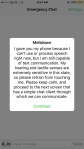
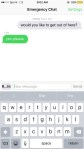
the app is really easy to use! all you do is open it and hand your phone to someone you need to communicate with during an attack but physically cannot, and it shows this cool little alert for the person to read, and then it takes them to an easy to use chat (that looks a lot like texting! except both of you are communicating using the same device).
the alert message is completely customizable and you can have it say whatever you need!
the app is called Emergency Chat and it’s available in the Apple Store and google play store.
I highly recommend it to anyone who might need it 🙂
OH MY GOD?!?!?? BOOST
That’s so bootiful!
thank you so much for this because i never know what to do when i cant talk to people and they just start trying to ask me questions and its really hard to force myself to say i cant talk and stuff. im definately getting this right now

 Holding the Bowl